Derryvree’s Between-Till Waters31369 BCE
Around 31,369 BCE, Ireland lay within the climatically unstable Late Pleistocene MIS 3 interval, not a datable historical year. Derryvree, County Fermanagh, preserves freshwater silts between glacial tills, indicating a locally ice-free, periglacial tundra environment during roughly 36,900–31,700 calibrated years before present. Open vegetation and freshwater habitats supported cold-adapted life. Castlepook Cave, County Cork, records MIS 3 fauna including mammoth, reindeer, giant deer, hyaena, wolf and Arctic fox, demonstrating ecological connections during lower sea levels. Human occupation remains unproven: a possibly butchered reindeer bone is contested. Evidence chiefly reveals changing climate, ice, habitats and animals, rather than societies or events.
Dateline
The label 31,369 BCE cannot be treated as a date in the ordinary historical sense. No written record, settlement sequence or event can be assigned to that individual year in Ireland. It is a modern calendar conversion, roughly 33,318 years before AD 1950, placed within the Late Pleistocene and Marine Isotope Stage 3 (MIS 3), a long and climatically unstable phase of the last Ice Age. The responsible subject is therefore an archaeological and environmental interval, not an annual chronicle.
For Ireland, the best evidence near this notional point comes from deposits, fossils and glacial landforms. These preserve a changing physical world far more clearly than they reveal human lives. Calibrated ranges, rather than exact calendar years, are essential. They allow historians to say that parts of Ireland were ice-free during portions of later MIS 3, while also showing that renewed growth of the Irish Ice Sheet was beginning to transform the island on a very large scale.
A Date Within a Broad Range
The key local archive is at Derryvree townland, near Maguiresbridge in County Fermanagh. Road works in 1969 cut through a drumlin and exposed an unusual sequence: thick glacial till below, freshwater silts and fine sands in the middle, and another thick till above. Till is the unsorted mixture of clay, stones and debris deposited directly by glacier ice. The sequence therefore gives a secure relative history. Ice had crossed the district; an interval without local glacier cover then allowed water, sediment, plants and small animals to accumulate; later ice sealed the deposit beneath another mass of till.
Organic material from the Derryvree freshwater beds produced the radiocarbon determination BIRM-166, conventionally reported as 30,500 radiocarbon years before present, with a substantial uncertainty. Radiocarbon years are not calendar years. Atmospheric carbon-14 levels have changed through time, and measurements must be compared with independently constructed calibration curves. Later scholarship places the age of the deposit broadly at about 36,900–31,700 calibrated years before present, approximately 34,950–29,750 BCE. The requested date falls within that wide span, but it does not identify a particular season, pool, plant, animal or human action at Derryvree.
Freshwater in a Periglacial Country
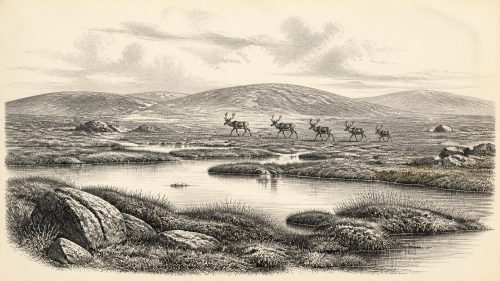
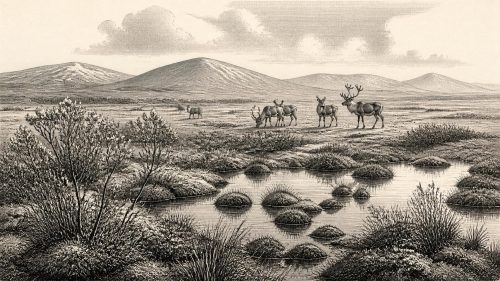
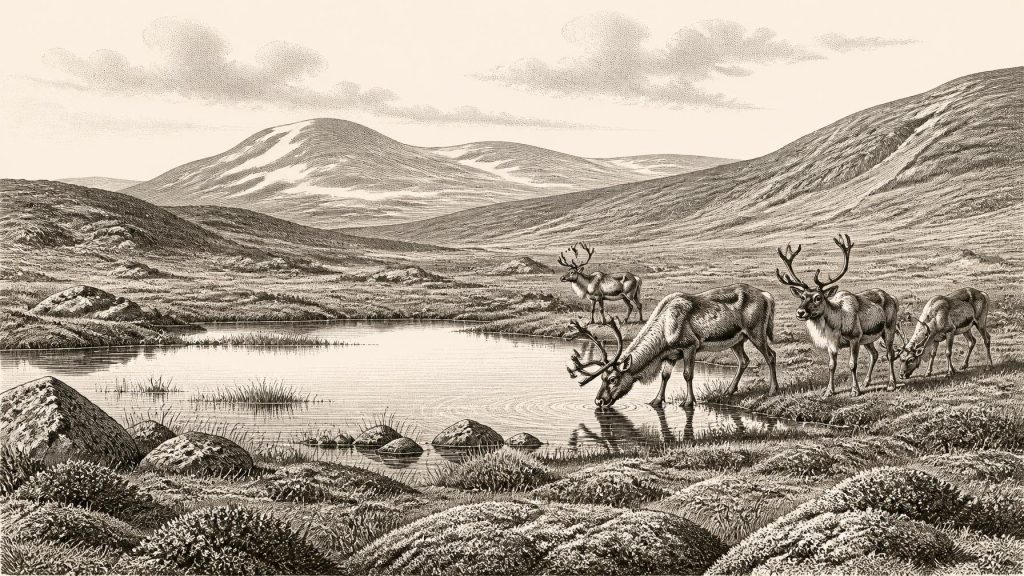
The Derryvree sediments are especially valuable because they record living conditions between separate glacial episodes. Their plant and animal remains indicate open tundra vegetation and a periglacial climate: a cold environment shaped by repeated freezing and thawing close to, but not necessarily beneath, active ice. This was not the green, wooded Ireland familiar today. Trees were absent or extremely scarce in the local landscape. Low-growing vegetation, mosses, sedges and cold-adapted herbs occupied ground exposed to wind, frost and short growing seasons, while standing or slow-moving freshwater provided a sheltered ecological niche.
The important distinction is between local evidence and island-wide reconstruction. Derryvree demonstrates that north-central Ireland contained an ice-free freshwater environment during part of later MIS 3. It does not prove that every coast, upland and valley of Ireland was simultaneously free of ice, equally cold, or occupied by identical vegetation. Ice sheets fluctuate unevenly, responding to snowfall, temperature, topography and the movement of ice across neighbouring seas. Even so, Derryvree is one of the rare Irish deposits that survived later glaciation sufficiently well to show that the country was not simply a timeless white expanse throughout the Ice Age.
At the wider scale, this was a turning point in landscape history. Research on the last Irish Ice Sheet indicates that substantial build-up and expansion followed the later MIS 3 ice-free interval. The ice sheet did not reach its best-established maximum extent until much later, broadly between about 26,000 and 21,000 calibrated years before present, with different sectors advancing and retreating at different times. Around the horizon represented by 31,369 BCE, Ireland was moving through environmental instability rather than experiencing one uniform climatic state.
Animals of Open Ground
Caves in southern Ireland, especially Castlepook Cave or Mammoth Cave near Doneraile in County Cork, supply another major strand of evidence. The cave’s fossil assemblages include remains of woolly mammoth, reindeer, giant deer, brown bear, wolf, Arctic fox, lemmings and spotted hyaena. Not all specimens belong to one moment: cave deposits accumulated over long periods, were disturbed by carnivores, water and excavation, and have required repeated radiocarbon reassessment. Yet modern dating confirms that an important part of the Castlepook fauna belongs to MIS 3, broadly the world of Derryvree’s cold interval.
This is evidence for a biologically connected Ireland, not for a permanent modern-style fauna. Mammals reached the island during periods when sea level was lower and the geography of the Irish Sea region differed greatly from the present. Reindeer and mammoth point towards open, productive grazing landscapes; lemmings and Arctic fox towards severe cold; hyaenas towards a food web capable of supporting large scavenging and hunting carnivores. Their presence shows that Ireland could sustain substantial animal populations in selected intervals, although fossil occurrence cannot measure their total numbers or establish a continuous population on the whole island.
Castlepook also warns against turning a faunal list into a single picturesque scene. A mammoth, hyaena and reindeer need not have stood together on the same day, and bones in a cave may have been carried there by carnivores rather than deposited where an animal died. The evidence establishes species presence and broad environmental possibilities. It does not supply a complete census, a mapped migration route, or a year-by-year narrative of hunting and predation.
The Human Question
Human presence is the most sensitive issue for this period. Ireland has no securely established MIS 3 settlement with a hearth, dwelling, stratified stone-tool assemblage or human remains. The National Museum of Ireland consequently continues to describe clear Palaeolithic evidence for people in Ireland as lacking. The first substantial and unambiguous evidence for settlement belongs much later to the Mesolithic, after the final retreat of the ice, from about 8000–7000 BCE.
There is, however, an important unresolved possibility at Castlepook. A reindeer femur from an old cave collection has been reported as dating to around 33,000 years ago and as carrying an incision interpreted as a stone-tool butchery mark. If that identification is sustained through specialist taphonomic study, it would show that one or more people handled a reindeer carcass in Ireland during the Upper Palaeolithic. It would be an extraordinary discovery. But the bone was not recovered from a newly excavated occupation surface, and identifying a line on bone as a human cut is a separate question from radiocarbon dating the animal itself.
For that reason, the find cannot responsibly be expanded into a settled community, a named archaeological culture, a camp beside the Awbeg, or a population of Ireland in 31,369 BCE. Nor can it demonstrate whether people hunted the animal, scavenged it, arrived briefly from Britain, or returned repeatedly. It is evidence under examination, not a licence to invent a Palaeolithic Irish society. The contrast between the potentially important femur and the absence of a diagnostic toolkit is precisely why caution matters.
What Cannot Yet Be Recovered
Political affairs, diplomacy, warfare, social rank, language, religious practice, education and organised trade cannot be described for Ireland at this date. There are no known Irish monuments, graves, houses, tools, ornaments, boats or inscriptions securely attributable to this horizon. Even if people did visit, their beliefs and social organisation remain beyond the reach of present evidence. Terms such as tribe, kingdom, chiefdom, ritual centre or frontier would impose later historical categories upon a record that cannot sustain them.
Economy, if people were present at all, can only be discussed in the most conditional terms. In the wider Upper Palaeolithic world, animal carcasses could provide meat, fat, hides, sinew and bone, and sharp stone could process them. The Castlepook incision, if anthropogenic, would be consistent with such activity. It does not prove a local subsistence system, regular exchange, seasonal rounds or specialised hunting in Ireland. The most secure “economy” visible here is ecological: plant growth fed herbivores; herbivores and carrion supported carnivores; freshwater basins preserved organic evidence; advancing ice periodically erased or buried landscapes.
An Archive Beneath the Ice
Derryvree’s significance lies in that survival. Its silts and organic layers preserve a brief environmental archive caught between two episodes of glaciation. They show that Late Pleistocene Ireland contained cold, open and locally wet landscapes in which freshwater life persisted, while the Castlepook caves demonstrate that a varied cold-stage fauna reached the island. Together, the sites replace the misleading image of an empty frozen land with a more dynamic one: an ecologically active country repeatedly made and remade by climate and ice.
Thus 31,369 BCE is best understood not as an Irish “year” with an event attached, but as a position within a deep-time interval. The evidence is powerful where it concerns sediment, climate, plants and animals; it is limited and contested where it touches human activity. That imbalance is not a failure of history. It is the central fact of Ireland’s Ice-Age past.
Primary Sources
- A Middle Midlandian Freshwater Series at Derryvree, Maguiresbridge, County Fermanagh, Northern Ireland
- The Irish Quaternary Fauna Project
- A Reconsideration of the Radiocarbon Dating of the Marine Isotope Stage 3 Fauna from Southern Ireland
- Trimlines, Blockfields and the Vertical Extent of the Last Ice Sheet in Southern Ireland
- Dimensions and Chronology of the Last Ice Sheet in Western Ireland
- Maximum Extent and Dynamic Behaviour of the Last British-Irish Ice Sheet West of Ireland
- Radiocarbon Constraints on the Age of the Maximum Advance of the British-Irish Ice Sheet in the Celtic Sea
- Stratigraphic and Palaeo-Geomorphological Evidence for the Glacial-Deglacial History of the Last British-Irish Ice Sheet in the North-Western Irish Sea
- Timing and Pace of Ice-Sheet Withdrawal Across the Marine–Terrestrial Transition West of Ireland During the Last Glaciation
- The Quaternary of Western Ireland: INQUA Field Guide Pre:GL-2
- Figure 6.—The Subdivision of the Quaternary Period in Ireland
- The IntCal20 Northern Hemisphere Radiocarbon Age Calibration Curve (0–55 cal kBP)
- IntCal Publications
- Prehistoric Details
- Spotted Hyena Skull
- Who Lived in Ireland Before Neolithic Times?
- Archaeology Research Excavation Grant 2022: Final Report
- Heritage Artefacts of County Cork
- The Exploration of Castlepook Cave, County Cork
- Occurrence of Mammalia Relicts at Site Castlepook Cave
- New Insights on the Fauna of Ireland’s Younger Dryas and Early Holocene from Alice & Gwendoline Cave
- The Mesolithic in Ireland: When Was It?