Aghnadarragh Beetle Assemblage31253 BCE
Around 33,200 cal BP, Ireland lay within the climatically unstable MIS 3 period, with changing ice margins, low sea levels and diverse open, wetland habitats. Intertill deposits at Derryvree, Greenagho and Aghnadarragh preserve evidence of freshwater environments, plants and insects. Southern caves, especially Castlepook, contain mammoth, reindeer, giant deer, carnivores and other Ice-Age fauna, demonstrating connections with north-west Europe. A possibly cut-marked reindeer femur from Castlepook may indicate brief Upper Palaeolithic human activity, but cannot prove settlement, hunting traditions or continuous occupation. No evidence supports reconstructed politics, society, ritual, agriculture or trade. Later ice expansion destroyed or concealed much evidence.
Dateline
The label 31,253 BCE is a modern way of placing a point deep in the past, not a year for which Ireland has an annal, a ruler, an event or even a season. No calendar was in use on the island that can be correlated with this date, and neither archaeology nor palaeoenvironmental science can resolve activity so far back to a single calendar year. In arithmetic terms it lies about 33,200 years before AD 1950, conventionally written c. 33.2 ka cal BP. The responsible approach is therefore to examine the wider Late Pleistocene interval around that point, especially the evidence from Irish caves, glacial deposits and fossil-rich sediments.
A Changing Ice-Age Landscape
This was part of Marine Isotope Stage 3 (MIS 3), a long, climatically unstable phase of the last glacial cycle, broadly between about 57,000 and 29,000 years ago. Ireland was not yet in the fullest grip of the Last Glacial Maximum. Later ice would remodel and bury large parts of its surface, but current reconstructions indicate that, as the final British–Irish Ice Sheet expanded after c. 31,000 cal BP, ice caps and mountain glaciers grew in some Irish uplands while other ground remained exposed. Conditions varied greatly by region, altitude and century. It would be misleading to call either all Ireland ice-free or all Ireland ice-covered at c. 33,200 cal BP.
The landscape was also not the island familiar today. Sea level stood far lower than at present, and the outlines of coasts, estuaries and plains were different. Connections across the surrounding shelf may at times have made movement by animals and people less difficult than the modern sea map suggests, although the exact routes available at any particular moment remain debated. What is secure is that Ireland formed part of the north-west European ecological world: large mammals reached it during MIS 3, and incoming ice later erased or concealed much of the evidence they and any people left behind.
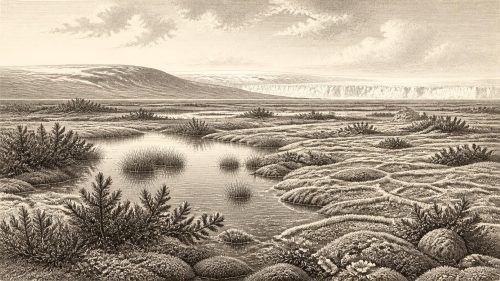
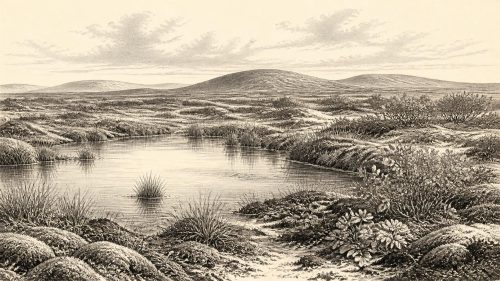
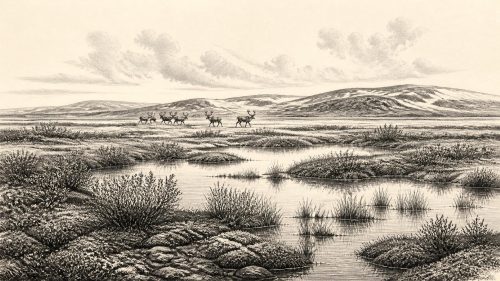
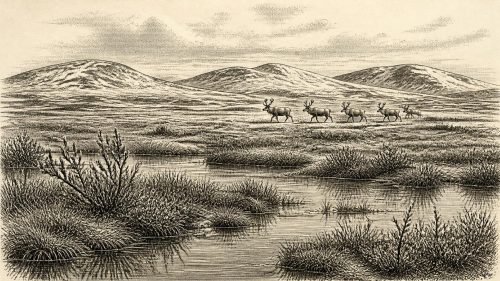
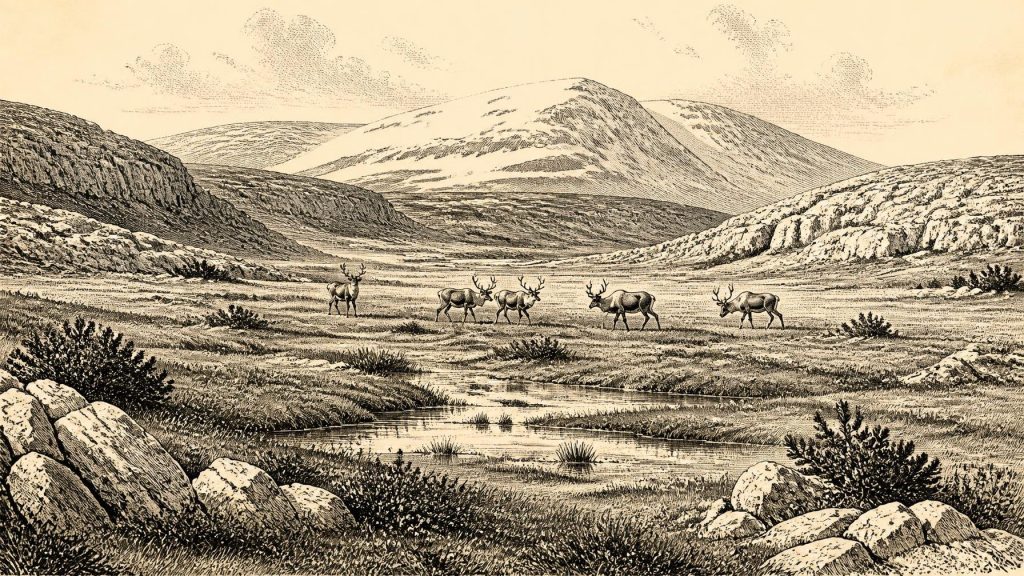
Cold did not mean featureless. Geological and biological archives point to a mosaic of open ground, grass- and herb-rich patches, wet hollows, streams, ponds and sparse shrub cover, changing as climate shifted. The wider interval is often described through terms such as tundra, steppe-tundra or mammoth-steppe. Each is useful shorthand, but none should be treated as a complete map of Ireland on one day. Local shelter, soils, drainage and proximity to ice would have produced contrasting habitats over short distances.
Fermanagh’s Buried Wetlands
One important environmental archive comes from Derryvree near Maguiresbridge in County Fermanagh. There, organic freshwater deposits were preserved between layers of glacial till. Pollen, plant macrofossils, insects and sediments provide rare evidence for an interlude when this part of northern Ireland supported standing or slow-moving fresh water and vegetation before a later ice advance sealed the deposits. The sequence is valuable precisely because it records more than animal bone: it preserves parts of a living wetland landscape.
The Derryvree evidence supports an interpretation of cold, largely open country with freshwater habitats, rather than woodland resembling later Holocene Ireland. Mosses, sedges and aquatic plants signal wet ground and shallow water; insects add clues about local temperature and habitat. But the deposit is not a national weather station. It cannot demonstrate that every Irish valley had identical vegetation, nor can its radiocarbon determinations be converted into a precise observation for 31,253 BCE. Its importance lies in showing that viable, varied environments existed in at least some parts of Ireland during the broader Middle Midlandian, or MIS 3, period.
Other intertill deposits, including those at Greenagho in County Fermanagh and Aghnadarragh in County Antrim, underline a larger point. Ireland’s glacial history was not a simple sequence in which ice arrived once, covered everything uniformly and vanished. Deposits formed in intervals between ice advances preserve evidence of water, soils, plants and animals. Their survival beneath later till is fortunate, but their stratigraphy must be read cautiously: correlations between sites, climatic episodes and calendar ages are often less exact than older labels may imply.
The Cave Record in the South
For animals around this broad date range, the limestone caves of southern Ireland are central. Castlepook Cave, also called Mammoth Cave or Doneraile Cave, near Doneraile in north County Cork, produced an exceptional assemblage during excavations conducted between 1904 and 1912. Its name reflects the woolly mammoth remains found there, but the collection also includes bones of reindeer, giant deer, brown bear, wolf, Arctic fox, lemming and spotted hyaena. Caves at Shandon and Ballynamintra in County Waterford, and Foley Cave in County Cork, complement the picture.
These finds demonstrate that a surprisingly broad Ice-Age fauna reached Ireland during the period from at least c. 45,000 to 20,000 years ago. Reindeer are particularly relevant to the cold, open habitats likely around c. 33 ka cal BP. Mammoth and hyaena attest to ecological connections with Britain and continental north-west Europe, while horse and red deer in some southern cave records may indicate locally milder or more varied conditions at other moments in MIS 3. Yet the animals must not be assembled into a single illustrated herd. Individual cave deposits accumulated over long periods, and each species has its own dated range.
Nor were caves neutral sample boxes. Bears and hyaenas could use them as dens; carnivores and scavengers could drag in carcass parts; water, frost, collapse and early excavation could mix material. A cave bone proves that an animal, or part of one, entered the cave system. It does not automatically prove where that animal died, how abundant its species was outside, or whether people hunted it. The re-dating of Irish faunal collections has also shown that improved accelerator radiocarbon methods and bone pretreatment can alter previously accepted ages by several thousand radiocarbon years.
A Reindeer Bone and a Human Question
The most consequential possible evidence for people at this depth of Irish time is a reindeer femur from Castlepook. It has been reported as bearing a deep linear modification interpreted by zooarchaeologist Ruth Carden as a mark made by a sharp stone tool while the bone was fresh. Public accounts have placed the animal at about 33,000 years ago. If the modification is correctly identified as butchery, it indicates that one or more Upper Palaeolithic people handled and processed a reindeer in Ireland many millennia before the better-established post-glacial record.
That is a significant possibility, but it is not a licence to invent a settled hunting people at Castlepook in 31,253 BCE. The femur came from an old collection made before modern excavation standards and without a securely recorded occupation surface. No associated stone-tool assemblage, hearth, dwelling floor, burial, human bone, ornament, art panel or repeated butchery deposit of comparable age has been recovered there. A radiocarbon determination dates the death of the animal, not necessarily the instant of marking, and radiocarbon ages must be calibrated using curves that themselves carry wider uncertainties this far back.
The most defensible conclusion is narrow. Castlepook offers a plausible, potentially transformative indication of a brief human encounter with a reindeer carcass in Ice-Age Ireland. It does not establish permanent population, a named archaeological culture, continuous ancestry or a route by which people arrived. Further securely excavated evidence would be needed to show whether such visitors formed a recurring seasonal presence, an isolated expedition or something else entirely.
Life Beyond the Evidence
Because the human evidence is so limited, political affairs, warfare and diplomacy cannot responsibly be reconstructed. There are no known chiefs, territories, alliances, fortifications or conflicts for Ireland around this point. Even if the Castlepook mark was made by people, it records an act of carcass processing rather than authority, identity or relations between groups. The proper historical answer is not that Ireland was certainly empty of social life, but that the surviving evidence cannot describe it.
The same restraint applies to society and everyday life. Upper Palaeolithic communities elsewhere in Europe made sophisticated stone and organic tools, used fire, shared knowledge, travelled widely and created art. Those wider comparisons make a human visit to Ireland intelligible, but they are not evidence that the same practices left traces at Castlepook. No Irish object from c. 33,200 cal BP presently demonstrates a house, clothing, boat, food store, tool kit or family group. If people were present, their actions were either short-lived, archaeologically slight, later destroyed, or some combination of all three.
There is likewise no direct Irish evidence for religion, formal ritual, visual culture or learning at this date. A cave should not be called a shrine merely because it is a cave, nor should the apparent rarity of human traces be turned into a claim that people lacked beliefs or traditions. Learning would have been socially transmitted if people visited the island, but its content is beyond recovery. The evidence records animals, sediment and environmental change; it does not record stories, languages or ceremonies.
Economy, Movement and Survival
There was no agriculture, herding, metalwork, market economy or trade network demonstrated in Ireland at this time. The only possible economic action directly suggested by the Castlepook femur is the acquisition or processing of animal tissue. Even that should be stated carefully: a cut-marked bone may show butchery, but it cannot establish whether the reindeer was hunted, scavenged, killed elsewhere or shared among a larger group. Reindeer would have supplied meat, fat, hide, sinew and bone, but these are general possibilities rather than documented Irish products.
Animal movements are more securely visible than human ones. Reindeer, mammoth and carnivores occupied or passed through landscapes capable of supporting them. Their presence implies ecological corridors across the broader landmass and seasons in which forage, water and shelter were available. It does not mean that every species was common, that their ranges overlapped exactly, or that human groups followed them into Ireland. The key regional development was environmental instability: habitats could expand or contract as temperature, precipitation, sea level and ice margins altered.
In this sense, the history of Ireland around 31,253 BCE is a history of thresholds. Wetland deposits in Fermanagh preserve a landscape later overridden by ice. Southern caves preserve a fauna that later vanished locally or was scattered by climatic change. Castlepook preserves a single possible sign of human action, whose significance exceeds its size but not its evidential limits. The coming millennia would bring greater ice expansion and further loss of accessible evidence. What survives allows a vivid but disciplined view: not a known Irish community, but a cold, dynamic country of open habitats, freshwater pockets, large animals and a tantalising possibility of human presence.
Primary Sources
- Prehistoric Details
- The Irish Quaternary Fauna Project
- A Reconsideration of the Radiocarbon Dating of the Marine Isotope Stage 3 Fauna from Southern Ireland
- New Insights on the Fauna of Ireland's Younger Dryas and Early Holocene from Alice & Gwendoline Cave
- First Evidence of a Late Upper Palaeolithic Human Presence in Ireland
- A Middle Midlandian Freshwater Series at Derryvree, Maguiresbridge, County Fermanagh, Northern Ireland
- Freshwater Organic Deposits and Stratified Sediments Between Early and Late Midlandian (Devensian) Till Sheets, at Aghnadarragh, County Antrim, Northern Ireland
- Middle Midlandian Interstadial Deposits at Greenagho, Near Belcoo, County Fermanagh, Northern Ireland
- Irish Pleistocene Biostratigraphy
- Mammoth and Musk Ox ESR-Dated to the Early Midlandian at Aghnadarragh, County Antrim, Northern Ireland, and the Age of the Fermanagh Stadial
- Growth and Retreat of the Last British–Irish Ice Sheet, 31,000 to 15,000 Years Ago: the BRITICE-CHRONO Reconstruction
- BRITICE-CHRONO Maps and GIS Data of the Last British-Irish Ice Sheet 31 to 15 ka
- Pattern and Timing of Retreat of the Last British-Irish Ice Sheet
- British–Irish Ice Sheet and Polar Front History of the Goban Spur, Offshore Southwest Ireland Over the Last 250,000 Years
- A Stratigraphic Investigation of the Celtic Sea Megaridges Based on Seismic and Core Data from the Irish-UK Sectors
- The IntCal20 Northern Hemisphere Radiocarbon Age Calibration Curve (0–55 cal kBP)
- The IntCal20 Approach to Radiocarbon Calibration Curve Construction: A New Methodology Using Bayesian Splines and Errors-in-Variables
- IntCal Publications
- Radiocarbon Dating and Chronological Modelling: Radiocarbon Dating
- The Archaeological Heritage of County Cork
- Heritage Artefacts of County Cork
- Irish Caves Database: Mammoth Cave
- The Quaternary of Western Ireland