Derryvree’s Buried Herbarium31283 BCE
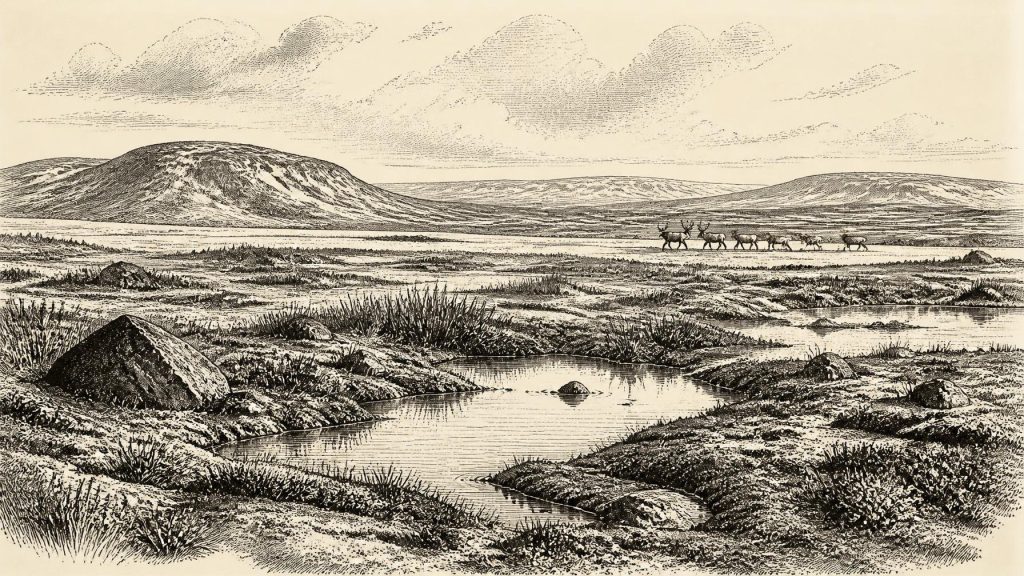
About 31,283 BCE, Ireland’s history is reconstructed from uncertain environmental and archaeological evidence, not annual events. During late Marine Isotope Stage 3, fluctuating Ice Age conditions produced shifting ice, exposed ground and wetlands. At Derryvree, Fermanagh, organic sediments sealed between glacial tills record an ice-free, treeless freshwater tundra with mosses, sedges and shallow water. Castlepook Cave, Cork, preserves pre-Last Glacial Maximum fauna, including reindeer, mammoth, giant deer, predators and cold-adapted small mammals. A marked reindeer femur may indicate human butchery, but cannot prove settlement or continuous occupation. No evidence supports communities, polities, farming or trade. Later glaciation erased much evidence.
Dateline
The label 31,283 BCE is a modern way of placing a very remote point in time; it is not a year that can be recovered from Ireland’s archaeological record. No Irish community then kept a written calendar, and no surviving deposit can resolve events to a particular twelve-month period. In the conventional system that counts backwards from AD 1950, this date is about 33,232 calendar years before present. It falls within the later part of Marine Isotope Stage 3 (MIS 3), a long, climatically unsettled phase of the last Ice Age. The responsible history of Ireland at this horizon is therefore not a chronicle of rulers, battles or named peoples, but a cautiously assembled account of changing ice, wetland plants, animals and a disputed trace of possible human activity.
Calendar precision is especially impossible at this depth of time. Radiocarbon years are not identical to calendar years because the amount of radiocarbon in the atmosphere has varied. Modern calibration curves improve the conversion, but they produce probability ranges, not exact dates, particularly for samples approaching 30,000 radiocarbon years old. The evidence can illuminate a broad interval around the early thirty-second millennium BCE; it cannot identify what happened in Ireland in the particular modern year 31,283 BCE.
A Country in an Unstable Ice Age
Ireland was part of a North Atlantic world in which climate changed sharply over millennia and sometimes more abruptly. MIS 3 preceded the Last Glacial Maximum, the later phase when the British–Irish Ice Sheet expanded most extensively across Ireland and its continental shelf. Yet it would be misleading to imagine a simple progression from a green island to uniform ice. Glaciers advanced and retreated at different times in different regions. Areas of ice, bare periglacial ground, waterlogged hollows, river valleys and cave country could coexist within a shifting landscape.
The later ice sheet also explains why evidence is so scarce. Moving ice eroded older surfaces, transported sediment and redeposited it as till; meltwater altered valleys and buried earlier landforms. Low sea levels transformed the surrounding shelves, while subsequent inundation concealed or destroyed former coastal landscapes. Ireland’s present outline, coastlines and county boundaries have no direct relevance to this period. Even so, lower sea level must not be turned into a simple story of a permanent, dry land bridge from Britain or continental Europe. The extent of exposed ground, ice barriers, water crossings and viable routes varied through time and remains the subject of palaeogeographical reconstruction.
Freshwater Between Two Glaciers
The clearest Irish environmental archive relevant to this date was found at Derryvree townland, near Maguiresbridge in County Fermanagh. Road excavation in 1969 cut through a drumlin and exposed a remarkable sequence: freshwater silts and fine sands, including organic material, lay between two thick and distinct sheets of till. In simple terms, ice had deposited the lower till; a subsequent non-glacial interval allowed water and organic sediments to accumulate; then a later glacier overran and sealed the deposit beneath the upper till. The stratigraphy is powerful evidence for major environmental change, although it is local evidence and cannot by itself map conditions across all Ireland.
The Derryvree organic layer produced a radiocarbon determination of 30,500 +1,170/−1,030 radiocarbon years BP. It has been assigned broadly to the Middle Midlandian, generally correlated with MIS 3. When expressed through modern calibration, discussion of this result yields a wide calendar bracket of approximately 36,900–31,700 cal BP, or roughly 34,950–29,750 BCE. The modern label 31,283 BCE lies close to, but just later than, that illustrative bracket; uncertainties in old determinations, calibration and correlation mean that it should not be used to declare the Derryvree wetland either certainly present or certainly absent in that exact year. The deposit is relevant because it records the wider kind of late-MIS-3 world into which this date falls, not because it provides an annual snapshot.
Mosses, Sedges and Shallow Water
The Derryvree flora and fauna demonstrate that at least this part of Fermanagh supported an ice-free freshwater environment during one cold-stage interval. Pollen was poorly preserved, but herbaceous types were identified; plant macrofossils included mosses, while the wider assemblage indicated sedges, aquatic and wet-ground vegetation. Researchers interpreted the setting as open tundra or muskeg: predominantly treeless, wet ground with shallow pools, saturated margins and seasonally constrained growth. Occasional grains of tree pollen do not demonstrate a local forest; they may have travelled far or been reworked from older material.
This was not a featureless frozen desert. Water, mud, moss and herb vegetation sustained invertebrates and created small ecological niches. But nor should it be romanticised as a familiar lakeside meadow. The evidence supports harsh, exposed and periglacial conditions, probably with frozen ground influencing drainage and soil development. Trees that dominate later Irish landscapes—oak, elm, hazel and ash—were absent from this record. A short growing season, persistent cold and physical disturbance by frost would have limited plant cover on drier ground. Differences of slope, shelter, groundwater and snow accumulation may nevertheless have produced locally richer patches of forage.
The wider North Atlantic climate reinforces the need for caution. Greenland ice cores show that MIS 3 was marked by marked millennial-scale swings between colder stadials and relatively milder interstadials. Irish sediments are not sufficiently precise to assign 31,283 BCE confidently to a particular Greenland event. The sensible conclusion is narrower: Ireland’s climate and habitats were unstable on long timescales, and a landscape suitable for wetland vegetation and grazing animals could be altered profoundly by renewed cooling and ice advance.
Animals in the Cave Archive
County Cork offers a second, very different window. Castlepook Cave, also called Mammoth Cave, near Doneraile has yielded one of Ireland’s richest collections of Pleistocene animal remains. Material attributed to the wider pre-Last Glacial Maximum fauna includes reindeer, woolly mammoth, giant deer, brown bear, wolf, Arctic fox, mountain hare, lemmings and spotted hyaena. A spotted-hyaena skull from the cave is held by the National Museum of Ireland. These species demonstrate that, during portions of the period, Ireland belonged ecologically to the cold-adapted north-west European world.
They do not establish that every listed species lived together at Castlepook in 31,283 BCE. Cave collections often combine remains accumulated at different times. Carnivores may have dragged carcass parts into dens; animals can die in caves or fissures; water, collapse and excavation may mix bones. Much of the Castlepook material was recovered during early twentieth-century work, before modern recording standards. Recent reassessment has shown that older radiocarbon measurements from Irish cave bones can be unreliable when compared with results obtained through improved pretreatment and accelerator dating. The cave is consequently an indispensable archive, but not a ready-made scene of one day’s hunting or one season’s wildlife.
For everyday life in the animal world, reindeer are particularly evocative. If herds used suitable Irish terrain, they would have converted sparse vegetation into mobile stores of meat, fat, hides, sinew, antler and bone for predators and, potentially, people. Hyaenas, wolves and bears indicate competition and scavenging as well as hunting. Mammoth remains show that very large herbivores reached Ireland during some pre-LGM phases. Yet animal bones tell us more securely about presence and environment than about population size, migratory routes or the stability of any local herd.
The Reindeer Femur Question
A reindeer femur from Castlepook has made this remote period especially important. The bone has been publicised as about 33,000 years old and carries a deep linear mark that zooarchaeologist Ruth Carden has interpreted as damage made by a sharp stone tool during carcass processing. If that interpretation is confirmed, it would provide potentially transformative evidence that Upper Palaeolithic people handled a reindeer in Ireland long before the formerly accepted post-glacial evidence for human presence.
Its limitations must be stated as firmly as its promise. The radiocarbon result dates the animal’s death, not automatically the cutting episode. The identification of a mark as a human tool cut is a specialist taphonomic judgement that must distinguish deliberate modification from carnivore damage, sediment abrasion, breakage or excavation damage. Most importantly, the femur was not recovered from a securely recorded camp floor with associated tools, hearths, butchered bone assemblages, shelters or human remains. The finding may indicate a brief human visit or processing event; it does not demonstrate a permanent Irish population, a settlement, a hunting territory or continuity between generations.
No Polities, No Proven Communities
There is no evidence from around this date for political institutions, diplomacy, warfare, territorial lordship or named leaders in Ireland. There are likewise no demonstrable houses, villages, graves, food stores, art objects, ritual monuments or learning traditions. It would be anachronistic to describe any possible visitors as an Irish people in an ethnic or national sense. If people did reach the island, the most plausible comparison is with highly mobile Upper Palaeolithic hunter-gatherers known elsewhere in north-west Europe, but that is an interpretation from neighbouring evidence, not a documented Irish social system.
The same restraint applies to economy and trade. There is no securely dated Irish lithic assemblage, imported material, exchange network or settlement evidence from this horizon. A possible butchered reindeer could suggest the practical use of animal resources, but cannot show whether animals were hunted locally, scavenged, processed by a travelling party or encountered through some other circumstance. Nor is there evidence for farming: cultivation, domestic livestock and pottery belong to vastly later chapters of Irish prehistory.
A Landscape Rather Than a Year
The most important development around 31,283 BCE was environmental. The Derryvree deposits preserve a cold freshwater tundra landscape during the broader late-MIS-3 interval; Castlepook preserves compelling proof that Ice Age mammals reached southern Ireland during pre-LGM phases; and one marked reindeer femur raises, but does not settle, the possibility of an early human visit. Growing ice would later erase much of the surface record and impose an even more formidable barrier to life and movement.
That fragmentary evidence is not a deficiency to be filled with invented chiefs, camps or ceremonies. It is the history available: mosses sealed beneath glacial sediment, bones in limestone caves, calibrated ranges and arguments tested by new methods. Around this modern date label, Ireland was a changing Pleistocene landscape whose ecological connections were real, whose human story remains uncertain, and whose surviving traces demand careful reading.
Primary Sources
- A Middle Midlandian Freshwater Series at Derryvree, Maguiresbridge, County Fermanagh, Northern Ireland
- Palaeoecology
- Early Midlandian–Middle Midlandian, Pleistocene, Northern Ireland
- A Reconsideration of the Radiocarbon Dating of the Marine Isotope Stage 3 Fauna from Southern Ireland
- The Irish Quaternary Fauna Project
- A Phylogeographic Study of the Irish Red Deer, Cervus elaphus, Reveals That Ireland has Had Two Different Deer Populations since the Late-Pleistocene
- New Insights on the Fauna of Ireland’s Younger Dryas and Early Holocene from Alice & Gwendoline Cave
- 2022:564 – Castlepook Cave, Castlepook South, Cork
- Spotted Hyena Skull
- Heritage Artefacts of County Cork
- Ireland's Palaeolithic Archaeology – Fleeting Footprints in a Frozen Land
- Growth and Retreat of the Last British–Irish Ice Sheet, 31,000 to 15,000 Years Ago: the BRITICE-CHRONO Reconstruction
- BRITICE-CHRONO: Introduction
- Exploring Controls of the Early and Stepped Deglaciation on the Western Margin of the British Irish Ice Sheet
- The Island of Ireland: Drowning the Myth of an Irish Land-Bridge?
- Ireland: Submerged Prehistoric Sites and Landscapes
- IntCal Publications
- The IntCal20 Northern Hemisphere Radiocarbon Age Calibration Curve (0–55 cal kBP)
- The Colonization of Ireland: A Human Ecology Perspective
- High-Resolution Record of Northern Hemisphere Climate Extending into the Last Interglacial Period