
Derryvree’s Silt Flora31300 BCE
Thirty-one thousand three hundred BCE has no identifiable Irish event, but falls within MIS 3’s unstable cold climate. At Derryvree, Fermanagh, freshwater silts between glacial tills, radiocarbon dated broadly to this period, preserve evidence of a treeless, periglacial wetland with grasses, sedges, herbs, juniper, mosses and aquatic plants. Castlepook Cave, Cork, records Late Pleistocene mammals including reindeer, mammoth, giant deer, wolves and hyaenas, demonstrating episodically viable open habitats. A cut-marked reindeer femur may indicate human butchery, but remains inconclusive. No settlements or cultural evidence survive. Growing ice sheets increasingly restricted life before the Last Glacial Maximum later in the period.
Dateline
A Date Without an Event
Nothing in the surviving evidence allows historians to say what happened in Ireland in the single modern-labelled year 31,300 BCE. No calendar then existed in Ireland, no written record was made, and no archaeological deposit can normally be resolved to a particular year at this depth in time. The date is best treated as a point within a much wider Late Pleistocene horizon: Marine Isotope Stage 3 (MIS 3), during the Midlandian cold stage of Irish Quaternary history. It was a period of abrupt climatic shifts, expanding ice and retreating ice margins, not an era of named peoples, states or dated events.
The closest useful chronological evidence is a freshwater deposit exposed at Derryvree, near Maguiresbridge in County Fermanagh. Organic silts and fine sands there produced a conventional radiocarbon result of 30,500 ± 1,200 radiocarbon years before present. “Before present” conventionally means before AD 1950; radiocarbon years are not calendar years. When calibrated against modern curves, the determination spans a broad interval, approximately 36,900–31,700 calibrated years before present. Thus 31,300 BCE falls broadly within the possible age-range of the deposit, but it cannot be represented as the date of a particular Derryvree pool, plant, animal or human action.
That imprecision is not a failure of the evidence. It is the evidence’s proper scale. Derryvree preserves a sequence of environmental change across generations or millennia. It offers a rare window onto an Irish landscape that later glaciation mostly buried, disturbed or removed.
Freshwater Between the Tills
The Derryvree sequence was revealed by roadworks in 1969 through a drumlin: a streamlined hill formed beneath moving ice. Its importance lies in its order. A lower deposit of glacial till shows that ice had formerly crossed the area. Above it lay freshwater silts, sands and organic material, formed during an interval when standing or slow-moving water, wet ground and vegetation existed. An upper till subsequently sealed the sediments beneath another glacial advance. The site therefore demonstrates a changing northern Irish environment: glaciation, an ice-free freshwater phase, and renewed glaciation.
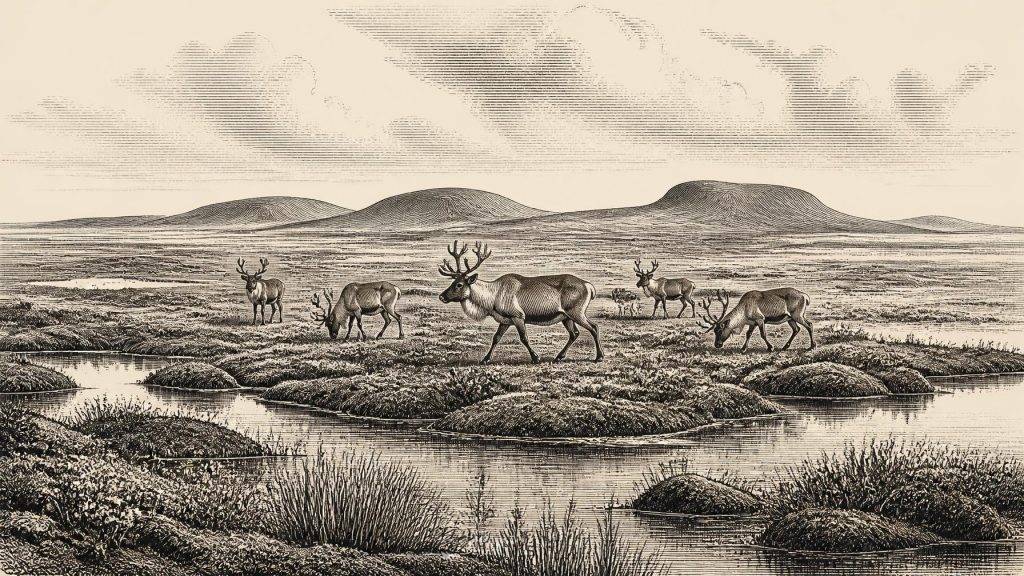
Plant macrofossils, pollen and insects from the freshwater beds indicate a cold, open and largely treeless landscape. Grasses, sedges, herbs, juniper and mosses formed much of the vegetation. Finds attributed to aquatic or wetland plants include bogbean (Menyanthes trifoliata) and alternate water-milfoil (Myriophyllum alterniflorum); mountain-avens (Dryas octopetala) points towards arctic-alpine conditions nearby. The combination has been interpreted as muskeg-like terrain: waterlogged, moss-rich ground broken by pools and channels, subject to frost and a short growing season.
This was not continuous permanent ice, nor was it a familiar green and wooded Ireland. It was a periglacial world in which freezing, thawing, shallow water and sparse vegetation controlled the shape of everyday ecology. The evidence demonstrates a functioning freshwater ecosystem in Fermanagh. It does not prove that every region of the island looked identical. Ireland’s varied relief, proximity to sea routes and changing ice margins would have produced local differences, while the record itself is fragmentary.
Cork’s Mammal Country
County Cork provides the principal faunal complement to Fermanagh’s environmental archive. Castlepook Cave, near Doneraile in the Awbeg valley, has produced an unusually rich collection of Late Pleistocene bones, much of it recovered in early excavations and later reassessed through the Irish Quaternary Fauna Project. Radiocarbon dates and species identifications show that Ireland was reached by a range of mammals between at least about 45,000 and 20,000 years ago, although individual finds do not necessarily belong to one moment or one undisturbed deposit.
The Castlepook assemblage includes woolly mammoth, reindeer, giant deer, brown bear, wolf, fox, hare, stoat, arctic lemming, Norway lemming and spotted hyaena. This formidable list should not be imagined as a single herd or community visible on one day. Caves accumulate bone through many processes: carnivore denning, scavenging, natural death, water transport, collapse, excavation disturbance and the later mixing of old collections. Nevertheless, the animals securely establish that, during parts of MIS 3, southern Ireland could support a fauna now wholly unfamiliar on the island.
Reindeer and lemmings fit an open, cold landscape; mammoth and giant deer indicate that substantial herbivores could at times find sufficient forage; wolves and spotted hyaenas show that large carnivores also used this wider environment. Caves may have been refuges, dens or traps rather than ordinary places of animal residence. The bones tell us more confidently about regional animal presence than about the precise terrain immediately outside the cave mouth.
By 31,300 BCE, the climatic direction was increasingly consequential. The build-up of the last British–Irish Ice Sheet is generally placed after roughly 35,000–32,000 years ago, with maximum extent later, around 27,000–21,000 years ago. The nominated year therefore belongs before the Last Glacial Maximum, but within an era in which deteriorating cold and growing ice were narrowing ecological opportunities. Subsequent ice movement would erase or conceal much of the evidence needed to reconstruct this transition.
The Reindeer Femur Question
Castlepook has also become central to the question of Ireland’s earliest possible human visitors. A reindeer femur in the National Museum of Ireland’s Natural History collections has been publicly identified as bearing a deep mark made while fresh tissue was being removed with a sharp stone tool. County Cork heritage publications associate the specimen with an approximate age of 31,000 BC. If both the age attribution and the interpretation of the incision are upheld, the bone could indicate that one or more Upper Palaeolithic people processed a reindeer in Ireland during MIS 3.
This is important, but it must not be overstated. A radiocarbon date establishes the age of the animal material sampled; it does not automatically establish when a surface mark was made. Nor does one modified bone demonstrate a camp, a resident population, a hunting territory or an unbroken ancestry leading to later Irish communities. Distinguishing a stone-tool cut from damage caused by teeth, abrasion, breakage, sediment movement or earlier excavation requires careful taphonomic analysis. Castlepook’s early collection history and the complex formation of cave deposits add further caution.
Accordingly, the reindeer femur is best described as serious but still limited evidence for a possible early human presence, rather than proof of settled Ice Age Ireland. The more securely documented direct evidence for Upper Palaeolithic human activity remains much later: a butchered brown-bear patella from Alice and Gwendoline Cave, County Clare, dated to roughly 12,810–12,590 calibrated years before present. That later discovery does not disprove the Castlepook claim. It shows, rather, why the distinction between a promising clue and a well-contextualised body of evidence matters.
People, If Present
If people did reach Ireland around this broad period, they were almost certainly small, mobile hunter-gatherer parties, not an island-wide population. Across north-west Europe, Upper Palaeolithic communities used sharp stone tools and relied on detailed knowledge of animals, seasonality, shelter, fuel and routes through difficult terrain. Reindeer could supply meat, fat, hide, sinew and bone. Yet those general comparisons cannot fill Ireland with unexcavated camps. No securely dated house, hearth, stone-tool assemblage, burial, food store, clothing fragment or boat belonging to this Irish horizon has been found.
For that reason, political affairs, diplomacy and organised conflict are beyond recovery. There is no evidence for chiefs, territories, alliances, warfare or institutions in Ireland at this time. The same restraint applies to religion, language, art and learning. People capable of symbolic culture lived elsewhere in Upper Palaeolithic Europe, but no Irish cave art, ritual object, grave or symbolic assemblage can responsibly be assigned to 31,300 BCE. Absence of evidence does not prove absence of thought, belief or social ties; it means that the Irish record cannot describe them.
Even travel requires caution. Lower global sea levels altered coastlines and may have changed access between Ireland, Britain and continental Europe, but the geography of crossings was shaped by sea, ice, rivers and shifting margins. The evidence does not permit a confident route, season or direction of movement. Any possible visitors may have come briefly, followed animal movements, or entered a landscape already becoming less hospitable as glaciation intensified.
An Economy of Survival
There is no evidence for farming, herding, metalworking, pottery, trade networks or permanent villages. The only economy that can be cautiously contemplated is the direct use of wild resources by mobile foragers, if the Castlepook modification proves human-made. Such an activity would have been organised around survival rather than production surplus: obtaining animal food and raw materials, making and maintaining stone edges, seeking shelter, and moving in response to weather and game.
Butchery need not have occurred in Castlepook Cave itself. A carcass could have been processed outdoors, after which carnivores or water introduced a limb bone into the cave. This possibility is not a defect in the interpretation; it is exactly why the find cannot tell us whether humans hunted the animal, scavenged it, or merely handled part of a carcass. It does, however, place the practical business of exploiting large animals at the centre of the question.
The dominant historical development around 31,300 BCE was therefore environmental. Northern Ireland’s Derryvree silts preserve plants, insects and water in a cold tundra wetland. Castlepook records a southern Irish fauna that included reindeer, mammoth and hyaena. Together they overturn any simple image of an eternally ice-covered or biologically empty Ireland. Yet the same archives reveal instability: a land capable of sustaining life in particular intervals, then transformed and buried by advancing ice. That unstable setting, rather than a datable political event, is the responsible history of Ireland at this remote point in time.
Primary Sources
- A Middle Midlandian Freshwater Series at Derryvree, Maguiresbridge, County Fermanagh, Northern Ireland
- Figure 6—The Subdivision of the Quaternary Period in Ireland
- The Irish Quaternary Fauna Project
- Irish Pleistocene Biostratigraphy
- Menyanthes trifoliata
- Dryas octopetala
- Myriophyllum alterniflorum
- Archaeological Heritage of County Cork
- Heritage Artefacts of County Cork
- Archaeology Research Excavation Grant 2022
- New Insights on the Fauna of Ireland’s Younger Dryas and Early Holocene from Alice & Gwendoline Cave
- First Evidence of a Late Upper Palaeolithic Human Presence in Ireland
- 2019:148—Alice & Gwendoline Cave, Clare
- Extent and Timing of the Last Glacial Maximum in Britain and Ireland: A Review
- Growth and Retreat of the Last British–Irish Ice Sheet, 31,000 to 15,000 Years Ago: The BRITICE-CHRONO Reconstruction
- Sedimentology and Chronology of the Advance and Retreat of the Last British-Irish Ice Sheet on the Continental Shelf West of Ireland
- Radiocarbon Constraints on the Age of the Maximum Advance of the British–Irish Ice Sheet in the Celtic Sea
- Maximum Extent and Dynamic Behaviour of the Last British-Irish Ice Sheet West of Ireland
- The IntCal20 Northern Hemisphere Radiocarbon Age Calibration Curve (0–55 cal kBP)
- The IntCal20 Northern Hemisphere Radiocarbon Age Calibration Curve (0–55 cal kBP)
- New Data for the Last Glacial Maximum in Great Britain and Ireland
- Reconstruction and 36Cl Based Geochronology of the Deglaciation of Central Ireland