
BIRM-166’s Broad Horizon31301 BCE
31,301 BCE is a modern label within MIS 3, not a recoverable Irish year. Derryvree, County Fermanagh, provides evidence: organic freshwater sediments between tills, dated by BIRM-166 to 36,900–31,700 calibrated BP, record an ice-free interval before glaciation. Tundra wetlands supported cold-adapted plants and insects. Castlepook Cave, County Cork, preserves MIS 3 fauna including mammoth, giant deer, reindeer and hyaena, indicating varied open habitats. A possibly cut-marked reindeer bone suggests, but does not establish, human presence. No settlement, institutions, ritual, agriculture or continuous occupation is evidenced. The period is best understood through uncertain ranges, changing ice margins, ecosystems and transient visitors.
Dateline
The label 31,301 BCE is a modern chronological convenience, not a year that can be recovered from Ireland’s prehistoric record. No Irish community kept a calendar, wrote an account, named a leader or left an archaeological layer that can be assigned to those particular twelve months. In calendar terms it lies about 33,250 years before AD 1950, during the Late Pleistocene and Marine Isotope Stage 3 (MIS 3), a long, unstable phase of the last Ice Age. The responsible history of this point is therefore a history of ranges, deposits and probabilities rather than an annual chronicle.
The most relevant Irish evidence is not a settlement but an environmental sequence at Derryvree, near Maguiresbridge in County Fermanagh. There, roadworks in 1969 cut through a drumlin and revealed freshwater silts, fine sands and organic material trapped between two thick deposits of glacial till. The lower till showed that ice had crossed the ground; the sediments above it accumulated when the locality was free of glacier ice; the upper till proved that ice later returned. This buried interval has become one of the clearest windows onto Ireland’s mid-glacial world.
A Date Within a Range
Organic material from Derryvree produced the radiocarbon determination BIRM-166: 30,500 radiocarbon years before present, with a substantial error margin of +1,170 and −1,030 years. A radiocarbon age is not a calendar date. Because the amount of carbon-14 in the atmosphere has varied through time, measurements must be calibrated against an internationally maintained curve; at this antiquity, both the original measurement and calibration produce wide intervals. Published discussion places the deposit broadly at c. 36,900–31,700 calibrated years BP, or approximately 34,950–29,750 BCE.
Thus 31,301 BCE falls within the broad chronological horizon illuminated by Derryvree, but it cannot date the formation of a particular pool, the life of a particular animal or an episode of human activity. Nor should one deposit be treated as a weather report for every corner of the island. Its importance is different: it establishes that part of northern Ireland supported freshwater life during an ice-free interval in a generally cold glacial age, before later ice buried and remodelled the landscape.
Water Between the Tills
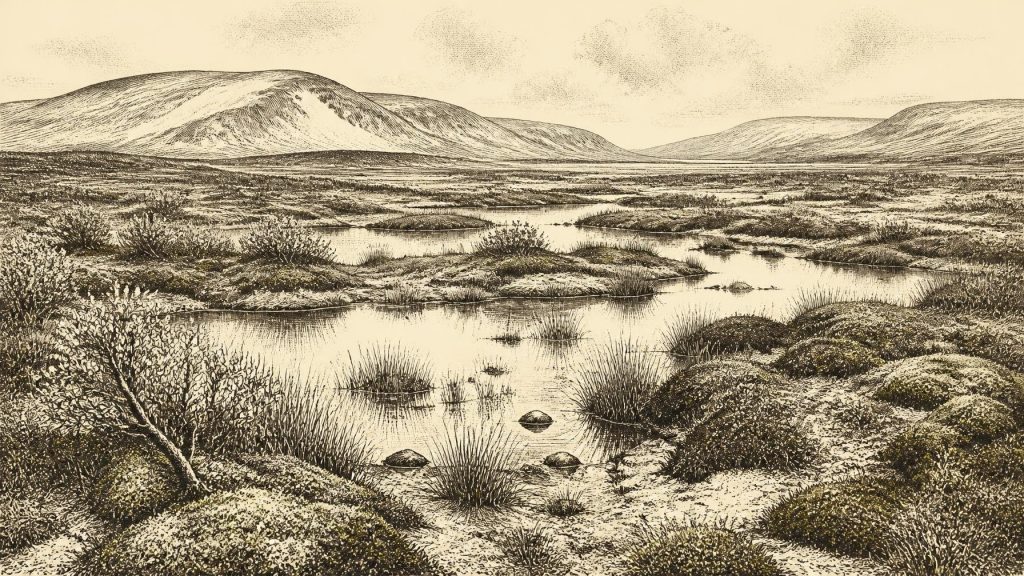
Derryvree was not a familiar green Irish countryside. Its plants and insects indicate open tundra and periglacial wetland: ground shaped by frost, brief thawing seasons, shallow water and low vegetation rather than woodland. Mosses, sedges, dwarf willow, mountain-avens, bogbean and other cold-adapted plants survived around pools and saturated ground. The fossil assemblage includes organisms that point to standing or slow-moving freshwater, plant-rich margins and a muskeg-like environment. Even in a severe climate, this was a functioning ecological mosaic, not an unbroken desert of ice.
The distinction matters. “Ice Age” does not mean that all of Ireland was permanently covered by ice at every moment. Ice sheets grew and shrank over long periods, while their margins, local glaciers, snowfields and ice-free terrain changed at different rates. The Derryvree succession preserves one episode in that complicated history. It shows an interval between glacial advances, and its biological contents reveal what could live in the exposed terrain. It does not demonstrate that the entire island was simultaneously ice-free, nor that conditions remained stable for centuries.
Climate in MIS 3 was volatile on a North Atlantic scale. Greenland ice-core records identify abrupt warmings and coolings, while Irish cave minerals and sedimentary archives suggest that these shifts affected the western edge of Europe. The Derryvree date range has been correlated broadly with several Greenland interstadials, but such correlations remain approximate. What can be said securely is that the landscape was cold, treeless and seasonally constrained; what cannot be recovered is the temperature, snowfall or rainfall of the modern calendar year called 31,301 BCE.
Animals in the Southern Caves
County Cork provides a complementary, though differently formed, archive. Castlepook Cave near Doneraile has yielded one of Ireland’s richest collections of Late Pleistocene animal remains. Reassessment and redating of bones from its old excavations have demonstrated that mammals including mammoth, giant deer, reindeer and spotted hyaena were present in southern Ireland during MIS 3. Brown bear, fox, hare and lemmings also form part of the wider cave fauna recovered or identified in the system. The cave is evidence of a varied cold-stage animal world, not a census of a single moment.
These animals imply open habitats with sufficient vegetation to sustain grazing and browsing herbivores, and a food web large enough for predators and scavengers. Reindeer are especially compatible with open northern environments, while mammoth and giant deer evoke a broader patchwork of grassland, herb-rich ground and sheltered places. Hyaenas complicate any picturesque vision of peaceful herds: caves could serve as dens, scavenging sites, traps or places where bones accumulated through several processes. A bone found in a cave is valuable evidence, but its journey into that cave may have involved animals, water, slope movement and excavation practices as well as people.
The relationship between Derryvree and Castlepook must therefore be handled carefully. The sites lie far apart, preserve different kinds of material and are dated by ranges rather than by an exact common horizon. Together they support a strong general conclusion: pre-Last Glacial Maximum Ireland was capable, at intervals, of sustaining freshwater ecosystems and a substantial cold-climate fauna. They do not prove that Fermanagh’s wet hollows and Cork’s cave animals were contemporaneous in a single season, or even in the same century.
The Human Question
A reindeer femur from Castlepook has made this period especially important to Irish archaeology. The specimen, recovered from an older collection and re-examined with modern methods, has been reported as about 33,000 years old and as bearing a deep linear modification interpreted by zooarchaeologist Ruth Carden as a possible stone-tool cut made while processing the carcass. If that interpretation is confirmed, it would be evidence that people handled reindeer in Ireland far earlier than the long-recognised Mesolithic settlement record.
It is a potentially momentous observation, but it is not a licence to populate the island with an established Upper Palaeolithic society. The dated bone records when the animal died, not automatically when the mark was made. The specimen does not come from a securely excavated living floor associated with hearths, stone tools, structures or a repeated sequence of occupation. Nor does it show whether people killed the animal, scavenged it, processed it at the cave, or passed through only once. A cut mark is direct physical evidence on bone; a hunting expedition, migration route or camp is an interpretation that requires further evidence.
Accordingly, neither permanent settlement nor continuous human residence in Ireland around 31,301 BCE has been demonstrated. If people did visit, they may have been highly mobile hunter-gatherers moving through a changing north-west European landscape, equipped with knowledge of animals, stone-working and cold-weather survival. That is a reasonable comparison with the wider Upper Palaeolithic world, not an excavated description of an Irish group. There is no securely dated Irish dwelling, burial, hearth, tool assemblage or human skeletal remain from this horizon.
No Polities, No Proven Ritual
Political affairs, diplomacy and organised warfare cannot be identified here. There were no known Irish states, territories, rulers or institutions, and no evidence from which to reconstruct alliances or disputes between human groups. The closest detectable forms of conflict are ecological: herbivores competed for sparse seasonal resources, while hyaenas and other carnivores were predators, scavengers and potential competitors for carcasses and shelter. For hypothetical human visitors, securing meat, hides, fuel, safe resting places and workable stone would have mattered far more than anything recognisable as government.
The same restraint applies to religion, art, language and learning. Ireland has no cave art, portable art, shrine, burial ritual or symbolic object securely attributable to this MIS 3 horizon. It would be wrong to infer the absence of beliefs merely from that silence; people elsewhere in Upper Palaeolithic Europe possessed rich cultural traditions. Yet no material evidence allows those traditions to be assigned to Ireland at this date. Knowledge, if visitors were present, would have been practical and social—reading terrain, weather and animal behaviour, making tools and maintaining group ties—but that remains an inference rather than a documented Irish tradition.
An Economy of Survival
There is likewise no evidence for farming, herding, permanent villages, pottery, metalwork, trade routes or organised exchange. The visible economy was ecological. Wetland vegetation made use of a short growing season; grazing animals converted plants into meat and hide; predators and scavengers followed those concentrations of food. Lower sea levels changed the configuration of the Irish Sea basin and may have increased opportunities for animal dispersal, but they did not automatically create a simple, continuously available land bridge from Ireland to Britain or the Continent. Routes depended on shifting sea, ice and terrain.
Regional change was the great development. In the decades and millennia around this nominal date, the British–Irish Ice Sheet was building towards its later maximum extent. Modern reconstructions indicate that growth was neither uniform nor simultaneous: different Irish and marine sectors advanced at different times. Derryvree’s organic bed is significant precisely because it records life before a later glacial advance sealed it beneath till. Its freshwater plants and insects are survivors of a landscape that subsequent ice largely erased from view.
For 31,301 BCE, then, Ireland’s most defensible history is not one of named people or happenings. It is the history of a cold but intermittently habitable physical world: tundra wetlands near Maguiresbridge, mammal-bearing caves near Doneraile, unstable ice margins and the unresolved possibility of brief human contact. BIRM-166 gives this otherwise anonymous interval a scientific anchor. Its lesson is not false precision, but the value of allowing sediment, bone and calibrated chronology to speak only as far as the evidence permits.
Primary Sources
- A Middle Midlandian Freshwater Series at Derryvree, Maguiresbridge, County Fermanagh, Northern Ireland
- The IntCal20 Northern Hemisphere Radiocarbon Age Calibration Curve (0–55 cal kBP)
- A Reconsideration of the Radiocarbon Dating of the Marine Isotope Stage 3 Fauna from Southern Ireland
- The Irish Quaternary Fauna Project
- Castlepook Cave: Cork County Geological Site Report
- 2022:564 – Castlepook Cave, Castlepook South, Cork
- Quaternary Geological Map of Ireland 1:500,000 Scale
- Growth and Retreat of the Last British–Irish Ice Sheet, 31,000 to 15,000 Years Ago: the BRITICE-CHRONO Reconstruction
- Trimlines, Blockfields and the Vertical Extent of the Last Ice Sheet in Southern Ireland
- Deglaciation Chronology of the Donegal Ice Centre, North-west Ireland
- Timing and Pace of Ice-sheet Withdrawal Across the Marine–Terrestrial Transition West of Ireland During the Last Glaciation
- The Geology of the Irish Sea: UK Offshore Regional Report
- Cork Area of Scientific Interest
- Prehistoric Details
- New Insights on the Fauna of Ireland's Younger Dryas and Early Holocene from Alice & Gwendoline Cave
- The Mesolithic in Ireland: When Was It?
- Archaeology and the M3
- Menyanthes trifoliata
- Salix herbacea
- Freshwater Organic Deposits and Stratified Sediments Between Early and Late Midlandian (Devensian) Till Sheets, at Aghnadarragh, County Antrim, Northern Ireland
- Ireland's Palaeolithic Archaeology – Fleeting Footprints in a Frozen Land
- What Was on the Menu in Prehistoric Ireland?
- References and Recommended Reading: Irish Quaternary Association Guide