Mammoth Cave’s Faunal Crossing31338 BCE
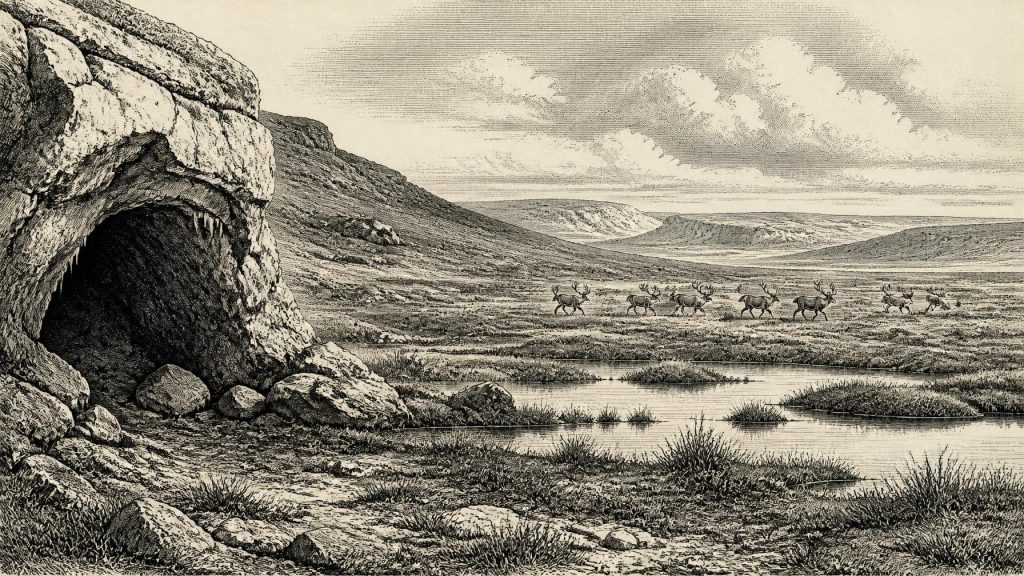
Around 33,300 calibrated years before present, Ireland lay within the climatically unstable Late Pleistocene, before the Last Glacial Maximum. Lower seas and shifting ice created changing routes for mammals, though no specific land bridge or event can be identified. Castlepook Cave, County Cork, preserves major faunal evidence, including reindeer, mammoth, giant deer, predators and lemmings, but its accumulated bones do not represent a single community. Revised dating complicates species chronologies. A possibly tool-marked reindeer bone suggests early human activity, yet remains unconfirmed. No contemporary settlement evidence exists. Vegetation records indicate cold, open, wet habitats; later glaciation subsequently destroyed much evidence.
Dateline
31,338 BCE is a modern calendar label, not a date that can be matched to a recorded Irish event. No people in prehistoric Ireland named years in this way, and archaeology cannot identify an occurrence in this particular twelve-month span. Expressed in the language used by Quaternary scientists, the point falls roughly 33,300 calibrated years before present (cal BP, where “present” is 1950), within the Late Pleistocene and Marine Isotope Stage 3 (MIS 3). The responsible history of Ireland at this depth of time is therefore a history of dated ranges, cave deposits, animal remains and changing ice, rather than rulers, battles or settlements.
A Landscape Before the Last Maximum
At about 33.3 thousand cal BP, Ireland was still several millennia short of the Last Glacial Maximum, the coldest and most extensively glaciated part of the last glacial cycle. That later maximum is generally placed at roughly 26,500–19,000 cal BP, although ice-sheet advances and retreats varied around the island and its seas. MIS 3 itself was climatically unstable: severe cold phases alternated with comparatively milder interstadials. It would be misleading to picture all Ireland at this notional date as either an unbroken ice cap or a temperate green island. Conditions, ice margins, coastlines and habitats changed repeatedly over long timescales, while the exact configuration for this one calendar year cannot be recovered.
Lower global sea levels exposed land now drowned beneath the Irish Sea and around the Atlantic shelf. Ireland’s relationship with Britain and continental Europe was consequently unlike that of the modern island. The fossil record shows that terrestrial mammals reached Ireland during parts of the Late Pleistocene, and this strongly implies routes of dispersal across landscapes and seaways then very different from today’s. It does not, however, demonstrate a particular land bridge, migration route or human crossing in 31,338 BCE. Even the geography that made movement possible was temporary, changing with sea level, ice volume and local glacial barriers.
Castlepook Cave and Its Limits
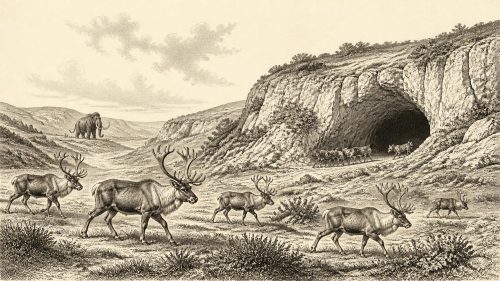
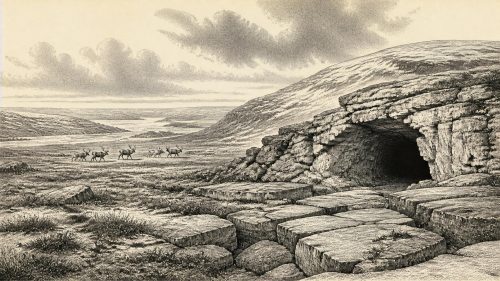
The most important Irish evidence for this broad period comes from Castlepook Cave, also known as Mammoth Cave, near Doneraile in north County Cork. Excavated principally in the early twentieth century under the auspices of the Royal Irish Academy’s cave-exploration work, it produced Ireland’s most significant assemblage of pre-Last Glacial Maximum animal remains. Material from the cave is held in the National Museum of Ireland’s collections. The place is central because it proves that a striking range of Pleistocene mammals reached southern Ireland during the later Ice Age; it is not a neatly preserved snapshot of one season, one camp or one community.
Among animals identified from Castlepook and comparable Irish contexts are reindeer, woolly mammoth, giant deer, brown bear, wolf, Arctic fox, mountain hare, collared lemming, Norwegian lemming and spotted hyaena. Each tells part of an environmental story. Reindeer and lemmings are especially compatible with cold, open country; mammoth likewise evokes expansive grass- and herb-rich terrain rather than closed woodland. Hyaenas and wolves indicate large predators and scavengers within the wider food web. Yet a cave bone assemblage is an accumulation: animals may have died at different times, carcasses may have been dragged in by carnivores or moved by water, and deposits were disturbed by early excavation. The full list must not be converted into a single illustrated herd gathered outside the cave in 31,338 BCE.
Modern redating has made this caution more important. Improved collagen pretreatment and accelerator radiocarbon methods have shown that some dates obtained from Irish cave bones in the 1990s were substantially too young. A 2020 reassessment of southern Irish MIS 3 fauna found that revised Castlepook dates could be thousands of radiocarbon years older than earlier determinations. This altered the chronology of some species and suggests that giant deer and spotted hyaena may have disappeared locally before about 40,000 cal BP. Consequently, the broad faunal world is real, but the precise overlap of species around 33,300 cal BP remains a research question rather than a settled fact.
People: A Possibility, Not a Population
The period has acquired particular significance because a reindeer femur from Castlepook has been reported as carrying a possible sharp-tool modification and has been associated with a date in the vicinity of 33,000 years ago. If microscopic and contextual study ultimately confirms that the mark was made by people while the bone was fresh, it would be exceptionally early evidence of human handling of an animal in Ireland. It could represent butchery, though a single marked bone cannot reveal how much meat was taken, how many people were involved, where they came from or whether they remained on the island.
The distinction is crucial. No securely associated hearth, stone-tool assemblage, dwelling floor, human bone, burial, artwork or enduring occupation site is presently known in Ireland from around 33,300 cal BP. The much firmer evidence for a human presence comes far later: a butchered brown-bear bone from Alice and Gwendoline Cave in County Clare has been directly dated to about 12,810–12,590 cal BP. That terminal Pleistocene evidence does not fill the immense earlier gap. Nor should the sophisticated Upper Palaeolithic cultures known on the European mainland be projected wholesale onto Ireland. People elsewhere made blades, ornaments, images and elaborate social connections; Ireland’s evidence cannot establish which, if any, were present here at this earlier point.
Life in a Cold Faunal Corridor
If people did visit or briefly occupy Ireland during this phase, they would have been mobile hunter-gatherers operating in a demanding, seasonal environment. Reindeer offered potentially valuable meat, fat, marrow, hide, sinew, antler and bone, but that is an inference from the animal and from wider Upper Palaeolithic practice, not a demonstrated Irish subsistence system. The word “corridor” is useful only in an ecological sense: animal movements between Britain and Ireland show that passages existed during suitable conditions. It must not imply a known road, an organised migration network or regular traffic by human groups.
There is no evidence for farming, domestic livestock, pottery, metalworking, permanent villages, monuments, markets or long-distance trade in the later prehistoric sense. Equally, there is no evidence from Ireland on which to reconstruct political authority, warfare, diplomacy, kinship rules, named peoples or religious institutions. Caves may have been shelters, dens, traps for sediment and bone, or all these things at different times; Castlepook cannot be called a human camp simply because it has yielded a tantalisingly marked bone. The most compelling story is not one of a vanished Irish polity, but of a landscape intermittently capable of supporting mobile animals—and perhaps very occasional people—at Europe’s north-western edge.
Vegetation, Water and Ice
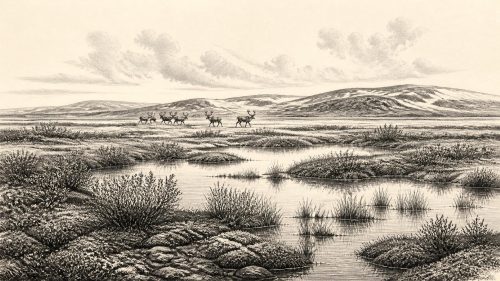
Plant and insect evidence from buried deposits in Ulster, including sequences beneath and between glacial sediments at Derryvree and Maguiresbridge, helps establish the kinds of cold-stage environments that occurred in Ireland during the last glacial cycle. Mosses, sedges, dwarf-shrub and tundra-associated plants, along with aquatic species in freshwater sediments, show that parts of the island could contain wetlands, pools and open vegetation during ice-free intervals. Some deposits have been placed close to 30,500 BP, rather than exactly at the date considered here. They are therefore valuable regional analogies, not proof of the precise vegetation around Doneraile in 31,338 BCE.
Such evidence corrects the simplistic image of an entirely lifeless frozen land. Open ground could support grasses, herbs and low vegetation, while wet hollows and watercourses created local habitats. But it does not permit a confident reconstruction of forest cover, snowfall or summer temperatures in any particular Irish valley. The later expansion of the British–Irish Ice Sheet would scour, bury and rework much of the older terrestrial record. That geological destruction is one reason Ireland preserves so few early archaeological traces compared with some regions of Britain and continental Europe.
An Archive Still Being Tested
For Ireland around 31,338 BCE, the archaeological record is both extraordinarily important and extraordinarily slight. The strongest conclusion is that Late Pleistocene Ireland formed part of a wider north-west European world of climatic fluctuation, altered coastlines and recurrent faunal movement. Castlepook Cave shows that cold-adapted and large-bodied mammals entered the island over a broad pre-Last Glacial Maximum span. A possible human modification on reindeer bone raises the prospect of a much earlier human presence than once accepted, but it remains evidence requiring continued testing, not a licence for certainty.
Future work may change the picture. New excavation in undisturbed parts of cave systems, careful taphonomic study, direct dating with modern pretreatment, ancient DNA, stable-isotope analysis and dating of sediments can distinguish animals that merely occur in the same archive from those that actually lived together. Until then, 31,338 BCE should stand in Irish history as a point illuminated by deep-time environmental evidence: a cold, open and shifting island landscape, inhabited demonstrably by Pleistocene fauna and standing at the uncertain threshold of possible human visitation.
Primary Sources
- A reconsideration of the radiocarbon dating of the Marine Isotope Stage 3 fauna from southern Ireland
- The Irish Quaternary Fauna Project
- First evidence of a Late Upper Palaeolithic human presence in Ireland
- New insights on the fauna of Ireland’s Younger Dryas and Early Holocene from Alice & Gwendoline Cave
- Spotted Hyena Skull
- Ice Age Ireland: Cool Fossils!
- A survey of the hybridisation status of Cervus deer species on the island of Ireland
- Occurrence of mammalia relicts at site Castlepook Cave
- Maximum extent and dynamic behaviour of the last British–Irish Ice Sheet west of Ireland
- The deglaciation of the western sector of the Irish Ice Sheet from the inner continental shelf to its terrestrial margin
- Timing and pace of ice-sheet withdrawal across the marine–terrestrial transition west of Ireland during the last glaciation
- Ice sheet extension to the Celtic Sea shelf edge at the Last Glacial Maximum
- Extent and retreat history of the Barra Fan Ice Stream offshore western Scotland and northern Ireland during the last glaciation
- Quaternary deposits and glacial stratigraphy in Ireland
- Figure 6.—The subdivision of the Quaternary Period in Ireland
- Archaeological excavations at Castlepook Cave, Co. Cork, 2022
- Ireland’s Palaeolithic Archaeology – Fleeting Footprints in a Frozen Land
- The Mesolithic in Ireland: when was it?
- Reconstruction and 36Cl based geochronology of the deglaciation of central Ireland
- Pleistocene vertebrates in the British Isles