Mammoth Cave Assemblage31944 BCE
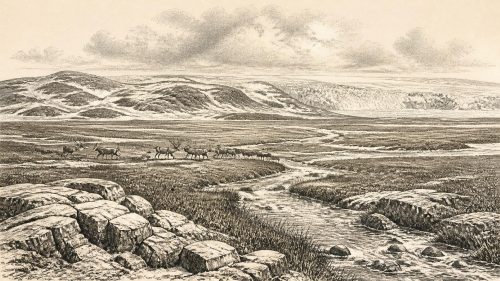
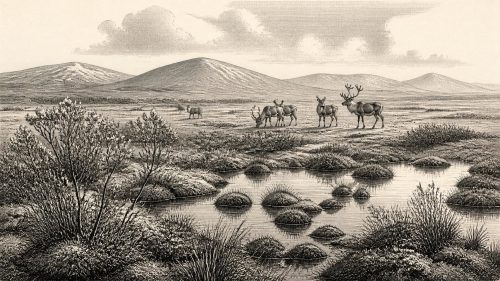
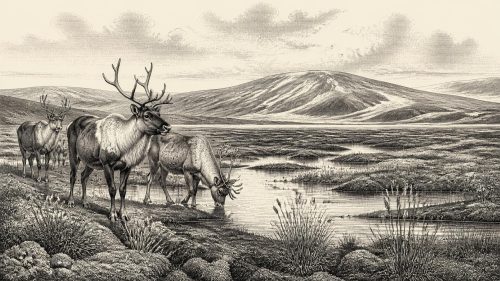
At 31,944 BCE, Ireland was entering a prolonged cold phase, although the extent of advancing ice remains uncertain and the island was not necessarily wholly glaciated. Lower sea levels altered coastlines, but no secure land route is known. Castlepook, or Mammoth, Cave in County Cork preserves Ireland’s richest pre-Last Glacial Maximum vertebrate assemblage, including mammoth, reindeer, giant deer, predators and lemmings, accumulated across many millennia rather than one moment. These animals indicate changing open steppe-tundra environments. Human presence is unproven: possible butcher marks require confirmation, while secure evidence dates only to about 12,800 years ago. Later ice obscured earlier evidence.
Dateline
31,944 BCE is a modern calendar label, not a date at which archaeology can identify an Irish event. In the dating convention used by Quaternary researchers, it lies roughly 33,900 calibrated years before 1950, within Marine Isotope Stage 3 of the Late Pleistocene. Radiocarbon results for this remote period are expressed as probability ranges, and the surviving evidence is far too sparse to distinguish one calendar year from the next. What can responsibly be said is that Ireland stood on the threshold of a profound glacial transformation. Its environments were cold, changeable and regionally varied; its animal life is known chiefly from cave deposits; and whether people ever reached the island at this early point remains unproven.
A Landscape Approaching Glaciation
This was long before the Last Glacial Maximum, the cold peak conventionally placed about 26,000–19,000 calibrated years before present. Yet ice was expanding across the wider British–Irish region. Large-scale reconstructions suggest that, by about 31,000 years before present, ice was already growing in parts of Ireland and around its northern approaches, while the exact limits, thickness and timing varied from place to place. Projecting that reconstruction back almost 3,000 more years to 31,944 BCE requires caution. It would be misleading to picture the whole island beneath an unbroken ice sheet at this moment. Equally, it was no mild green island: severe winters, frost action, sparse plant cover and unstable climatic swings shaped much of the land.
Sea level was substantially lower than today because immense quantities of water were held in northern ice sheets. The coastline therefore lay farther out across areas that are now seabed. But lower sea level did not automatically create a simple, permanent dry road between Ireland and Britain or continental Europe. The changing configuration of sea, land and ice in the Irish Sea and North Channel remains a specialised subject of geological reconstruction. Any movement of animals or people into Ireland may have involved exposed coastal plains, intermittent ice connections, short sea crossings, or combinations of these. The evidence does not permit a confident route map for 31,944 BCE.
What the Caves Preserve
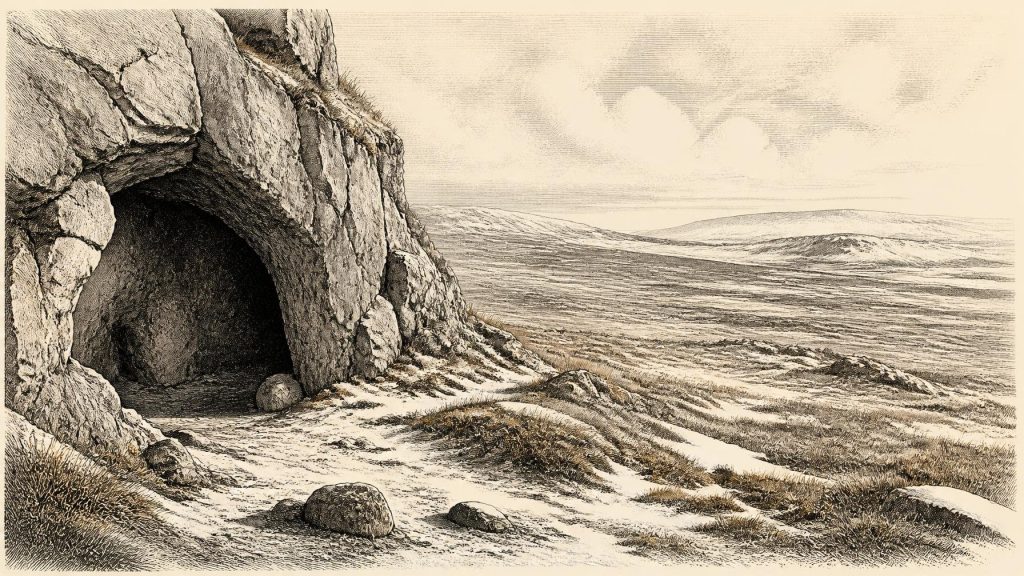
The chief Irish archive for this period is Castlepook Cave, also known as Mammoth Cave, near Doneraile in north County Cork. Formed in Carboniferous limestone above the Awbeg valley, it is a maze of narrow passages and chambers. Excavations conducted between the late nineteenth and early twentieth centuries recovered more than 2,000 animal bones. Modern reassessment makes Castlepook exceptionally important: it is Ireland’s richest known assemblage for vertebrate life before the Last Glacial Maximum, and individual specimens have produced dates ranging broadly from about 45,700 to 19,950 radiocarbon years before present.
That impressive span is also a warning. Castlepook is not a sealed snapshot of one season, one generation or one year. Carnivores accumulated bones there; water disturbed parts of the deposits; antiquarian excavation methods did not record every layer to modern standards; and bones from widely separated episodes could become mixed. A list of animals from the cave cannot be converted into a claim that every species stood together outside its entrance in 31,944 BCE. Rather, the assemblage demonstrates that, across the middle and later phases of the last Ice Age, Ireland intermittently supported a remarkable cold-stage fauna.
The animals identified from Castlepook include woolly mammoth, reindeer, giant deer, brown bear, wolf, Arctic fox and spotted hyaena, alongside small mammals such as collared and Norwegian lemmings. These remains overturn an older popular image of Ice Age Ireland as simply empty. They indicate landscapes capable, at different times, of supporting grazing herds, scavengers and large predators. Reindeer and mammoth point towards open, low-productivity environments often described as steppe-tundra or tundra-steppe mosaics: grassland, herbs, sedges and patches of dwarf shrub rather than closed forest. Caves served as traps, dens, shelters and repositories within that ecosystem, not merely as scenic holes in the rock.
Recent radiocarbon work has complicated the story in a productive way. Improved pretreatment of bone samples has shown that some older dates from Irish caves were too young. Re-dating at Castlepook indicates a deeper Marine Isotope Stage 3 history for some fauna, and suggests that giant deer and spotted hyaena may have disappeared locally before about 40,000 calibrated years before present. This is important for the present date: these animals belong to the broader pre-glacial Irish record, but their presence specifically in 31,944 BCE cannot simply be assumed. The most secure conclusion is regional ecological change over millennia, not a fixed menagerie in a numbered year.
People: A Possibility, Not a Settlement
There is no securely dated house, hearth, stone-tool assemblage, burial, camp floor or human bone from Ireland that can be assigned to around 31,944 BCE. Nor is there evidence for a permanent population. The best-established published evidence for Palaeolithic human activity in Ireland remains much later: a brown-bear kneecap from Alice and Gwendoline Cave, County Clare, bearing cut marks made on fresh bone and dated to approximately 12,810–12,590 calibrated years before present. That evidence belongs around 10,800–10,500 BCE, more than 20,000 years after the date considered here.
Castlepook nevertheless keeps the earlier question open. Researchers have reported a reindeer bone from old collections with marks considered potentially consistent with stone-tool butchery and a date of roughly 33,000 years ago. If that interpretation is confirmed by further analysis and secure archaeological context, it could indicate a very early human presence in Ireland before the glacial maximum. It is not, however, a basis for declaring an established community in 31,944 BCE. Current investigations at Castlepook are seeking undisturbed sediments, further modified bones, lithics, charcoal and other evidence capable of testing this possibility. Until such material is securely recovered and dated, human activity at this depth of time remains an informed hypothesis rather than a demonstrated fact.
Society Beyond the Evidence
Consequently, there can be no responsible account of Irish political affairs, diplomacy, named leaders, territorial rule or organised warfare for this year. There are no texts, monuments or settlements from which to reconstruct them. If small human groups did visit the island, comparison with Upper Palaeolithic societies elsewhere in north-west Europe suggests highly mobile foraging parties, knowledge of seasonal animal movements, and skilled use of stone, hide, bone and fire. But this is comparative interpretation, not direct evidence from Ireland. The same distinction applies to trade: movement of people, animals or raw materials may have linked Ireland to neighbouring lands, but no imported tool or exchange network has been securely demonstrated for this date.
Religion, art and learning likewise leave no identified Irish trace from 31,944 BCE. Across Europe, Upper Palaeolithic people made images, ornaments and carefully worked objects, and caves could acquire symbolic significance. None of that permits us to assign cave art, ritual, language or funerary custom to Ice Age Ireland. Castlepook’s name and the antiquarian labels of its chambers are modern, not prehistoric. Its true value is more austere but no less compelling: fossil bone, cave sediment, geological context and the possibility that overlooked museum collections may yet contain evidence of people.
The Making of a Future Island
The most important development around this remote date was environmental rather than political. Ireland was entering the long cold phase that would alter its topography, drainage and habitable spaces. As ice expanded later, glaciers eroded bedrock, redistributed boulders and sediment, and helped create the landforms now mapped as drumlins, moraines, eskers, corries and glacial lineations. These processes also destroyed or buried many earlier surfaces on which people might once have camped. The shortage of open-air Palaeolithic sites may therefore reflect both genuinely limited human presence and the poor survival of evidence.
For Ireland in 31,944 BCE, the honest historical picture is therefore one of limits and possibilities. The island was part of a wider north-west European Ice Age world, with lowered seas, advancing ice and cold-adapted fauna. Castlepook Cave establishes that this was not an ecological blank, while its complicated deposits demonstrate why every claim must be qualified. No year-specific human drama can be recovered. Yet the bones beneath the limestone preserve a deeper truth: before the ice reshaped the country, Ireland was already a changing frontier of climate, animals and perhaps occasional human exploration.
Primary Sources
- A Reconsideration of the Radiocarbon Dating of the Marine Isotope Stage 3 Fauna from Southern Ireland
- The Irish Quaternary Fauna Project
- Castlepook Cave: Cork County Geological Site Report
- Growth and Retreat of the Last British–Irish Ice Sheet, 31,000 to 15,000 Years Ago: the BRITICE-CHRONO Reconstruction
- The Deglaciation of the Western Sector of the Irish Ice Sheet from the Inner Continental Shelf to its Terrestrial Margin
- Pattern and Timing of Retreat of the Last British–Irish Ice Sheet
- Reconstructing the Last Irish Ice Sheet 2: a Geomorphologically-Driven Model of Ice Sheet Growth, Retreat and Dynamics
- Trimlines, Blockfields and the Vertical Extent of the Last Ice Sheet in Southern Ireland
- Quaternary Geomorphology, Geological Survey Ireland
- Quaternary Geological Map of Ireland
- Figure 6: The Subdivision of the Quaternary Period in Ireland
- Our Ancient Landscapes: Hunter-Gatherers in Ireland
- First Evidence of a Late Upper Palaeolithic Human Presence in Ireland
- New Insights on the Fauna of Ireland's Younger Dryas and Early Holocene from Alice & Gwendoline Cave
- 2022:564 – Castlepook Cave, Castlepook South, Cork
- Archaeology Research Excavation Grant 2022: Castlepook Cave Project Final Report
- The Archaeological Heritage of County Cork
- Ireland Through Geological Time
- The Island of Ireland: Drowning the Myth of an Irish Land-Bridge?
- Occurrence of Mammalia Relicts at Site Castlepook Cave