Mammoth Cave31959 BCE
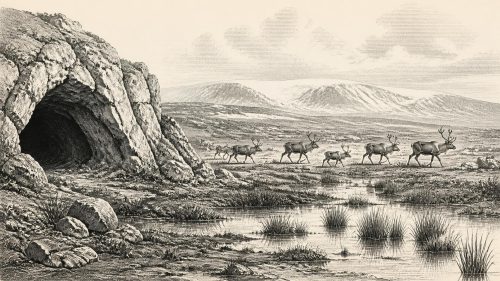
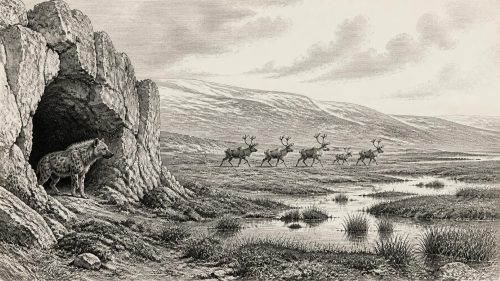
Around 31,959 BCE, Ireland was an unstable Late Pleistocene landscape, not a recorded society. Before the Last Glacial Maximum, exposed areas may have supported open steppe and tundra vegetation and fauna. Castlepook, or Mammoth Cave, County Cork, contains bones of mammoth, reindeer, giant deer, bears, wolves, foxes and hyaenas, although its disturbed deposits represent long periods rather than a single moment. A cut-marked reindeer femur may indicate human butchery about 33,000 years ago, but remains contested and lacks context. It cannot prove settlement, culture or routes of arrival. Glaciation, sea-level change and poor preservation leave human presence uncertain, pending research.
Dateline
31,959 BCE is a modern chronological label, not a year that can be isolated in Ireland’s archaeological record. There were no calendars, written records, named leaders or dated events on the island at this depth of time. Expressed in the convention used by Quaternary scientists, the label falls roughly 33,900 calendar years before AD 1950, within the Late Pleistocene and Marine Isotope Stage 3 of the last Ice Age. That conversion should not be mistaken for an exact archaeological date: radiocarbon results require calibration, are normally presented as probability ranges, and cannot identify what happened in a particular season or year. The responsible history of Ireland at this point is therefore a history of landscapes, animal remains and a small, contested body of possible evidence for people.
An Ice-Age Ireland
Ireland around this notional date stood before the coldest phase of the last glaciation, the Last Glacial Maximum, conventionally dated to roughly 26,000–19,000 calendar years ago. It was not yet the uniformly ice-covered landscape often imagined under the phrase “Ice Age”. Reconstructions indicate a changing, climatically unstable world in which ice sheets and local ice caps expanded and contracted, while exposed lowlands and coastal margins could support cold-adapted animals. Exactly how much of Ireland was ice-free at any one time remains debated. Some reconstructions indicate ice-free conditions in parts of Ireland until about 34,000 years ago; others allow for earlier and more extensive ice growth. This uncertainty is crucial: it rules out any confident picture of a single, continuous Irish landscape or a simple route into it.
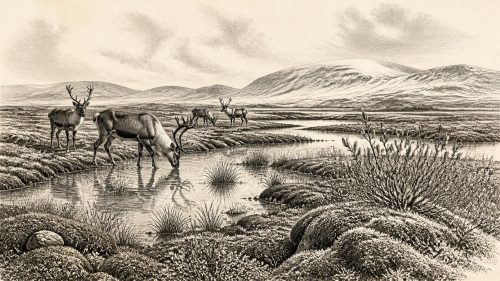
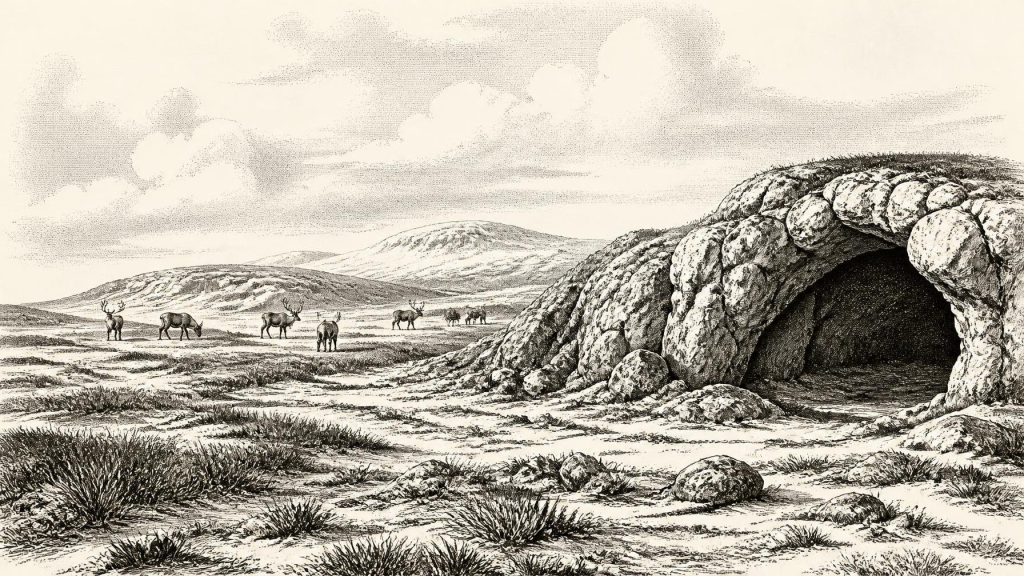
Even where ground was exposed, it did not resemble modern green Ireland. The available evidence points towards open, treeless or sparsely vegetated terrain in a cold, continental environment: a mosaic of grassland, herb-rich steppe, tundra-like patches, bare mineral ground and sheltered valleys. Temperature, precipitation and seasonality fluctuated sharply over centuries and millennia. Pollen records capable of describing this exact moment are scarce, so the vegetation picture is an informed reconstruction rather than a direct local snapshot. Yet the animal record makes clear that Ireland could, at intervals, sustain large grazing and browsing mammals as well as formidable predators.
Caves and Animal Evidence
The principal archive is Castlepook Cave, also known as Mammoth Cave, near Doneraile in north County Cork. Excavated in the early twentieth century, it yielded an extraordinary assemblage of Ice-Age animal bones. Woolly mammoth, reindeer, giant deer, brown bear, wolf, fox and spotted hyaena are among the species recorded from its deposits. The cave has special importance because it preserves evidence from before as well as after the Last Glacial Maximum. Reassessment of the old collections, including more rigorous radiocarbon dating and improved treatment of bone collagen, has pushed some faunal dates significantly earlier than earlier programmes suggested and has strengthened the case that southern Ireland supported varied mammal communities during Marine Isotope Stage 3.
That list must not be turned into a painted scene of all these animals gathering together in 31,959 BCE. Cave deposits accumulate over long spans; animals may have entered naturally, been dragged in by predators, or been moved by water and sediment. The original excavations also removed much of the stratified material before modern recording standards existed. Castlepook is therefore best understood as a time-compressed archive, not a single hunting camp. Its evidence demonstrates that parts of Ireland were ecologically habitable during earlier phases of the last glacial cycle. It does not establish the population size, seasonal movements or precise coexistence of every species represented by the bones.
The Possible Human Trace
The most consequential claim for this period concerns a fragment of reindeer femur from Castlepook. Ruth Carden’s examination identified a deep mark interpreted as a cut or chop made by a sharp stone tool during butchery; reporting associated with the discovery described the bone as dating to about 33,000 years ago. If that interpretation and chronology are sustained by further study, it would place human activity in Ireland more than 20,000 years before the better-established Late Upper Palaeolithic evidence from County Clare. It would mean that hunter-gatherers reached, or at least briefly used, an Irish landscape during a comparatively favourable window before the full expansion of the last ice sheet.
But this is not evidence for a settled population, nor for a named archaeological culture. There are presently no securely associated hearths, stone-tool assemblages, dwellings, human remains, burials or rock art from Castlepook that can describe the people who may have cut the bone. The specimen came from an antiquarian collection rather than a modern, intact excavation context, and the cut-mark interpretation needs to be considered alongside natural damage, carnivore activity and the disturbed history of the cave deposits. Recent fieldwork has sought surviving sediments, additional modified bones, charcoal, lithics and possible cave art precisely because the original find, though potentially transformative, cannot answer these questions on its own.
The distinction matters. Across north-west Europe, people of the Upper Palaeolithic made sophisticated stone and organic tools, hunted large game, travelled widely and sometimes created striking figurative or abstract art. Around 34,000 years ago, archaeologists on the continent conventionally discuss the late Aurignacian and the emergence of Gravettian traditions. Ireland has no assemblage that permits it to be assigned confidently to either. It would be reasonable to infer that any hunters who butchered reindeer possessed practical knowledge of stone cutting tools and animal carcasses. It would not be responsible to infer their language, identity, kinship system, ritual beliefs or artistic practices from one modified bone.
Mobility, Not a Polity
Political affairs, diplomacy and organised conflict leave no identifiable trace in Ireland at this date. There is no evidence for tribes, territories, rulers, alliances or warfare, and projecting later Irish identities backwards would be false. If people were present, they were almost certainly members of small, highly mobile hunter-gatherer groups whose social worlds extended beyond the island. Their movements would have depended on changing animal ranges, weather, safe crossing points and knowledge passed between generations. Whether they arrived over temporarily exposed terrain, across narrow stretches of water, beside ice margins or by some combination of routes is not known. Lower global sea levels altered the geography of the surrounding shelf, but should not be simplified into a proven walkable land bridge between Ireland and Britain.
Nor can an economy or trade network be recovered in the usual sense. The possible butchery mark suggests the use of animal food and perhaps hides, sinew or bone, but it does not show a permanent camp or exchange system. Reindeer would have been valuable prey if encountered, supplying meat and fat as well as materials for clothing, bindings and implements. Mammoth, giant deer and carnivores shaped the opportunities and risks of the environment, but their bones alone do not show that people hunted them. A cave may have been a predator den, a trap for animals, a place where bones accumulated after scavenging, or merely a geological container for material washed in from outside.
What Cannot Be Seen
Religion, learning and cultural memory are similarly beyond direct recovery. Caves became significant places in much later Irish prehistory, but there is no basis for calling Castlepook a sanctuary in 31,959 BCE. There are no graves, offerings, structured deposits or images attributable to this period. Knowledge undoubtedly mattered to any Ice-Age travellers: reading tracks, locating shelter, preparing carcasses, working stone and anticipating weather were skills essential to survival. Archaeology can infer that such practical learning existed if human butchery is accepted; it cannot reconstruct stories, ceremonies or beliefs.
The weakness of the record is itself historically meaningful. Subsequent glaciation eroded and buried landscapes, while rising seas later drowned parts of the former coastal plain. Many potential open-air sites may have been destroyed, lie offshore, or remain invisible beneath later sediments. Older cave collections, often excavated before systematic stratigraphic methods, preserve invaluable specimens but frequently lack the contextual information now expected. Ireland’s apparent archaeological silence before the Last Glacial Maximum may therefore reflect both genuinely intermittent human use and the severe survival bias imposed by ice, water and earlier excavation.
A Precarious Frontier
For Ireland, the importance of this date lies not in an event but in a possibility. The faunal evidence shows an Ice-Age country that was not always sealed beneath ice: a northern frontier where reindeer, mammoth, giant deer, bears and hyaenas could inhabit exposed terrain. The cut-marked Castlepook reindeer bone offers a plausible, still developing indication that people entered this world and processed an animal there or nearby. It does not yet demonstrate enduring colonisation. Much later, at Alice and Gwendoline Cave in County Clare, a brown-bear patella bearing cut marks has securely calibrated dates of about 12,810–12,590 cal BP, demonstrating Late Upper Palaeolithic human activity long after the period considered here. The gap between these traces remains one of the central unsolved questions of Irish prehistory.
Thus, around 31,959 BCE, Ireland should be envisaged not as a land of recorded societies but as a changing Ice-Age environment at the edge of human possibility. Future work on cave sediments, direct dating, microscopic surface damage, ancient DNA and submerged landscapes may clarify whether Castlepook records a short hunting visit, repeated seasonal incursions or something more substantial. Until then, the evidence supports cautious wonder rather than certainty.
Source References
Hover over a number to see the source. Select it to open the source.

- [1] A reconsideration of the radiocarbon dating of the Marine Isotope Stage 3 fauna from southern Ireland
- [2] The Irish Quaternary Fauna Project
- [3] The colonization of Ireland: A human ecology perspective
- [4] First evidence of a Late Upper Palaeolithic human presence in Ireland
- [5] New insights on the fauna of Ireland's Younger Dryas and Early Holocene from Alice & Gwendoline Cave
- [6] Trimlines, blockfields and the vertical extent of the last ice sheet in southern Ireland
- [7] Dimensions and chronology of the last ice sheet in Western Ireland
- [8] The timing and magnitude of the British–Irish Ice Sheet between Marine Isotope Stages 5d and 2: implications for glacio-isostatic adjustment, high relative sea levels and ‘giant erratic’ emplacement
- [9] Behavioural tendencies of the last British–Irish Ice Sheet revealed by data–model comparison
- [10] Timing, pace and controls on ice sheet retreat: an introduction to the BRITICE-CHRONO transect reconstructions of the British-Irish Ice Sheet
- [11] The Island of Ireland: Drowning the Myth of an Irish Land-Bridge?
- [12] Archaeology Research Excavation Grant 2022: Castlepook Cave, Co. Cork
- [13] 32564: Castlepook Cave, Co. Cork
- [14] Prehistoric Details: Mell Flint Flake
- [15] The Mesolithic in Ireland: when was it?
- [16] Heritage Artefacts of County Cork
- [17] The exploration of Castlepook Cave, Co. Cork. With 3 plates.
- [18] Castlepook Caves
- [19] Revisiting Alice and Gwendoline Cave, Co. Clare: New light on the 1902 excavations
- [20] IntCal20 Northern Hemisphere Radiocarbon Age Calibration Curve (0–55 cal kBP)
Primary Sources
- A reconsideration of the radiocarbon dating of the Marine Isotope Stage 3 fauna from southern Ireland
- The Irish Quaternary Fauna Project
- The colonization of Ireland: A human ecology perspective
- First evidence of a Late Upper Palaeolithic human presence in Ireland
- New insights on the fauna of Ireland's Younger Dryas and Early Holocene from Alice & Gwendoline Cave
- Trimlines, blockfields and the vertical extent of the last ice sheet in southern Ireland
- Dimensions and chronology of the last ice sheet in Western Ireland
- The timing and magnitude of the British–Irish Ice Sheet between Marine Isotope Stages 5d and 2: implications for glacio-isostatic adjustment, high relative sea levels and ‘giant erratic’ emplacement
- Behavioural tendencies of the last British–Irish Ice Sheet revealed by data–model comparison
- Timing, pace and controls on ice sheet retreat: an introduction to the BRITICE-CHRONO transect reconstructions of the British-Irish Ice Sheet
- The Island of Ireland: Drowning the Myth of an Irish Land-Bridge?
- Archaeology Research Excavation Grant 2022: Castlepook Cave, Co. Cork
- 32564: Castlepook Cave, Co. Cork
- Prehistoric Details: Mell Flint Flake
- The Mesolithic in Ireland: when was it?
- Heritage Artefacts of County Cork
- The exploration of Castlepook Cave, Co. Cork. With 3 plates.
- Castlepook Caves
- Revisiting Alice and Gwendoline Cave, Co. Clare: New light on the 1902 excavations
- IntCal20 Northern Hemisphere Radiocarbon Age Calibration Curve (0–55 cal kBP)