Elephant Hall Faunal Archive31337 BCE
31,337 BCE is a modern label for a broad MIS 3 interval, not a recoverable Irish historical year. Ireland experienced unstable conditions, changing ice margins, lower seas and varied open landscapes of tundra, wetlands and sparse vegetation. Glacial activity later obscured evidence. Castlepook Cave in County Cork preserves fauna including reindeer, mammoth, hyaena, wolf and Arctic fox, demonstrating habitats for cold-adapted mammals, although bones derive from different episodes and disturbed deposits. A cut-mark-like reindeer femur may indicate Upper Palaeolithic human handling, but lacks settlement evidence. Research treats human presence as possible, while Ice Age animals and environments remain the record.

Dateline
The label 31,337 BCE is a modern calendar convenience, not a recoverable Irish year. No calendar, inscription or historical narrative existed on the island, and the available evidence cannot identify an event, a named individual or even a particular season at this depth of time. Converted mechanically, the label falls roughly 33,286 years before AD 1950; archaeologists would more responsibly place it within the later part of Marine Isotope Stage 3 (MIS 3), a climatically unstable phase of the Last Glacial period. Dates from this era are normally expressed as radiocarbon determinations and calibrated probability ranges, not annual anniversaries. The proper subject is therefore not an imagined day in prehistoric Ireland, but the changing landscape and the slender traces which survive from a broad interval around 34,000–30,000 years ago.
A Landscape in Transition
Ireland at this point was not the green, wooded island familiar today. It lay on the north-western edge of Europe’s cold-world zone, where climate altered sharply over centuries and millennia. The British–Irish Ice Sheet had experienced earlier phases of growth and retreat, while its great expansion towards the Last Glacial Maximum was beginning or approaching in different regions. The fullest late-glacial ice cover came later: recent reconstructions place the local maximum of the British–Irish Ice Sheet at about 27,000 years ago, with maximum extents varying by sector. Around 31,337 BCE, therefore, it is unsafe to portray all Ireland as either wholly ice-covered or wholly open. The best interpretation is a regionally varied landscape, increasingly affected by cold, ice growth, strong winds and shifting sea levels.
This uncertainty is not a failure of scholarship but a property of the evidence. Later glaciers eroded, buried and rearranged earlier deposits. Ice-rafted debris in Atlantic cores, raised-beach sequences, cave sediments, till layers, landforms and exposure dates demonstrate that the ice sheet was dynamic during MIS 3. They do not provide a neat national map for one modern calendar year. Northern and upland areas may have supported local or expanding ice, while lower ground and southern districts could at times have offered open terrain. The sea was lower globally because water was held in ice sheets, but Ireland was not thereby joined to Britain by a simple dry-land bridge. Any human arrival, if it occurred, required sea crossing or movement through a fragmented coastal and maritime landscape.
Open Ground and Cold Waters
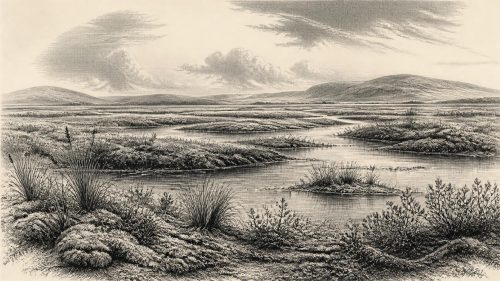
The Irish palaeoenvironmental record supplies glimpses rather than a continuous picture. Organic deposits sealed between glacial tills at places such as Derryvree and Maguiresbridge in County Fermanagh preserve plant remains, pollen and insect evidence from cold-stage environments. They show that, during ice-free intervals, freshwater basins and wet ground could support mosses, sedges, willows, bogbean, water-milfoil and other hardy plants. Such deposits do not date precisely to 31,337 BCE, nor should they be treated as a single nationwide habitat. They do, however, establish that cold Ireland was not simply a lifeless white expanse. Its landscapes included pools, marshes, stream margins and patches of low vegetation, changing as climate and ice margins changed.
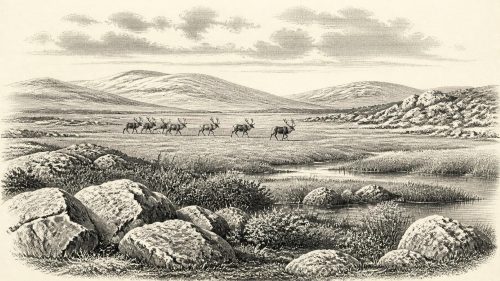
For the interval around this date, the wider evidence points towards predominantly treeless or sparsely vegetated country: tundra, herb-rich steppe, wet hollows and exposed mineral ground rather than closed forest. In favourable summers, these landscapes could have produced grasses, sedges, herbs and browse sufficient for grazing animals. Winters would have been severe, and wind exposure on open ground formidable. Rivers and meltwater channels shifted sediment; frost fractured bedrock; and caves, fissures and hollows became traps or shelters for animals and repositories for bone. The foundations of much later Irish scenery – its drumlins, till plains, rock-smoothed uplands, basins and drainage patterns – were being created or prepared by these glacial processes, though most visible forms record later advances and retreat.
Castlepook’s Animal World
The most important Irish evidence close to this broad period comes from Castlepook Cave near Doneraile in north County Cork, a limestone cave system in the Awbeg valley below the Ballyhoura Hills. Early twentieth-century excavators recovered a remarkable collection of animal remains from passages they named Elephant Hall, Hyaena Hall, Wolf Hall and other chambers. Subsequent study, especially the Irish Quaternary Fauna Project, used accelerator radiocarbon dating to demonstrate that some of the fauna belonged to the pre-Last Glacial Maximum world. The collection includes reindeer, woolly mammoth, brown bear, wolf, Arctic fox, spotted hyaena, hare and lemmings, as well as giant deer and red deer from different episodes. It is a powerful record of animal presence, but not a single, simultaneous community.
That qualification matters. Castlepook is a complex cave with deposits disturbed by water, animals, antiquarian excavation and later activity. Bones from differing ages can be mixed or re-deposited. Older radiocarbon determinations have also been reassessed as laboratory pretreatment techniques improved. A dated reindeer or mammoth bone demonstrates that the animal lived in, or reached, Ireland during a particular broad span; it cannot automatically date every bone in the chamber, reconstruct a complete food web, or establish a human camp. Yet the broad pattern is secure: southern Ireland was intermittently accessible to large mammals during MIS 3, and parts of the island could sustain a cold-adapted fauna.
Reindeer are especially evocative because their presence implies open country with seasonal forage and because their movements may have linked Irish environments to wider north-west European animal ranges. Mammoths and hyaenas signal a substantially different ecological setting from modern Ireland. The latter were not merely exotic visitors in a modern-looking countryside: their remains belong to an Ice Age landscape with predator–scavenger relationships, migrating herbivores and harsh seasonal constraints. Whether particular carcasses were carried into cave passages by hyaenas, washed in, died nearby or were moved by people must be decided specimen by specimen through taphonomic study – cutmarks, tooth marks, breakage, weathering, sediment context and dating.
The Reindeer Femur Question
A reindeer femur from the Castlepook collection has given this period exceptional importance. Zooarchaeologist Ruth Carden identified a deep linear mark on the bone as consistent with modification of fresh bone by a sharp stone tool. Public accounts have described the specimen as dating to about 33,000 years ago. If that interpretation is upheld through continuing study, the mark would be evidence that a person, or a very small group, handled and probably processed a reindeer in Ireland during MIS 3. It would extend the possible Irish human record far beyond the long-established evidence for final-Pleistocene activity in County Clare and the secure Mesolithic settlement record at Mount Sandel, County Londonderry, beginning around 9,800–9,600 calibrated years before present.
It would not, however, prove a settled population in north Cork. No securely associated hearth, living floor, stone-tool assemblage, dwelling, burial, repeated butchery deposit or dated occupation layer has yet been published from Castlepook for this time. A mark on a bone and the age of that bone are two related but separate lines of evidence: radiocarbon dating addresses when the animal died, while microscopic and contextual analysis assesses how the mark was made. Carnivore damage, sediment abrasion, excavation damage and natural breakage can sometimes resemble human modification. The responsible conclusion is that Castlepook offers a significant possible indication of Upper Palaeolithic human activity, not a basis for inventing a village, tribe, voyage or individual hunter.
If people did briefly reach Ireland, their practical economy would have centred on mobility and animal resources. Reindeer meat, fat, hide, sinew, marrow and bone would have been valuable to hunter-gatherers elsewhere in Ice Age Europe; a sharp stone edge could have been used to separate tissue or open a limb. That is a reasonable comparative interpretation, not direct evidence for a local Irish tradition. There is no evidence for farming, herding, pottery, metalworking, long-distance exchange networks or a permanent settlement economy. Nor is there evidence for political institutions, diplomacy, organised warfare, named territories, language, religious observance, art or formal learning in Ireland at this date. Caves elsewhere in Europe can preserve art or ritual use, but Castlepook’s animal-rich chambers do not demonstrate either.
Absence Is Evidence Too
The silence of the archaeological record is central to this year’s story. Ireland’s caves retain animal bone partly because limestone chambers can protect material, but open-air camps on exposed ground were vulnerable to erosion, burial beneath glacial deposits and later sea-level change. It is entirely possible that evidence has been lost or remains undiscovered, particularly on former coastlines now beneath the sea. Possibility is not proof. The National Museum of Ireland consequently continues to describe the Palaeolithic human presence as lacking clear evidence, while active research at Castlepook seeks new, stratified deposits and applies modern dating and recording methods.
That tension is productive rather than contradictory. Scientific understanding advances by testing exciting claims against the limits of context, calibration and preservation. Radiocarbon measurements require calibration because atmospheric carbon-14 has varied through time; at 30,000 or more years ago, their calibrated ranges can be broad. New pretreatment methods can remove contaminants from ancient collagen and alter the apparent age of samples previously dated decades ago. Excavation, sediment analysis, palaeontology and geochronology are therefore as important as dramatic headline finds. Around 31,337 BCE, Ireland’s best-documented inhabitants remain its Ice Age animals and environments. Human presence is a carefully framed question – an intriguing possibility resting on one important object, rather than a year-by-year historical certainty.
Primary Sources
- The Irish Quaternary Fauna Project
- First Evidence of a Late Upper Palaeolithic Human Presence in Ireland
- New Insights on the Fauna of Ireland's Younger Dryas and Early Holocene from Alice & Gwendoline Cave
- The Colonization of Ireland: A Human Ecology Perspective
- The Timing and Magnitude of the British–Irish Ice Sheet Between Marine Isotope Stages 5d and 2: Implications for Glacio-Isostatic Adjustment, High Relative Sea Levels and ‘Giant Erratic’ Emplacement
- Growth and Retreat of the Last British–Irish Ice Sheet, 31,000 to 15,000 Years Ago: The BRITICE-CHRONO Reconstruction
- Dimensions and Chronology of the Last Ice Sheet in Western Ireland
- Stratigraphic and Palaeo-Geomorphological Evidence for the Glacial-Deglacial History of the Last British-Irish Ice Sheet in the North-Western Irish Sea
- Timing and Pace of Ice-Sheet Withdrawal Across the Marine–Terrestrial Transition West of Ireland During the Last Glaciation
- Late Pleistocene Chronostratigraphy and Ice Sheet Limits, Southern Ireland
- Figure 6.— The Subdivision of the Quaternary Period in Ireland
- Outreach and Education Resources
- Quaternary Geological Map of Ireland
- Ireland Through Geological Time
- Quaternary Geomorphology 1:50,000 Ireland (ROI) ITM
- Archaeological Heritage of County Cork
- Heritage Artefacts of County Cork
- Archaeology Research Excavation Grant 2022
- 2022:564 – Castlepook Cave, Castlepook South, Cork
- Prehistoric Details: Mell Flint Flake
- The IntCal20 Northern Hemisphere Radiocarbon Age Calibration Curve (0–55 cal kBP)
- The IntCal20 Approach to Radiocarbon Calibration Curve Construction: A New Methodology Using Bayesian Splines and Errors-in-Variables