
A Cutmark Near Doneraile31129 BCE
Around 31,129 BCE, Ireland lay within a climatically unstable phase of the Last Glacial Period, before maximum ice expansion. Derryvree, County Fermanagh, preserves freshwater sediments indicating an ice-free, treeless tundra of pools, mosses, sedges and cold-adapted plants. Castlepook Cave, County Cork, yielded remains of mammoth, reindeer, giant deer, hyaena and other open-country animals, accumulated over extended periods. A cutmarked reindeer femur may indicate human butchery, but its interpretation remains uncertain and lacks associated tools or occupation evidence. No settlements, institutions or named peoples are known. These fragmentary records reveal a changing Pleistocene landscape intermittently supporting wildlife and possibly mobile people.
Dateline
The label 31,129 BCE gives an impression of precision that the evidence cannot sustain. No written record, calendar, named community or securely dated human event survives from Ireland at this depth of time. In modern chronological terms, the year corresponds roughly to 33,078 years before AD 1950, the conventional ‘present’ used in radiocarbon reporting. It falls within Marine Isotope Stage 3, a long, climatically unstable part of the Last Glacial Period, before the Last Glacial Maximum covered much of Ireland with ice. The responsible history of this moment is therefore a history of deposits, animal bones, pollen, insects and landforms: evidence that can establish broad environmental conditions and occasional animal presence, but only rarely human action.
A Date Within a Wide Range
The best Irish environmental evidence relevant to this nominal year comes from Derryvree near Maguiresbridge, County Fermanagh. Road works exposed fine sands and organic silts trapped between two layers of till, the unsorted material laid down directly by glacier ice. Their order is important. An earlier glacier had occupied the locality; then water, plants and sediment accumulated in an ice-free interval; finally, a later ice advance sealed the freshwater deposits beneath new till. Later glaciation destroyed or disturbed much of Ireland’s older surface record, so this buried sequence is unusually valuable.
The Derryvree organic material produced radiocarbon determination Birm-166, conventionally reported as 30,500 radiocarbon years BP, with a substantial uncertainty of roughly a millennium. Radiocarbon years are not calendar years: atmospheric carbon-14 has varied, and dates must be calibrated against independently constructed curves. Modern discussion consequently places the Derryvree deposits broadly around 36,900–31,700 calibrated years BP, approximately 34,950–29,750 BCE. The nominal year 31,129 BCE lies within that broad range. It cannot, however, identify the precise year in which a particular plant flowered, a pool formed, or an animal passed through Fermanagh.
This is not a defect in the archaeology; it is its proper scale. The sequence records an environmental interval, accumulated over time at one locality. It supports neither a claim that all Ireland looked exactly the same nor a year-by-year narrative. It does show that, during part of this pre-maximum cold phase, the Derryvree area was free of local glacier ice and supported a cold freshwater landscape.
Open Water, Moss and Tundra
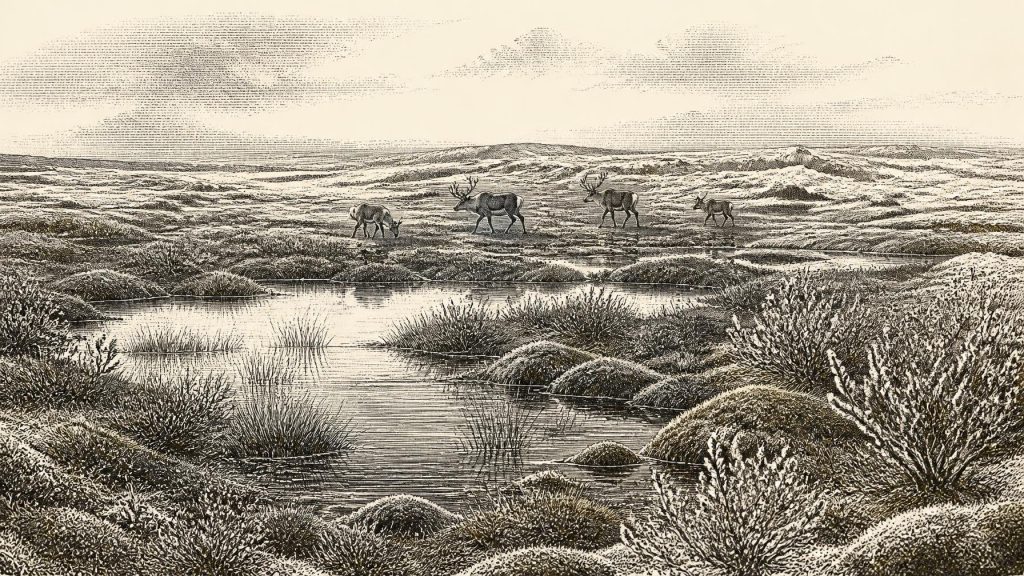
The silts, plant macrofossils, pollen and insect remains at Derryvree point to an open, treeless tundra or muskeg environment. Grasses and sedges were prominent, alongside herbs, juniper and a rich moss flora. Fossil evidence includes plants associated with cold, wet ground and shallow freshwater, among them dwarf willow, lesser clubmoss and bogbean. Beetles and other invertebrate traces indicate wet ground with open pools and abundant decaying plant matter. This was not the familiar green, wooded Ireland of later millennia, nor necessarily a wholly barren snowfield. It was a patchwork of marsh, shallow water, mossy ground and sparse low vegetation shaped by frost, harsh winters and short growing seasons.
Such evidence reveals everyday ecological processes rather than human society. Water could collect where drainage was impeded; seasonal thaw and refreezing affected soils; plants had to tolerate exposure and cold. The climate was variable on scales far beyond a human lifetime. North Atlantic and Greenland records show abrupt shifts between relatively milder interstadials and colder stadials during this part of the Ice Age. Ireland’s position on the Atlantic edge did not remove it from those swings. Derryvree is best understood as one local window onto a changing northern landscape, not a static portrait.
Before the Ice Sheet’s Maximum
At 31,129 BCE, Ireland had not yet reached the Last Glacial Maximum, when the British–Irish Ice Sheet expanded across much of the island and far onto the surrounding continental shelf. Research on the western offshore record places the maximum advance much later, broadly after 26,400 years ago and with retreat under way before about 24,400 years ago. The difference matters. The landscape relevant to this article belonged to an earlier, cold phase in which ice margins, periglacial terrain, wetlands and open country could coexist across different regions and at different times.
Sea level was far lower than today because vast quantities of water were held in continental ice sheets. Ireland’s present coastline did not exist, and the Irish Sea basin was a markedly different physical setting. Yet it would be unsafe to turn low sea level into a simple map of a dry land bridge or an easy route for people. The changing positions of ice, water, coast and exposed shelf are still debated, and physical connection is not the same thing as regular travel. What can be said is that Ireland was part of a wider north-west European zone through which animals could disperse during favourable intervals.
The Castlepook Fauna
About 250 kilometres south-west of Derryvree, Castlepook Cave near Doneraile in County Cork preserves Ireland’s richest known assemblage of pre-Last Glacial Maximum vertebrate remains. Its deposits have yielded woolly mammoth, reindeer, giant deer, brown bear, wolf, Arctic fox, mountain hare, collared lemming, Norwegian lemming and spotted hyaena. The list conveys a cold, open-country fauna, but it must not be read as though every species stood together on one day. Cave deposits accumulated over long periods, and carnivores, water movement, excavation history and later disturbance complicate their interpretation.
Spotted hyaena is especially significant. Hyaenas could drag or carry bones into caves, chew them and leave droppings; a bone in a cave therefore need not be evidence of a human meal, camp or burial. Mammoth and reindeer remains show that large herbivores reached Ireland during suitable phases, while predators and scavengers followed or exploited the same animal communities. Their presence suggests food webs based on open vegetation, but it does not permit firm estimates of animal numbers, migration routes or seasonality for the precise year in question.
Improved accelerator radiocarbon methods have also changed the chronology. Re-dating has shown that some earlier Irish cave dates were too young, partly because of limitations in the preparation of old bone samples. Castlepook material now demonstrates that elements of this fauna occupied Ireland during Marine Isotope Stage 3, and that giant deer and spotted hyaena may have disappeared locally before the later ice maximum. The lesson is methodological as well as historical: old collections remain indispensable, but their dates and contexts need continual testing.
The Reindeer Bone and the Human Question
Castlepook matters to human history because a reindeer femur has been reported to carry a deep fresh-bone incision interpreted as the mark of a sharp stone tool used in carcass processing. Public heritage accounts associate the bone with an age of about 33,000 years ago, close to the nominal date considered here. If the mark is confirmed as a cut or chop made during butchery, it would be remarkable evidence that people handled a reindeer in Ireland during the Middle Upper Palaeolithic.
That possibility must be stated carefully. The bone itself is evidence for a reindeer; the interpretation of its surface mark is a separate zoological and taphonomic judgement. Castlepook’s old cave collection came from complex deposits, and no securely associated stone-tool assemblage, hearth, occupation surface, dwelling, burial or human skeleton of comparable age has been recovered there. Nor does one modified bone demonstrate permanent settlement, a population of any size, a language, ancestry or political territory. A brief visit by mobile hunters, scavengers or small parties remains an inference rather than an established narrative.
The European context makes such a visit plausible without making it certain. Homo sapiens groups elsewhere in north-west Europe were highly mobile hunter-gatherers able to exploit large game and seasonally changing resources. Reindeer could provide meat, fat, hide, sinew, bone and antler. But Ireland has not produced the campsites and tool scatters needed to reconstruct those practices locally. The much later butchered brown-bear bone from Alice and Gwendoline Cave in County Clare offers stronger evidence for human presence during the terminal Pleistocene, around 12,890–12,678 calibrated years BP, but it cannot fill the far older evidential gap at Castlepook.
No Polities, No Proven Institutions
There is no evidence from Ireland around this date for political affairs, diplomacy, organised warfare, formal religion, permanent settlements, agriculture, trade networks or named peoples. It would be misleading to invent them merely because contemporary hunter-gatherers elsewhere had social lives, beliefs and practical knowledge. People, if present, certainly possessed culture and learned skills; every stone-tool cut would itself imply technical knowledge. But no Irish object or site presently permits a responsible account of ritual, leadership, exchange or family organisation in 31,129 BCE.
The archaeological emphasis belongs instead to environmental opportunity and uncertainty. The Derryvree wetlands show that life persisted in a severe periglacial setting. Castlepook shows that substantial mammals and carnivores entered the island during parts of the same broad period. The marked reindeer femur raises the prospect of human contact with that world. Together, these fragments give Ireland a deeper Palaeolithic horizon than older histories allowed, while also reminding us how little survives from a landscape repeatedly altered by ice.
A Landscape Rather Than a Chronicle
Ireland in 31,129 BCE was not yet a historical society in the documentary sense. It was a changing Ice Age landscape: cold, open, wet in places, inhabited by specialised plants and intermittently by striking animals. Derryvree’s sealed freshwater sediments and Castlepook’s cave fauna are the principal witnesses. They support a vivid but restrained conclusion: long before later Ireland’s farms, monuments and kingdoms, the island formed part of a dynamic Pleistocene world in which reindeer, mammoths, hyaenas and perhaps small groups of people could briefly share the same northern margin.
Primary Sources
- A Middle Midlandian Freshwater Series at Derryvree, Maguiresbridge, County Fermanagh, Northern Ireland
- Irish Pleistocene Biostratigraphy
- Figure 6.— The Subdivision of the Quaternary Period in Ireland
- A Reconsideration of the Radiocarbon Dating of the Marine Isotope Stage 3 Fauna from Southern Ireland
- New Insights on the Fauna of Ireland's Younger Dryas and Early Holocene from Alice & Gwendoline Cave
- Castlepook Cave: County Geological Site Report
- The Irish Quaternary Fauna Project
- Pleistocene Vertebrates in the British Isles
- 32564: Castlepook Cave, County Cork
- Archaeological Heritage of County Cork
- The Mesolithic in Ireland: When Was It?
- The IntCal20 Northern Hemisphere Radiocarbon Age Calibration Curve (0–55 cal kBP)
- IntCal Publications
- Oscillating Retreat of the Last British-Irish Ice Sheet on the Continental Shelf Offshore Galway Bay, Western Ireland
- The Deglaciation of the Western Sector of the Irish Ice Sheet from the Inner Continental Shelf to Its Terrestrial Margin
- Trimlines, Blockfields and the Vertical Extent of the Last Ice Sheet in Southern Ireland
- Last Glacial Maximum Cirque Glaciation in Ireland and Implications for Reconstructions of the Irish Ice Sheet
- The Problem of a Late Quaternary Landbridge Between Britain and Ireland
- Selaginella selaginoides
- Salix herbacea