
Derryvree–Castlepook Horizon31116 BCE
31,116 BCE is a modern label for a broad, uncertain Late Pleistocene horizon rather than a recoverable Irish year. At Derryvree, County Fermanagh, organic sediments between glacial tills record a locally ice-free, treeless wetland of tundra plants, shallow water and severe seasonal freezing. Castlepook Cave, County Cork, preserves a disturbed, time-spanning assemblage including mammoth, giant deer, reindeer, bear and hyaena. A marked reindeer femur may indicate human butchery, but cannot demonstrate settlement. No social institutions or occupation sites are known. Advancing ice later damaged evidence, leaving environmental archives, cave bones and carefully qualified possibilities of transient human presence in Ireland.
Dateline
31,116 BCE is a modern chronological label, not a date that can be recovered as a lived Irish year. No calendar, named community, settlement surface or historical event can be assigned to this particular twelve-month interval. In calendar terms it falls roughly 33,000 years before the radiocarbon convention’s “present” of AD 1950, within the Late Pleistocene and Marine Isotope Stage 3. At this depth in time, chronological precision comes from measurements with substantial uncertainty, and radiocarbon ages must be calibrated into ranges rather than converted into an exact anniversary. The responsible subject is therefore Ireland around this broad horizon: a cold, unstable Ice Age landscape known through a very small number of buried sediments, cave bones and later scientific reassessments.
A Date Within Ranges
The closest Irish environmental archive is at Derryvree, near Maguiresbridge in County Fermanagh. Road works in 1969 cut through a drumlin and exposed freshwater silts, fine sands and organic deposits trapped between two thick beds of till, sediment laid down by glacier ice. The sequence is clear in its basic order: an earlier ice advance deposited the lower till; a period without ice at that spot allowed freshwater and wet ground to develop; a later advance covered and preserved the deposit beneath another till sheet.
Organic material from the Derryvree series produced the conventional radiocarbon result BIRM-166, 30,500 radiocarbon years before present, with an uncertainty of +1,170/−1,030 years. That determination is not the same thing as a calendar date. Calibration is essential because atmospheric radiocarbon levels have varied, while the part of the calibration curve this far back is necessarily less precise than that for recent millennia. Scholarship can therefore place the Derryvree evidence broadly in the climatic world relevant to the requested date, but cannot say that its plants grew, its insects lived, or its water lay open in 31,116 BCE itself.
This distinction is more than a technicality. It prevents a false historical confidence. A sediment layer records a phase of environmental conditions accumulated over time; it is not an annual chronicle. The same caution applies to fossil bones. A date on a bone concerns when the animal died, within a statistical range. It does not automatically establish when the animal entered a cave, whether it was moved by a predator, or whether people were present.
Fermanagh’s Open Wetland
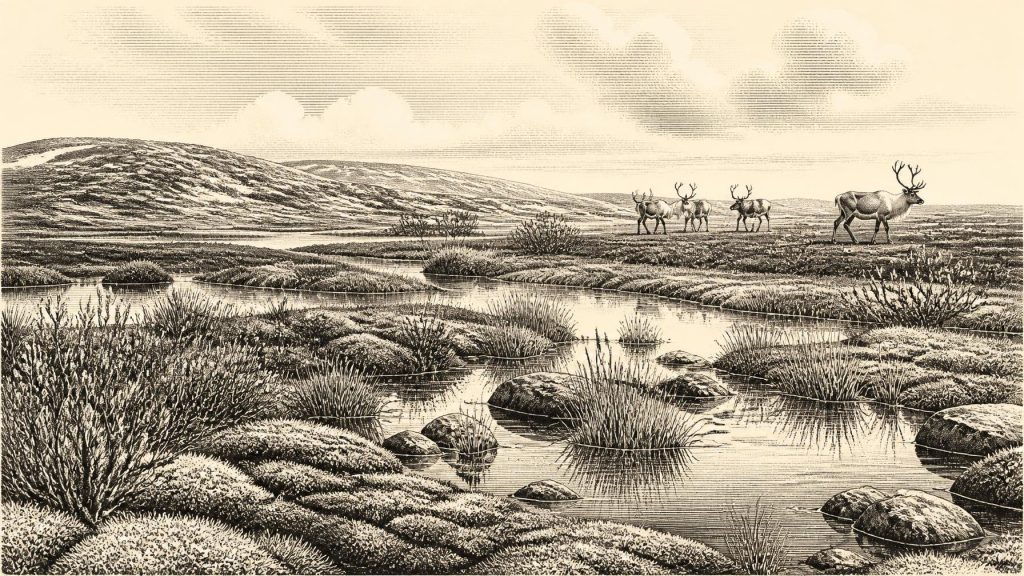
Derryvree nevertheless offers an unusually vivid local picture. Its organic silts contained pollen, plant remains and animal evidence indicative of open tundra vegetation and a periglacial regime: ground subject to severe cold and seasonal freezing rather than a familiar wooded Ireland. The record includes plants associated with wet, cold and exposed habitats. Fossil evidence for dwarf willow, mountain avens, bogbean and alternate water-milfoil is particularly valuable because it shows both sparse terrestrial vegetation and standing or slow-moving freshwater. Mosses, sedges and low herbs would have occupied saturated margins, while shallow pools offered a different habitat from the drier, frost-affected ground nearby.
That does not mean every part of Ireland looked identical. Derryvree was a particular basin in Fermanagh, not a map of the whole island. Yet it demonstrates that, during a Middle Midlandian interval, at least one northern locality supported a cold, treeless wetland rather than being continuously buried beneath glacier ice. The landscape was likely a mosaic of water, sedge-rich ground, dwarf shrubs, herbaceous tundra and exposed mineral soils. Long winters, short growing seasons and repeated freezing and thawing would have governed its character.
The wider North Atlantic climate was volatile. Marine Isotope Stage 3 contained abrupt shifts between comparatively milder interstadial conditions and colder stadial ones. Ireland lay on the western edge of north-west Europe, where ice, sea level, weather systems and vegetation could alter markedly over periods much shorter than later archaeological eras. The Derryvree succession proves local environmental change between two glacial episodes; it does not permit the neat correlation of its individual beds with a single Greenland warming, European cultural phase or island-wide advance of ice.
Animals and Cave Archives
For the animal world, Castlepook Cave near Doneraile in north County Cork is crucial. Also called Mammoth Cave, its passages yielded more than 2,000 bones during excavations in the early twentieth century. The cave is Ireland’s richest known archive for vertebrate life in the long period leading towards, through and after the Last Glacial Maximum. Its dated specimens span a broad interval, not one moment. Water movement, carnivore activity and the methods of early excavation have complicated the original deposits, so the assemblage must not be treated as a single community caught together.
Even with that qualification, Castlepook establishes that a striking range of cold-stage mammals reached Ireland at different points in the Late Pleistocene: woolly mammoth, giant deer, reindeer, brown bear and spotted hyaena, followed in later phases by Arctic fox, wolf and two kinds of lemming. The presence of hyaena is especially informative. Caves could be dens and bone-accumulating places as well as shelters; carnivores may have transported parts of carcasses into them. This helps explain why a cave bone is powerful evidence for fauna but less straightforward evidence for a human campsite.
Such animals support an interpretation of open country with grazing and browsing opportunities, but they do not licence a painted panorama in which all species stand together beside Derryvree in one season. Fossil occurrence establishes that a species reached Ireland during a dated interval. It does not prove its abundance across the island, its exact seasonal movements, or its coexistence with every other dated specimen. The physical geography also differed from today because lower sea levels exposed continental shelves, but the exact routes available at any given time depended on changing coastlines, ice margins and water barriers.
The Marked Reindeer Femur
Castlepook has acquired exceptional archaeological importance through a reindeer femur reported as about 33,000 years old. Zooarchaeologist Ruth Carden identified a deep linear modification on the fresh bone and interpreted it as a mark made by a sharp stone tool during carcass processing. If that assessment is confirmed, the object is potential evidence that people handled a reindeer in Ireland in the Upper Palaeolithic, vastly earlier than the well-established record of post-glacial settlement. County Cork heritage material accordingly presents the find as a major opening for research into an otherwise almost invisible human past.
But the word potential is indispensable. The bone came from an old cave collection rather than a modern excavation of an intact, fully recorded occupation floor. No securely associated hearth, house, stone-tool assemblage, burial, repeated butchery area or human remains of comparable age have been recovered in Ireland. A cave whose contents were disturbed by water and carnivores cannot by itself reveal whether people killed the animal locally, processed it elsewhere, visited once, returned seasonally, or ever entered the cave. Nor can one specimen establish a continuous population or the ancestry of later Irish communities.
The reindeer femur should therefore be treated neither as a trivial curiosity nor as proof of an imagined Ice Age tribe. It is a specific, testable claim: a dated animal bone may preserve human modification. Further microscopic study, direct publication of the dating evidence, new cave excavation and the discovery of securely stratified stone artefacts would all strengthen or challenge its interpretation. Until then, the evidence supports a possibility of fleeting human activity, not a settled Palaeolithic Ireland.
No Polities, No Recorded Conflict
There is no evidence from Ireland around this horizon for political institutions, rulers, territorial diplomacy, organised warfare, language, religious rites, formal learning or trade networks. There are no farms, fields, houses, pottery, graves, monuments or written signs from which daily social arrangements could be reconstructed. It would be misleading to fill these absences with assumptions drawn from better-known Upper Palaeolithic societies elsewhere in Europe.
If people did visit Ireland, their economy may have involved the opportunistic acquisition and processing of large animals, as the reindeer femur has been interpreted to suggest. That is an inference from one contested object, not a demonstrated subsistence system. No evidence presently supports farming, herding, permanent villages, long-distance commerce or political leadership. “Society” at this date is therefore better approached through the limits of the record: animals adapted to a demanding landscape are securely attested; people are possible but archaeologically elusive.
Iceward Change
The most important long-term development was environmental rather than political. Ireland was moving towards the growth and eventual maximum extent of the British–Irish Ice Sheet. Modern reconstructions show that ice-sheet advance and retreat were asynchronous across Ireland and Britain, and that the maximum ice volume occurred much later, around 23,000 years before present. At roughly 33,000 years ago, the island should not be simplified as either wholly ice-covered or wholly ice-free. Derryvree’s freshwater layer is direct proof of a local ice-free interval; later till above it records renewed glaciation.
Later ice also explains much of the silence. Glacial erosion and redeposition removed, buried or disturbed older land surfaces, while rising post-glacial seas submerged parts of the former landscape. The odds against preserving a brief campsite, an exposed kill site or a trackway were therefore high. Ireland around 31,116 BCE is not empty of history. Rather, it is a history whose surviving witnesses are a sealed Fermanagh wetland, a complex Cork cave archive, a handful of dated bones and the disciplined uncertainty required to read them.
Primary Sources
- A Middle Midlandian Freshwater Series at Derryvree, Maguiresbridge, County Fermanagh, Northern Ireland
- The Irish Quaternary Fauna Project
- Castlepook Cave, County Geological Site Report
- New Insights on the Fauna of Ireland’s Younger Dryas and Early Holocene from Alice & Gwendoline Cave
- Castlepook Cave, Castlepook South, County Cork: Excavation Report 2022
- Heritage Artefacts of County Cork 2021
- Growth and Retreat of the Last British–Irish Ice Sheet, 31,000 to 15,000 Years Ago: The BRITICE-CHRONO Reconstruction
- Growth and Retreat of the Last British–Irish Ice Sheet, 31,000 to 15,000 Years Ago: Open-Access Repository Record
- New Data for the Last Glacial Maximum in Great Britain and Ireland
- Trimlines, Blockfields and the Vertical Extent of the Last Ice Sheet in Southern Ireland
- Freshwater Organic Deposits and Stratified Sediments Between Early and Late Midlandian (Devensian) Till Sheets, at Aghnadarragh, County Antrim, Northern Ireland
- Mammoth and Musk Ox ESR-Dated to the Early Midlandian at Aghnadarragh, County Antrim, Northern Ireland, and the Age of the Fermanagh Stadial
- The Palaeoglaciology of the Central Sector of the British and Irish Ice Sheet During the Last Glacial Maximum
- The IntCal20 Northern Hemisphere Radiocarbon Age Calibration Curve (0–55 cal kBP)
- IntCal History
- Pleistocene Vertebrates in the British Isles
- Occurrence of Mammalia Relicts at Site Castlepook Cave
- Mammoth Cave (Castlepook Cave), County Cork
- Salix herbacea in Fermanagh: Fossil History at Derryvree
- Myriophyllum alterniflorum in Fermanagh: Fossil Occurrence at Derryvree