

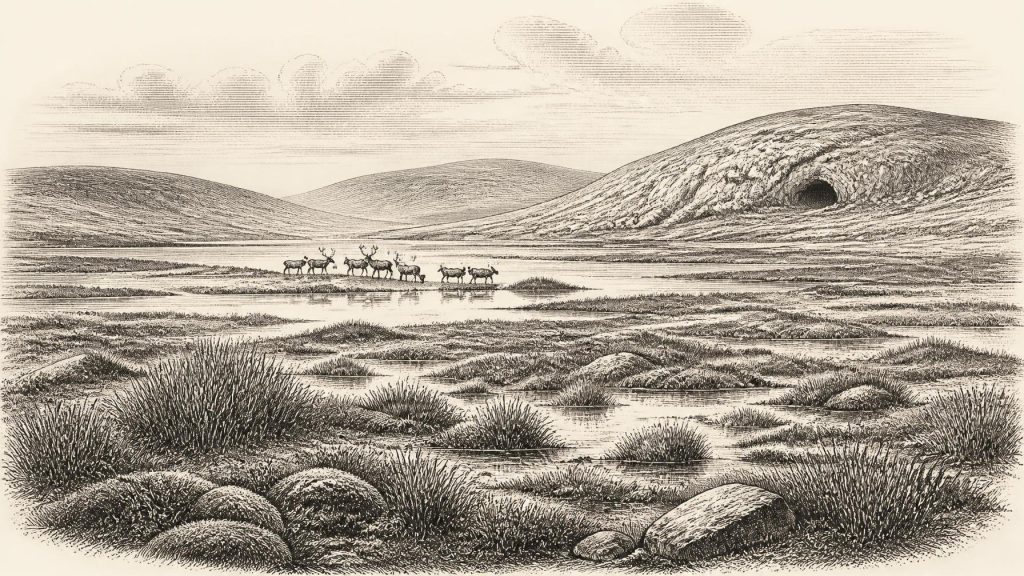
Rangifer at Mammoth Cave31158 BCE
31,158 BCE represents a broad Late Pleistocene, MIS 3 interval rather than a precise Irish year. Ireland experienced fluctuating cold conditions before the last British–Irish Ice Sheet maximum, with treeless wetlands, open vegetation and locally variable ice. Derryvree sediments and Crag Cave calcite document ice-free or less severe episodes. Castlepook Cave preserves a complex fauna including mammoth, giant deer, reindeer, lemmings, predators and hyenas, showing connections with wider European ecosystems. A reindeer femur bearing a possible stone-tool cut mark may indicate human carcass processing, but lacks secure archaeological context. Evidence supports intermittent habitation, not continuous settlement, society, or cultural reconstruction.
Dateline
The label 31,158 BCE does not identify a recoverable Irish “year” in the modern sense. No calendar, written testimony, settlement sequence or archaeological layer can be assigned to that precise point. In the conventional count from AD 1950 it falls roughly 33,100 calendar years before present, within the Late Pleistocene and Marine Isotope Stage 3 (MIS 3), an unstable part of the last glacial cycle. The responsible scale is therefore centuries and millennia. What can be described is an Ireland that, during parts of this broad interval, supported cold-adapted animals and was not yet engulfed by the maximum extent of the last British–Irish Ice Sheet.
There is one reason this date has unusual interest. A reindeer femur from Castlepook Cave, also known as Mammoth Cave, near Doneraile in north County Cork, has been presented as approximately 33,000 years old and as bearing a deep incision consistent with cutting by a sharp stone tool. If that interpretation is sustained, it may be evidence that a person handled a reindeer carcass in Ireland at roughly this time. It is an important possibility, not a complete history of an Irish population.
A Date Without a Diary
Modern calendar notation gives a deceptive appearance of precision. Radiocarbon determinations measure the remaining carbon isotope in once-living material; they must then be calibrated against changing atmospheric radiocarbon levels. Their results are ranges, and archaeological deposits can be mixed, redeposited or disturbed. A date such as 31,158 BCE is thus best used as a convenient point within a chronological window, not as the date of a hunt, migration or political event.
At Derryvree near Maguiresbridge, County Fermanagh, roadworks in 1969 exposed organic-rich freshwater silts and sands between two deposits of glacial till. The original radiocarbon result from the organic material, BIRM-166, was 30,500 radiocarbon years BP, with a substantial error range. The sediments have long been important because they show that an ice-free interval occurred between advances of glacier ice. Their pollen and plant macrofossils describe a treeless, wet, cold landscape rather than woodland. They cannot, however, be converted into a diary entry for 31,158 BCE, nor should they be treated as a complete picture of every Irish region at once.
Crag Cave in County Kerry provides a different kind of evidence. Uranium-series dating of broken and reworked cave calcite indicates episodes of speleothem growth during MIS 3. Since dripstone needs water moving through unfrozen ground and karst, its formation points to intervals less hostile to infiltration than a wholly frozen landscape. It does not mean that Ireland was warm, heavily wooded or continuously habitable; rather, it confirms climatic fluctuation within a generally cold age.
Before the Ice Sheet Maximum
Ireland was approaching, but had not yet reached, the last glacial maximum. The later British–Irish Ice Sheet attained its greatest known extent around 27,000 calendar years ago, with major ice retreat following thereafter. Around the broad time represented by 31,158 BCE, the island’s environments changed sharply as temperature, snowfall, permafrost and sea level responded to rapid North Atlantic climatic shifts. Ice may have occupied some upland or northern sectors at particular moments, while other areas remained open country. The surviving record is too fragmented to map an annual ice margin.
The Derryvree evidence is especially evocative: a freshwater, moss-rich wetland or muskeg developed in a depression later overridden or bordered by ice. Plants represented in the deposit include cold-tolerant mosses, sedges and aquatic species such as bogbean and water-milfoil, while herb pollen and dwarf-shrub indicators point to open ground. Such assemblages suggest patches of shallow water, saturated soil and low vegetation, not a blanket of forest. Seasonal thaw would have created muddy margins and standing water, while winter conditions could be severe.
That landscape should not be imagined as uniform tundra from Cork to Donegal. Ireland’s relief, limestone caves, river valleys, coasts and local snow accumulation created varied habitats. Nevertheless, the evidence favours a mostly treeless mosaic of herb-rich ground, wet hollows and exposed mineral soils in the better documented cold-stage settings. Lower global sea level altered the surrounding shelves and shorelines. Yet the exact configuration of land and sea between Ireland and Britain, and the route by which animals or any people entered, remain matters for reconstruction, not established facts for this date.
Castlepook’s Animal Archive
Castlepook Cave is the principal Irish archive for mammals living before the last glacial maximum. Excavations undertaken mainly in the early twentieth century recovered a very large, complex collection. It includes remains attributed to woolly mammoth, giant deer, reindeer, brown bear, wolf, fox, Arctic fox, mountain hare, Norwegian and collared lemmings, and spotted hyena. Direct dates from individual specimens and the association of bones with different deposits show that this is not a single momentary fauna. The cave accumulated material across a long period, through animal activity, natural deaths, water movement, sediment transport and excavation practices that predate modern recording standards.
Even with those cautions, the assemblage establishes an important regional fact: southern Ireland was reached, at intervals, by a broad cold-stage fauna. Reindeer and lemmings fit open, cold environments; mammoth and giant deer indicate that large herbivores could occupy or traverse parts of the island; wolves and hyenas reveal a predator and scavenger guild rather than an empty wilderness. A cave may exaggerate predators, because denning and scavenging animals bring bones into sheltered places, but it is still powerful evidence that Irish ecosystems were connected to wider north-west European faunal movements.
The spotted hyena is particularly striking. Castlepook is Ireland’s key locality for the species, and its bones and coprolites suggest that the cave was used within a carnivore landscape. Hyenas were not merely exotic visitors in a museum display: their presence helps explain why bone assemblages need taphonomic scrutiny. Tooth marks, breakage, trampling, water abrasion and human tool marks can all alter bone surfaces. Distinguishing them is central to the interpretation of the reindeer femur.
The Reindeer Femur Question
The marked reindeer bone is the closest evidence to human action currently relevant to this date. Its reported cut marks have been interpreted as fresh-bone butchery with a lithic edge. That conclusion, if confirmed, would push possible human activity in Ireland far earlier than the well-established post-glacial hunter-gatherer record. It would also place Ireland within the far western margins of Upper Palaeolithic movement at a time when Homo sapiens were widespread elsewhere in Europe.
But the limits are as important as the promise. The femur was recovered from an old cave collection, not from a newly excavated occupation floor with associated hearth, stone tools, food debris and securely recorded stratigraphy. No contemporary dwelling, burial, human remains or lithic assemblage has yet been recovered from Castlepook. Nor can one modified bone demonstrate whether visitors stayed for hours, days or seasons; whether they travelled as a family group, a hunting party or something else; or whether they returned. Current fieldwork at Castlepook is therefore rightly seeking undisturbed deposits, charcoal, lithics and further modified bone.
It is reasonable to say that reindeer meat, marrow, hide, sinew and antler would have been valuable to mobile foragers if people were present. It is not reasonable to turn that general possibility into a detailed Irish economy. There is no evidence here for farming, herding, long-distance trade networks, monuments, permanent villages, named communities or a language. The cave offers a possible trace of carcass processing, not proof of a settled society.
Society Beyond Recovery
Political affairs, diplomacy and organised conflict cannot be reconstructed for Ireland around this point. There are no chiefs, territories, alliances, forts or weapons assemblages known from the island that can responsibly be tied to 31,158 BCE. Likewise, religion and learning leave no identifiable Irish evidence of ritual places, burial practice, figurative art, oral tradition or teaching. It would be misleading to supply them from later Irish mythology or from famous Upper Palaeolithic sites elsewhere in Europe.
Comparative archaeology does offer a carefully limited frame. Human groups in Upper Palaeolithic Europe generally lived by hunting, gathering and extensive seasonal movement, relying on detailed environmental knowledge and social cooperation. Should the Castlepook cut-mark interpretation prove correct, any human presence in Ireland was likely small-scale and intermittent rather than the beginning of demonstrable continuous occupation. That is an inference from the scarcity and nature of the evidence, not a direct observation of a camp.
The most consequential development around 31,158 BCE is therefore neither a battle nor a ruler’s accession. It is the survival of clues: a wetland sealed beneath glacial sediments in Fermanagh, calcite in a Kerry cave, and a reindeer bone from north Cork that may preserve a human gesture. Together they show a changing, sometimes habitable Ice Age Ireland at the edge of Europe. They also demonstrate why prehistory requires restraint. The evidence makes the island’s deep past richer than an empty interval, but it does not yet make it a story of continuous settlement.
Primary Sources
- The Irish Quaternary Fauna Project
- New Insights on the Fauna of Ireland’s Younger Dryas and Early Holocene from Alice & Gwendoline Cave
- Castlepook Cave, County Geological Site Report
- Spotted Hyena Skull
- Heritage Artefacts of County Cork
- Archaeological Heritage of County Cork
- Archaeology Research Excavation Grant 2022: Castlepook Cave Project Report
- Archaeology Research Excavation Grant 2023: Castlepook Cave Project Report
- Castlepook Cave, Co. Cork: 2022 Excavation Report
- Palaeoecology: Field Guide 16
- Figure 6: The Subdivision of the Quaternary Period in Ireland
- A Middle Midlandian Freshwater Series at Derryvree, Maguiresbridge, County Fermanagh, Northern Ireland
- Trimlines, Blockfields and the Vertical Extent of the Last Ice Sheet in Southern Ireland
- Episodic Speleothem Deposition Tracks the Terrestrial Impact of Millennial-Scale Last Glacial Climate Variability in SW Ireland
- The Nature and Timing of MIS 3 Interstadials: New Constraints from U-Series Dated Speleothems from Crag Cave, S.W. Ireland
- Exploring Controls of the Early and Stepped Deglaciation on the Western Margin of the British Irish Ice Sheet
- Early Deglaciation of the British-Irish Ice Sheet on the Atlantic Shelf Northwest of Ireland Driven by Glacioisostatic Depression and High Relative Sea Level
- Pattern and Timing of Retreat of the Last British-Irish Ice Sheet
- Occurrence of Mammalia Relicts at Site Castlepook Cave
- Pleistocene Vertebrates in the British Isles