Castlepook’s Pre-Maximum Fauna31078 BCE
Around 31,078 BCE, Ireland lay within the volatile Midlandian cold stage, before the Last Glacial Maximum, rather than a datable historical year. Changing ice, sea levels and land connections created an environmentally varied, intermittently accessible landscape. Derryvree sediments in Fermanagh preserve evidence of treeless tundra wetland, including mosses, sedges and cold-adapted insects, during an ice-free interval. Castlepook Cave in Cork contains mammoth, reindeer, giant deer, predators and smaller mammals, documenting a diverse cold-stage fauna. A possibly cut-marked reindeer bone suggests fleeting Upper Palaeolithic human activity, but lacks secure context. No evidence supports permanent settlement, institutions or society; uncertainty remains essential.
Dateline
“31,078 BCE” is a modern label, not a date that anybody in Ireland could have known or recorded. There was no Irish calendar, writing, named ruler or annual chronicle at this depth of time. Nor can archaeology distinguish this particular modern year from the centuries on either side. In conventional archaeological terms, the label lies roughly 33,000 years before AD 1950, within the later part of the Pleistocene and before the fullest expansion of the Last Glacial Maximum. The responsible chronology is therefore expressed in broad, calibrated ranges and environmental phases, rather than as an event on a specific day or in a specific year.
A Cold Stage Before the Maximum
Ireland was then part of the wider north-west European world of Marine Isotope Stage 3, a long and climatically volatile portion of the last glacial cycle. The term “Midlandian” is often used for Ireland’s last cold stage. It should not conjure a simple image of an island permanently smothered in ice. Ice margins advanced and retreated over very long timescales; landscapes that were ice-covered in one phase could be open, frozen, waterlogged or sparsely vegetated in another. Around the notional date used here, the great late-glacial ice-sheet maximum still lay ahead. Reviews of the British–Irish Ice Sheet place its principal build-up after about 35,000–32,000 years ago and its maximum extent broadly between about 27,000 and 21,000 years ago.
This was nevertheless a severe environment. Temperatures, precipitation, sea level and the extent of seasonal frost changed repeatedly. Ireland’s present coastline did not exist: lower global sea levels exposed large areas of the continental shelf, while the Irish Sea basin and connections towards Britain altered as ice and water levels changed. Whether a particular route was dry, marshy, coastal, ice-blocked or navigable depended on the phase and locality. The evidence does not permit a map of travel routes for 31,078 BCE, but it does show that Ireland was not biologically sealed off from neighbouring lands throughout the period. Mammals reached the island during pre-maximum intervals, almost certainly through changing land and coastal connections.
Derryvree’s Buried Waters
The clearest environmental evidence close to this broad period comes from Derryvree near Maguiresbridge, County Fermanagh. There, organic-rich freshwater sediments were preserved between two beds of glacial till. The sequence matters because the lower till records an earlier ice advance; the organic layers record a subsequent interval in which open water, wet ground and living plants existed at the site; and the upper till records later overriding or renewed glacial conditions. A radiocarbon determination from the organic material was reported as 30,500 radiocarbon years BP, with an uncertainty of roughly a millennium. Such a result is not equivalent to a single calendar year: calibration and the statistical range place it within a substantially broader span of calendar time.
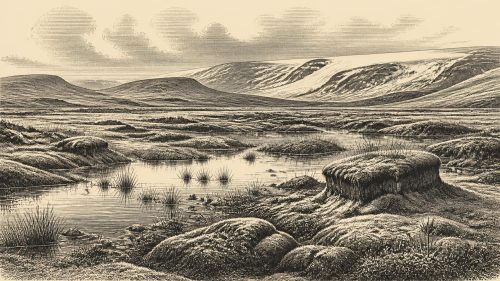
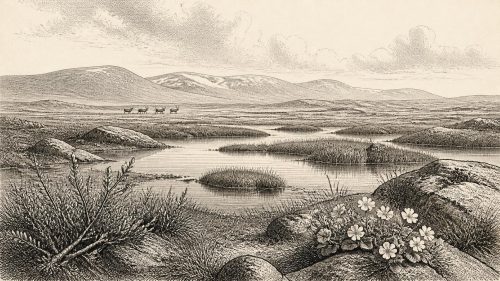
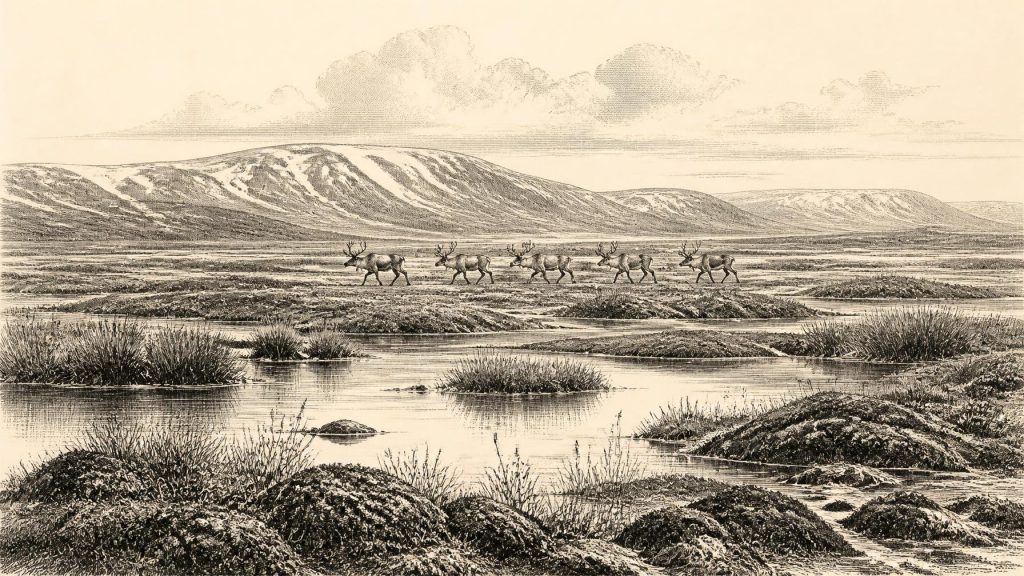
The Derryvree deposits contain freshwater mosses and sedges, together with plant remains and insects of cold northern character. These are direct traces of organisms that lived in or beside a wetland. They support a reconstruction of a treeless, open, cold landscape with freshwater pools, sedgy margins and patches of mossy ground, sometimes described as muskeg or tundra wetland. That reconstruction is an interpretation, not a photograph of all Ireland. A buried Fermanagh basin cannot prove that every county was ice-free, equally wet or identical in vegetation. It does, however, decisively complicate the idea of a uniformly frozen island and shows that habitable ecological niches existed between major glacial episodes.
Plant evidence also establishes what was absent as well as what was present. There is no basis for imagining the wooded Ireland of later millennia, fields, hedges or agricultural clearances. Trees were extremely restricted or absent locally; low-growing herbs, grasses, sedges, dwarf shrubs, mosses and aquatic plants were better suited to the conditions. The productive parts of such country would have been unevenly distributed: sheltered slopes, river corridors, spring-fed ground and shallow lakes could offer food and cover where exposed ridges and wind-scoured ground did not. Seasonality would have been decisive, although no Irish deposit can reconstruct the weather of a particular winter or summer at this date.
Castlepook and the Animal World
At the opposite end of the island, Castlepook Cave—also called Mammoth Cave—near Doneraile in north County Cork provides the most important Irish faunal archive for the period leading towards the Last Glacial Maximum. Excavations undertaken in the early twentieth century recovered a large collection later transferred to the National Museum of Ireland. Its contents include remains of woolly mammoth, reindeer, giant deer, brown bear, wolf, fox, mountain hare, lemmings and spotted hyaena. Individual bones and deposits have different histories and dates; the assemblage is not a single moment frozen in time. Yet taken together, it demonstrates that Ireland supported, or was repeatedly visited by, a notably diverse cold-stage mammal community between approximately 45,000 and 30,000 years ago.
That community was not a peaceful pastoral scene. Reindeer and other herbivores were potential prey for carnivores as well as scavengers. Spotted hyaenas, now absent from both Ireland and Europe, are especially significant. Their remains indicate that the cave system formed part of a predator-and-scavenger landscape, in which bones could be accumulated, moved, gnawed, broken and mixed by animals, water, frost and cave collapse. This is why cave bone requires careful taphonomic study. A damaged surface may result from carnivore activity, trampling, weathering, excavation or museum handling; it cannot automatically be treated as evidence of people.
One reindeer femur from the old Castlepook collection has made the human question unusually prominent. It has been publicly presented by zooarchaeologist Ruth Carden as bearing a deep mark consistent with cutting or chopping by a sharp stone edge while the bone was fresh, and it has been associated with an age of about 33,000 years. If the mark is confirmed as anthropogenic, it would indicate that people handled a reindeer carcass in Ireland during the Upper Palaeolithic, far earlier than the island’s once accepted post-glacial archaeological beginning. It would be a major discovery. It would not, however, establish a permanent population, a village, an ethnic group, a named migration or an event precisely in 31,078 BCE.
The limits are crucial. The femur derives from an antiquarian cave collection rather than a modernly excavated occupation floor with an unbroken stratigraphic record. No securely associated stone-tool assemblage, hearth, shelter, human burial, ornament or repeated butchery surface has yet been published for this proposed early episode. A radiocarbon result dates the animal’s death, while identifying a cut mark is a separate judgement about how the surface was modified. Recent excavation at Castlepook has sought surviving undisturbed deposits and has confirmed the continuing research value of the cave, but it cannot retrospectively supply all the contextual information lost during older investigations.
People: Possibility, Not Population
Accordingly, a cautious account of society must begin with absence. There is no evidence for Irish political institutions, chiefs, borders, diplomacy, organised warfare, ritual sites, language, art or formal learning at this date. There is no demonstrable settlement pattern, economy of exchange, or enduring community from which social ranks or family organisation can responsibly be inferred. To describe “Irish tribes” confronting one another would be invention. The word Ireland is used only for the geographical area occupied by the modern island, not for a political or cultural entity that then existed.
If people did reach Castlepook or other Irish localities in this phase, the most defensible interpretation is brief activity by highly mobile Upper Palaeolithic hunter-gatherers. Comparable groups elsewhere in north-west Europe knew fire, sophisticated stone technologies, animal skins, seasonal movement and wide social connections. But those wider comparisons describe possibilities, not demonstrated Irish practice. Even the marked femur would not tell us whether a reindeer was hunted, scavenged after a carnivore kill, or processed somewhere else before the bone entered the cave. Meat, fat, hide, sinew, bone and antler could all have been useful, but no securely contextualised Irish evidence shows how such resources were shared, transported or worked.
Landscape as Historical Force
The strongest historical development around this notional year was therefore environmental rather than political. The approach of the Last Glacial Maximum was reshaping the opportunities available to every living thing. Wetlands such as Derryvree reveal local freshwater life during an ice-free interval; Castlepook records a broader animal world capable of reaching and exploiting the island; subsequent ice advances would erode, bury and fragment much of the evidence. This destruction helps explain why the record of any possible human visits is so thin. The absence of camps is meaningful, but it is not identical to proof that no person ever stood in Ireland before the maximum.
For 31,078 BCE, then, the appropriate history is one of calibrated uncertainty. Ireland was a cold, unstable and regionally varied land on the threshold of more extensive glaciation. Its surviving archives preserve sedges, mosses, insects, freshwater muds and animal bones rather than rulers or battles. They show an ecological frontier occupied by cold-adapted plants and mammals, with a tantalising but unconfirmed indication that people may have entered it. That distinction between what the deposits demonstrate and what they merely allow us to imagine is the essential discipline of Ireland’s deepest past.
Primary Sources
- A Middle Midlandian Fresh-Water Series at Derryvree, Maguiresbridge, County Fermanagh, Northern Ireland
- Early Midlandian–Middle Midlandian, Pleistocene, Northern Ireland
- Figure 6.— The Subdivision of the Quaternary Period in Ireland
- The Irish Quaternary Fauna Project
- Irish Pleistocene Biostratigraphy
- Freshwater Organic Deposits and Stratified Sediments Between Early and Late Midlandian (Devensian) Till Sheets, at Aghnadarragh, County Antrim, Northern Ireland
- Middle Midlandian Interstadial Deposits at Greenagho, Near Belcoo, County Fermanagh, Northern Ireland
- Spotted Hyena Skull
- 2022:564 – Castlepook Cave, Castlepook South, Cork
- Extent and Timing of the Last Glacial Maximum (LGM) in Britain and Ireland: A Review
- Last Glacial Maximum Cirque Glaciation in Ireland and Implications for Reconstructions of the Irish Ice Sheet
- Early Deglaciation of Western Ireland: Implications for the Last Irish Ice Sheet
- Deglaciation Chronology of the Donegal Ice Centre, North-West Ireland
- Dimensions and Chronology of the Last Ice Sheet in Western Ireland
- The Colonization of Ireland: A Human Ecology Perspective
- First Evidence of a Late Upper Palaeolithic Human Presence in Ireland
- New Insights on the Fauna of Ireland’s Younger Dryas and Early Holocene from Alice & Gwendoline Cave
- Red Deer (Cervus elaphus) in Ireland: A Biogeographical and Phylogeographical Perspective
- The IntCal20 Northern Hemisphere Radiocarbon Age Calibration Curve (0–55 cal kBP)
- A Stratigraphic Framework for Abrupt Climatic Changes During the Last Glacial Period Based on Three Synchronized Greenland Ice-Core Records: Refining and Extending the INTIMATE Event Stratigraphy
- Quaternary Sediments 1:50,000 Map Viewer
- The Quaternary of Western Ireland