Derryvree Intertill Sequence31067 BCE
Around 31,067 BCE, Ireland lay within the climatically unstable Late Pleistocene. Derryvree, County Fermanagh, preserves freshwater silts between glacial tills, dated broadly to 36,900–31,700 calibrated years BP. These reveal locally ice-free, treeless tundra wetlands with mosses, sedges, insects and shallow pools before renewed glaciation. Castlepook Cave, County Cork, contains accumulated remains of mammoth, reindeer, giant deer, bear and hyaena, but does not represent a single moment. A possibly cut-marked reindeer bone suggests, without proving, human activity. No securely dated settlements or political, cultural or economic institutions are known. The evidence instead records changing habitats, mobile fauna and uncertain human presence.

Dateline
“31,067 BCE” is a modern calendar label, not a year for which Ireland preserves an event, a ruler, a settlement diary or even a season-specific archaeological horizon. There is no year-zero in the BCE/CE system, and the label corresponds roughly to 33,016 calendar years before AD 1950. At that depth of time, responsible dating is expressed in ranges. The most useful Irish evidence places this notional year within the Late Pleistocene, in Marine Isotope Stage 3 (MIS 3), a climatically unstable part of the last Ice Age. What can be written is therefore an account of an interval and its evidence, not an annual chronicle.
A Date Within a Broad Range
The closest and most revealing Irish archive is Derryvree townland, near Maguiresbridge in County Fermanagh. Roadworks in 1969 cut through a drumlin and exposed an exceptional sequence: freshwater silts and fine sands, including organic material, trapped between two thick deposits of glacial till. The order of those layers is fundamental. An earlier glacier had laid down the lower till; afterwards, at least locally, ice-free conditions allowed water, sediment, plants and insects to accumulate; then a later glacial advance buried the wetland beneath a second till sheet.
Organic material from the Derryvree deposit returned a conventional radiocarbon determination of 30,500 years BP, with a substantial uncertainty of +1,170 and –1,030 years. Radiocarbon years are not calendar years. Atmospheric carbon-14 has varied through time, so results must be calibrated against independently dated records. Later work places the Derryvree evidence broadly at about 36,900–31,700 calibrated years BP, or approximately 34,950–29,750 BCE. The date 31,067 BCE falls inside that span, but it cannot be attached to a particular plant, animal, pool or human action in the sediment. It is best understood as a point within a long environmental window.
Fresh Water Between Glacial Episodes
Derryvree matters because it shows that south Fermanagh was not continuously smothered by glacier ice during this part of the last glacial cycle. It does not demonstrate that the whole island was ice-free at the same moment. Ireland’s ice cover was dynamic, with regional advances and retreats shaped by terrain, snowfall, temperature, sea level and the interaction of Irish and British ice masses. The freshwater deposit instead records a local landscape that existed between episodes of glaciation and was subsequently sealed from view by the returning ice.
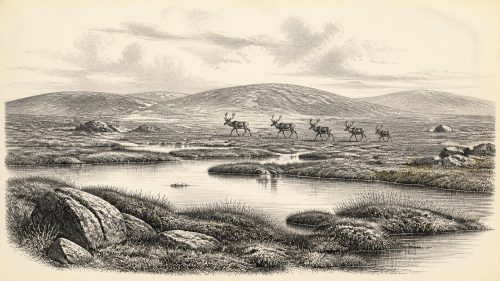
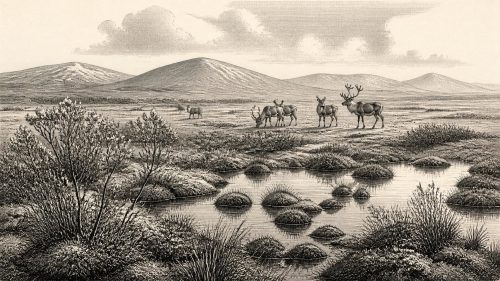
The plant and animal remains recovered from the silts point to open tundra and a severe periglacial regime. Periglacial does not mean a simple, lifeless frozen desert. It describes ground and ecosystems affected by intense cold, seasonal thaw and frost action beyond the immediate edge of ice. The Derryvree assemblage indicates wet ground, moss-rich vegetation, sedges and shallow water in an otherwise treeless country. Plants associated with the deposit include aquatic and wetland species, while the wider assemblage suggests an intricate patchwork of open pools, marshy ground and sparsely vegetated surfaces. Summer thaw could create biologically productive pockets even where winters were long and harsh.
This was not the familiar green Ireland of later prehistory, nor a landscape of oak woods, fields or permanent villages. Woodland of the later Holocene kind had no place in the evidence from Derryvree. Instead, the country around the freshwater basin was likely exposed, wind-swept and variable at short distances: wet hollows beside drier mineral ground, stretches of moss and sedge beside bare or thinly vegetated surfaces, and perhaps sheltered sites where snow lingered. Such habitat diversity helps explain how cold-adapted plants, insects and grazing animals could use parts of an otherwise demanding landscape.
Animals and the Cave Record
County Cork provides a second, different kind of evidence. Castlepook Cave, also called Mammoth Cave or Doneraile Cave, lies in limestone country near Doneraile. It is Ireland’s richest known repository of vertebrate remains from the period leading up to the Last Glacial Maximum. More than 2,000 bones have been recovered there, representing a long and complicated accumulation rather than one occupation episode. The cave’s Ice Age fauna includes woolly mammoth, giant deer, reindeer, brown bear and spotted hyaena; later material includes lemmings, Arctic fox and wolf.
These remains demonstrate that Ireland, or at least accessible parts of it over the wider period, could support a striking cold-climate fauna. Yet the cave should not be treated as a photograph of 31,067 BCE. Bones from different millennia accumulated in different chambers and circumstances. Water movement disturbed deposits, while spotted hyaenas may themselves have transported or modified carcasses. Castlepook is decisive evidence for the presence of particular animals across a long interval, but it cannot show that mammoths, hyaenas, reindeer and people all met in the cave on one occasion. Taphonomy—the study of what happened to remains between death, burial and excavation—is central to reading the site honestly.
Reindeer are especially important to the history of this date because a femur fragment from Castlepook has been reported as bearing marks consistent with cutting by a stone tool and has been dated to roughly 33,000 years ago. If the marks are confirmed as anthropogenic, the bone would suggest that people processed a reindeer carcass in Ireland in the broad period relevant here. It would be an extraordinary discovery. But the find comes from an old cave collection rather than a newly excavated, securely associated occupation floor. It is not accompanied by an unequivocal hearth, dwelling, stone-tool assemblage or cemetery. The proper conclusion remains careful: possible human activity, not proof of a settled population.
The Human Question
There is no securely dated settlement in Ireland from around 31,067 BCE. No house plan, hearth, rubbish pit, burial, workshop, harbour or durable route can be assigned to this calendar label. Nor is there evidence for an Irish population continuous from this time into later prehistory. The subsequently advancing Irish Ice Sheet would have eroded, displaced and buried much of the earlier landscape; later sea-level rise also drowned former coastal terrain where evidence of short-lived visits might once have survived. These processes help explain the poverty of the record, but they cannot turn absence into proof of occupation.
Across north-west Europe, Homo sapiens communities were making Upper Palaeolithic technologies, hunting and gathering in environments shaped by sharp climatic change. Ireland lay at the far Atlantic margin of that wider world. Lower sea levels altered the geography of the surrounding seas and may have changed routes of access, but they did not automatically create a simple, dependable land bridge or establish that people crossed it. If people reached Ireland in this period, the available evidence is more compatible with small, mobile groups making brief, opportunistic incursions than with year-round communities. That is an interpretation from the scarcity and character of the finds, not a directly observed social fact.
No Politics, No Proven Diplomacy
Political affairs cannot responsibly be reconstructed for Ireland at this time. There are no named peoples, chiefs, territories, laws, alliances or conflicts in the evidence. Even the existence of a local human group remains unproven. It would be misleading to describe mammoth hunting as warfare, animal movement as trade, or crossings of the sea as diplomacy. The scale of the evidence does permit one modest inference: any people who did enter such a cold and uncertain landscape would have required extensive practical knowledge of weather, animal behaviour, tool maintenance, clothing and movement. That is a general inference from comparable Upper Palaeolithic lifeways, not knowledge of a particular Irish community.
The same restraint is necessary for religion, culture and learning. No art, ornament, musical instrument, grave, shrine or symbolic object from Ireland can be dated to around 31,067 BCE. The potential cut-marked reindeer bone concerns carcass processing, not belief. Nor can language, kinship, gender roles or ritual be recovered from Derryvree’s plants and insects. Their absence from this article is not a gap to be filled with imaginative reconstruction; it is the principal fact about the surviving Irish record.
Economy Without a Market
There is likewise no evidence for farming, herding, metalworking, exchange networks or permanent trade at this point. If humans were present, their subsistence would most plausibly have depended on foraging, hunting and scavenging within a highly seasonal environment, perhaps including the use of reindeer and other large animals where opportunity allowed. But no excavated Irish assemblage identifies their food range, hunting methods, tool kit or seasonal round. The strongest economic story is ecological rather than commercial: wetland plants and insects occupied a short-lived refuge; herbivores moved through available habitats; predators and scavengers followed animal resources; and ice later transformed the setting.
Regional change gives that story its force. In Fermanagh, Derryvree records freshwater conditions in a drumlin landscape. In Cork, Castlepook preserves a cave archive of animal bones accumulated over tens of thousands of years. Offshore and western Irish evidence shows that ice margins could fluctuate markedly before the formal Last Glacial Maximum, which reached its greatest extent later. Ireland around this date was not a uniform white blank, but neither was it a stable habitable island. It was a changing mosaic whose best records survive in exceptional sediment traps and caves.
The most important development around 31,067 BCE was therefore neither a battle nor a dynasty, but the precarious existence of an open, wet tundra landscape before renewed glaciation. Derryvree’s silts preserve a rare interval when freshwater life persisted between two episodes of ice. Castlepook’s bones show that large Ice Age mammals belonged to the island’s wider ecological history and raise, without yet settling, the possibility of a human encounter with that world. The evidence is fragmentary, but it is enough to replace the idea of an empty prehistoric void with a more accurate one: an Ireland of cold water, tundra vegetation, mobile animals, uncertain human presence and deep chronological caution.
Primary Sources
- A Middle Midlandian Freshwater Series at Derryvree, Maguiresbridge, County Fermanagh, Northern Ireland
- A Middle Midlandian Freshwater Series at Derryvree, Maguiresbridge, County Fermanagh, Northern Ireland
- Castlepook Cave: County Geological Site Report
- The Irish Quaternary Fauna Project
- The Irish Quaternary Fauna Project
- Radiocarbon Constraints on the History of the Western Irish Ice Sheet Prior to the Last Glacial Maximum
- Radiocarbon Constraints on the History of the Western Irish Ice Sheet Prior to the Last Glacial Maximum
- Episodic Speleothem Deposition Tracks the Terrestrial Impact of Millennial-Scale Last Glacial Climate Variability in SW Ireland
- Episodic Speleothem Deposition Tracks the Terrestrial Impact of Millennial-Scale Last Glacial Climate Variability in SW Ireland
- Growth and Retreat of the Last British–Irish Ice Sheet, 31,000 to 15,000 Years Ago: The BRITICE-CHRONO Reconstruction
- Growth and Retreat of the Last British–Irish Ice Sheet, 31,000 to 15,000 Years Ago: The BRITICE-CHRONO Reconstruction
- The Deglaciation of the Western Sector of the Irish Ice Sheet from the Inner Continental Shelf to Its Terrestrial Margin
- Timing and Pace of Ice-Sheet Withdrawal Across the Marine–Terrestrial Transition West of Ireland During the Last Glaciation
- Dimensions and Chronology of the Last Ice Sheet in Western Ireland
- Trimlines, Blockfields and the Vertical Extent of the Last Ice Sheet in Southern Ireland
- The IntCal20 Northern Hemisphere Radiocarbon Age Calibration Curve (0–55 cal kBP)
- The IntCal20 Northern Hemisphere Radiocarbon Age Calibration Curve (0–55 cal kBP)
- IntCal: International Radiocarbon Calibration
- Archaeology Research Excavation Grant 2022: Final Report
- UCD School of Archaeology Research Day 2022
- Mammoth Cave
- The Mammoth Caves of Castlepook, Near Doneraile
- Palaeoecology: Irish Quaternary Association Field Guide
- Revealing the Past 2023: In Search of the Elusive Palaeolithic in Ireland
- Ireland’s Palaeolithic Archaeology: Fleeting Footprints in a Frozen Land