
Derryvree’s Ice-Age Fen31038 BCE
Around 31,038 BCE, Ireland lay within the unstable cold conditions of Marine Isotope Stage 3, not a documented historical year. At Derryvree, County Fermanagh, freshwater silts between glacial tills, dated broadly to 36,900–31,700 calibrated years ago, preserve evidence of tundra-like wetland: mosses, sedges, aquatic plants and low shrubs. Castlepook Cave, County Cork, yielded fauna including mammoth, reindeer, giant deer, hyena and Arctic fox, indicating productive open habitats. A marked reindeer femur may record stone-tool butchery, but cannot prove settlement. Advancing ice later reshaped Ireland, leaving fragmentary environmental archives rather than evidence of society or politics before the Last Glacial Maximum.
Dateline
The label 31,038 BCE is a modern chronological convenience, not a date that can be matched to an Irish event, ruler, journey or settlement. No written record exists, and archaeological science cannot identify what happened in one particular calendar year so far back in the Late Pleistocene. The responsible approach is to place this nominal year within broad calibrated ranges and ask what deposits, fossils and landscapes can illuminate Ireland around it. The most useful evidence comes from Derryvree near Maguiresbridge in County Fermanagh, and from the cave-fauna assemblage at Castlepook near Doneraile in County Cork.
In calendar terms, 31,038 BCE falls roughly 33,000 years before present. It lies within Marine Isotope Stage 3, an unstable late-Ice-Age interval before the Last Glacial Maximum, when climate and ice margins altered repeatedly. Ireland was not a recognisable political country, nor a land of fixed borders or named peoples. Its history at this point is primarily environmental: a history of glaciers, sediment, freshwater, vegetation and animals, with only a tantalising and contested possibility of human activity.
A Date Within a Range
Derryvree provides the closest important chronological anchor. Roadworks in 1969 cut through a drumlin and exposed organic freshwater silts and fine sands trapped between two layers of till, the unsorted debris left by moving ice. The sequence matters as much as its contents. It shows that glacier ice had affected the place, that a period followed in which water and living things could occupy the site, and that renewed glaciation later sealed the deposit. This was not a continuously frozen, lifeless landscape.
Organic material from the Derryvree layer returned a conventional radiocarbon age of about 30,500 years before present, with a large uncertainty. Radiocarbon years are not calendar years: fluctuations in atmospheric carbon-14 must be corrected through calibration. Later discussion places the deposit broadly at approximately 36,900–31,700 calibrated years before present, or about 34,950–29,750 BCE. The nominal year 31,038 BCE therefore sits within the wide calendar span that Derryvree can reasonably illuminate, but cannot be assigned to a particular sediment lens, season or generation.
That limitation is central rather than disappointing. The Derryvree bed cannot tell us that a particular plant flowered, animal drank, or person travelled there in 31,038 BCE. It can show that, during a broad interval encompassing that date, part of Fermanagh supported a freshwater wetland in a severe periglacial setting between episodes of local ice cover. It is an archive of conditions and change, not an annual chronicle.
Wet Ground in a Cold Land
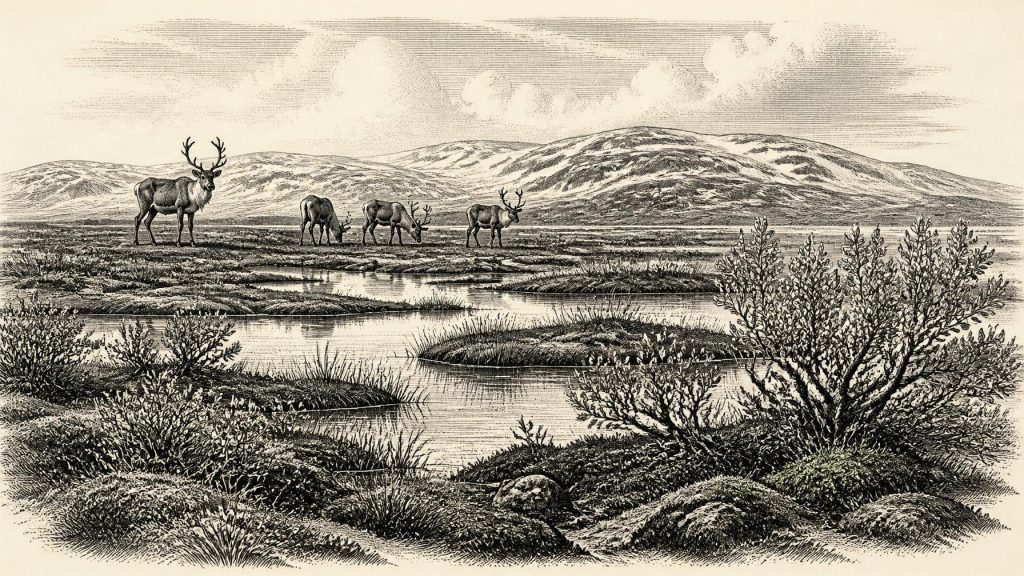
The fossil evidence from Derryvree points to open tundra or muskeg: waterlogged, mossy ground with pools, sedges, grasses, herbs and low-growing shrubs rather than closed woodland. Pollen was poorly preserved, but plant macrofossils were more revealing. Mosses and cold-adapted species, including mountain-avens, dwarf willow, bogbean and aquatic plants, indicate that the basin held standing or slow-moving freshwater and supported vegetation despite harsh conditions. Such a place should not be imagined as a modern Irish bog transported unchanged into the Ice Age. It was a cold, exposed mosaic of wet ground, shallow pools, mossy surfaces and sparsely vegetated terrain affected by frost.
Seasonality was likely pronounced. Long, cold winters, repeated freezing and thawing, short growing seasons and strong winds would have limited tree growth. Yet the surviving plant record makes clear that the landscape was biologically active. Invertebrate evidence supports the same broad interpretation of damp, plant-rich ground with open water. The wider terrain may have appeared austere to modern eyes, but it contained local refuges where moisture, soils and low vegetation sustained life.
Regional variation must nevertheless be respected. Derryvree was one locality in what is now Northern Ireland, not a thermometer for the whole island. Coastal, upland and inland areas could differ markedly in exposure, drainage and proximity to ice. Ice-sheet reconstructions show major uncertainty at the beginning of this period; they suggest early centres of ice accumulation in northern Ireland and elsewhere across Britain and Ireland, while the fullest expansion lay ahead. The Irish landscape around this horizon was changing quickly enough that a single uniform map would mislead.
Castlepook’s Animal World
For the animal life of the wider period, Castlepook Cave in north County Cork is indispensable. Antiquarian excavations there recovered remains attributed to woolly mammoth, reindeer, giant deer, brown bear, Arctic fox, wolf, mountain hare, lemmings and spotted hyena. Re-dating has shown that some bones once treated as comparatively recent are considerably older, placing important parts of the assemblage in Marine Isotope Stage 3, before the Last Glacial Maximum. Mammoth and hyena material has produced ages in the broad vicinity of the mid-thirties of thousands of radiocarbon years before present.
The cave is not a neatly sealed snapshot. Bones were accumulated through more than one process: carnivores dragged in carcass parts; animals died or sheltered in the cave; water moved material; and early excavations disturbed context. Individual specimens need not be contemporary. The assemblage nevertheless establishes an important fact: Ireland intermittently formed part of a north-west European cold-stage animal world capable of supporting large herbivores and formidable scavenging predators.
Spotted hyenas are especially revealing. A cave rich in chewed and fragmented bones is more likely to record a carnivore den or scavenging place than an undisturbed human camp. Mammoths and giant deer need not have been hunted by any people who may have been present; carnivores, natural death and later transport all offer explanations for bones in a cave. Reindeer, however, are well suited to cold open country, and their presence accords with the Derryvree picture of treeless, productive tundra-like habitats.
The Human Question
A reindeer femur from Castlepook has transformed discussion of this period. The bone has been publicised as approximately 31,000 BCE and carries a deep linear mark interpreted by zooarchaeologist Ruth Carden as a fresh-bone cut or chop made with a sharp stone tool during carcass processing. If that interpretation is confirmed, it would be remarkably early evidence that a person handled a reindeer in Ireland during the Upper Palaeolithic.
But the wording must remain conditional. A radiocarbon measurement dates the death of the animal, not automatically the moment at which a mark was made. Identifying a humanly made cut also requires taphonomic judgement, distinguishing tool damage from breakage, carnivore action and other alterations. Moreover, the femur derives from an old cave collection rather than a modern excavation of an intact occupation surface. No associated hearth, stone-tool assemblage, dwelling, burial, repeated food-processing area or securely dated camp of this age has been recovered in Ireland.
The most cautious conclusion is therefore modest but significant: the specimen is proposed evidence for a brief human encounter with a reindeer, not proof of a settled population. It cannot tell us whether people lived nearby, arrived on a short hunting expedition, scavenged an animal, or crossed the region only once. It does not establish a tribe, language, ancestry, seasonal round or population size. The later, securely evidenced human record in Ireland should not be projected backwards onto this much earlier and far less certain horizon.
Society Beyond the Evidence
There is no direct evidence for political affairs, diplomacy, formal leadership, warfare, religion, ritual, art, teaching or trade in Ireland around this nominal year. It would be misleading to invent them. If people did visit, comparisons with Upper Palaeolithic groups elsewhere in north-west Europe suggest that they would have relied on close social cooperation, portable possessions and practical knowledge of animals, weather and terrain. That is an inference from broader European archaeology, not an Irish fact demonstrated by Derryvree or Castlepook.
The same distinction applies to economy. A possible butchered reindeer bone could indicate the extraction of meat, hide, sinew, marrow or other useful material, but it cannot specify which resources were taken or how they were shared. There is no evidence for farming, herding, permanent villages, markets, long-distance exchange, boats or organised trade. Nor can we safely describe routes between Ireland and Britain. Lower sea levels altered coastlines, but the evidence discussed here does not document a particular crossing or connection.
What can be stated with confidence is that survival, whether of animals or of any small visiting human group, depended on responding to rapid environmental change. Freshwater basins such as Derryvree offered plant and invertebrate habitats; open terrain could sustain grazing animals; limestone caves could become shelters, traps, dens and long-term bone archives. These were ecological opportunities, but also vulnerable places as cold intensified and ice advanced.
Approaching the Great Ice
The great historical development around 31,038 BCE was not a battle or a dynasty but the approach of more extensive glaciation. Later ice sheets eroded, buried and rearranged much of Ireland’s older landscape, which is one reason evidence for this interval is so fragmentary. Derryvree survived precisely because its organic sediments were protected beneath later glacial deposits. Castlepook survived because caves can preserve bones where open-air sites are lost.
Ireland at this point was neither an empty white wilderness nor a settled homeland known to history. It was a variable cold-stage landscape, locally wet and vegetated, visited by an unusual mixture of herbivores and predators. Its human story remains an open question centred on one exceptional reindeer bone. Its environmental story is firmer: mosses, sedges, shallow water, reindeer, carnivores and advancing ice together mark a precarious interval before the island was profoundly reshaped by the Last Glacial Maximum.
Primary Sources
- A Middle Midlandian Freshwater Series at Derryvree, Maguiresbridge, County Fermanagh, Northern Ireland
- Palaeoecology: The Middle Midlandian Palaeoenvironment of South Fermanagh
- Growth and Retreat of the Last British–Irish Ice Sheet, 31,000 to 15,000 Years Ago: The BRITICE-CHRONO Reconstruction
- A Reconsideration of the Radiocarbon Dating of the Marine Isotope Stage 3 Fauna from Southern Ireland
- The Irish Quaternary Fauna Project
- The Exploration of Castlepook Cave, County Cork
- Occurrence of Mammalia Relicts at Site Castlepook Cave
- Heritage Artefacts of County Cork 2021
- Castlepook Cave, Castlepook South, County Cork: Excavation Report 2022
- New Insights on the Fauna of Ireland’s Younger Dryas and Early Holocene from Alice & Gwendoline Cave
- The Colonization of Ireland: A Human Ecology Perspective
- The IntCal20 Northern Hemisphere Radiocarbon Age Calibration Curve (0–55 cal kBP)
- Irish Pleistocene Biostratigraphy
- The Deglaciation of the Western Sector of the Irish Ice Sheet from the Inner Continental Shelf to its Terrestrial Margin
- Trimlines, Blockfields and the Vertical Extent of the Last Ice Sheet in Southern Ireland
- Advance and Retreat of the Marine-Terminating Irish Sea Ice Stream into the Celtic Sea During the Last Glacial: Timing and Maximum Extent
- Pleistocene Vertebrates in the British Isles
- Proceedings of the Postglacial Colonisation Conference
- Soils of County Waterford
- Figure 6: The Subdivision of the Quaternary Period in Ireland