
Cork’s Reindeer Before Maximum31039 BCE
Around 31,039 BCE, Ireland’s past can only be reconstructed broadly within the unstable Late Pleistocene Marine Isotope Stage 3, not assigned to a precise year. Derryvree, County Fermanagh, preserves a freshwater interval between glacial advances, dated broadly to 36,900–31,700 calibrated years BP, indicating cold, open tundra-like wetlands. Castlepook Cave, County Cork, contains reindeer, mammoth, giant deer and carnivore remains accumulated over multiple episodes, demonstrating changing ecological links with Britain and Europe. A possibly cut-marked reindeer femur suggests, but cannot prove, early human activity. No secure evidence exists for settlement, society, economy or ritual; later ice destroyed or obscured much evidence.
Dateline
The modern label 31,039 BCE should not be mistaken for an ancient Irish calendar date. No written chronology, annual layer sequence or securely datable human occupation lets historians identify an event in that particular year. It is more responsible to place the notional date within the later part of Marine Isotope Stage 3, a climatically unstable interval of the Late Pleistocene. The relevant Irish evidence is dated in broad radiocarbon and calibrated ranges, often with large uncertainties. It illuminates environments and animal communities over centuries or millennia, not named people, seasonal journeys or a single year.
Dating A Vanished Landscape
At this depth of time, the distinction between radiocarbon years and calendar years is essential. Radiocarbon ages measure the remaining carbon-14 in once-living material; they must be calibrated against independently dated records because atmospheric carbon-14 has varied. A reported age of 30,500 radiocarbon years before present, for example, cannot simply be converted by subtracting from 1950. Calibration produces a probability range rather than a precise historical year. The requested date lies broadly within the chronological territory of several Irish Late Pleistocene archives, but it cannot be attached to a particular stratum, animal death or human action.
Ireland was then part of the wider north-west European world, not yet the familiar island of later history. Sea level was substantially lower than today, and the shape of coastlines, river valleys and connections to Britain altered repeatedly as ice sheets and oceans changed. Yet a lower sea level did not automatically make travel easy. Routes could have involved exposed plains, river systems, sea crossings, ice margins and terrain subject to severe weather. The evidence does not allow a map of a dependable route into Ireland at this particular point.
The period came before the peak of the Last Glacial Maximum, when the British–Irish Ice Sheet reached its greatest known extent in the later interval, broadly around 27,000 to 23,000 calibrated years before present in many reconstructions. That does not mean that Ireland at c. 33,000 years ago was mild or uniformly ice-free. Ice extent changed regionally; cold, snow, permafrost-like ground conditions and glaciers shaped different districts in different ways. Later ice also eroded, buried and rearranged much of the older archaeological landscape.
Derryvree’s Freshwater Interval
The strongest environmental evidence relevant to this broad date comes from Derryvree near Maguiresbridge, County Fermanagh. Road works in 1969 exposed freshwater silts and fine sands enclosed between two thick till sheets in a drumlin. Till is debris laid down by glacier ice. The sequence therefore establishes an important relative order: glacial conditions had affected the locality, a freshwater environment developed there, and renewed ice later sealed the deposit beneath further till. It is a record of environmental change, not a settlement layer.
Organic material from Derryvree yielded a conventional radiocarbon determination of 30,500 +1,170/−1,030 years BP. Calibrated estimates place the deposit broadly in a range of roughly 36,900 to 31,700 calibrated years BP. That broad span overlaps the notional era represented by 31,039 BCE. It cannot, however, establish that the wetland existed in precisely that numbered year, nor prove that conditions in Fermanagh were duplicated throughout Ireland.
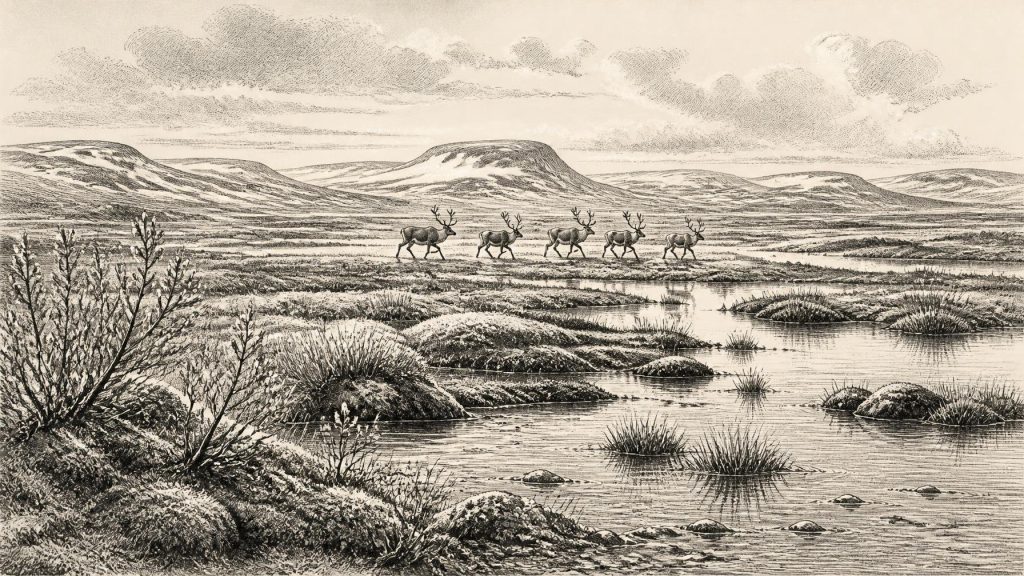
The fossils indicate a cold, open and largely treeless landscape. Herb pollen was poorly preserved, but plant macrofossils, mosses and insect remains were revealing. Sedges and grasses, bogbean, water-milfoil, dwarf willow, mountain-avens and lesser clubmoss point to shallow water, wet ground and low vegetation adapted to a harsh climate. Researchers have described the setting as a tundra or muskeg-like mosaic: pools and saturated margins within exposed country, with a short growing season and severe winters. This was not an empty ice desert. It was a living freshwater habitat, though a demanding one.
That qualification matters. Derryvree demonstrates that a particular part of Fermanagh supported freshwater life between glacial episodes. It does not demonstrate an unbroken, hospitable Ireland, a forested refuge or a population living beside the pools. Equally, the later burial of the deposits warns against treating the absence of campsites as conclusive proof that no people ever passed through the wider region. Ice can preserve selected pockets of evidence while removing or concealing extensive surfaces.
Castlepook’s Mixed Fauna
For the animal world of southern Ireland, Castlepook Cave near Doneraile, County Cork, is especially important. Excavations and later re-examination of its collections have produced remains of reindeer, mammoth, giant deer, brown bear, wolf, fox, hare, lemmings and spotted hyaena. Together these animals show that Ireland was connected ecologically to the cold-stage faunas of Britain and continental Europe during parts of the Late Pleistocene. Reindeer and lemmings favour open, cold environments; mammoth and giant deer evoke extensive grazing landscapes; hyaenas and wolves show that large carcasses were contested resources.
But Castlepook is not a snapshot. Its narrow limestone galleries, sands, stalagmite floors and disturbed older collections contain material accumulated at different times and by different agencies. Carnivores may have dragged bones into the cave; water, collapse and excavation may have moved them again. Radiocarbon determinations on individual bones span many thousands of years. The fauna should therefore be read as evidence that these species occurred in Ireland across episodes of the Late Pleistocene, not as a claim that every listed animal stood together in one Cork valley in 31,039 BCE.
Re-dating work has strengthened the case that parts of the southern Irish fauna belong to Marine Isotope Stage 3, well before the Last Glacial Maximum. It also demonstrates how fragile older narratives can be. Mammoth, reindeer, giant deer and hyaena remains provide firm evidence of animal presence, yet the dating and depositional history of each specimen must be considered separately. The cave’s greatest historical value lies in precisely this mixture of richness and difficulty: it preserves an extraordinary archive while requiring restraint in interpretation.
The Human Question
A reindeer femur from Castlepook has been publicly presented as bearing a deep incision consistent with carcass processing by a sharp stone tool. If the modification was made by people while the bone was fresh, it would be a remarkable indication of Upper Palaeolithic activity in Ireland far earlier than the better-established late-glacial evidence from County Clare. Public heritage material has associated the bone with about 31,000 BC, but this should be treated as a broad, approximate placement rather than a precise calendar date.
The limits are as important as the possibility. The bone derives from an old cave collection rather than a modern excavation of a sealed hunting floor. Ireland has no securely associated hearth, dwelling, burial, human skeletal remains or unequivocal stone-tool assemblage of this age. A modified reindeer bone, even if accepted as humanly cut, can show only that somebody may have processed an animal. It cannot reveal whether a small party camped nearby, whether people visited once or repeatedly, how many travelled, or whether a population survived locally through later climatic deterioration.
There is consequently no responsible basis for describing an Irish polity, ruler, territory, diplomacy or warfare in this period. Nor can language, kinship, clothing, food-sharing rules or gender roles be recovered from the available Irish record. Comparisons with Upper Palaeolithic hunting peoples elsewhere in Europe may suggest possibilities, but they remain comparisons, not evidence for Ireland. The same caution applies to claims of ritual or religion: no Irish cave art, shrine, burial rite or portable artwork is securely attributable to this horizon.
Life, Movement And Resources
Where human presence remains unproven or fleeting, economy and trade must be considered in the narrowest sense. There is no evidence for farming, livestock, crops, metalworking, pottery, permanent villages or exchange networks in Ireland at this time. If people did reach the island, the marked reindeer femur suggests the practical use of animal resources: meat, marrow, hides, sinew and bone were potentially valuable to mobile hunter-gatherers. That is an inference from the anatomy of a butchered carcass and wider European practice, not proof of an Irish hunting economy.
The animal evidence does support movement on a larger scale. Mammals colonised or recolonised Ireland during suitable cold-stage intervals, which implies changing geographical links and habitable corridors. Carnivores followed prey, while herbivores depended on forage across open ground. Such ecological movements were not diplomacy or trade, but they shaped the opportunities available to any human visitors. The later advance of major ice sheets would have disrupted these routes, transformed drainage and destroyed many places where people or animals might once have left traces.
Culture and learning are therefore represented most clearly by the modern scientific work needed to recover this deep past. Radiocarbon measurement, calibration, faunal identification, microscopic examination of bone surfaces, pollen analysis, plant macrofossils, insects, sediment stratigraphy and mapping of glacial landforms each provide a partial line of evidence. Their agreement can produce a persuasive reconstruction; their disagreement is equally informative. Around 31,039 BCE, Ireland’s history is not a tale of kingdoms in formation. It is the history of a cold, changing landscape, of wetlands between ice advances, and of animals whose bones preserve a cautious possibility of human contact.
Primary Sources
- A Middle Midlandian Freshwater Series at Derryvree, Maguiresbridge, County Fermanagh, Northern Ireland
- The Irish Quaternary Fauna Project
- A Reconsideration of the Radiocarbon Dating of the Marine Isotope Stage 3 Fauna from Southern Ireland
- Late Pleistocene Chronostratigraphy and Ice Sheet Limits, Southern Ireland
- Response of the Irish Ice Sheet to Abrupt Climate Change During the Last Deglaciation
- Dimensions and Chronology of the Last Ice Sheet in Western Ireland
- Trimlines, Blockfields and the Vertical Extent of the Last Ice Sheet in Southern Ireland
- Radiocarbon Constraints on the History of the Western Irish Ice Sheet Prior to the Last Glacial Maximum
- Growth and Retreat of the Last British–Irish Ice Sheet, 31,000 to 15,000 Years Ago: the BRITICE-CHRONO Reconstruction
- Stratigraphic and Palaeo-Geomorphological Evidence for the Glacial-Deglacial History of the Last British-Irish Ice Sheet in the North-Western Irish Sea
- Timing and Pace of Ice-Sheet Withdrawal Across the Marine–Terrestrial Transition West of Ireland During the Last Glaciation
- The Timing and Magnitude of the British–Irish Ice Sheet Between Marine Isotope Stages 5d and 2
- The IntCal20 Northern Hemisphere Radiocarbon Age Calibration Curve (0–55 cal kBP)
- First Evidence of a Late Upper Palaeolithic Human Presence in Ireland
- New Insights on the Fauna of Ireland’s Younger Dryas and Early Holocene from Alice & Gwendoline Cave
- Revisiting Alice and Gwendoline Cave, Co. Clare: New Light on the 1902 Excavations
- Quaternary Site Descriptions
- Palaeoecology
- The Subdivision of the Quaternary Period in Ireland
- Heritage Artefacts of County Cork
- Archaeological Heritage of County Cork
- Occurrence of Mammalia Relicts at Site Castlepook Cave
- Menyanthes trifoliata
- Selaginella selaginoides