Mammoth Cave’s Bone Archive31023 BCE
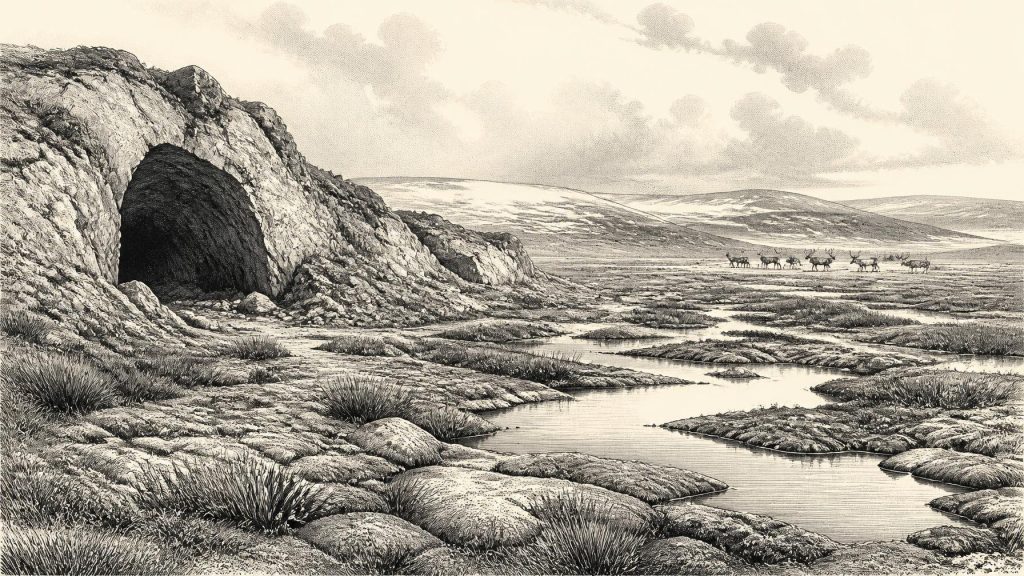
Around 31,023 BCE, Ireland lay within the Midlandian glacial cycle, and evidence describes environments rather than datable events. Derryvree, County Fermanagh, preserves freshwater sediments between till layers, indicating a local ice-free interval with treeless, waterlogged tundra, mosses, insects and short growing seasons. Castlepook Cave, County Cork, contains a long-accumulated, disturbed assemblage of mammoth, reindeer, giant deer, bear, hyena and other cold-stage fauna, demonstrating intermittent links with Britain and Europe. A possible stone-tool mark on a reindeer bone suggests brief human presence, but remains unconfirmed. No evidence supports permanent settlement, society or culture. Changing ice, sea levels and routes governed access.
Dateline
The label 31,023 BCE is a modern way of locating a very remote point in time, not a year that anyone in Ireland could have named, recorded or experienced as a date. No archaeological evidence can isolate an event, a ruler, a journey or even a single human lifetime to this calendar year. The responsible frame is therefore a broad one: Ireland in the later part of Marine Isotope Stage 3, within the Midlandian, the Irish expression of the last glacial cycle. Radiocarbon chronologies at this depth are necessarily ranges, and conventional radiocarbon ages must be calibrated against changing atmospheric carbon levels. Around this notional year, the island’s history is principally an environmental and faunal history, with only a debated hint of human activity.
A Date Without a Chronicle
In archaeological convention, “before present” means before AD 1950. A modern BCE conversion can make an ancient age look misleadingly precise. The best evidence relevant to this point comes from deposits dated over centuries or millennia, not from a calendar. At Derryvree near Maguiresbridge, County Fermanagh, organic silts produced a conventional radiocarbon determination of 30,500 ± 1,170 radiocarbon years BP. Calibration gives a broader and differently shaped calendar range rather than one neat equivalent. Castlepook Cave, near Doneraile in north County Cork, has yielded animal bones spanning a long part of the Ice Age; revised dates show that some are substantially older than earlier measurements suggested. These records illuminate a changing Ireland around the thirty-first millennium BCE, but neither proves conditions everywhere on the island nor identifies one particular year.
The evidence is unusually fragile because much of it survived only in caves, buried wet sediments and old museum collections. Later glaciers eroded, reworked or buried great stretches of the earlier landscape. Moreover, nineteenth- and early twentieth-century cave excavations did not always retain the stratigraphic information expected today. A bone can establish that an animal reached Ireland; it cannot by itself show the size of a population, the precise route it used, or whether people were present when it died. This is why the period must be reconstructed from converging clues: sediment layers, plant remains, insect assemblages, animal bones, radiocarbon measurements and the wider geography of the British–Irish Ice Sheet.
Wet Tundra at Derryvree
Derryvree provides the clearest local environmental window. In 1969 a road cutting exposed freshwater silts and fine sands trapped between two thick till sheets within a drumlin. The position is crucial. It shows that an episode of open-water and wetland deposition occurred after one phase of ice movement and before another, demonstrating ice-free conditions at that place during an interval of the Midlandian. It does not demonstrate that all Ireland was ice-free simultaneously. The subsequent ice advance sealed the deposit, preserving an exceptionally rare sample of an Irish cold-stage ecosystem.
Pollen in the deposit was poorly preserved, but plant macrofossils, mosses and insects are more informative. Together they indicate an open, treeless tundra or muskeg: waterlogged ground with pools, plant-rich margins and mossy surfaces, set within a harsh periglacial climate. Herbaceous vegetation dominated. The record includes plants associated with cold, open habitats, while insect evidence supports shallow pools and damp organic ground rather than woodland. There is no basis for imagining the familiar green, wooded Ireland of later millennia. The local landscape was sparse, seasonally exacting and shaped by frost, wet ground and short growing seasons.
Such a landscape was not lifeless. Low plants, sedges, mosses and aquatic vegetation could sustain insects and herbivores, while thawed margins and freshwater basins concentrated resources. Yet it was a precarious ecology. Severe winters, permafrost or seasonally frozen ground, and rapid climatic shifts would have restricted plant cover and altered animal movements. Derryvree is therefore valuable not merely as a list of fossil species, but as evidence for a habitable patchwork at the edge of a glacial world. It reveals environmental opportunity as well as constraint.
Castlepook’s Cold-Stage Fauna
Nearly 300 kilometres to the south-west, Castlepook Cave offers a different archive. Also known as Mammoth Cave, it is Ireland’s richest known site for vertebrate remains from the period leading towards the Last Glacial Maximum. Excavations recovered more than 2,000 bones from a complex limestone cave system. Its fauna includes woolly mammoth, giant deer, reindeer, brown bear and spotted hyena; later cold-stage material also includes Arctic fox, wolf, collared lemming and Norwegian lemming. The assemblage establishes that Ireland, at least intermittently, supported or received a far richer large-mammal community than the island possesses today.
The cave should not be mistaken for an intact snapshot of one day or one herd. Its bones accumulated across a very long span, conventionally dated at the site between roughly 45,700 and 19,950 radiocarbon years BP, and water disturbance obscured parts of the original contexts. Spotted hyenas may themselves have carried carcass parts into the cave, while natural deaths, scavenging and sediment movement all contributed to the deposit. Consequently, it is not safe to place every listed species together in the same valley in 31,023 BCE. What Castlepook securely provides is evidence for a sequence of cold-stage animal communities and for ecological connections with Britain and continental Europe before Ireland became permanently isolated by rising seas.
Reindeer are especially important to the period’s possibilities. They were well adapted to exposed, cold terrain and could have moved through open country in seasonal patterns. Mammoth remains show that the island was at times reachable by animals suited to steppe-tundra conditions. Hyena, wolf and Arctic fox reveal a food web containing powerful predators and scavengers as well as herbivores. But animal presence should not be simplified into a ready-made hunting landscape. The bones do not tell us how dense herds were, whether crossings occurred annually, or whether food was abundant in every season. They demonstrate potential resources and ecological movement, not predictable plenty.
The Human Question
A reindeer femur from Castlepook has made this remote era historically arresting. Zooarchaeological examination has interpreted a deep mark on it as damage made by a sharp stone implement during the processing of fresh bone. If that interpretation is confirmed and the mark is contemporary with the animal’s death, it would indicate human handling of a reindeer in Ireland about 33,000 years ago, far earlier than the securely established post-glacial settlement record. It is an important hypothesis, and one that deserves further microscopic, taphonomic and contextual testing.
It is not, however, enough to populate Ireland with a settled Upper Palaeolithic community. No securely associated hearth, dwelling, stone-tool assemblage, burial, human bone, occupation floor or repeated camp of comparable age has been recovered from the island. The femur entered a cave archive affected by older excavation methods and complicated depositional processes. Nor does an animal’s radiocarbon date automatically date a cut mark independently. The most careful conclusion for around 31,023 BCE is that people may have reached or visited Ireland during this broader cold-stage interval, perhaps briefly and perhaps to exploit animal resources, but sustained occupation remains unproven.
Society Beyond the Evidence
That limit governs every human theme normally expected in a year-by-year history. There is no evidence for a polity, leadership, territory, diplomacy, warfare, formal trade network, permanent settlement or named community in Ireland at this time. There are no grounds for assigning language, ancestry, social rank, kinship rules or gendered tasks. Likewise, no shrine, grave, art object or ritual deposit can responsibly illuminate religious belief. The absence of such evidence does not prove that visiting people had no culture or social life; it means that the Irish record does not preserve it in a form that can be demonstrated.
Even everyday economy must be expressed conditionally. If people did reach this landscape, the practical attraction of a reindeer carcass would have included meat, marrow, hide, sinew, antler and bone. Such uses are well documented among Upper Palaeolithic hunter-gatherers elsewhere, but Castlepook’s single controversial mark cannot show which portions were removed, whether hunting rather than scavenging occurred, or whether any material was transported away. There is no evidence in Ireland at this date for farming, livestock, pottery, metalworking, boats, constructed routes or organised exchange. The relevant economy was ecological before it was archaeological: seasonal vegetation, freshwater, mobile animals and the changing accessibility of land.
Ice, Connections and Change
Ireland’s regional position was changing as ice sheets expanded towards the Last Glacial Maximum, whose principal phase came later, broadly between about 27,000 and 21,000 years ago. Lower sea levels altered coastlines and reduced the water barriers between Ireland, Britain and continental north-west Europe, but the exact configuration of land, sea ice, glaciers and viable passage changed repeatedly. It is therefore unwise to describe a simple land bridge or a single migration route. Faunal connections demonstrate that animals crossed during favourable intervals; they do not establish a continuously open corridor for humans.
The most important development around this notional date was thus not a political event but a threshold in environmental history. Derryvree records a cold freshwater wetland in Fermanagh during an ice-free interval. Castlepook preserves the bones of large mammals and carnivores that reached southern Ireland across a wider Pleistocene timespan. Together they show an island—or, more precisely, a fluctuating north-western peninsula and island-margin—within an unstable glacial world. The evidence allows a vivid but bounded picture: open tundra, pools and mossy wet ground; reindeer and other cold-adapted animals moving through favourable landscapes; predators using caves; and perhaps an exceptionally early human encounter with a carcass. Beyond that threshold lies conjecture, not history.
Primary Sources
- A Middle Midlandian Freshwater Series at Derryvree, Maguiresbridge, County Fermanagh, Northern Ireland
- A Reconsideration of the Radiocarbon Dating of the Marine Isotope Stage 3 Fauna from Southern Ireland
- The Irish Quaternary Fauna Project
- Irish Quaternary Vertebrates
- Castlepook Cave: County Geological Site Report
- Spotted Hyena Skull
- Learn About: The Ice Age
- Ice Age Ireland: Cool Fossils! Woolly Mammoth Activity Sheet
- Heritage Artefacts of County Cork
- The Exploration of Castlepook Cave, County Cork
- 2022:564 – Castlepook Cave, Castlepook South, Cork
- New Insights on the Fauna of Ireland's Younger Dryas and Early Holocene from Alice & Gwendoline Cave
- The IntCal20 Northern Hemisphere Radiocarbon Age Calibration Curve (0–55 cal kBP)
- Palaeoecology: Irish Quaternary Association Field Guide
- Maximum Extent and Dynamic Behaviour of the Last British–Irish Ice Sheet West of Ireland
- Dimensions and Chronology of the Last Ice Sheet in Western Ireland
- The Colonization of Ireland: A Human Ecology Perspective
- An Island World? Hunter-Gatherers in Ireland
- Pleistocene Vertebrates in the British Isles
- The Exploration of Castlepook Cave, County Cork: Bibliographical Record