The Doneraile Limb Mark31056 BCE
Around 31,056 BCE, Ireland was a cold, changing Late Pleistocene landscape rather than a historically dated society. Derryvree deposits in Fermanagh preserve tundra vegetation between glacial advances, although their radiocarbon chronology is broad and uncertain. Castlepook Cave, County Cork, contains diverse Marine Isotope Stage 3 fauna, including reindeer, mammoth and hyaena, accumulated through varied natural processes. A reindeer femur bearing a possible stone-tool cut mark may indicate human carcass processing, but lacks secure archaeological context. No camp, tools, hearths or human remains confirm settlement. Later ice expansion disrupted habitats and erased evidence, leaving only cautious evidence of possible brief visits.

Dateline
31,056 BCE is a modern way of labelling a point far beyond the reach of historical calendars. No event can responsibly be assigned to this particular year in Ireland, and it would be misleading to suggest otherwise. The evidence consists instead of sediments, cave deposits, animal bones and scientific dates with substantial margins of uncertainty. The safest setting is the later part of Marine Isotope Stage 3, before the Last Glacial Maximum: a cold, changeable Ice Age world in which parts of Ireland could support tundra and large mammals, but in which expanding ice would ultimately transform the island.
The most evocative Irish object associated with this broad interval is a reindeer femur from Castlepook Cave near Doneraile, County Cork. It has been presented in heritage publications as dating to about 31,000 BC and as carrying a deep mark made by a sharp stone implement during carcass processing. That claim, if sustained, would indicate a very early human visit to Ireland. It does not, however, provide a dated camp, a named people, or a continuous settlement. The bone comes from an old cave collection with a difficult depositional history, and its wider significance remains dependent on further testing.
Dating a Calendarless Landscape
The numbered year should therefore be treated as a notional waypoint, not a date known to its inhabitants. Radiocarbon laboratories report ages in years before present, where “present” conventionally means 1950; those results then need calibration against changing levels of atmospheric radiocarbon. At great antiquity, a single laboratory result may calibrate to a wide calendar range rather than a precise year. The modern IntCal20 curve reaches back to 55,000 calibrated years before present, but it does not turn an isolated Ice Age specimen into evidence for a single calendar year.
One of the closest environmental records is at Derryvree, near Maguiresbridge in County Fermanagh. There, organic-rich freshwater mud lay between glacial deposits: an earlier ice advance had left till, a period without local ice permitted water and plant remains to accumulate, and a later advance sealed the deposit beneath further sediment. Organic material produced a conventional radiocarbon age of 30,500 ± 1,100 BP. Subsequent assessments class this as a low-confidence, pre-Last Glacial Maximum legacy date, but it still demonstrates why year-level certainty is impossible. Its broad calibrated span, approximately 36,900–31,700 cal BP in one published compilation, overlaps the general era represented by this article rather than pinpointing 31,056 BCE.
Wet Ground Between Ice Advances
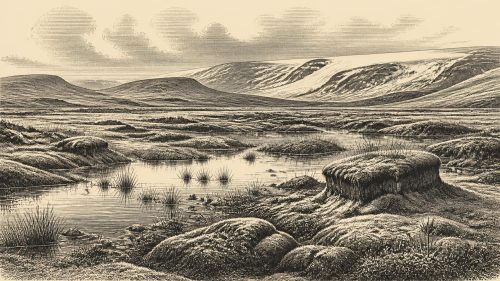
Derryvree is important because it preserves a local ecological snapshot rather than a human story. Plant macrofossils and spores from the deposit include cold-adapted species such as mountain avens, lesser clubmoss and Irish saxifrage. Taken together, these remains support the interpretation of open, periglacial ground with wet hollows, mosses and freshwater pools: a tundra or muskeg-like mosaic, not the wooded Ireland familiar today. Such vegetation could provide forage for herbivores and cover for smaller animals, while shallow water and saturated sediment preserved fragments of the environment that would otherwise have vanished.
This was not a stable wilderness suspended outside time. Ice-sheet reconstructions show that the British–Irish Ice Sheet changed rapidly over the later glacial period. Its greatest extent is generally placed later, around 26,000–21,000 years ago, though the pace, thickness and precise limits of Irish ice remain debated region by region. By about 31,000 BCE, the relevant development was not necessarily ice covering every part of Ireland, but a deteriorating climatic regime in which habitable zones could contract, ice margins could advance, and routes used by animals could be broken or erased. Later ice movement also destroyed or disturbed much of the evidence that a short human visit might have left behind.
Castlepook’s Animal Archive
Castlepook Cave provides a complementary, though equally complicated, record. The limestone cave system was explored mainly in the late nineteenth and early twentieth centuries, long before modern excavation methods. Its chambers acquired memorable names including Hyaena Hall, Elephant Hall and the Gallery of Aged Carnivores. The cave yielded a remarkable Ice Age fauna: woolly mammoth, reindeer, giant deer, brown bear, wolf, Arctic fox, lemmings and spotted hyaena. The list should not be read as a census of animals standing together in one season. Bones accumulated over long periods through natural deaths, carnivore activity, water movement and earlier excavation, then were re-sorted in places.
Even so, the fauna establishes an important reality. Ireland was not uniformly lifeless before the last great expansion of ice. Reindeer and other cold-environment animals reached the island during parts of the Late Pleistocene, probably when changing sea levels and geography made movement from Britain and continental Europe possible. Direct dating of Castlepook material has shown that some earlier determinations were too young, owing to limitations in older bone pretreatment; revised work places part of the assemblage securely within Marine Isotope Stage 3. That revision matters because it makes the cave a stronger archive for the environmental setting of the period, while also reminding us that scientific chronologies can change.
The Reindeer Femur
The femur is more consequential than the rest of the animal assemblage because it raises the possibility of people. A deep linear modification on the bone has been interpreted by zooarchaeologist Ruth Carden as a fresh-bone cut or chop made with a sharp stone tool. If that interpretation is correct, somebody handled a reindeer carcass in Ireland during the Upper Palaeolithic. It would be evidence of butchery or dismemberment, not necessarily of a successful hunt: people could have killed the animal, encountered a carcass, removed meat, cut hide or sinew, or broken down a limb elsewhere before the remains entered the cave.
The qualifications are essential. No associated stone tools, hearth, occupation surface, human remains or securely excavated food debris have yet been found at Castlepook to demonstrate a camp. Nor does the old collection allow researchers to prove that the mark was made in the cave, rather than before a carnivore or water carried the bone there. The date of the animal is not automatically the date of the modification. A 2022 excavation was undertaken specifically to seek better contextual evidence, illustrating that Castlepook is an active research question rather than a settled foundation for a detailed narrative of Ice Age society.
People, Politics and Daily Life
Accordingly, there is no evidence for political affairs, rulers, territories, diplomacy, warfare, religion, language, art, formal learning or trade in Ireland at this point. There are no Irish houses, graves, monuments, boats or toolkits that can be securely attributed to 31,056 BCE. It is equally unwarranted to project later Celtic identities, medieval origin traditions, or even the well-documented Mesolithic communities of much later millennia back into this landscape.
If people did visit, the best comparison is with small, mobile Upper Palaeolithic hunting groups known elsewhere in north-west Europe. Their practical knowledge may have included animal movement, seasonal weather, stone tools and the use of animal materials. But that is interpretation from a broader European context, not direct evidence for an Irish social group. A reindeer bone with a possible tool mark can support only a narrow conclusion: a brief human encounter with an animal may have occurred. It cannot establish population size, family structure, gender roles, belief or political organisation.
Nor can continuity be assumed. The later growth of the Irish Ice Sheet was a severe ecological interruption. Faunal populations disappeared or were displaced, and any fleeting human presence would have left little chance of a continuous archaeological record. The securely dated terminal Pleistocene evidence from Alice and Gwendoline Cave in County Clare is far younger, dating to roughly 12,810–12,590 cal BP, and is not proof of an unbroken population extending back to Castlepook.
An Ireland Defined by Evidence
The best account of Ireland around this nominal date is therefore one of environmental possibility and archaeological restraint. Wet, open Fermanagh ground preserved a cold-climate plant record between episodes of glaciation. Caves in north Cork accumulated bones from a varied Ice Age fauna. One marked reindeer femur may record human processing of a carcass. These are significant discoveries precisely because they are few, fragile and testable. They reveal an Ireland connected to the wider Pleistocene world of tundra animals and climatic upheaval, while leaving the political and cultural history of any visitors almost entirely unknown.
Primary Sources
- Prehistoric Details
- A Reconsideration of the Radiocarbon Dating of the Marine Isotope Stage 3 Fauna from Southern Ireland
- The Irish Quaternary Fauna Project
- Castlepook Cave, County Cork: Geological Site Report
- Heritage Artefacts of County Cork
- Archaeological Heritage of County Cork
- 2022:564 – Castlepook Cave, Castlepook South, Cork
- First Evidence of a Late Upper Palaeolithic Human Presence in Ireland
- New Insights on the Fauna of Ireland’s Younger Dryas and Early Holocene from Alice & Gwendoline Cave
- Our Ancient Landscapes: Hunter-Gatherers in Ireland
- Figure 6: The Subdivision of the Quaternary Period in Ireland
- Devising Quality Assurance Procedures for Assessing and Reporting Cosmogenic-Nuclide Exposure Ages
- The IntCal20 Northern Hemisphere Radiocarbon Age Calibration Curve (0–55 cal kBP)
- IntCal
- BSBI: Selaginella selaginoides
- BSBI: Saxifraga rosacea
- BSBI: Dryas octopetala
- Dimensions and Chronology of the Last Ice Sheet in Western Ireland
- Late Pleistocene Chronostratigraphy and Ice Sheet Limits, Southern Ireland
- Last Glacial Maximum Cirque Glaciation in Ireland and Implications for Reconstructions of the Irish Ice Sheet
- Oscillating Retreat of the Last British-Irish Ice Sheet on the Continental Shelf Offshore Galway Bay, Western Ireland
- Early Deglaciation of the British-Irish Ice Sheet on the Atlantic Shelf Northwest of Ireland Driven by Glacioisostatic Depression and High Relative Sea Level
- Exposure-Age Constraints on the Extent, Timing and Rate of Retreat of the Last Irish Sea Ice Stream
- Could Brown Bears Have Survived in Ireland During the Last Glacial Maximum?