Derryvree’s Calibrated Wetland30856 BCE
30,856 BCE is not a recoverable Irish year but falls within a Late Pleistocene radiocarbon range. Derryvree, County Fermanagh, preserves freshwater silts between glacial tills, recording a local ice-free interval of tundra, wetland plants, mosses, sedges and cold-adapted insects before renewed glaciation. Castlepook Cave, County Cork, provides evidence of cold-climate mammals, including reindeer, mammoth, giant deer, hyaena and wolf, although dating and deposition require caution. No secure evidence establishes human settlement. A marked reindeer bone may indicate Upper Palaeolithic butchery, yet cannot demonstrate occupation. Environmental instability, shifting ice, animal movements and survival define Ireland’s evidence during Marine Isotope Stage 3.
Dateline
30,856 BCE is a modern chronological label, not a year recoverable from Ireland’s own past. No written calendar, named community, political event or human lifetime can be placed in this particular year. In the conventional archaeological system it lies about 32,806 calendar years before AD 1950, but that arithmetic is not a precise date for an Irish deposit, animal or human action. At this depth of time, radiocarbon evidence produces probability ranges, not an annual diary. The responsible subject is therefore Ireland during a broad part of the Late Pleistocene: a cold, unstable world of ice, exposed ground, pools, tundra vegetation and mobile animals.
The most informative evidence comes from Derryvree, near Maguiresbridge in County Fermanagh. Here, roadworks in 1969 cut through a drumlin and exposed an extraordinary sequence. Organic freshwater silts and fine sands lay between two thick layers of till, the unsorted debris left by glacier ice. The stratigraphy establishes a simple but important order: ice had occupied the locality; water and organic sediment then accumulated during an interval when it was not ice-covered; and a later glacier buried the wetland beneath fresh till. The buried deposit is not a settlement, but it is an unusually rare survival from an Irish landscape repeatedly reshaped by later ice.
A Date Within a Range
Material from Derryvree gave the radiocarbon determination BIRM-166: 30,500 radiocarbon years before present, with a substantial error range of +1,170 and −1,030 years. Radiocarbon years are not identical to calendar years, because atmospheric carbon-14 levels have changed over time. Calibration against the IntCal20 curve is essential, yet it cannot transform one old measurement into an exact historic date. Published discussion places the Derryvree horizon broadly at about 36,900–31,700 calibrated years before present, approximately 34,950–29,750 BCE. The nominal year 30,856 BCE lies within that broad span, but cannot be assigned to a particular layer in the silt, a season at the pool, or a moment in the life of any animal.
This distinction is more than technical. It prevents an attractive but false picture of a fixed Irish landscape in a single year. Derryvree provides direct evidence for conditions at one northern locality during a lengthy interval. It does not prove that all of Ireland was ice-free at once, that its plants and animals were simultaneously present everywhere, or that the same conditions endured without interruption. The island’s record is patchy partly because advancing glaciers eroded older surfaces, mixed deposits and sealed others beneath thick sediment. What remains is precious precisely because it is fragmentary.
Water Beneath the Drumlin
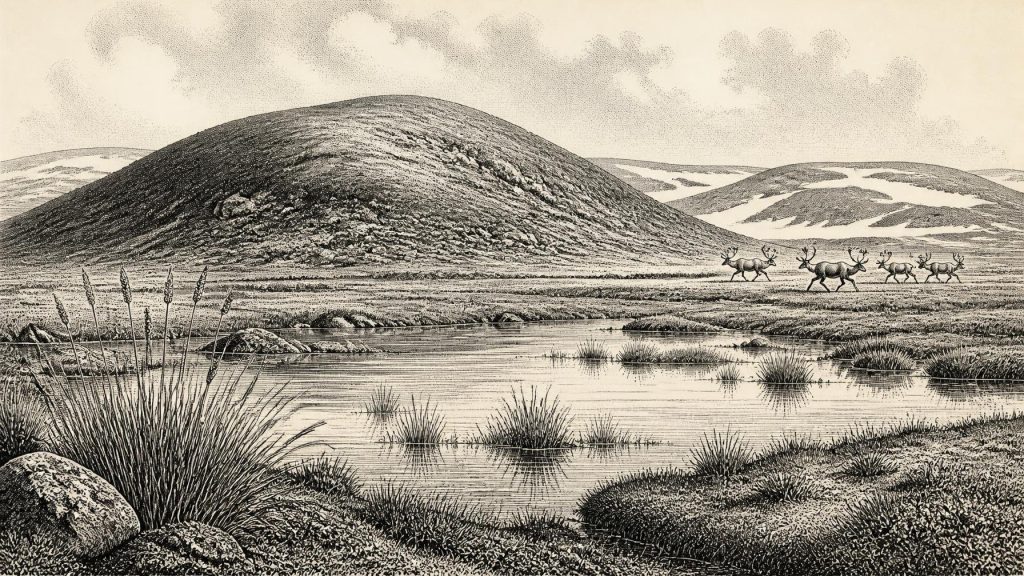
The Derryvree flora and fauna indicate open tundra vegetation and a periglacial climate: conditions shaped by severe cold, seasonal freezing and thawing, and ground near an ice margin rather than by the oak-and-hazel woodland familiar from much later Irish prehistory. Freshwater mosses and sedges, along with aquatic and wet-ground plants, show that water persisted locally. Insect remains of cold northern aspect reinforce the conclusion. The scene was not an uninterrupted white desert. It included shallow water, wet sediment, plant-rich margins and patches of forage, all within a treeless, exposed and climatically demanding setting.
Such evidence supports an ecological interpretation rather than a detailed reconstruction. A pool or marsh could shelter distinctive plant communities even when surrounding slopes were windswept and sparsely vegetated. Snow cover, frozen ground, meltwater and seasonal daylight would have altered conditions sharply through the year. Derryvree’s freshwater sediments demonstrate that local habitats existed between ice advances; they do not allow us to calculate temperatures for 30,856 BCE or to paint every Fermanagh valley with the same vegetation. The evidence is strongest for a mosaic of cold open ground and wetland, not for a uniform island-wide biome.
Animals on a Changing Island
Cave deposits in southern Ireland add another, geographically distant window onto the period. Castlepook Cave, also called Mammoth Cave, near Doneraile in County Cork, has yielded one of the island’s most important assemblages of last-cold-stage mammals. Its collections include remains of reindeer, woolly mammoth, giant deer, brown bear, wolf, Arctic fox, lemmings and spotted hyaena. The National Museum of Ireland preserves, among other material, a spotted-hyaena skull from the cave. Together, these finds show that Ireland was accessible to a varied cold-climate fauna during parts of Marine Isotope Stage 3, the fluctuating interval broadly spanning this date.
The cave assemblage must nevertheless be handled carefully. Many bones were recovered during early twentieth-century excavations, before modern standards of stratigraphic recording, sampling and chemical pretreatment. Cave predators may have dragged prey and scavenged remains into chambers; water, sediment movement and later disturbance could mix material of different ages. Recent redating has shown that some earlier Irish cave radiocarbon determinations were too young, while improved bone-treatment methods have shifted elements of the Castlepook chronology further back into Marine Isotope Stage 3. Individual species need not have lived together, and an animal found in Cork cannot be assumed to have grazed beside the Derryvree water.
Even so, the broad ecological lesson is powerful. Reindeer point to cold open country and seasonal grazing routes. Mammoth and giant deer imply extensive areas capable, at intervals, of supporting large herbivores. Hyaenas and wolves indicate predators and scavengers within those food webs. These animals did not make Ireland a permanent refuge from climatic stress. Their presence represents movements through a changing north-west European landscape, enabled or blocked by sea level, ice extent, habitat and connections with Britain. The sea was lower than today, but neither a simple continuous land bridge nor an effortless route to Ireland should be assumed for this exact date.
The Human Question
There is no securely excavated camp, hearth, dwelling, grave, tool assemblage or resident population that can be dated to around 30,856 BCE in Ireland. Consequently, there is no basis for describing a contemporary Irish polity, diplomacy, warfare, religion, language, artistic tradition, trade network or settled economy. Farming was tens of millennia away. If people entered the island, they would have been highly mobile Upper Palaeolithic hunter-gatherers operating in a continental-scale world, not inhabitants of villages or members of historically identifiable tribes. That is a contextual possibility, not evidence for a resident Irish society.
The main reason the question remains open is a reindeer femur from Castlepook. It has been reported as bearing a deep fresh-bone mark interpreted as having been made by a sharp stone tool, and its date has been publicised as roughly 33,000 years old. If that interpretation is sustained, it would be evidence that a person processed a reindeer carcass in Ireland during the Upper Palaeolithic. It would be a major extension of the human record on the island. But one modified bone from an old cave collection cannot establish the location of the kill, the number of people involved, their duration of stay, their route, their identity or a continuing occupation.
The prudent conclusion is therefore deliberately limited. Human activity near this broad period is possible and potentially represented at Castlepook; permanent settlement is not demonstrated. Nor can the bone establish cultural links with a particular named archaeological tradition in Britain or continental Europe. Stone tools, hearth residues and securely stratified associated material would be required to move from a suggestive encounter to a fuller social history. The absence of such evidence may partly reflect later glaciation, rising seas and the small scale of past research, but absence cannot simply be filled with imagined camps.
Ice, Routes and Regional Change
In Irish terminology this was part of the Midlandian cold stage; in the wider climatic framework it belongs to Marine Isotope Stage 3. It preceded the Last Glacial Maximum, when the British–Irish Ice Sheet reached much greater extent between roughly 26,000 and 20,000 years ago, though the timing and thickness of ice differed between regions and remain actively researched. The Derryvree sequence is especially important because it records an earlier local alternation: glacier, freshwater environment, then glacier again. It warns against describing the whole island as either wholly frozen or wholly habitable in a single sweeping phrase.
Political affairs in the familiar sense did not exist in the evidence, but changing ice had consequences analogous to borders: it opened and closed ecological corridors, redirected animals and erased places where people might once have stopped. The decisive forces were climate, glaciers, water and geography. At Derryvree, a modest freshwater basin accumulated the biological traces that allow modern researchers to glimpse that lost terrain. At Castlepook, caves retained fragments of a wider animal world. Elsewhere, later ice and erosion removed much of the record.
For Ireland around 30,856 BCE, then, the central development was not a ruler’s act or a battle but environmental volatility. Open tundra and wetland could briefly support plants, insects and grazing animals between glacial episodes. Predators moved through the same broad landscapes. A single marked reindeer bone raises the prospect of human presence, but does not yet give us a community, culture or event. The historical value of this remote date lies in learning to read what survives: silt, moss, insect, bone, cave and till, each carrying evidence, each imposing limits on interpretation.
Primary Sources
- A Middle Midlandian Freshwater Series at Derryvree, Maguiresbridge, County Fermanagh, Northern Ireland
- Early Midlandian–Middle Midlandian, Pleistocene, Northern Ireland
- The Irish Quaternary Fauna Project
- A Reconsideration of the Radiocarbon Dating of the Marine Isotope Stage 3 Fauna from Southern Ireland
- Growth and Retreat of the Last British–Irish Ice Sheet, 31,000 to 15,000 Years Ago: the BRITICE-CHRONO Reconstruction
- BRITICE-CHRONO Maps and GIS Data of the Last British-Irish Ice Sheet 31 to 15 ka
- The IntCal20 Northern Hemisphere Radiocarbon Age Calibration Curve (0–55 cal kBP)
- IntCal Publications
- The Timing and Magnitude of the British–Irish Ice Sheet Between Marine Isotope Stages 5d and 2
- Last Glacial Maximum Cirque Glaciation in Ireland and Implications for Reconstructions of the Irish Ice Sheet
- Deglaciation Chronology of the Donegal Ice Centre, North-West Ireland
- Irish Pleistocene Biostratigraphy
- Geology of Northern Ireland: Our Natural Foundation
- Spotted Hyena Skull
- Heritage Artefacts of County Cork
- Occurrence of Mammalia Relicts at Site Castlepook Cave
- 2022:564 – Castlepook Cave, Castlepook South, Cork
- New Insights on the Fauna of Ireland’s Younger Dryas and Early Holocene from Alice & Gwendoline Cave
- Palaeoecology
- Dating Constraints on the Last British-Irish Ice Sheet: a Map and Database
- Sedimentology and Chronology of the Advance and Retreat of the Last British-Irish Ice Sheet on the Continental Shelf West of Ireland
- Dimensions and Chronology of the Last Ice Sheet in Western Ireland