
Maguirebridge’s Fossil Mosses30857 BCE
Around 30,857 BCE, Ireland lay within the climatically unstable Marine Isotope Stage 3, rather than a precisely datable historical year. Freshwater sediments beneath Derryvree drumlin, County Fermanagh, dated broadly to 36,900–31,700 calibrated years BP, preserve mosses and plants indicating cold, open, wet periglacial terrain between glacial advances. Cave faunas, notably at Castlepook, show that mammoth, reindeer, giant deer and other Ice Age animals reached Ireland intermittently. No secure evidence demonstrates human settlement then. A possibly butchered reindeer bone suggests a tentative Upper Palaeolithic visit, but cannot establish occupation. Later ice buried or destroyed much evidence of these changing Irish ecosystems.
Dateline
The label 30,857 BCE cannot describe a named year in Irish history. No calendar, written record, settlement sequence or archaeological layer permits events in Ireland to be dated to that level of precision so far back. It is a modern chronological point, roughly 32,800 years before 1950, within the later part of the Last Glacial period. The responsible evidence is therefore broader: calibrated age ranges, glacial sediments, cave fauna and environmental remains. These illuminate changing conditions in Ireland during Marine Isotope Stage 3 (MIS 3), not a particular day, season or generation.
The most relevant Irish evidence comes from deposits whose date ranges overlap this nominal year, especially the remarkable freshwater sediments found beneath a drumlin at Derryvree, near Maguiresbridge in County Fermanagh. They offer no story of rulers or battles. Instead, they preserve a more fundamental history: an Ice Age landscape briefly capable of supporting plants, insects and animals before later glacier ice sealed its traces beneath till.
A Date Within a Wide Window
Roadworks in 1969 exposed a section through the Derryvree drumlin. Beneath an upper glacial till lay fine sands, silts and organic deposits; below them was another till. The sequence establishes a clear order. Ice had affected the locality, then a freshwater and wetland environment formed, and later ice advanced or reworked the ground again. Organic material from the intervening deposit returned a conventional radiocarbon age of 30,500 years BP, with a large uncertainty of +1,170/−1,030 years. Modern calibration places it broadly at about 36,900–31,700 calibrated years BP.
That calibrated interval includes 30,857 BCE, but it must not be mistaken for proof that the Derryvree pool existed at that precise point. Radiocarbon dates measure the age of sampled carbon rather than an annual historical timestamp, and calibration becomes especially complex this far back. The deposit belongs broadly to the Middle Midlandian, Ireland’s regional term for part of MIS 3. It is best understood as evidence for a long phase of cold, variable conditions, not as an anniversary.
MIS 3 was climatically unstable across the North Atlantic. Greenland ice-core records show abrupt swings between colder stadial conditions and comparatively milder interstadials, sometimes over periods far shorter than traditional archaeological eras. Irish records cannot always be correlated tightly enough to assign a single local deposit to a particular Greenland event. Yet Crag Cave in County Kerry provides independent support for this wider pattern: episodes of speleothem growth there indicate intervals when liquid water could enter the cave system and mean annual conditions were less severe than during full permafrost phases. Ireland was not environmentally uniform or static.
The Derryvree Wetland
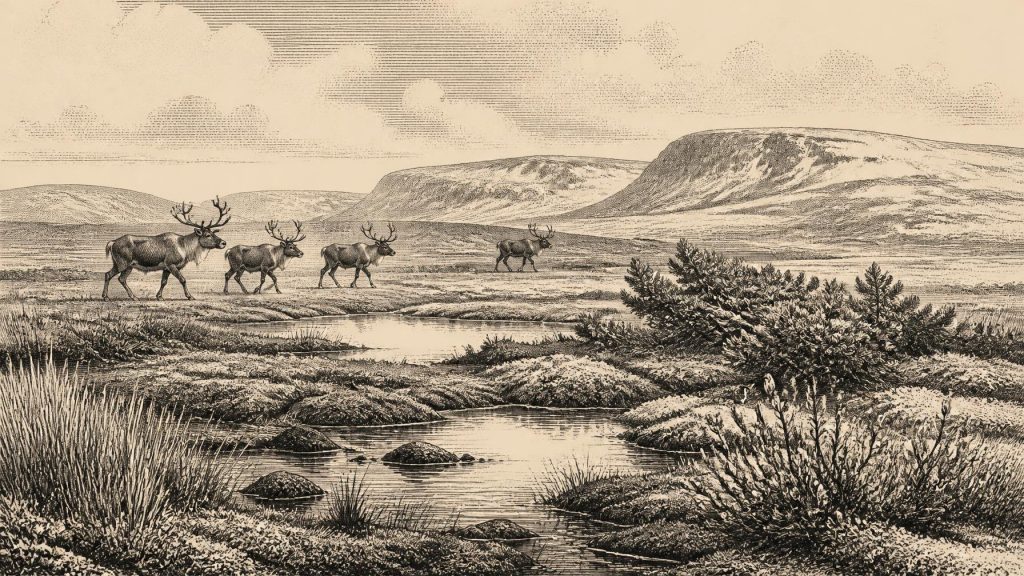
Derryvree is valuable precisely because later ice buried it. Its pollen was poorly preserved, but plant macrofossils, moss remains and other small biological traces point to an open, cold and largely treeless environment. Grasses, sedges, herbs, juniper and cold-tolerant plants belonged to a wet, periglacial landscape rather than to familiar Irish woodland. Mountain avens, bogbean, dwarf willow, clubmoss and a varied moss flora are among the kinds of plants associated with the deposit and comparable Irish MIS 3 records. Small pools, saturated ground and sedge-rich margins probably broke up more exposed, sparsely vegetated surfaces.
Descriptions of this setting as tundra or muskeg are useful provided that they are not made too picturesque. They signify low vegetation, waterlogged hollows, short growing seasons, repeated frost action and imperfectly developed soils. They do not mean that every part of Ireland was a single unbroken white wilderness. The Derryvree evidence is local, from what is now south Fermanagh. Nevertheless, it demonstrates that at least some ground in Ireland could be free of overriding ice for long enough to sustain a freshwater ecosystem during the broader interval represented by the date.
The drumlin itself is a reminder that the landscape visible today is younger than the wetland it entombed. The landform was shaped by glacier action, while the buried organic bed records a markedly different episode between ice incursions. At this depth of time, geological evidence is often better at revealing environmental succession than at drawing a complete map of the island. It would be unsafe to infer that all Irish regions were simultaneously ice-free, or that coastlines, river courses and sea crossings resembled those of the present.
Animals on a Changing Margin
Irish cave collections demonstrate that late Pleistocene Ireland was intermittently connected, ecologically at least, to the wider north-west European world. Castlepook Cave, near Doneraile in County Cork, has yielded one of the island’s richest Ice Age faunas: woolly mammoth, giant deer, reindeer, brown bear, wolf, Arctic fox, mountain hare, lemmings and spotted hyaena. Improved radiocarbon pretreatment has shown that several earlier dates from Castlepook were substantially too young, strengthening the case that some animals occupied Ireland during MIS 3, well before the Last Glacial Maximum.
These fossils do not prove that every species lived together at one moment, nor do they measure their abundance. Cave deposits can accumulate for millennia and may be altered by carnivores, water, collapse and excavation. Spotted hyaenas could transport or scatter bones; a cave can record a den, a refuge, a natural trap or material washed in from outside. Even so, the fauna makes ecological sense beside Derryvree’s open-country plants. Reindeer and lemmings, in particular, are consistent with cold habitats, while mammoth and giant deer evoke a mosaic of grazing ground, wet hollows and exposed terrain rather than dense forest.
The Human Question
There is no securely demonstrated settlement, hearth, dwelling, burial or stone-tool assemblage in Ireland dating to around 30,857 BCE. Consequently, no responsible account can claim a resident population, a hunting camp or an Irish community at this exact date. The question is nevertheless important because a reindeer femur from Castlepook has been publicised as bearing a deep modification interpreted as a sharp-stone butchery mark. The bone has been presented as roughly 33,000 years old, raising the possibility that people handled a reindeer carcass in Ireland during the Upper Palaeolithic.
If sustained by further study, that interpretation would transform the chronology of human activity in Ireland. It would suggest a brief human incursion many millennia before the better-established terminal Pleistocene evidence from Alice and Gwendoline Cave in County Clare, where cut marks on a brown-bear patella are associated with dates around 12,800–12,600 calibrated years BP. But the distinction between a potentially modified bone and a proven occupation site is crucial. A radiocarbon measurement dates the animal’s death, not automatically the mark; the mark must also be separated from carnivore damage, sediment abrasion, breakage or damage incurred during recovery. Nor can one specimen establish the duration, frequency or route of any human visit.
The most cautious conclusion is that Ireland may have been within the roaming range of Upper Palaeolithic people during parts of MIS 3, but the evidence currently cannot demonstrate a settled population around this nominal year. At lower sea levels, the geography of the Irish Sea basin differed greatly from today, but changing ice, marsh, exposed shelf and sea channels made access contingent. Faunal movement confirms that terrestrial connections or near-connections existed at some stages; it does not by itself reveal a simple permanent land bridge available to people.
Society Without Institutions
Political affairs, diplomacy and organised warfare leave no identifiable Irish evidence at this horizon. There are no known polities, leaders, territorial monuments or formal exchange networks. Religion, learning and artistic culture are equally beyond direct recovery: no ritual site, portable art, ornament or human grave can be assigned to Ireland at this date. Silence here is evidence of the limits of the record, not evidence that visiting people elsewhere in north-west Europe lacked social lives, beliefs or knowledge.
If humans did enter Ireland, comparison with Upper Palaeolithic communities elsewhere suggests small, mobile groups equipped with stone tools, clothing and detailed environmental knowledge. That is an informed regional analogy, not a fact demonstrated for Derryvree or Castlepook. Their immediate economy would have depended on flexible use of animal and plant resources in a dangerous, highly seasonal landscape. No evidence supports farming, permanent villages, domestic animals, metalworking or long-distance trade from Ireland itself.
Before the Ice Returned
The central development illuminated by 30,857 BCE is therefore environmental rather than political. Derryvree records a cold wetland living between episodes of glaciation; Castlepook records a wider fauna capable of reaching Ireland during the last cold stage; and cave and ice-core research shows that such worlds could alter sharply as climate shifted. Later expansion of the British–Irish Ice Sheet would cover much of Ireland and erase or bury many older surfaces. The fossils and silts that survived are rare windows onto an Ireland of sedges, mosses, shallow water, open ground and Ice Age animals—an inhabited ecosystem, but not yet a documented human society.
Primary Sources
- Palaeoecology: The Middle Midlandian Palaeoenvironment of South Fermanagh
- The Irish Quaternary Fauna Project
- A Reconsideration of the Radiocarbon Dating of the Marine Isotope Stage 3 Fauna from Southern Ireland
- New Insights on the Fauna of Ireland's Younger Dryas and Early Holocene from Alice & Gwendoline Cave
- A Stratigraphic Framework for Abrupt Climatic Changes During the Last Glacial Period Based on Three Synchronized Greenland Ice-Core Records
- Episodic Speleothem Deposition Tracks the Terrestrial Impact of Millennial-Scale Last Glacial Climate Variability in SW Ireland
- Late Pleistocene Chronostratigraphy and Ice Sheet Limits, Southern Ireland
- The Timing and Magnitude of the British-Irish Ice Sheet Between Marine Isotope Stages 5d and 2
- Dimensions and Chronology of the Last Ice Sheet in Western Ireland
- Maximum Extent and Dynamic Behaviour of the Last British-Irish Ice Sheet West of Ireland
- Radiocarbon Constraints on the Age of the Maximum Advance of the British-Irish Ice Sheet in the Celtic Sea
- New Data for the Last Glacial Maximum in Great Britain and Ireland
- Ireland: Submerged Prehistoric Sites and Landscapes
- Heritage Artefacts of County Cork
- The Mesolithic in Ireland: When Was It?
- Landscapes and Environments of the Last Glacial-Interglacial Transition: A Time of Amazingly Rapid Change in Ireland
- The Timing and Mechanisms of Ice Sheet Build-Up During the Last Glacial Cycle in Britain and Ireland
- Stratigraphic and Palaeo-Geomorphological Evidence for the Glacial-Deglacial History of the Last British-Irish Ice Sheet in the North-Western Irish Sea
- Reindeer Bone Found in Cork Cave Shows Human Activity in Ireland 33,000 Years Ago
- Ireland's Palaeolithic Archaeology – Fleeting Footprints in a Frozen Land