
Castlepook’s Lone Toolmark30822 BCE
Thirty thousand years ago, Ireland lay within the unstable MIS 3 phase of the last Ice Age, not a precisely datable historical year. Derryvree, County Fermanagh, preserves freshwater sediments between glacial tills, indicating a cold, treeless, periglacial mosaic of wetlands, tundra vegetation and seasonal habitats. Castlepook Cave, County Cork, contains mixed Ice Age fauna and a reindeer femur possibly cut by a stone tool, potentially the earliest sign of human activity. The evidence cannot demonstrate settlement, hunting parties or social organisation. Later ice-sheet expansion probably destroyed many traces. This horizon therefore records demanding environments, animals, possible visitors, and archaeological uncertainty.
Dateline
Modern calendar-year precision is not available for Ireland in 30,822 BCE. No written calendar, settlement sequence or archaeological deposit can tell us what occurred in that particular year. The number is a modern label, equivalent to roughly 32,772 years before the conventional radiocarbon present of AD 1950. It belongs to the Late Pleistocene, during Marine Isotope Stage 3 (MIS 3), a long and highly unstable phase of the last Ice Age. The responsible history of this point in time is therefore not an annual chronicle but an account of a broad environmental and archaeological horizon, described through dated ranges, stratigraphy and fossil evidence.
For Ireland, the period around the thirty-first millennium BCE is important for two reasons. First, it precedes the great expansion of the last Irish Ice Sheet towards its later maximum. Secondly, it lies close to the disputed but significant evidence from Castlepook Cave near Doneraile, County Cork: a reindeer femur said to bear a stone-tool cutmark. Together with buried freshwater sediments at Derryvree near Maguiresbridge, County Fermanagh, it suggests that Ireland was neither timelessly frozen nor simply empty. It was a changing, cold landscape in which plants, animals, water, ice and perhaps occasional human visitors left exceptionally fragmentary traces.
A Date Within Broad Ranges
Radiocarbon dating is essential here, but it does not produce an exact BCE year. A radiocarbon measurement records remaining carbon-14 in a once-living sample; it must then be calibrated because atmospheric carbon-14 levels have changed over time. At more than 30,000 years ago, both laboratory uncertainty and the shape of the calibration curve can translate one result into a wide calendar interval. Consequently, a date such as 30,822 BCE should be used only as a point of orientation within a span of centuries or millennia, not as the date of a hunt, a journey, a seasonal camp or an environmental change.
The key Fermanagh evidence comes from Derryvree, a townland about two kilometres north-east of Maguiresbridge. Roadworks in 1969 exposed a drumlin cut through by a remarkable sequence. Beneath the surface lay a lower till, unsorted sediment deposited by glacier ice. Above it were freshwater silts, fine sands and organic deposits; another till later sealed the sequence. Organic material produced a conventional radiocarbon age of 30,500 radiocarbon years before present, with a substantial error range. It demonstrates a non-glacial interval at that locality between episodes of ice cover, but it cannot be equated mechanically with 30,822 BCE or treated as a record of all Ireland at one moment.
The stratigraphy is nevertheless powerful evidence. Ice had previously crossed south Fermanagh; a lake or wetland then accumulated sediment and organic material; later glacial action covered and protected that archive. Such sequences are the foundation for reconstructing Ireland’s deep past. They are also a warning against simple narratives. A date on organic matter identifies the age of that material, not the opening and closing dates of every environmental phase represented by a deposit.
Wet Ground in a Cold Land
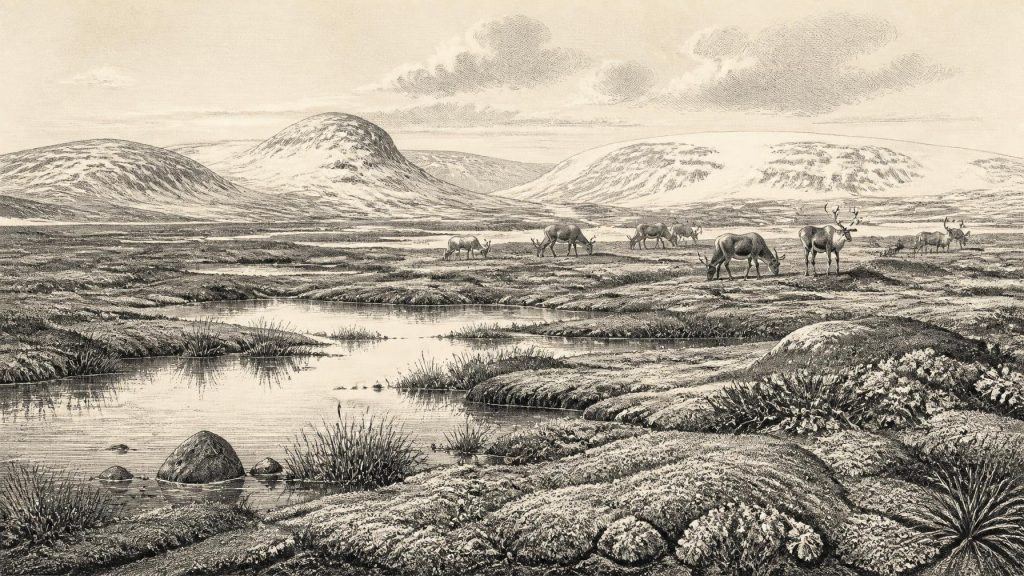
Derryvree’s plant and animal remains indicate a cold, periglacial landscape rather than woodland. Pollen was poorly preserved, but surviving herb pollen, mosses, plant macrofossils and small-animal evidence point towards open tundra vegetation. Species associated with sedges, damp ground, shallow fresh water and sparse herb-rich terrain could flourish during the summer thaw. Moss-rich wetland, pools and saturated silt occurred beside areas where dry ground was thinly vegetated, frost-affected and exposed to strong seasonality.
This should not be imagined as an unbroken white wasteland. The environmental evidence supports a varied mosaic: cold-water pools, wet margins, sedge beds, mosses, low herbs and patches of open mineral ground. Yet it would have been a difficult country. Long winters, frozen ground and limited plant productivity constrained life; thawing seasons altered drainage and made particular places temporarily richer. A few grains of tree pollen do not prove a nearby forest, since pollen can travel far. The broader botanical assemblage makes sparse, treeless vegetation the sounder interpretation.
Regional variation was certainly important, although it cannot be mapped in annual detail. Fermanagh’s enclosed lowlands and freshwater basins were unlike the limestone caves of north Cork, the Atlantic-facing western seaboard or high ground in the west and south. Ireland’s present shoreline did not exist: lower global sea levels exposed much of the surrounding continental shelf. Whether all practical routes into Ireland were dry, glaciated, marine or intermittently passable is still debated, and no evidence allows a precise route to be assigned to any possible visitors. What is secure is that Ireland formed part of a wider north-west European world in which ice margins, rivers, coasts and animal ranges repeatedly changed.
Castlepook’s Reindeer Bone
The nearest potentially human evidence is from Castlepook Cave, also called Mammoth Cave, near Doneraile in north County Cork. The cave’s old collections contain a rich but time-mixed Ice Age fauna, including reindeer, woolly mammoth, giant deer, brown bear, wolf, Arctic fox, mountain hare, lemmings and spotted hyaena. These animals were not necessarily contemporaries. Their bones accumulated over a very long interval, and cave deposits are especially difficult to interpret because carnivores, water, sediment movement, excavation and nineteenth- and early twentieth-century collecting can disturb associations.
A reindeer femur from Castlepook has been interpreted by the palaeozoologist Ruth Carden as carrying a deep cut or chop made by a sharp stone tool while the bone was fresh. County Cork heritage interpretation places it broadly at about 31,000 BC. If this identification is sustained, it is potentially Ireland’s earliest evidence of people handling an animal: perhaps stripping meat, hide or sinew from a carcass, or processing it for marrow. It is an arresting possibility, but it must remain a carefully qualified one.
The femur is not a settlement. No securely associated stone-tool assemblage, hearth, dwelling surface, human burial or repeated occupation floor of this age has been found in Ireland. Nor can the bone tell us whether people killed the reindeer, found it dead, butchered it outside the cave, or arrived as a family group, a small hunting party or an isolated traveller. Carnivores may have carried remains into the cave after human activity elsewhere. The most that can responsibly be said is that the object may record a brief Upper Palaeolithic human action in Ireland within the broad period surrounding this date.
The cave fauna does, however, establish that large grazing animals and their predators reached the island during MIS 3. Reindeer were adapted to cold, open environments and could have moved seasonally across extensive grazing country. Mammoth and giant deer signal a wider terrestrial ecosystem, while hyaena remains caution against treating caves as human homes or larders. A cave could be a den, a refuge, a trap for bones carried in by scavengers, or all of these at different times. The distinction is central to honest archaeological interpretation.
Society Without a Settlement Record
There is no evidence from Ireland around 30,822 BCE for political institutions, chiefs, territories, diplomacy, warfare or formal alliances. Nor is there evidence for farming, permanent villages, metalworking, pottery, monuments, regular exchange networks or organised seafaring. It would be misleading to fill these absences with scenarios borrowed from much later Irish prehistory. The Neolithic farming communities, megalithic tomb builders and historic polities of Ireland lay tens of millennia in the future.
If Castlepook’s mark is human-made, the best comparison is not with later settled societies but with mobile Upper Palaeolithic foragers elsewhere in north-west Europe. Such people depended on knowledge of animal movement, weather, fuel, shelter, stone and seasonal food. They could have used sharp stone edges, hides and organic equipment, much of which would rarely survive. But that comparison remains an interpretation drawn from wider European archaeology, not direct proof of a particular Irish group, language, identity, belief or social organisation.
For the same reason, religion and learning remain beyond the evidence. There are no known ritual sites, artworks, graves, markings, musical instruments or symbolic objects from Ireland securely attributable to this horizon. A person capable of making a cut with a stone tool would, of course, have possessed learned skills; practical knowledge must have been transmitted somehow if visitors came. Yet archaeology cannot identify a tradition, story, ceremony or teaching community from one modified bone. Silence in the record is not evidence that people lacked culture; it is evidence that this particular culture has not survived in recoverable form.
Economy, Movement and Loss
In the narrowest defensible sense, the economy visible at Castlepook would be the direct use of animal resources. A reindeer carcass could supply meat, fat, hide, sinew and bone, all valuable to a mobile foraging party. But even that proposition is conditional on accepting the human origin of the mark. There is no basis for describing trade, tribute, market exchange or sustained contact between communities within Ireland. Any human presence may have been episodic rather than permanent.
The later growth of ice is part of the explanation for this scarcity. Reconstructions of the last British–Irish Ice Sheet show major expansion after the MIS 3 interval represented at Derryvree, with maximum conditions later, broadly around 27,000–23,000 years ago. Advancing ice eroded, rearranged and buried older ground surfaces. It almost certainly destroyed much evidence of fleeting human activity, while leaving occasional protected archives beneath till or inside caves. Absence of sites, then, should not be mistaken for certain absence of people.
Thirty thousand years ago, Ireland’s history was chiefly environmental because environmental archives are what remain. Derryvree preserves a cold freshwater world between glacial episodes. Castlepook preserves an animal community and one tantalising possible toolmark. Together they make 30,822 BCE a date of disciplined uncertainty: a period in which Ireland supported life in demanding conditions, may have been visited by hunters, and was moving towards the far more extensive glaciation that would reshape the island and erase much of what had gone before.
Primary Sources
- A Middle Midlandian Freshwater Series at Derryvree, Maguiresbridge, County Fermanagh, Northern Ireland
- Palaeoecology
- Heritage Artefacts of County Cork
- Archaeology Research Excavation Grant 2022
- The Irish Quaternary Fauna Project
- Proceedings of the Royal Irish Academy
- Advances in Irish Quaternary Studies
- The Last Irish Ice Sheet: Extent and Chronology
- Dimensions and Chronology of the Last Ice Sheet in Western Ireland
- Trimlines, Blockfields and the Vertical Extent of the Last Ice Sheet in Southern Ireland
- Response of the Irish Ice Sheet to Abrupt Climate Change During the Last Deglaciation
- Sedimentology and Chronology of the Advance and Retreat of the Last British-Irish Ice Sheet on the Continental Shelf West of Ireland
- Growth and Retreat of the Last British–Irish Ice Sheet, 31,000 to 15,000 Years Ago: the BRITICE-CHRONO Reconstruction
- Timing, Pace and Controls on Ice Sheet Retreat: an Introduction to the BRITICE-CHRONO Transect Reconstructions of the British-Irish Ice Sheet
- Stratigraphic and Palaeo-Geomorphological Evidence for the Glacial-Deglacial History of the Last British-Irish Ice Sheet in the North-Western Irish Sea
- Magnetic Signature of European Margin Sediments: Provenance of Ice-Rafted Debris and the Climatic Response of the British Ice Sheet During Marine Isotope Stages 2 and 3
- The IntCal20 Northern Hemisphere Radiocarbon Age Calibration Curve (0–55 cal kBP)
- IntCal Publications
- New Insights on the Fauna of Ireland's Younger Dryas and Early Holocene from Alice & Gwendoline Cave
- The Mesolithic in Ireland: When Was It?
- Quaternary Geological Map of Ireland
- Outreach and Education Resources