
BIRM-166’s Buried Basin30823 BCE
Around 30,823 BCE, Ireland lay within the climatically unstable Late Pleistocene MIS 3, not a historically recorded year. At Derryvree, County Fermanagh, freshwater sediments dated by BIRM-166 were sealed between glacial tills, documenting an ice-free periglacial wetland with mosses, sedges, aquatic plants, insects and treeless tundra-like ground. Castlepook Cave, County Cork, preserves mixed remains of mammoth, reindeer, giant deer, bear, wolf, Arctic fox, lemmings and hyaena, indicating cold open habitats across overlapping periods. A marked reindeer femur may suggest human butchery, but cannot establish settlement. Growing ice later reshaped landscapes and erased much evidence of earlier life across Ireland itself.
Dateline
Modern calendar-year precision is not available for Ireland at this depth in time. 30,823 BCE is a modern chronological label, equivalent to roughly 32,772 years before the 1950 reference point used in radiocarbon dating, not a year recorded or named by anyone then living. There are no texts, rulers, settlements, battles or dated human lives to recover. The responsible subject is therefore not an event in one year, but Ireland during the later part of the Late Pleistocene, within Marine Isotope Stage 3 (MIS 3), a long and climatically unstable phase of the last Ice Age.
The most useful Irish evidence close to this notional date is a buried freshwater deposit at Derryvree, near Maguiresbridge in County Fermanagh. Its radiocarbon age, its position between glacial deposits, and its fossil plants and invertebrates provide a rare environmental window. Cave bones from Castlepook, near Doneraile in County Cork, widen the picture by showing that a striking range of large mammals and predators occupied Ireland during overlapping parts of MIS 3. Neither source supplies a diary for 30,823 BCE. Together they show an island of cold wetlands, open ground, mobile animal populations and advancing ice, with only a disputed hint of human activity.
A Date Inside a Range
Derryvree was exposed during road works in 1969, when a cutting passed through a drumlin about two kilometres north-east of Maguiresbridge. Beneath the familiar rounded hill was an unusually revealing sequence: a lower sheet of till, freshwater silts and fine sands with organic muds, and an upper sheet of till. Till is the unsorted mixture of clay, stones and other debris laid down by glacier ice. The order of the layers is secure. Ice had occupied the locality; later, fresh water, plants and sediment accumulated in an ice-free interval; then a subsequent glacial advance buried and protected the wetland record.
Organic material from the freshwater deposits produced the conventional radiocarbon determination BIRM-166, 30,500 radiocarbon years before present, with a large uncertainty of approximately 1,100 years. Radiocarbon years are not calendar years: atmospheric carbon-14 has varied over time, so determinations must be calibrated against independently dated records. Published calibration of BIRM-166 has placed it broadly at about 36,900–31,700 calibrated years before present, equivalent approximately to 34,950–29,750 BCE. The modern label 30,823 BCE falls within that wide span. It does not date a particular season, pool, animal or human action to this exact numbered year.
That imprecision is not a defect to be concealed; it is central to the evidence. The Derryvree mud accumulated over time, and the date applies to organic material within a deposit, not to the whole landscape. Moreover, later glaciation removed or disturbed much of Ireland’s older Pleistocene record. Derryvree survives because it was sealed beneath later sediment. It can illuminate the kind of environment present in north-central Ireland around this period, but it cannot be turned into a map of the entire island on a single day.
Wet Ground Between Ice Advances
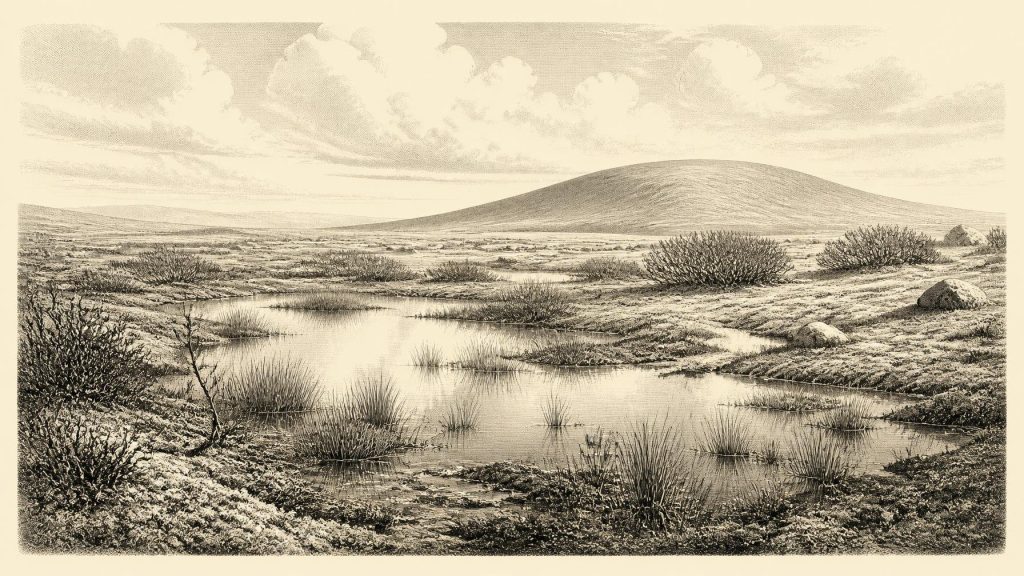
The fossil evidence from Derryvree indicates a cold, open and wet landscape rather than woodland, pasture or permanent ice cover. The freshwater series contained mosses, sedges, pollen, plant macrofossils and invertebrate remains. Plants reported from the deposit include dwarf willow, mountain-avens, lesser clubmoss, bogbean and alternate water-milfoil. Some grew in wet margins or shallow water; others are associated with exposed, cold-climate ground. The strongest conclusion is a periglacial wetland: a terrain subject to severe frost, seasonal thaw, saturated soils and short growing seasons, but locally capable of supporting vegetation and small freshwater habitats.
It should not be imagined as an empty, uniformly frozen plain. Mosses grew, plants flowered during the short productive season, insects occupied wet and dry niches, and fine sediment moved through shallow water. Yet neither was it the green, wooded Ireland familiar from later prehistory. The plant assemblage supports low, treeless vegetation, with pools, marshy hollows and sedge-rich ground. Isolated tree pollen is a weak basis for reconstructing a nearby forest, since pollen can travel far or be redeposited. The local evidence is much firmer for tundra-like and wetland communities than for trees.
At the broadest scale, the interval belonged to MIS 3, when North Atlantic climates shifted repeatedly between relatively milder interstadials and colder stadials. Such shifts could alter snow cover, growing seasons, drainage and glacier margins within spans far shorter than conventional archaeological periods. Ireland’s later Last Glacial Maximum was still to come: syntheses place the principal build-up of the British–Irish Ice Sheet after about 35,000–32,000 years ago, with maximum extent broadly between 27,000 and 21,000 years ago. Around the date considered here, glacial expansion was becoming a decisive force, but conditions and ice cover varied sharply by region.
An Island of Large Mammals
Castlepook Cave, also called Mammoth Cave, near Doneraile offers a second, very different archive. Excavated chiefly in the early twentieth century, its galleries yielded Ireland’s richest known assemblage of Pleistocene vertebrates. The cave fauna includes woolly mammoth, reindeer, giant deer, brown bear, wolf, Arctic fox, mountain hare, lemmings and spotted hyaena. The National Museum of Ireland holds important material from the site, including a spotted-hyaena skull. These remains make clear that Ireland supported, during parts of the late Ice Age, animal communities wholly unlike those of the modern island.
Dates from Castlepook must be used with care. The cave accumulated bones over a long interval; carnivores, water movement, collapse and early excavations all affected the deposits. Modern redating has also shown that several older radiocarbon measurements were substantially too young, demonstrating why individual dates and contexts need continual reassessment. A mammoth bone or a hyaena skull proves that the animal, or part of it, reached the cave. It does not necessarily prove that all the recorded species lived together, that the cave was a hunting camp, or that its fauna represents conditions in every Irish region at once.
Nonetheless, Castlepook strongly supports the wider ecological interpretation. Reindeer and lemmings are consistent with cold open environments; mammoths and giant deer point to extensive grazing country somewhere within their ranges; wolves and hyaenas indicate large carnivores capable of exploiting carcasses and prey. Hyaenas could transport bones into dens, complicating any simple reading of the assemblage. The cave was therefore a natural archive, perhaps at times a carnivore refuge or den, rather than a neatly preserved snapshot of a single living landscape.
The Reindeer Femur Question
One Castlepook object matters especially for Ireland’s human story: a reindeer femur reported to bear a deep linear mark interpreted as damage made by a sharp stone implement during butchery. A County Cork heritage publication assigns the bone approximately to 31,000 BCE and identifies the interpretation with the zoologist Ruth Carden. If that assessment is sustained, it would be remarkable evidence that people handled or processed a reindeer in Ireland in the Upper Palaeolithic, vastly earlier than the long-established record of post-glacial settlement.
The claim must not be enlarged beyond the object. The femur is not a securely associated stone-tool assemblage, hearth, dwelling surface, burial, food store or repeated concentration of butchered animals. Its age is the age of the bone, not an annual date for the mark. Nor can it show whether the animal was killed locally, processed in the cave, scavenged by people, or carried there later by carnivores. It offers a serious question for research, not proof of a settled population in Ireland in 30,823 BCE.
Society Without a Recorded Society
There is no direct Irish evidence from this date for villages, kin groups, political authority, warfare, diplomacy, religion, art, formal learning, farming, trade routes or seafaring. No language can be identified, and no later national, ethnic or cultural label should be projected backwards onto this landscape. Political history, in the ordinary sense, has not yet begun in the evidence.
If people did reach Ireland during this period, comparison with Upper Palaeolithic hunter-gatherers elsewhere in north-west Europe suggests that survival would have required close knowledge of animal movement, weather, fuel, shelter and workable stone. That is a reasonable general inference, but it remains an inference rather than demonstrated Irish social history. There is no securely dated Irish camp from which to reconstruct household size, seasonal routine, hunting technology or belief. The most defensible conclusion is more restrained: humans may have made brief incursions into an ecologically demanding Irish landscape, but their presence at this date is unconfirmed beyond the contested implication of one modified bone.
Nor should lowered sea levels be converted automatically into a known land bridge or easy route. The exposed continental shelf, the position of ice and the changing Irish Sea basin created a complicated geography. The movement of mammals demonstrates intermittent ecological connection with the wider north-west European world, but does not by itself reveal precisely how, when or along which route each species or any humans arrived.
What This Year Can Mean
The dominant development around this point was environmental, not political: the interplay of cold, wetland life and growing ice. At Derryvree, a freshwater basin supported mosses, sedges, aquatic plants and cold-adapted terrestrial vegetation during a locally ice-free interval. At Castlepook, over a broader and mixed timespan, bones record mammals and predators adapted to open, severe Late Pleistocene landscapes. Subsequent glaciation would reshape drainage, scour terrain and destroy much evidence of the worlds that came before it.
For 30,823 BCE, then, Ireland’s history is best approached through a buried basin rather than a named event. BIRM-166 does not preserve a lost year. It preserves something both humbler and more durable: proof that life persisted in a cold Fermanagh wetland between episodes of glaciation, and a chronological framework within which Ireland’s deepest human and environmental past can still be investigated.
Primary Sources
- A Middle Midlandian Freshwater Series at Derryvree, Maguiresbridge, County Fermanagh, Northern Ireland
- A Reconsideration of the Radiocarbon Dating of the Marine Isotope Stage 3 Fauna from Southern Ireland
- The Irish Quaternary Fauna Project
- New Insights on the Fauna of Ireland's Younger Dryas and Early Holocene from Alice & Gwendoline Cave
- Extent and Timing of the Last Glacial Maximum (LGM) in Britain and Ireland: A Review
- Exploring Controls of the Early and Stepped Deglaciation on the Western Margin of the British-Irish Ice Sheet
- Trimlines, Blockfields and the Vertical Extent of the Last Ice Sheet in Southern Ireland
- Deglaciation Chronology of the Donegal Ice Centre, North-West Ireland
- Castlepook Cave, County Cork: County Geological Site Report
- Spotted Hyena Skull
- 2022:564 – Castlepook Cave, Castlepook South, Cork
- The Exploration of Castlepook Cave, County Cork
- Middle Midlandian Interstadial Deposits at Greenagho, Near Belcoo, County Fermanagh, Northern Ireland
- The IntCal20 Northern Hemisphere Radiocarbon Age Calibration Curve (0–55 cal kBP)
- IntCal Publications
- The Problem of a Late Quaternary Landbridge Between Britain and Ireland
- The Marine δ18O Record Overestimates Continental Ice Volume During Marine Isotope Stage 3
- Dansgaard–Oeschger Events in Climate Models: Review and Baseline Marine Isotope Stage 3 Protocol
- Quaternary Site Descriptions
- Irish Quaternary Association: Outreach and Education Resources
- BSBI: Salix herbacea
- BSBI: Myriophyllum alterniflorum
- Occurrence of Mammalia Relicts at Site Castlepook Cave
- Heritage Artefacts of County Cork