Elephant Hall Metacarpal30804 BCE
Around 30,804 BCE, Ireland formed part of a cold, unstable Late Pleistocene landscape, with changing ice margins, low sea levels and uncertain routes to Britain and Europe. Castlepook Cave in County Cork preserves Ireland’s richest pre-Last Glacial Maximum vertebrate archive, documenting reindeer, mammoth, hyaena, giant deer and other fauna accumulated over millennia, rather than one moment. These animals indicate episodically productive open habitats. No secure evidence establishes human settlement, tools, hearths or communities. A marked reindeer bone may record stone-tool butchery, suggesting a brief human visit, but its interpretation remains uncertain. Future excavation and analysis may clarify Ireland’s human presence.
Dateline
The label 30,804 BCE gives a useful point of reference for a very remote past, but it cannot identify an event that happened in one Irish year. No calendar, written record, named community or excavated occupation surface permits that precision. In conventional terms the date lies about 32,750 calendar years before AD 1950, during the Late Pleistocene and broadly within Marine Isotope Stage 3 (MIS 3). At this depth of time, radiocarbon determinations must be calibrated and expressed as ranges; cave deposits and animal remains generally represent episodes spread across centuries or millennia. The responsible history of Ireland at this point is therefore one of environments, animal movements, ice-sheet change and a tantalising but unproven human trace.
A Changing Ice-Age Island
Ireland was not yet the wholly ice-covered landscape associated with the later Last Glacial Maximum. That maximum lay in the future, although the British–Irish Ice Sheet was already developing through a sequence of advances, retreats and shifting margins. Recent glaciological syntheses stress that the configuration of ice during MIS 3 remains less securely dated than that of the later maximum. It would be unsafe, therefore, to draw a single coast-to-coast ice front for 30,804 BCE or to claim that every part of Ireland was either habitable or glaciated at once.
What can be said is that the island’s geography, climate and coastlines differed radically from those of modern Ireland. Global sea level was lower, the continental shelf was more exposed, and the surrounding seas, channels and ice margins changed the practical possibilities of movement. Ireland may at times have been more closely connected environmentally to western Britain and north-western Europe than it is today, but the exact routes open at any particular moment remain disputed. A lower sea level does not by itself prove a walkable land bridge, nor does it demonstrate that people crossed it.
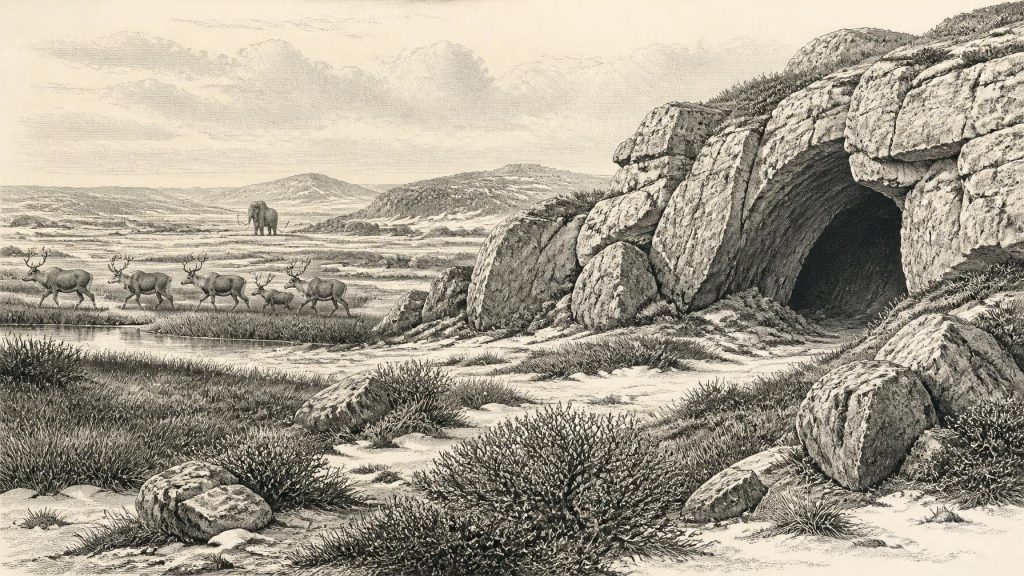
Climate oscillated sharply during MIS 3. Greenland ice-core records reveal repeated abrupt changes between relatively milder interstadials and colder stadials; the exact correspondence of those northern signals to a particular Irish valley is not simple. Around this notional date, Irish conditions are best envisaged as cold, exposed and unstable rather than as permanently frozen everywhere. Open grassland, herb-rich steppe-tundra, patches of low shrub vegetation, bare mineral ground and wet hollows could occur where ice did not dominate. Trees, if present at all in the wider region during colder phases, cannot be assumed to have formed Irish woodland.
What the Caves Preserve
The most important Irish evidence for this broad period comes from Castlepook Cave, also called Mammoth Cave, near Doneraile in north County Cork. Its maze of limestone passages includes chambers given evocative names by earlier investigators, among them Elephant Hall, Hyaena Hall and the Gallery of Aged Carnivores. These names are modern labels, not prehistoric ones, but they reflect the remarkable animal collection recovered there. Castlepook is Ireland’s richest known archive of vertebrate remains from the interval before the Last Glacial Maximum.
Radiocarbon measurements from Castlepook have returned a wide spread of ages. Bones attributed to mammoth, reindeer, brown bear, giant deer and spotted hyaena include specimens dating to the middle part of the last Ice Age, while other remains are much younger. Geological Survey Ireland describes the overall dated sequence as extending roughly from 45,700 to 19,950 radiocarbon years before present. Those figures are not calendar ages, and they do not mean that all the creatures met in a single landscape, season or generation. They instead establish that the cave received animal remains across a long and environmentally variable period.
This qualification matters especially at 30,804 BCE. A reindeer metacarpal from Elephant Hall, for example, produced a conventional radiocarbon age of 35,200 ± 950 BP; a mammoth rib from the same chamber produced 34,100 ± 840 BP. Calibration turns such determinations into broad, non-linear calendar ranges, not a date that can be matched mechanically to a numbered BCE year. The Castlepook record nevertheless makes one conclusion secure: before the later ice maximum, southern Ireland supported, or was periodically reached by, a much richer large-mammal fauna than the modern island.
Reindeer, Mammoth and Hyaena
Reindeer are particularly revealing. They are animals adapted to open, cold environments and their presence fits a landscape with extensive grazing rather than closed forest. Giant deer, brown bear, wolf, Arctic fox, mountain hare, Norwegian lemming and collared lemming add to the picture, though each species has its own chronology and ecological tolerance. Woolly mammoth is the most arresting member of the fauna. Its remains show that Ireland was, at least episodically, part of the wider north-west European world of large herbivores and their predators.
Spotted hyaena is equally important. Castlepook is the key Irish locality for this predator and scavenger. Hyaenas could drag bones into dens, crush them, leave tooth marks and mix material from different prey animals and moments in time. Water, sediment movement, roof collapse and the disruptive effect of early excavation also altered deposits. A cave bone assemblage is therefore not a frozen snapshot of a living herd beside a cave entrance. It is an archive created by animal behaviour and geological processes, then further transformed by human collection and curation.
Everyday life in this ecosystem was consequently governed by mobility and seasonality. Herd animals sought forage across wide open ground; carnivores followed prey and scavenging opportunities; small mammals occupied specialised cold-climate habitats. The evidence supports the existence of a productive, if severe, fauna in parts of Ireland, not an image of a uniform white wilderness. Yet it cannot establish the colours of a particular season in 30,804 BCE, the exact size of a reindeer herd, or whether mammoths and hyaenas were contemporaries at Castlepook.
The Question of People
There is no securely excavated house, hearth, stone-tool assemblage, human burial, artwork or cemetery in Ireland that can be dated to this period. There were no states, chiefs known by name, political boundaries, diplomatic relations or religious institutions that archaeology can responsibly recover. It would be misleading to populate the island with an imagined settled Palaeolithic society merely because Upper Palaeolithic groups were living elsewhere in Europe.
One object has nonetheless reopened the question. A reindeer femur from Castlepook, held in the National Museum of Ireland’s natural-history collections, was publicised after re-examination as bearing a deep mark consistent with cutting or chopping by a sharp stone tool. County Cork heritage material associates it with an age around 31,000 BC. If the modification proves to be a fresh-bone stone-tool mark, it may indicate that people processed a reindeer in Ireland during the earlier part of the last Ice Age.
That is a significant possibility, but it remains a limited one. The bone does not derive from a modern controlled excavation with associated tools, charcoal, hearths, repeatedly butchered remains and an undisturbed occupation floor. Its date primarily concerns the death of the animal, while identifying the mark requires a separate taphonomic judgement against damage from carnivores, sediment, breakage and excavation. Even a confirmed human cut would show an encounter with a carcass, not permanent settlement, a named group, a population size or a route of arrival. At most, it would suggest a brief visit by highly mobile hunter-gatherers operating at the western edge of Upper Palaeolithic Europe.
Society Beyond Recovery
It is possible to describe the practical demands that any visitors would have faced. Small groups in comparable northern European settings needed intimate knowledge of animal movements, weather, shelter, stone, fuel and safe travel. Reindeer could provide meat, fat, hide, sinew, antler and bone; mammoths and giant deer represented immense but dangerous resources. Such observations are informed comparisons, however, not direct evidence for a camp at Castlepook. No Irish artefacts of this age reveal tool-making traditions, clothing, language, kinship, ritual or learning.
Nor is there evidence for trade in the later sense. Long-distance social contacts may have mattered to Upper Palaeolithic people elsewhere, but no imported object, quarry source or exchange network can presently be demonstrated for Ireland around this date. The sea, lowered though it was, remained a crucial geographical fact, while advancing or retreating ice could either block travel or create new corridors. For the island’s human history, the central question is not which polity controlled the land, but whether people entered it at all and, if they did, how often.
Evidence, Not a Dated Episode
The enduring importance of 30,804 BCE lies in the contrast between its apparent exactness and the evidence’s genuine scale. Ireland was within a cold, dynamic Late Pleistocene world. Castlepook Cave preserves proof of a diverse fauna, including reindeer, mammoth and hyaena, and of environments capable of sustaining large mammals before the Last Glacial Maximum reshaped the island. It also preserves a provocative possible sign of human butchery. But it does not yield a year-specific incident.
Future work may narrow these uncertainties. Renewed excavation at Castlepook has located surviving sediments in areas missed or disturbed by earlier digging, while improved radiocarbon methods, microscopic study of bone surfaces, ancient biomolecular techniques and better ice-sheet modelling can test older conclusions. Until then, this point in Ireland’s past should be understood not as the year of a first settlement or a famous hunt, but as part of a long Ice-Age interval in which animals certainly moved through a changing Irish landscape and humans may have done so briefly.
Primary Sources
- The Irish Quaternary Fauna Project
- New Insights on the Fauna of Ireland’s Younger Dryas and Early Holocene from Alice & Gwendoline Cave
- Castlepook Cave: County Geological Site Report
- Heritage Artefacts of County Cork
- Preliminary Assessment of the Archive of Faunal Remains from Excavated Irish Cave Sites
- 2022:564 – Castlepook Cave, Castlepook South, Cork
- Archaeology Research Excavation Grant 2022: Castlepook Cave Final Report
- A Natural Heritage Area Survey of County Cork: Areas of Scientific Interest
- The Timing and Magnitude of the British–Irish Ice Sheet Between Marine Isotope Stages 5d and 2
- Growth and Retreat of the Last British–Irish Ice Sheet, 31,000 to 15,000 Years Ago: The BRITICE-CHRONO Reconstruction
- Late Pleistocene Chronostratigraphy and Ice Sheet Limits, Southern Ireland
- Trimlines, Blockfields and the Vertical Extent of the Last Ice Sheet in Southern Ireland
- Dating Constraints on the Last British-Irish Ice Sheet: A Map and Database
- BRITICE-CHRONO: Project Introduction
- Project Findings Provide Essential Insight into the Last British–Irish Ice Sheet
- The IntCal20 Northern Hemisphere Radiocarbon Age Calibration Curve (0–55 cal kBP)
- Greenland Ice-Core Chronology 2005 (GICC05) for Various Greenland Ice Cores
- NGRIP/GRIP GICC05 Time Scale and δ18O Data
- Mammoth Cave (Castlepook Cave)
- The Dungarvan Valley Caves Project: Second Interim Report