Castlepook’s Mammoth-Reindeer World30762 BCE
Nominally dated 30,762 BCE, this period belongs to Ireland’s fluctuating Late Pleistocene MIS 3, not a precisely identifiable year. Ice margins, sea passages and habitats changed regionally, leaving fragmentary evidence. Derryvree, County Fermanagh, preserves freshwater sediments, bogbean and mountain avens, indicating a local cold, tundra-like wetland during an ice-free or ice-marginal interval. Castlepook Cave, County Cork, contains Late Pleistocene remains including mammoth, reindeer, giant deer, predators and smaller cold-adapted animals, accumulated across several episodes. Human presence remains unproven: a possibly cut-marked reindeer bone suggests investigation-worthy visitation, not settlement. Ireland’s history here is palaeoecological, shaped by environmental instability and uncertain preservation.
Dateline
“30,762 BCE” is a modern label imposed on a time for which Ireland has no written record, no indigenous calendar and no archaeological sequence precise enough to identify a single year. It should therefore not be read as the date of an event. In radiocarbon practice, “before present” is counted from 1950, so this nominal year lies roughly 32,700 years before present in simple calendar arithmetic; that is not the same thing as a calibrated archaeological age. At this depth of time, radiocarbon measurements must be converted through a calibration curve and commonly resolve only into ranges, sometimes broad or discontinuous ones. The responsible subject is consequently Ireland during the later part of Marine Isotope Stage 3: a cold, changeable phase of the Late Pleistocene, long before the Last Glacial Maximum.
The evidence does not permit a conventional annual history of rulers, battles, treaties or settlements. There are no demonstrable political communities in Ireland to name, no securely identified dwelling, hearth, tool assemblage, grave, shrine or exchange network dating specifically to this point. What can be recovered is more fundamental: a fragmentary record of wetland plants, glacial deposits, cave sediments and animal bones. Together, those sources show that parts of Ireland could support life during intervals of the last cold stage, even though advancing ice, later erosion and antiquarian excavation have removed or disturbed much of the evidence.
A Cold-Stage Island
Ireland was already an island or near-island on the Atlantic fringe, not a simple western extension of continental Europe. Lower global sea levels altered coastlines, but any route for people or land animals was conditioned by changing sea passages, ice margins and terrain. The wider British–Irish Ice Sheet was not static. Recent synthesis identifies growth before the Last Glacial Maximum, with dynamic retreat and advance during MIS 3, while stressing that the geographical extent of that earlier ice is much less securely dated than the later maximum. Thus it is unsafe to imagine either an entirely ice-covered Ireland or a uniformly open island at 30,762 BCE. Conditions varied sharply by region and through time.
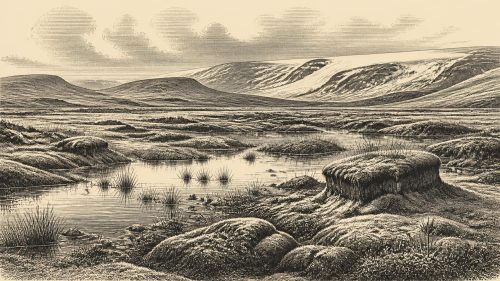
The useful archaeological term is therefore not a national “Ice Age landscape” but a mosaic. In northern Fermanagh, a road cutting at Derryvree near Maguiresbridge exposed freshwater organic sediments enclosed between glacial tills. This rare survival is conventionally dated to about 30,500 radiocarbon years BP. Its calendar equivalent is older than the radiocarbon number and should be calibrated with a current curve rather than casually translated into a BCE year. It nevertheless places a real freshwater environment in the broad chronological neighbourhood of the date considered here. The deposit is evidence for a local ice-free or ice-marginal basin when it formed; it is not evidence that all Ireland was similarly open.
Derryvree’s Living Basin
Derryvree offers the clearest environmental counterweight to any picture of an utterly lifeless frozen island. Plant macrofossils from the freshwater series include bogbean (Menyanthes trifoliata) and mountain avens (Dryas octopetala). These are tangible remains of plants, not merely climatic assumptions derived from modern distributions. They point to shallow water or wet ground beside open, cold-country vegetation. Mosses, sedges and small herbaceous plants belong in this scene more readily than forest: woodland was not the dominant setting indicated by the deposit. The inference of tundra-like, periglacial conditions is well founded, but it remains a reconstruction of a particular basin and its catchment, not a photograph of the entire island.
Such wetlands mattered ecologically. Meltwater, ponds and sedge margins created concentrated food and drinking places in a sparse landscape, while surrounding open ground could sustain grazing animals. Seasonal thaw, frost-heave, wind and sediment movement would have made the terrain difficult but not uniform. The later glacial landforms so conspicuous in Ireland—drumlins, eskers, U-shaped valleys and deposits of till—are reminders that ice repeatedly reshaped the country, buried older surfaces and disrupted the survival of archaeological traces. The exceptional value of Derryvree lies in the fact that an organic interval escaped that destructive history long enough to be recorded.
The Cave Evidence of Southern Ireland
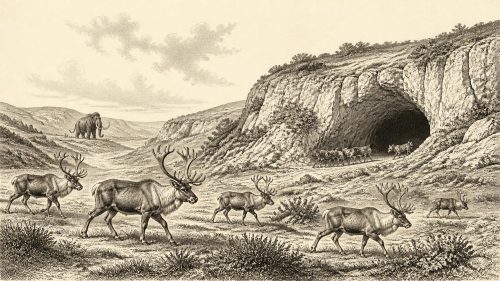
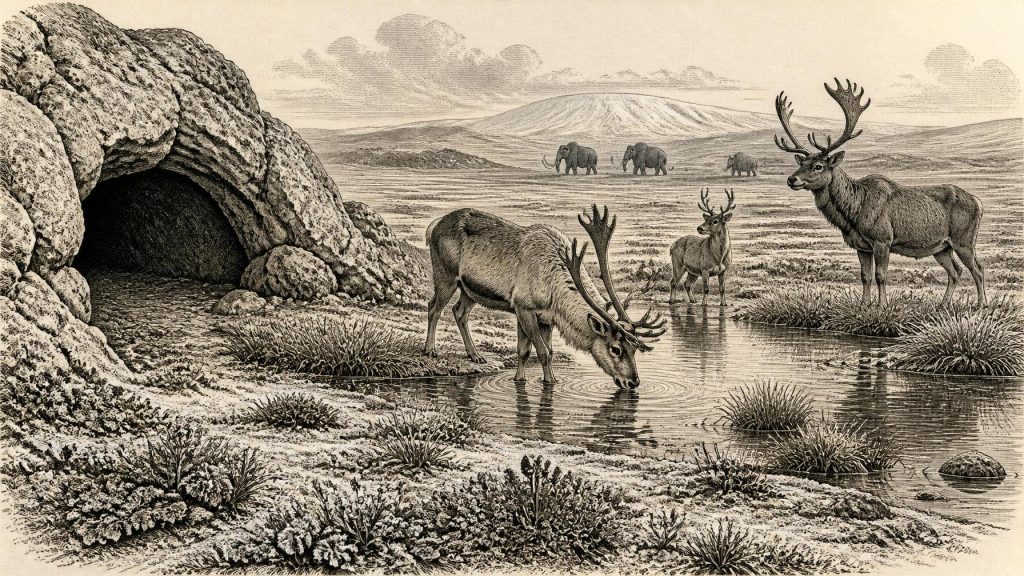
In north Cork, Castlepook Cave near Doneraile is the principal faunal archive relevant to this era. Its deposits and museum collections have yielded remains attributed to woolly mammoth, reindeer, giant deer, brown bear, wolf, Arctic fox, lemmings and spotted hyaena. Not every species necessarily lived together at one moment, and a cave bone assemblage is not a census of the local countryside. Carnivores could carry carcass parts into caves; sediments could be moved; and bones from several episodes could become mixed. Yet direct dating shows that Castlepook preserves mammals from several phases of the Late Pleistocene, including MIS 3, rather than a single undifferentiated “Ice Age” fauna.
For the broad period around 30,762 BCE, the mammoth–reindeer–giant deer association is especially evocative, but it should be handled carefully. Reindeer suggest open, cold-adapted grazing country; mammoth and giant deer add to the impression of substantial herbivore biomass; hyaena and wolf indicate carnivores able to exploit it. This was not modern Ireland with its familiar woods, pasture and livestock. It was a Pleistocene ecosystem in which animals now absent from the island moved through exposed valleys and limestone country. The remains also show that Ireland’s animal history was more varied than a simple story of post-glacial recolonisation. The Irish Quaternary Fauna Project concluded that a broad mammal fauna reached Ireland between at least about 45,000 and 20,000 years ago, though individual species and local habitats changed repeatedly within that long span.
A Question of Human Presence
Human history at this date is the most important uncertainty. The National Museum of Ireland has long stated that no clear Palaeolithic evidence demonstrates human presence in Ireland; its prehistoric sequence begins securely with post-glacial hunter-gatherers. The oldest established settlement evidence remains much later, at Mount Sandel in County Londonderry, where occupation began around 9,800–9,600 calibrated years BP. This enormous chronological gap means that the tools, houses, kinship structures, language, ritual practices and trade links of any people who might have briefly entered Ireland around 30,762 BCE are unknown. They must not be supplied from Upper Palaeolithic France, Britain or elsewhere as if they were Irish facts.
Castlepook nevertheless raises a significant possibility. A reindeer femur from the cave’s old collection has been reported as bearing a deep linear mark consistent with cutting by a sharp stone implement and as dating to roughly 33,000 radiocarbon years BP. If microscopic study, dating and context ultimately sustain that interpretation, it would show that a human handled and processed a reindeer carcass in Ireland during the Upper Palaeolithic. It would not, by itself, prove a permanent population, a camp at Castlepook, a named hunting group or continuous occupation. The bone was recovered during early twentieth-century cave exploration, when excavation and recording standards were far below modern practice; later research has also shown that some earlier Irish cave dates required substantial revision after improved bone pretreatment. The mark is therefore promising evidence under investigation, not a licence for a fully populated Ice Age Ireland.
Society Beyond the Evidence
If people did reach Ireland during a favourable MIS 3 interval, the most defensible interpretation is of small, mobile foraging parties rather than villages. They would have required knowledge of seasonal animal movement, shelter, fire, clothing, stone working and safe routes across a hazardous maritime or ice-marginal world. Those propositions describe the practical requirements of survival, not discoveries from an Irish camp of this age. There is no basis for describing chieftains, warfare, diplomatic relations, territorial states, agriculture, metalworking, formal religion, monuments or regular overseas commerce. Equally, absence of evidence should not be turned into certainty that no person ever set foot on the island: it reflects both the fragility of the record and the fact that later ice and water destroyed or concealed many landscapes where traces might once have survived.
Religion and learning are wholly beyond recovery. Animal bones and plant remains can demonstrate environments and sometimes human modification; they cannot reveal stories, beliefs, personal names or spoken languages. Culture survives here as palaeoecology and taphonomy: the study of how organisms lived, died, were transported and were preserved. The difference is vital. A hyaena-chewed bone tells of scavenging or denning behaviour, not human conflict; a fossil bogbean seed demonstrates a wetland plant, not a cultivated resource; and a supposed cut mark needs testing against trampling, excavation damage and other natural processes before it becomes evidence of butchery.
An Island in Motion
The central development around this nominal year was environmental instability. Ireland was part of the north-west European world of rapid climatic oscillation, fluctuating ice margins and changing animal ranges. Derryvree’s freshwater flora records one local cold-stage refuge; Castlepook’s bones record a southern Irish fauna assembled over more than one episode. Their juxtaposition is valuable precisely because it resists a single neat narrative. Fermanagh’s small basin and Cork’s limestone cave preserve different kinds of evidence, at different resolutions, and neither can speak for every coast, mountain or plain.
For Ireland, then, 30,762 BCE is best understood not as a dated chapter in national politics but as a point within a long Pleistocene interval. The island had places where water, tundra plants and large mammals endured; ice was an active force in the wider landscape; and a possible humanly marked reindeer bone keeps open a challenging question about very early visitation. Future dating, re-excavation and microscopic analysis may refine that picture. Until then, the most honest history is one of cave fauna, periglacial wetlands and carefully bounded possibility.
Primary Sources
- A Middle Midlandian Freshwater Series at Derryvree, Maguiresbridge, County Fermanagh, Northern Ireland
- The Irish Quaternary Fauna Project
- A Reconsideration of the Radiocarbon Dating of the Marine Isotope Stage 3 Fauna from Southern Ireland
- New Insights on the Fauna of Ireland's Younger Dryas and Early Holocene from Alice & Gwendoline Cave
- The Timing and Magnitude of the British–Irish Ice Sheet Between Marine Isotope Stages 5d and 2
- Dimensions and Chronology of the Last Ice Sheet in Western Ireland
- Response of the Irish Ice Sheet to Abrupt Climate Change During the Last Deglaciation
- Trimlines, Blockfields and the Vertical Extent of the Last Ice Sheet in Southern Ireland
- The IntCal20 Northern Hemisphere Radiocarbon Age Calibration Curve (0–55 cal kBP)
- Ireland Through Geological Time
- Geology of Ireland
- Spotted Hyena Skull
- Guide to the National Museum of Ireland
- Prehistoric Ireland
- Menyanthes trifoliata
- Dryas octopetala
- Palaeoecology
- Postglacial Conference: Proceedings
- The Colonization of Ireland: A Human Ecology Perspective
- Heritage Artefacts of County Cork
- Radiocarbon Dates from the Oxford AMS System: Archaeometry Datelist 31
- Excavations at Mount Sandel, 1974