Mammoth Cave’s Reindeer Scar30728 BCE
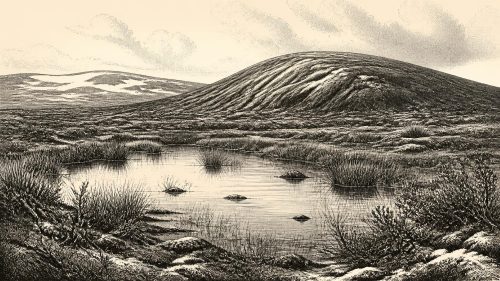
Around 30,728 BCE, Ireland lay within the climatically unstable Late Pleistocene. Sediments at Derryvree in Fermanagh record ice-free intervals of cold, treeless wetland, with pools, sedges, mosses, juniper and dwarf willow. Castlepook Cave in Cork yielded mammoth, reindeer, giant deer and predators, demonstrating a diverse cold-stage fauna. A cut-marked reindeer femur may indicate Upper Palaeolithic butchery by humans, although its date and context remain uncertain. No settlement, tools, hearths or social structures are securely attested. The evidence instead depicts a changing glacial landscape offering possible brief human visitation, while requiring cautious interpretation through future dating, analysis and excavation of deposits.
Dateline
The numbered year 30,728 BCE cannot be recovered as a moment in Irish history in the ordinary sense. No written calendar, settlement record, ruler, battle or named community can be assigned to it. It falls broadly within the Late Pleistocene, during Marine Isotope Stage 3 (MIS 3), a climatically unstable part of the last Ice Age. For this depth of time, responsible chronology is expressed in radiocarbon and calibrated ranges, not single calendar years. The best evidence therefore illuminates an interval around the notional date rather than conditions on a particular day, season or year.
Two Irish records are especially important. Organic sediments exposed at Derryvree, near Maguiresbridge in County Fermanagh, preserve a freshwater and wet-ground environment that existed between episodes of glaciation. A conventional radiocarbon determination of 30,500 ± 1,170/1,030 BP from the sequence has been calibrated and modelled broadly within a range extending into the later 30,000s to earlier 30,000s calendar years before present. The range overlaps the historical horizon represented by 30,728 BCE, but does not date that numbered year itself. Far to the south, Castlepook Cave near Doneraile in north County Cork has produced animal remains dating to roughly 45,000–33,000 years ago. Together, the sites reveal a cold but biologically active Ireland shortly before the major ice expansion of the Last Glacial Maximum.
Open Country Between Ice Advances
Derryvree is valuable because its organic silts were sealed between two tills: sediments left by advancing ice. Road works revealed a temporary environmental archive that would otherwise have been lost beneath later glacial deposits. Plant macrofossils, pollen, mosses and insect remains indicate open, treeless ground, with wet hollows, sedges, mossy vegetation and shallow freshwater. Bogbean and water-milfoil are among the plants that point to standing or slow-moving water. Juniper, dwarf willow, grasses and herbs belong to a low-growing vegetation cover rather than a wooded landscape.
The most defensible description is a tundra or muskeg-like mosaic: waterlogged patches and pools amid exposed, frost-affected ground. Such language needs care. It does not mean that all Ireland was an identical Arctic plain, still less that it lay perpetually under snow. Derryvree records one local basin in what is now County Fermanagh. Slope, drainage, snow cover, altitude and proximity to ice would have created sharp regional differences. Yet the broader interpretation is secure: parts of Ireland were ice-free at times in MIS 3, but conditions were cold enough to prevent forest development and to make seasonal freezing a decisive environmental force.
This was also a changing landscape. The Irish Ice Sheet had not yet reached its Last Glacial Maximum extent, but the later advance that covered much of the island was part of the longer story. Modern reconstructions suggest substantial growth of the Irish Sea sector after about 30,000 years ago, although the timing, thickness and precise margins of earlier ice remain debated. At this point, Ireland should not be imagined either as wholly glaciated or as a stable, uniformly habitable island. It was a northern land repeatedly reshaped by climatic swings, ice build-up, meltwater and periglacial processes.
Castlepook’s Animal World
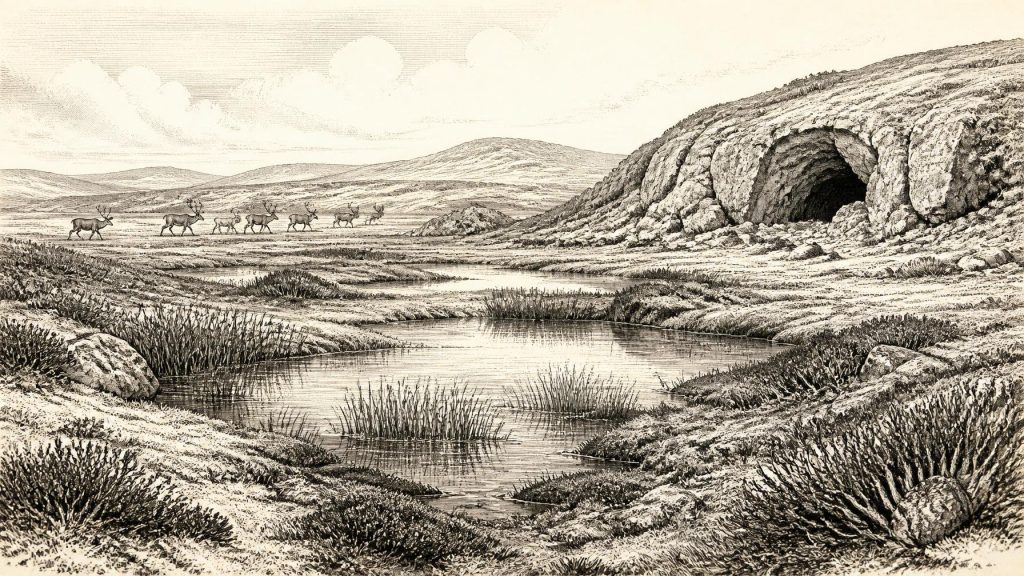
Castlepook Cave, once called Mammoth Cave, gives the clearest Irish view of the large-animal community of this broad period. Antiquarian excavations early in the twentieth century recovered a remarkable bone assemblage, while later work and radiocarbon dating have refined its significance. The cave has produced remains attributed to woolly mammoth, reindeer, giant deer, brown bear, wolf, Arctic fox, hare, lemmings and spotted hyaena. Not every specimen derives from the same moment, and old excavations often mixed material from complex deposits. Nevertheless, the overall assemblage securely demonstrates that Ireland supported, or was periodically visited by, a varied cold-stage fauna before the Last Glacial Maximum.
The presence of both prey animals and predators matters. Reindeer and mammoth evoke open country with grazing opportunities; hares and lemmings strengthen the impression of cold, treeless habitats. Wolves and hyaenas were active carnivores, not merely fossil names. Castlepook may have served in part as a carnivore den, where animals dragged in bones and scavenged carcasses. Hyena tooth damage on some material is a warning against treating every broken or marked bone as humanly altered. A cave bone deposit is a record made by many agents: animals, water, gravity, excavation and later curation as well as people.
The landscape around the cave was therefore neither empty nor gentle. Its food webs included powerful grazers, browsers, scavengers and predators. But it would be misleading to picture a continuous herd-filled plain. The dated evidence demonstrates presence over long spans; it does not establish animal numbers in any one year. Migration, weather and changing access to forage may have altered the local fauna from season to season. Nor does the evidence show that all listed species occupied the same valley at the same time.
A Mark on a Reindeer Femur
The most arresting possible human evidence is a fragment of reindeer femur from Castlepook. Zooarchaeological examination identified a deep linear mark interpreted as having been made on fresh bone by a sharp stone tool during carcass processing. County Cork heritage material places the object broadly around 31,000 BC, while public reporting describes it as approximately 33,000 years old. Those formulations convey its extraordinary antiquity, but they should not be converted into an exact historical date. Radiocarbon years and calibrated calendar years differ, and the dated object belongs within an interval of uncertainty rather than to 30,728 BCE precisely.
If the mark is correctly identified as a cut mark, it is evidence for a human action of limited but profound importance: someone used a stone edge while processing a reindeer in Ireland during the Upper Palaeolithic. It could reflect removing meat, severing tissue or another stage of butchery. It does not prove a permanent settlement beside the cave, a large hunting party, an uninterrupted Irish population or a named archaeological culture. No securely associated hearth, lithic toolkit, dwelling floor or burial of this age has yet been found in Ireland. Recent excavation has located further Pleistocene deposits in the cave system, but it has not yet produced a definitive in-situ Upper Palaeolithic occupation layer.
This distinction between evidence and interpretation is central. The femur is direct physical evidence for the bone and its modification; the identity of the modifier and the circumstances of butchery are interpretations tested through microscopy, dating, experimental comparison and cave-context study. The cautious conclusion is that Castlepook offers a serious, potentially transformative indication of brief human activity. It is not yet a full settlement history. The possibility that small, mobile groups reached Ireland during favourable phases of MIS 3 is stronger than it was before the re-examination of the bone, but it remains a research question rather than a completed narrative.
People Without a Recorded Polity
Accordingly, there are no political affairs to describe for Ireland at this date. There were no states, kings, boundaries, assemblies, diplomatic treaties or written law attested on the island. If people were present, their social organisation must have been on the small scale characteristic of Upper Palaeolithic hunter-gatherers elsewhere in Europe: mobile groups linked by kinship, practical knowledge and probably wider social contacts. That comparison can suggest possibilities, but it cannot supply facts missing from Ireland’s archaeological record.
Conflict is equally invisible. Predation and competition for carcasses are plausible ecological realities in a landscape occupied by hyaenas, wolves and bears, but there is no evidence for warfare or interpersonal violence in Ireland at this time. Diplomacy, in the formal sense, is untraceable. Nor can archaeology identify language, ethnicity, personal names or political allegiance. Even the route by which any human visitors arrived is uncertain. Lower global sea levels altered coasts and crossings during the Ice Age, but the available Irish evidence does not demonstrate a particular land bridge, boat journey or overland route for the people implied by the Castlepook femur.
Daily Survival and Material Culture
Should the Castlepook interpretation endure, everyday life would have depended on movement, shelter and knowledge of animal behaviour rather than farming or village life. Reindeer could have supplied meat, marrow, hide, sinew, bone and antler. Yet none of these uses can be assumed in detail from one marked limb bone. There is no securely identified Irish blade, point, scraper or other stone implement from this horizon. The indispensable technology is inferred from the morphology of the mark, not recovered as an artefact.
There is likewise no direct Irish evidence for clothing, tents, boats, cooking pits or storage. Cold conditions make the likelihood of insulation and fire understandable as a general human necessity, but such necessities should not be mistaken for excavated facts in Ireland. The cave itself is not proof that people lived there. Carnivores, including hyaenas, may have been the principal occupants of parts of the system. A human group could have processed an animal in the open and the discarded bone could subsequently have entered the cave through scavenging or natural movement.
Culture, Belief and Exchange
Religion, art and learning are beyond direct recovery for Ireland in this period. Upper Palaeolithic communities elsewhere in Europe made sophisticated stone tools, ornaments, engravings and paintings, and maintained social networks across considerable distances. None of that permits an Irish attribution without Irish finds. It would be irresponsible to claim cave art, ritual practice or a local symbolic tradition at Castlepook merely because comparable phenomena existed elsewhere.
The same restraint applies to economy and trade. Hunting and scavenging are the only economic activities even tentatively indicated by the femur and the faunal record. There is no evidence for agriculture, livestock, pottery, mining, market exchange or long-distance trade on the island. Any contacts beyond Ireland remain possible but unproven. The important historical development is therefore not commerce or governance, but opportunity: an intermittently ice-free landscape offered wetlands, grazing, animal movement corridors and, perhaps, brief openings for human exploration.
An Archive of Possibilities
Ireland around 30,728 BCE was not a prehistoric nation awaiting its first chronicler. It was an environmentally volatile edge of north-west Europe, where ice-free terrain, wet tundra and large mammals existed within a wider glacial world. Derryvree preserves the plants, insects and freshwater conditions of one such interval. Castlepook preserves a cave assemblage of animals adapted to, or able to exploit, open cold country. The reindeer femur adds a tantalising indication that humans may have entered this world and processed one of its animals.
That is already a significant history. It shifts attention from a supposedly vacant Ice Age island to a landscape with ecological depth and possible, fleeting human visitation. But it is a history told by sediment, bone, toothmarks, pollen and calibrated ranges. Modern calendar-year precision is unavailable. Future dating, microscopic analysis and controlled excavation may strengthen, revise or overturn parts of the present picture. For now, the reindeer scar at Mammoth Cave is best understood not as the record of a single known event in 30,728 BCE, but as a fragile clue to Ireland’s deep Palaeolithic past.
Primary Sources
- A Middle Midlandian Freshwater Series at Derryvree, Maguiresbridge, County Fermanagh, Northern Ireland
- The Irish Quaternary Fauna Project
- Irish Pleistocene Biostratigraphy
- The Subdivision of the Quaternary Period in Ireland
- Quaternary Deposits and Glacial Stratigraphy in Ireland
- Freshwater Organic Deposits and Stratified Sediments Between Early and Late Midlandian (Devensian) Till Sheets, at Aghnadarragh, County Antrim, Northern Ireland
- Aghnadarragh
- New Insights on the Fauna of Ireland's Younger Dryas and Early Holocene from Alice & Gwendoline Cave
- Archaeology Research Excavation Grant 2022: Castlepook Caves Project
- Archaeology Research Excavation Grant Report: Castlepook Cave
- 2022:564 – Castlepook Cave, Castlepook South, Cork
- Heritage Artefacts of County Cork 2021
- AMS Radiocarbon Dating of Ancient Bone Using Ultrafiltration
- The IntCal20 Northern Hemisphere Radiocarbon Age Calibration Curve (0–55 cal kBP)
- IntCal Publications
- Exploring Controls of the Early and Stepped Deglaciation on the Western Margin of the British-Irish Ice Sheet
- A Critical Review and Re-investigation of the Pleistocene Deposits Between Cranfield Point and Kilkeel, Northern Ireland
- The Timing and Magnitude of the British–Irish Ice Sheet Between Marine Isotope Stages 5d and 2
- Maximum Extent and Readvance Dynamics of the Irish Sea Ice Stream and Irish Sea Glacier Since the Last Glacial Maximum
- Timing and Pace of Ice-sheet Withdrawal Across the Marine–terrestrial Transition West of Ireland During the Last Glaciation
- Dimensions and Chronology of the Last Ice Sheet in Western Ireland
- Radiocarbon Constraints on the Age of the Maximum Advance of the British-Irish Ice Sheet in the Celtic Sea
- Stratigraphic and Palaeo-geomorphological Evidence for the Glacial-deglacial History of the Last British-Irish Ice Sheet in the North-western Irish Sea