Castlepook’s Advancing Ice30683 BCE
30,683 BCE is a modern label for a resolvable phase of Pleistocene Ireland, not a datable event year. During Marine Isotope Stage 3, glacial growth was transforming an unstable landscape of exposed ground, lower seas, wetlands and advancing ice. Derryvree’s organic deposits reveal cold, treeless wet tundra between glaciations. Castlepook Cave preserves diverse fauna, including reindeer, mammoth, giant deer, predators and arctic species, indicating open, severe yet varied habitats, though remains are not necessarily contemporary. A possibly cut-marked reindeer bone suggests human activity but cannot prove settlement. No evidence supports polities, culture or trade; environmental change remains the secure history.
Dateline
The label 30,683 BCE is a modern chronological convenience, not a recoverable Irish calendar year. It corresponds approximately to 32,633 years before AD 1950, but neither human records nor archaeological deposits can identify what occurred in a particular Irish year at that depth of time. Radiocarbon measurements need calibration, their uncertainties are substantial, and deposits may represent accumulated material rather than a single moment. The responsible subject is therefore Ireland during the later part of Marine Isotope Stage 3: a long, cold and unstable phase of the Late Pleistocene, when ice, open ground, wetlands and animal communities changed repeatedly.
A Landscape Entering a New Glacial Phase
This was not yet the maximum of the last British–Irish Ice Sheet. That broader maximum came later, with ice-sheet extent varying from sector to sector and reaching its greatest overall area around 26,000 years before present. Yet Ireland was already entering a decisive period of glacial growth. Reconstructions based on landforms, marine sediments, dating programmes and ice-sheet modelling suggest that, by roughly 31,000–30,000 years before present, upland ice masses were enlarging and northern and western sectors of the developing ice sheet were changing rapidly. At the nominal date represented by 30,683 BCE, some parts of Ireland may have remained exposed while ice accumulated in mountain areas and advanced across adjoining lowlands and seas.
That wording matters. A map showing ice at a thousand-year interval is a scientific reconstruction, not a photograph of one year. The evidence is strongest for the overall trend: a climatically severe, increasingly glaciated Ireland whose geography was being remade. The coastline was also unlike that of today because global sea level was lower, exposing parts of the continental shelf. But exposed shelf did not automatically create a simple, dry walking route to every part of Britain or continental Europe. Ice margins, rivers, marshes, sea inlets and shifting local topography governed movement, while the exact configuration at any one moment remains uncertain.
Derryvree’s Earlier Wetland Record
The most informative Irish environmental archive relevant to this broad interval lies at Derryvree, near Maguiresbridge in County Fermanagh. There, organic-rich silts were found between two tills: sediments laid down by glaciers. The intervening deposit demonstrates that a freshwater wetland existed during an earlier ice-free episode before later ice buried the site. Its conventional radiocarbon result, BIRM-166, was about 30,500 radiocarbon years before present, with a wide error range; modern calibration places the sampled material broadly around 37,200–35,700 calendar years before present. It therefore predates the nominal year by several millennia, rather than documenting it directly.
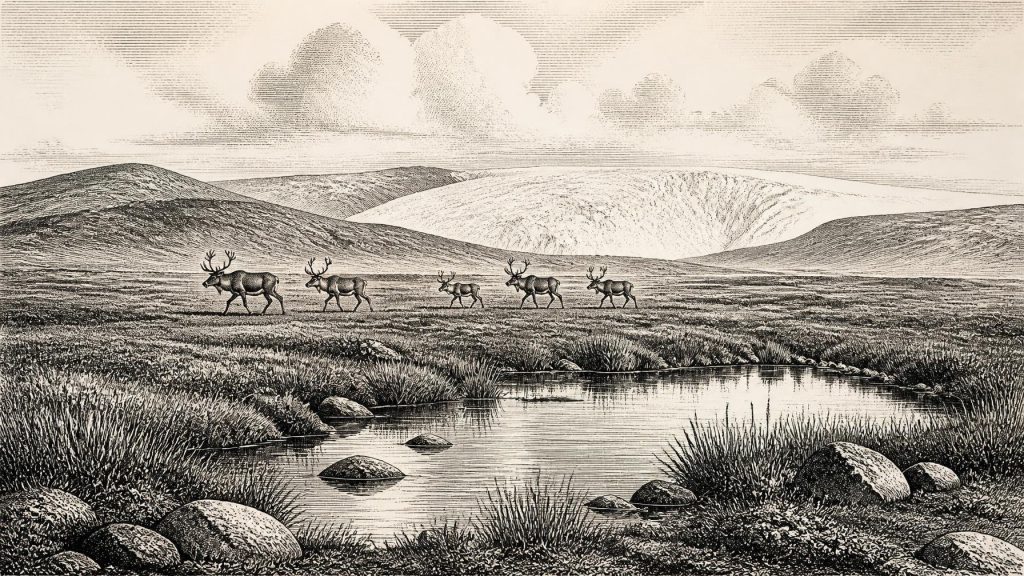
Even so, Derryvree is crucial because it shows the kind of environmental volatility from which the later landscape emerged. Plant and invertebrate remains indicate a cold, treeless setting, often described as muskeg or wet tundra: mosses, sedges, dwarf shrubs and arctic-alpine plants around shallow freshwater. This was no featureless blanket of snow. During suitable seasons there were wet margins, standing or slow water, plant cover and insect life. Frost action, seasonal thaw and poor drainage would have shaped the ground. The deposit records ecology, not a named community, village or political territory; nevertheless, it provides an unusually local view of how life persisted between episodes of glaciation.
Animals on Open Ground
For animal life, the principal Irish evidence comes from caves, especially Castlepook Cave near Doneraile in north County Cork, long known as Mammoth Cave. Its early twentieth-century excavations recovered a remarkable but complicated collection of Late Pleistocene bones. Reindeer, woolly mammoth, giant deer, red deer, brown bear, wolf, fox, Arctic fox, mountain hare, lemmings and spotted hyaena have all figured in the Castlepook record. Re-dating has shown that several older determinations were too young, and the cave’s faunal history is now understood principally as belonging to Marine Isotope Stage 3, before the Last Glacial Maximum. Individual animals, however, need not have been contemporary with one another or with 30,683 BCE.
The fauna supports a picture of open, cold and varied habitats. Reindeer were well adapted to sparse northern landscapes and could have ranged across broad open country. Lemmings and Arctic fox point towards severe conditions, while mammoth and giant deer indicate that, in at least some episodes, Ireland could sustain or receive large grazing and browsing mammals. Spotted hyaena is especially revealing: Castlepook was not a peaceful storehouse of carcasses but a cave environment that could be used by carnivores, altered by scavenging and disturbed by water and collapse. The bones tell us that food webs existed; they do not permit a precise reconstruction of a single herd, season or migration route.
Nor should the animal list be treated as a complete inventory for the entire island. Irish cave sites are geographically restricted, preservation is uneven and excavations occurred long before modern recovery methods. Much of the former land surface has been scoured, buried or drowned, so absence of evidence for an animal in one place is not proof of absence from Pleistocene Ireland. Conversely, one bone proves only that the animal, or material from it, reached that site at some point.
The Human Question
The possibility of human activity makes Castlepook important but also demands restraint. A reindeer femur from the old collection has been interpreted by zooarchaeologist Ruth Carden as bearing a deep incision made on fresh bone with a sharp stone edge. If that interpretation and its broad age are confirmed, it could indicate that people processed a reindeer in Ireland during the Upper Palaeolithic, far earlier than the traditionally accepted evidence for human presence. It is an important research claim, not a foundation for a detailed history of an Irish population in this year.
There is no securely associated hearth, stone-tool assemblage, dwelling, burial, occupation surface or human skeleton from Castlepook that can establish a camp at around 30,683 BCE. The cave deposits have a complex history of carnivore activity, sediment movement and antiquarian excavation. Recent investigation has sought surviving stratified Pleistocene deposits precisely because firm context is essential. The National Museum of Ireland’s longstanding caution that clear Palaeolithic human presence has not been demonstrated remains a useful warning against turning one potentially modified bone into proof of permanent settlement.
No Polities, But Possible Movements
Political affairs, diplomacy and warfare cannot responsibly be supplied for this period. There are no named peoples, leaders, boundaries, alliances or monuments through which to infer them. If people did reach Ireland during favourable phases of the Upper Palaeolithic, they may have been small, mobile hunter-gatherer parties connected to wider north-west European worlds. That is an interpretation based on contemporary human lifeways elsewhere, not direct evidence for a particular Irish group. Their visits could have been short, intermittent or separated by long absences as climate, ice and animal distributions altered.
The same limits apply to everyday life. A human party capable of butchering a large animal would have known perishable technologies of clothing, hide-working, wooden implements, cordage and fire management, but no Irish find from this horizon demonstrates such equipment. Reindeer, if obtained, could provide meat, fat, marrow, hide, sinew, antler and bone; these are possibilities inferred from the animal, not recovered evidence of local practice. There is no basis for claiming houses, families, gender roles, language, ancestry or seasonal camps in Ireland at this date.
Culture Beyond Recovery
There is equally no evidence for religion, formal learning, art or ceremony in Ireland around the nominal year. Upper Palaeolithic communities elsewhere in Europe made art and developed rich symbolic traditions, but Ireland has no securely dated cave art, portable art or ritual deposit from the Derryvree–Castlepook horizon. The most meaningful cultural lesson is methodological: deep Irish prehistory must distinguish a preserved object from the stories later readers wish to attach to it.
Economy and trade are also beyond direct recovery. The island was part of a changing north-west European environmental zone, and the presence of cold-adapted mammals proves that dispersal into Ireland occurred during some intervals. It does not prove regular exchange networks, established sea crossings or trade in goods. The dominant historical development was environmental rather than institutional: a landscape of open wetlands and animal movement was being overtaken by the growth of the ice sheet that would later cover much of Ireland and erase much of the evidence needed to tell this story more fully.
Thus 30,683 BCE should be understood not as an event year but as a point within a profound transition. The securely visible history is one of climate, ice, water, plants and animals. Possible human action at Castlepook remains a compelling question, but the enduring evidence is the fragile record of an island repeatedly made habitable, altered and concealed by the advance of ice.
Primary Sources
- Growth and retreat of the last British–Irish Ice Sheet, 31,000 to 15,000 years ago: the BRITICE-CHRONO reconstruction
- A reconsideration of the radiocarbon dating of the Marine Isotope Stage 3 fauna from southern Ireland
- Late Pleistocene chronostratigraphy and ice sheet limits, southern Ireland
- Last Glacial Maximum cirque glaciation in Ireland and implications for reconstructions of the Irish Ice Sheet
- A stratigraphic investigation of the Celtic Sea megaridges based on seismic and core data from the Irish-UK sectors
- The deglaciation of the western sector of the Irish Ice Sheet from the inner continental shelf to its terrestrial margin
- The configuration of Northern Hemisphere ice sheets through the Quaternary
- Spatio-temporal dynamics of speleothem growth and glaciation in the British Isles
- First evidence of a Late Upper Palaeolithic human presence in Ireland
- New insights on the fauna of Ireland's Younger Dryas and Early Holocene from Alice & Gwendoline Cave
- 2022:564 – Castlepook Cave, Castlepook South, Cork
- Archaeological Heritage of County Cork
- Heritage Artefacts of County Cork
- Prehistoric Details
- Ireland's Palaeolithic Archaeology – Fleeting Footprints in a Frozen Land
- Irish Pleistocene Biostratigraphy
- Cenozoic: Tertiary and Quaternary
- Episodic speleothem deposition tracks the terrestrial impact of millennial-scale climatic variability during Marine Isotope Stage 3
- Proceedings: Postglacial Colonisation Conference
- Holocene relative sea-level changes in northwest Ireland: An empirical test for glacial isostatic adjustment models
- Ice sheet sources of sea level rise and freshwater discharge during the last deglaciation
- Marine Isotope Stage 4 (71–57 ka) on the Western European margin: Insights to the drainage and dynamics of the Western European Ice Sheet