Castlepook’s Reindeer Cut30688 BCE
30,688 BCE is a modern label within Ireland’s Late Pleistocene, not a date supported by annual records. Derryvree, County Fermanagh, preserves freshwater organic deposits between glacial tills, indicating a harsh, treeless periglacial wetland during an ice-free interval, though not across all Ireland. Castlepook Cave, County Cork, contains diverse cold-stage fauna, including reindeer, mammoth, giant deer, predators and lemmings, accumulated over extended periods. A cut-marked reindeer femur may indicate Upper Palaeolithic carcass processing by people, but cannot prove hunting, settlement or continuity. Environmental instability preceded major ice-sheet expansion; available evidence documents changing habitats, not society or events in a single year.
Dateline
30,688 BCE is a modern chronological label, not a recoverable Irish year. No calendar, written record, named community or securely dated event permits an account of one twelve-month period at this depth of time. The number falls within the Late Pleistocene, during the fluctuating cold conditions conventionally called the Midlandian in Ireland and Marine Isotope Stage 3 internationally. What can responsibly be said comes from sediments, fossils, cave deposits and glacial landforms, all dated in ranges rather than to an exact year.
The closest Irish environmental archive is the Derryvree deposit near Maguiresbridge in County Fermanagh. There, roadworks in 1969 cut through a drumlin and exposed freshwater silts, sands and organic material between two layers of glacial till. The sequence establishes a clear order: glacier ice had formerly occupied the locality; an ice-free freshwater and wet-ground environment subsequently developed; and a later ice advance or ice-derived deposition sealed it beneath more till. That is powerful evidence for changing conditions, but not proof that all Ireland was ice-free at the same time.
An organic sample from Derryvree, BIRM-166, produced a conventional radiocarbon age of 30,500 years before present, with a substantial uncertainty. Radiocarbon years are not calendar years: atmospheric carbon-14 has varied, so determinations must be calibrated against an internationally maintained curve. Published calibrations place the Derryvree material within a broad Late Pleistocene range, commonly expressed at roughly 36,900–31,700 calibrated years before present. The modern label 30,688 BCE lies within the wider chronological neighbourhood illuminated by that range, but cannot be assigned to a particular layer, season or ecological episode at the site.
An Ice-Age Wetland
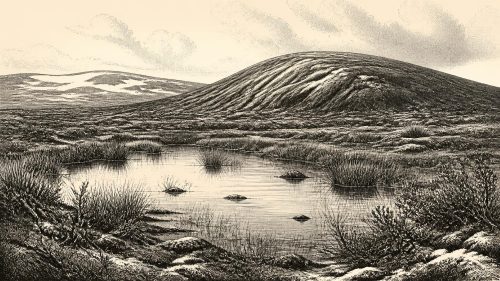
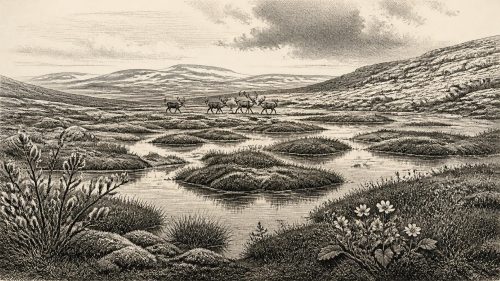
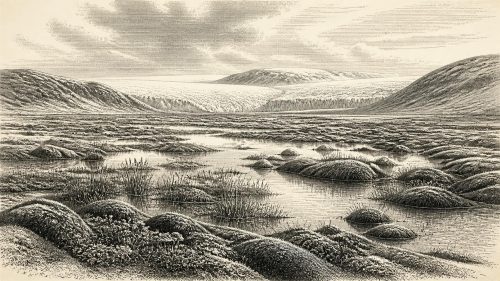
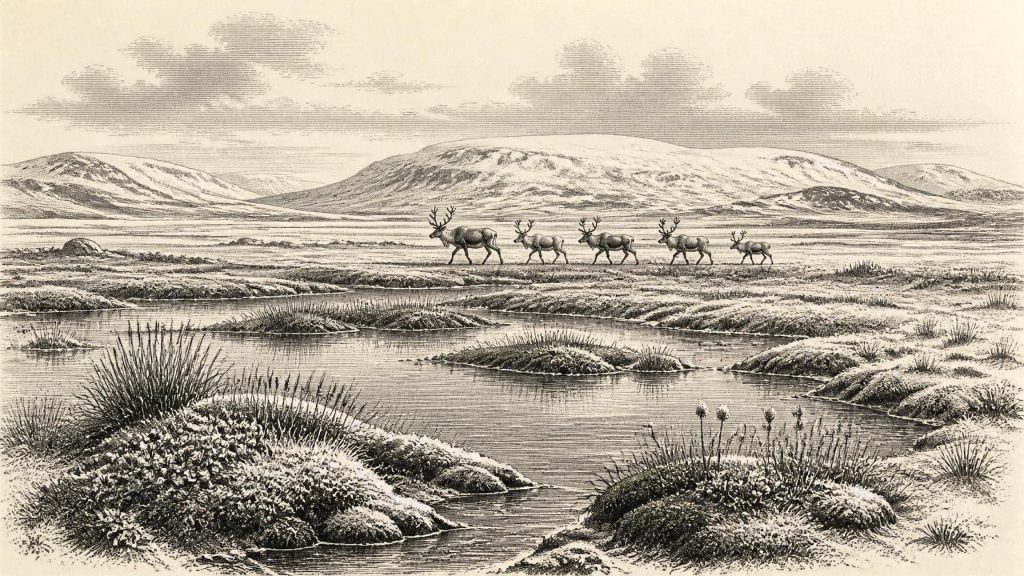
Derryvree is especially valuable because organic deposits are rare survivors in a landscape repeatedly altered by ice. Its plant remains, pollen and insect evidence point to a severe, largely treeless periglacial environment. The term does not mean a featureless frozen desert. It describes country shaped by intense frost, short summers, cold winters and ground conditions close to glacier margins. Fresh water could collect locally in shallow basins even while the wider climate remained harsh.
The vegetation reconstructed from the deposit was open rather than wooded. Mosses, sedges, grasses and hardy herbs formed the principal cover, with aquatic and wetland plants occupying pools and saturated ground. Some pollen grains of trees occur, but their poor preservation and the possibility of long-distance transport mean they cannot demonstrate local woodland. This distinction is important. The strongest evidence is for tundra-like vegetation and muskeg, not for forests filled with large browsing animals.
Such terrain would have changed rapidly over short distances. Waterlogged hollows, gravelly ridges, exposed mineral soils and frost-disturbed ground could sit close together. Snow cover, summer meltwater, wind exposure and proximity to ice determined which plants survived. Derryvree therefore offers a local environmental window into south Fermanagh, not a map of every Irish valley, coast and upland. Its principal lesson is that the island’s glacial history was episodic: ice, water, sparse vegetation and renewed ice succeeded one another.
Castlepook’s Animal World
Nearly 300 kilometres to the south, Castlepook Cave near Doneraile in north County Cork preserves Ireland’s most important older cave-fauna assemblage. The cave, also known as Mammoth Cave, was excavated in the early twentieth century by Richard Ussher and colleagues. Its deposits and collections include remains attributed to mammoth, reindeer, giant deer, brown bear, wolf, Arctic fox, mountain hare, stoat, lemmings and spotted hyaena. These animals did not necessarily occupy the cave at one moment: cave deposits accumulate through many visits, deaths, flooding episodes and disturbance. Nevertheless, the fauna demonstrates that Ireland was intermittently connected to the ecological world of cold-stage north-western Europe.
The animal evidence indicates open habitats capable of supporting grazing and browsing herds, alongside formidable predators and scavengers. Reindeer are particularly relevant to cold, open ground; mammoth and giant deer evoke a broader mosaic of grassland, herb-rich tundra and sheltered patches rather than dense forest. The two lemming species strengthen the cold-climate signal. Hyaenas matter for another reason: a cave full of bones is not automatically a human camp. Carnivores dragged carcass parts into dens, gnawed bones and mixed material from different times. Water and later excavation could further scramble the evidence.
For that reason, it would be wrong to picture a single grand procession of mammoths, reindeer, giant deer and hunters across Ireland in 30,688 BCE. The fossil record is patchy, the chronology is broad and the individual specimens have different histories. Absence is equally difficult to interpret. A species missing from the handful of known deposits need not have been absent from Ireland altogether; it may simply not have been preserved, discovered or securely dated.
The Marked Reindeer Femur
One Castlepook bone has given this period unusual significance for Irish human history. A fragment of reindeer femur from the old collection has been dated broadly to around 33,000 radiocarbon years ago and bears a deep linear mark. Zooarchaeologist Ruth Carden has interpreted that mark as damage made by a sharp stone tool during the processing of a fresh carcass. County Cork heritage material accordingly presents the specimen as possible evidence for Palaeolithic hunters handling reindeer in Ireland around 31,000 BCE.
If that interpretation is confirmed, the implication is profound. It would move evidence for human activity on the island far earlier than the previously secure terminal-Pleistocene record. Yet the wording must remain precise. The bone is not a dwelling floor, hearth, burial, stone-tool assemblage or settlement. Its date is the age of the animal bone, not an annual date for the cut itself; the mark’s identification as a stone-tool incision is a separate specialist judgement. Moreover, Castlepook was excavated before modern methods of recording stratigraphy, and its deposits were affected by carnivores and other natural processes.
The most that can presently be inferred is modest but important: a person or small party may have processed a reindeer in Ireland during the Upper Palaeolithic. They may have hunted it, found it dead, removed meat or detached part of the limb elsewhere; the evidence does not decide between these possibilities. Nor can it establish how long they stayed, whether they crossed in one journey or several, what language they spoke, or whether they left descendants on the island. It is a possible trace of an encounter, not proof of a settled population.
People, Society and Silence
There is no basis for describing political affairs, diplomacy, territorial rule or organised conflict in Ireland at this date. No named groups, leaders, boundaries, weapons assemblages or meeting places are known. If the Castlepook cut mark is human-made, it suggests only the practical knowledge needed to use a sharp stone edge on animal tissue. Comparisons with Upper Palaeolithic groups in Britain and continental Europe can help frame possibilities—high mobility, seasonal use of animal resources and skilled stoneworking—but such comparisons remain interpretation, not direct evidence from Ireland.
The same caution applies to religion, art and learning. Ireland has no securely associated cave art, portable art, grave, ritual deposit or symbolic object from this period. It would be misleading to import continental cave paintings, burial rites or named archaeological cultures and present them as Irish facts. The absence of evidence is not evidence that visiting people lacked beliefs, stories, skills or social ties; it means that the Irish record has not preserved identifiable material signs of them.
There was likewise no demonstrable agriculture, animal husbandry, pottery, metalworking, market economy or long-distance trade network in Ireland. The relevant economy, if people were present, would have been an immediate one of movement, observation and the use of seasonal resources. Reindeer could provide meat, hide, sinew, bone and antler; however, those uses are known elsewhere and cannot be documented at Castlepook from the femur alone. Large mammals and carnivores, meanwhile, were plainly part of the island’s ecological economy whether humans were present or not.
Approaching the Great Expansion of Ice
This interval preceded the Last Glacial Maximum, when the British–Irish Ice Sheet expanded to a far greater extent, broadly after 30,000 years ago and especially between about 26,500 and 19,000 years before present. Recent reconstructions show that ice growth and retreat were regionally complex. Derryvree’s wetland should therefore not be used to claim a uniformly hospitable Ireland immediately before the maximum, just as later full glaciation should not erase evidence for earlier ice-free episodes.
The most important development around the notional year is environmental instability. In Fermanagh, a cold wetland formed between glacial episodes. In Cork, cave deposits preserve a richer animal world and a tantalising possible sign of human butchery. Together they show an Ireland whose availability to plants, animals and perhaps occasional people changed with climate, ice and water. They do not provide an annual chronicle. For 30,688 BCE, the honest history is one of evidence patiently recovered from mud, bone and stone—and of the limits that evidence still imposes.
Primary Sources
- A Middle Midlandian Freshwater Series at Derryvree, Maguiresbridge, County Fermanagh, Northern Ireland
- Palaeoecology: The Middle Midlandian Palaeoenvironment of South Fermanagh
- Figure 6.— The Subdivision of the Quaternary Period in Ireland
- The Irish Quaternary Fauna Project
- A Reconsideration of the Radiocarbon Dating of the Marine Isotope Stage 3 Fauna from Southern Ireland
- Occurrence of Mammalia Relicts at Site Castlepook Cave
- The Exploration of Castlepook Cave, Co. Cork. With 3 Plates
- Proceedings of the Royal Irish Academy: The Exploration of Castlepook Cave, County Cork
- Castlepook Cave, County Geological Site Report
- Heritage Artefacts of County Cork
- Pleistocene Vertebrates in the British Isles
- Irish Quaternary Vertebrates
- The IntCal20 Northern Hemisphere Radiocarbon Age Calibration Curve (0–55 cal kBP)
- IntCal Publications
- IntCal History
- The Timing and Magnitude of the British–Irish Ice Sheet Between Marine Isotope Stages 5d and 2
- Exploring Controls of the Early and Stepped Deglaciation on the Western Sector of the British-Irish Ice Sheet
- The Deglaciation of the Western Sector of the Irish Ice Sheet from the Inner Continental Shelf to Its Terrestrial Margin
- Early Deglaciation of the British-Irish Ice Sheet on the Atlantic Shelf Northwest of Ireland
- The Last Eurasian Ice Sheets – a Chronological Database and Time-Slice Reconstruction, DATED-1
- The Problem of a Late Quaternary Landbridge Between Britain and Ireland
- New Insights on the Fauna of Ireland’s Younger Dryas and Early Holocene from Alice & Gwendoline Cave