Menyanthes Beneath Fermanagh30722 BCE
Thirty thousand seven hundred and twenty-two BCE is only a modern label within a broad radiocarbon range, not a recoverable Irish date. At Derryvree, County Fermanagh, freshwater sediments between tills record a cold, treeless wetland during MIS 3, supporting bogbean, sedges, aquatic plants, mosses and tundra-like vegetation before later glaciation. Castlepook Cave, County Cork, preserves diverse fauna including mammoth, reindeer, giant deer, hyaena and predators, indicating intermittently habitable open landscapes and functioning food webs. Possible human evidence remains contested, with no secure settlement or cultural traces. No politics, trade, farming or beliefs can be reconstructed. Archives reveal change, not events.
Dateline
“30,722 BCE” is a useful modern label, not a date that can be recovered from the Irish archaeological record. No calendar, written account or year-specific event survives from this depth of time. In radiocarbon convention the date falls roughly 32,700 calendar years before AD 1950, within the Late Pleistocene and Marine Isotope Stage 3 (MIS 3), long before the maximum spread of the last Irish Ice Sheet. Evidence can be assigned only to broad calibrated ranges. The responsible history of Ireland at this point is therefore a reconstruction from sediments, fossil plants, animal remains and ice-shaped landforms—not a chronicle of named people or happenings.
A Date Within a Range
The most informative Irish evidence close to this notional year comes from Derryvree, near Maguiresbridge in County Fermanagh. Roadworks in 1969 cut through a drumlin and exposed a remarkable sequence: freshwater silts and fine sands with organic material lay between two thick sheets of till, the unsorted debris left by moving ice. The organic layer produced a conventional radiocarbon result of 30,500 years before present, with a substantial uncertainty of +1,170/−1,030 years. Modern calibration makes clear why that cannot be converted into one exact BCE year. Published assessments place the deposit broadly at about 31,700–36,900 calibrated years before present; 30,722 BCE lies within that wide interval.
That range is the essential caution. The Derryvree deposit accumulated over time in one local basin. It demonstrates that this part of Fermanagh supported freshwater conditions between episodes of glaciation; it does not prove that every district of Ireland was ice-free at once, nor that its plants were all growing in the same season. The radiocarbon determination itself belongs to organic sediment, rather than to an event such as a human arrival. Calibration curves are continually improved as scientists compare radiocarbon measurements with independently dated records. At this age, the resulting intervals remain broad enough that a modern calendar year must never be mistaken for archaeological precision.
A Wetland Between Ice Advances
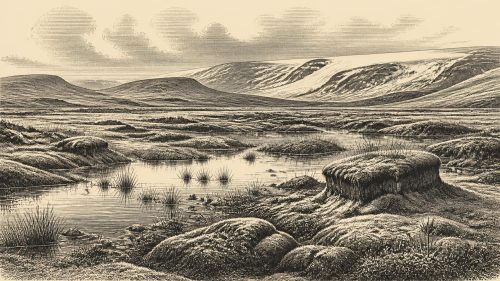
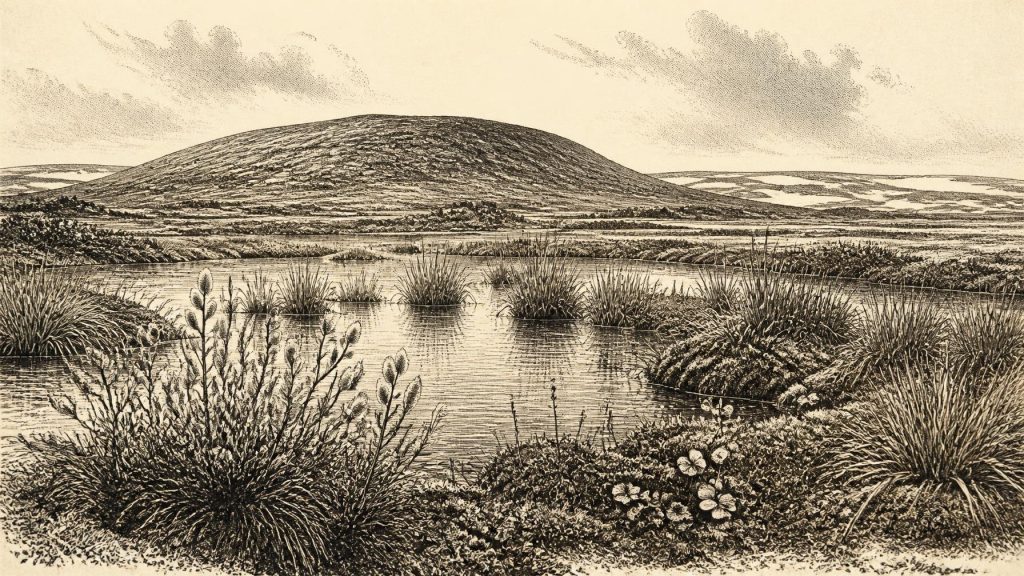
Derryvree nevertheless gives Ireland an unusually vivid environmental archive. The fossil evidence points to a cold, treeless, periglacial landscape: ground subject to severe frost and thaw near ice, rather than a forested countryside. Herb pollen was poorly preserved, but the plant macrofossils and mosses are highly revealing. Sedges and other hardy plants occupied wet margins; aquatic water-milfoil indicates standing or slow-moving fresh water. A seed of bogbean, Menyanthes trifoliata, is especially evocative. It shows that a plant now associated with wet ground and shallow water had reached this Ice Age basin.
Other recorded plants, including dwarf willow, mountain-avens and lesser clubmoss, support the interpretation of open tundra-like vegetation. This should not be imagined as an unbroken carpet of modern Arctic species. Local moisture, exposure, soil, snow cover and seasonality would have produced a patchwork: shallow pools and muddy margins, sedge-rich hollows, mossy ground, stony drier surfaces and sparse shrub vegetation. In summer, the basin could have been briefly productive; in winter it would have been a difficult, frozen environment. The evidence is strongest for the wetland and its immediate catchment, not for a uniform island-wide landscape.
The two till sheets framing the freshwater layer are equally important. They record glacial activity before and after the period represented by the silts. This was not a simple story in which Ireland was either completely buried beneath ice or wholly free of it. MIS 3 was climatically unstable, marked in Greenland ice-core records by abrupt shifts between colder stadials and relatively milder interstadials. Irish deposits cannot always be matched securely to individual Greenland events, especially where their dates have large uncertainties. Yet the Derryvree sequence is firm evidence that the north of Ireland experienced an interval in which local freshwater habitats existed before later ice overrode and sealed them.
Animal Country, Not a Human Census
For the broader pre-Last Glacial Maximum animal world, the principal Irish archive is Castlepook Cave, also called Mammoth Cave, near Doneraile in north County Cork. Antiquarian excavations there recovered bones of woolly mammoth, reindeer, giant deer, spotted hyaena, wolf, bear, fox, hare and smaller cold-adapted animals. Improved dating and reassessment have shown that important parts of the southern Irish cave fauna belong to MIS 3, though the material derives from more than one time and from complicated cave processes. A bone from Castlepook is not automatically contemporary with a plant fossil from Derryvree, and neither is a precise witness to 30,722 BCE.
Still, these remains demonstrate that habitable land existed in Ireland during parts of this long interval and that animal populations reached it from the wider north-west European world. Reindeer and mammoth suggest open country with substantial grazing; predators and scavengers indicate a functioning food web rather than isolated wanderers. Spotted hyaenas are particularly significant because caves can serve as dens or places into which bones were carried. Their presence cautions against treating every accumulation of bones as the remains of a human meal. Water movement, carnivore activity, natural deaths, later disturbance and the methods of early excavators all shaped the collections now available to research.
There is no basis for reconstructing a settled human population in Ireland at this date. A reindeer femur from Castlepook has been reported as bearing a mark interpreted as stone-tool butchery damage, and its reported age has made it an important possible Palaeolithic clue. If that interpretation is confirmed, it may show that people briefly handled an animal in Ireland during the later Ice Age. It would not establish a permanent settlement, a camp of known size, or an unbroken human occupation. The cave has not yielded a securely associated dwelling floor, hearth, stone-tool assemblage, burial or food store of this age. For now, the careful conclusion is that human presence in this broad period remains possible and contested rather than historically demonstrable in detail.
No Polities, No Proven Trade
Consequently, political affairs, diplomacy and warfare cannot responsibly be described for Ireland in 30,722 BCE. There are no rulers, territories, monuments, weapons caches or community boundaries that can be tied to this date. Nor is there evidence for farming, herding, metalworking, formal exchange networks or maritime trade. The sea was lower globally during the glacial period, and Ireland’s connections to Britain and continental Europe differed greatly from those of the present. But changing geography alone does not prove journeys by people, or identify the routes used by any animals that entered the island.
“Economy” is meaningful here chiefly in an ecological sense. Herd animals grazed the plants available in open habitats; carnivores and scavengers fed on them; wetlands furnished water and seasonal vegetation. If people did visit, reindeer would have offered meat, hide, sinew, bone and antler, as they did to Upper Palaeolithic communities elsewhere in Europe. That is a reasonable comparative possibility, not evidence for an Irish hunting economy. The responsible distinction is simple: Ireland’s fauna establishes available resources, whereas human use of them requires direct traces that are presently scarce.
Culture Beyond Recovery
Religion, language, learning and artistic practice are also beyond recovery for this date. No shrine, grave, image, musical instrument or securely identified symbolic object belongs to this Irish horizon. Fossil plants and bones cannot tell us what any passing people believed, how they organised kinship, or what stories they may have told. The absence of such evidence should not be confused with proof that people, if present, had no culture; it marks the limits of preservation and discovery. Later ice movement, erosion, acidic soils and the rarity of protected cave deposits have all severely reduced what could survive.
What can be recovered is a more elemental history of regional change. A Fermanagh drumlin preserved a freshwater episode between advances of ice. A north Cork cave retained traces of animals that moved through, lived in or died within a changing cold landscape. These separate archives show that Ireland was not merely a blank white space before the Last Glacial Maximum. It was a variable northern environment, at times capable of sustaining wetlands, plants and sizeable mammals, but exposed to climatic reversals that could rapidly transform the available ground.
The Value of a Seed
The bogbean seed beneath the Derryvree drumlin is modest beside a mammoth bone, but it is the more exact symbol of what can responsibly be said about this period. It is direct evidence for a plant in a freshwater environment during a broad, calibrated span. From it, and from associated mosses, pollen, silts and tills, archaeologists and palaeoecologists infer a cold open wetland on an intermittently ice-free landscape. From the wider cave fauna they infer animal movement and ecological opportunity. The inferences are powerful precisely because they remain proportionate to the evidence.
Thus Ireland around 30,722 BCE was not a country of recorded events. It was a place undergoing profound environmental change: cold but not everywhere perpetually ice-covered; open rather than wooded in the best-documented Fermanagh locality; inhabited by hardy plants and, during this broad phase, visited or occupied by diverse Ice Age animals. Whether people were also present remains one of the most important questions in Irish prehistory. The answer will depend not on assigning certainty to a single modern year, but on further excavation, direct dating and careful analysis of the fragile archives that survived the ice.
Primary Sources
- A Middle Midlandian Freshwater Series at Derryvree, Maguiresbridge, County Fermanagh, Northern Ireland
- A Reconsideration of the Radiocarbon Dating of the Marine Isotope Stage 3 Fauna from Southern Ireland
- The Irish Quaternary Fauna Project
- New Insights on the Fauna of Ireland's Younger Dryas and Early Holocene from Alice & Gwendoline Cave
- Exploring the Last British-Irish Ice Sheet: New Insights from Marine Geophysical Data
- Radiocarbon Constraints on the History of the Western Irish Ice Sheet Prior to the Last Glacial Maximum
- Timing and Pace of Ice-Sheet Withdrawal Across the Marine–Terrestrial Transition West of Ireland During the Last Glaciation
- Marine Geophysical Evidence for Late Pleistocene Ice Sheet Extent and Recession off Northwest Ireland
- A Stratigraphic Framework for Abrupt Climatic Changes During the Last Glacial Period Based on Three Synchronized Greenland Ice-Core Records
- The IntCal20 Northern Hemisphere Radiocarbon Age Calibration Curve (0–55 cal kBP)
- Palaeoecology
- Regional Pleistocene Geology
- Middle Midlandian Interstadial Deposits at Greenagho, Near Belcoo, County Fermanagh, Northern Ireland
- Episodic Speleothem Deposition Tracks the Terrestrial Impact of Millennial-Scale North Atlantic Climate Variability During MIS 3
- Pleistocene Glaciations in Ireland
- Geology of Ireland
- Quaternary Geomorphology Map Service
- Prehistoric Details
- The Archaeological Heritage of County Cork
- 2022:564 – Castlepook Cave, Castlepook South, Cork
- Mammoth Cave (Castlepook Cave)
- History of Climatostratigraphic Units