Colhoun’s Freshwater Interval30723 BCE
Around 30,723 BCE, Ireland lay within the unstable Late Pleistocene, rather than a single recoverable historical year. At Derryvree, County Fermanagh, freshwater organic deposits between glacial tills record a cold, open, largely treeless wetland during an interval between ice advances. Plants, mosses and insects indicate sedges, pools and periglacial habitats. Castlepook Cave, County Cork, preserves mixed animal remains accumulated over millennia, demonstrating varied cold-stage fauna but not a single contemporary ecosystem. A marked reindeer femur may indicate Upper Palaeolithic butchery, yet remains inconclusive. No evidence supports settlements, institutions or cultures. Environmental change, expanding ice and intermittent habitats define this period.

Dateline
The label 30,723 BCE is a modern chronological convenience, not a year that anyone in Ireland could have named, recorded or experienced as part of a calendar. It denotes roughly 32,700 years before AD 1950, the reference point conventionally used for “before present” dating. At this depth of time, however, neither a single calendar year nor a single island-wide condition can be recovered. The responsible history of Ireland at this point lies in broad calibrated ranges, fossil assemblages and sedimentary sequences. It belongs to the Late Pleistocene, broadly Marine Isotope Stage 3 (MIS 3), a volatile phase of the last Ice Age when climate, ice margins, coastlines and habitats changed repeatedly.
A Date Within a Broad Range
The most useful Irish evidence for conditions broadly comparable with this date comes from Derryvree, near Maguiresbridge in County Fermanagh. Road works in 1969 cut through a drumlin, exposing a remarkable sandwich of deposits: glacial till below, freshwater silts and fine sands with organic material in the middle, and another thick body of till above. Till is debris laid down by glacier ice. The sequence therefore supplies a clear relative history. Ice occupied the locality; an interval followed in which a wetland or shallow freshwater basin developed; then a later ice advance buried and preserved the evidence.
Organic material from the Derryvree freshwater bed, laboratory sample BIRM-166, returned a conventional radiocarbon age of 30,500 years BP, with a sizeable uncertainty of +1,170/−1,030 years. A radiocarbon age is not the same as a calendar age: atmospheric carbon levels varied through time, so results must be calibrated. Published discussion has placed this legacy determination broadly at about 36,900–31,700 calibrated years BP. The modern label 30,723 BCE falls within that very wide interval. It does not identify a particular season, plant, animal or episode at Derryvree, but it permits the deposit to illuminate the environmental world of this broad phase.
A Wetland Between Ice Advances
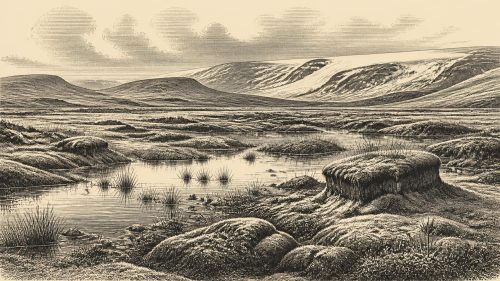
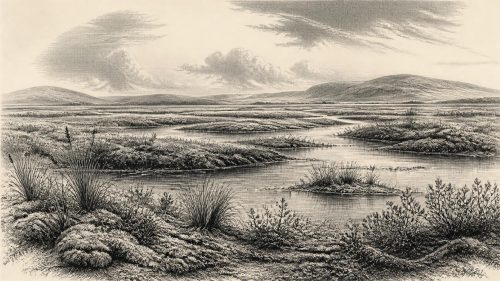
Derryvree is important precisely because it does not show an unbroken frozen wilderness. Its pollen, plant macrofossils, mosses and insect remains indicate a cold, open and largely treeless landscape with standing or slow-moving fresh water. Grasses and sedges were prominent, joined by herbs, juniper and Arctic-alpine plants. Finds reported from the sequence include mountain-avens, dwarf willow, bogbean, water-milfoil and clubmosses, alongside a rich moss flora. These species should not be imagined as a tidy modern meadow. They represent plant communities adapted to exposed, strongly seasonal ground, wet hollows and shallow pools in a periglacial setting.
The older term muskeg, used by investigators for the Derryvree environment, is useful if treated cautiously: waterlogged ground with mosses, sedges, accumulated organic matter and open pools. Insects reinforce that reconstruction, pointing to aquatic and wetland habitats surrounded by open country. This is direct evidence for what survived in and beside one freshwater basin. It is not proof that every part of Ireland was ice-free, equally wet or covered by the same vegetation. Later glaciation removed, rearranged or concealed much of the older landscape, making such protected intertill deposits exceptionally valuable but necessarily local archives.
An Island in a Changing Ice-Age World
At the scale of the island, Ireland was not yet at the fullest extent of the Last Glacial Maximum. Reconstructions of the British–Irish Ice Sheet indicate major ice-sheet growth from about 31,000 to 26,000 years ago, followed by maximum volume around 23,000 years ago. Thus the date considered here belongs to an earlier, unstable part of the build-up rather than to the later moment when ice dominated much more of Ireland and the surrounding shelves. Derryvree’s ice-free freshwater interval is one local expression of that complex history: glaciers did not simply advance once and remain fixed.
Lower global sea levels altered the geography of north-west Europe. The present Irish Sea basin was not arranged as it is today, and the extent of dry land, coastal plains, ice and water corridors shifted with climate and ice volume. Such change matters for plants and animals, because it affected possible routes into and out of Ireland. Yet it does not license a simple picture of a permanent land bridge or an easy migration route. Conditions would have varied sharply across time and region, while expanding ice could obstruct as well as create pathways. Ireland was a north-western edge landscape: environmentally connected to Britain and continental Europe at intervals, but never insulated from the practical barriers of cold, distance and terrain.
Castlepook and the Animal Record
In north County Cork, Castlepook Cave near Doneraile provides a different kind of evidence. Its limestone passages have yielded Ireland’s richest known assemblage of middle-to-late Ice Age vertebrate remains. Woolly mammoth, reindeer, giant deer, brown bear and spotted hyaena occur among the older fauna; Arctic fox, wolf, mountain hare and lemmings belong to later cold-stage components. The collection demonstrates that large mammals and predators could reach or survive in Ireland during parts of the Late Pleistocene, and that open habitats supported complex food webs.
But Castlepook is not a single moment frozen in time. Its bones accumulated in caves over many millennia, were affected by carnivores and water, and were excavated substantially before modern methods of recording context. Improved radiocarbon work has revised the ages of several Irish cave specimens and shown that some earlier determinations were too young. Accordingly, it would be wrong to claim that mammoth, hyaena, reindeer and every smaller animal listed from Castlepook necessarily met one another in 30,723 BCE. The stronger conclusion is that the cave records changing Pleistocene faunas across a long span before and after the period considered here.
Spotted hyaena are especially instructive. Their presence helps explain why a cave can become a bone repository: carnivores may drag prey or carrion into dens, modify bones and mix material from separate events. A mammoth or reindeer bone in the cave does not automatically indicate a human kill, a camp at the entrance or even the place where the animal died. It tells us that the species formed part of Ireland’s wider fauna and that cave processes were active. The distinction between an animal’s life, its death, the transport of its remains and their eventual excavation is essential to sound interpretation.
The Reindeer Femur Question
A reindeer femur from the Castlepook collection has given this period unusual archaeological importance. It has been reported as around 33,000 years old and bears a deep mark interpreted by zooarchaeologist Ruth Carden as damage from a sharp stone tool used during butchery. If that interpretation is upheld, it is evidence that people handled and processed a reindeer in Ireland during the Upper Palaeolithic, vastly earlier than the securely documented post-glacial settlement record. It would be a major indication of human visitation during a cold-stage interval when Ireland was often treated as beyond the reach of people.
The claim must remain deliberately narrow. The mark occurs on a single bone from an old, disturbed cave assemblage. Its radiocarbon determination dates the animal’s death within a statistical range; it does not independently date the incision, identify who made it, establish where butchery took place or reveal the duration of any visit. No securely associated stone-tool assemblage, hearth, dwelling surface, burial, human remains, artwork or stratified camp of comparable age has yet been published from Ireland. Recent research excavations at Castlepook are important because they seek surviving deposits capable of testing such possibilities with modern methods.
What Cannot Be Written
There is therefore no evidence for political communities, rulers, territorial boundaries, diplomacy, warfare or formal institutions in Ireland at this date. There is no basis for reconstructing a language, named people, religion, ritual practice, art tradition, learning system or trade network. Nor can possible visitors be assigned responsibly to an Aurignacian, Gravettian or another continental archaeological culture without diagnostic tools or an undisturbed occupation context. The possible reindeer butchery mark suggests an action, not a society.
Everyday human life is equally elusive. Should people have reached Ireland, they may have travelled in small, mobile groups exploiting seasonal opportunities, as hunter-gatherers did elsewhere in Late Pleistocene Europe. That is an informed regional analogy, not a demonstrated Irish fact. No evidence supports farming, permanent villages, livestock, crop cultivation or long-distance commerce on the island at this time. The only economy securely visible at Derryvree is ecological: plants colonising wet ground, insects inhabiting pools and peat-like margins, herbivores feeding in open country, and carnivores using caves and carcasses.
Evidence Before Narrative
For Ireland around 30,723 BCE, the central historical development was environmental instability. Derryvree records an ice-free freshwater refuge between separate glacial episodes; Castlepook preserves the scattered remains of cold-stage animal worlds; the wider British–Irish Ice Sheet was entering a period of major growth. Together they replace the old image of a featureless, permanently ice-covered Ireland with a more dynamic one: cold, exposed and difficult, yet intermittently inhabited by wetlands, vegetation and large mammals. Whether people briefly joined that world remains a compelling question rather than a settled chapter of national history.
Primary Sources
- A Middle Midlandian Freshwater Series at Derryvree, Maguiresbridge, County Fermanagh, Northern Ireland
- A Reconsideration of the Radiocarbon Dating of the Marine Isotope Stage 3 Fauna from Southern Ireland
- Castlepook Cave: County Geological Site Report
- Heritage Artefacts of County Cork 2021
- 2022:564 – Castlepook Cave, Castlepook South, Cork
- Archaeology Research Excavation Grant 2022: Final Report
- Growth and Retreat of the Last British–Irish Ice Sheet, 31,000 to 15,000 Years Ago: the BRITICE-CHRONO Reconstruction
- Exploring the Last British-Irish Ice Sheet: Reconstructions and Palaeoglaciological Implications
- Stratigraphic and Palaeo-Geomorphological Evidence for the Glacial-Deglacial History of the Last British-Irish Ice Sheet in the North-Western Irish Sea
- The IntCal20 Northern Hemisphere Radiocarbon Age Calibration Curve (0–55 cal kBP)
- IntCal Publications
- Middle Midlandian Interstadial Deposits at Greenagho, Near Belcoo, County Fermanagh, Northern Ireland
- Freshwater Organic Deposits and Stratified Sediments Between Early and Late Midlandian (Devensian) Till Sheets, at Aghnadarragh, County Antrim, Northern Ireland
- Early Midlandian–Middle Midlandian, Pleistocene, Northern Ireland
- Irish Pleistocene Biostratigraphy
- The Irish Quaternary Fauna Project
- The Exploration of Castlepook Cave, County Cork, Being the Third Report from the Committee Appointed to Explore Irish Caves
- The Exploration of Castlepook Cave, Co. Cork: National Library of Ireland Catalogue Record
- Archaeological Heritage of County Cork
- Trimlines, Blockfields and the Vertical Extent of the Last Ice Sheet in Southern Ireland
- The Geology of Ireland: Cenozoic, Tertiary and Quaternary
- Introduction to the Late Quaternary and Holocene of Northern Ireland