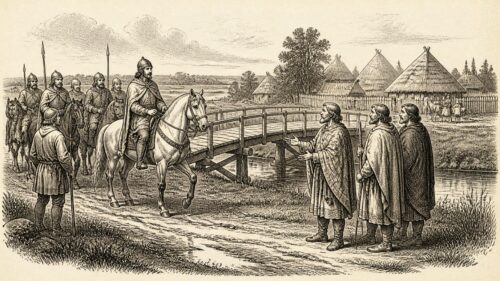
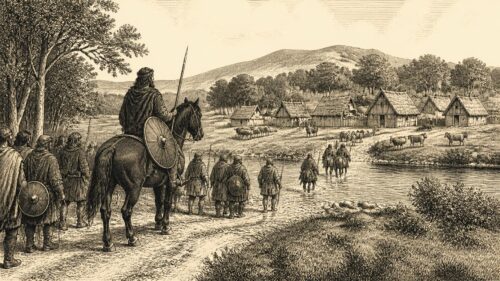
A Kingdom Divided1086 CE
In 1086, Toirdelbach Ua Briain, Munster’s dominant ruler and effective overlord of much of Ireland, died at Cenn Corad after illness. Munster was briefly divided among his sons Tadc, Muirchertach and Diarmait; Tadc soon died and Muirchertach expelled Diarmait, but inherited no uncontested national supremacy. Warfare continued across Leinster, Dublin’s Norse-Gaelic sphere, the midlands, Ulster and south-west, demonstrating resilient local dynasties and shifting alliances. Notable deaths included kings, bishops and Máel Ísu Ua Brolcháin, Armagh scholar and bilingual poet. The annals chiefly record elites, while broader evidence depicts a rural, cattle-based economy linked through churches, towns, trade and military obligations.
Dateline
Ireland entered the year under the authority of its most powerful king, Toirdelbach Ua Briain, but ended it amid a contested succession and renewed regional warfare. The chronicles preserve unusually detailed notices for these months, although they remain selective: deaths of kings, bishops and scholars, battles and dynastic changes mattered far more to annalists than harvests, households or ordinary labour. The firmly dated record therefore presents a year of political rupture. Archaeology and evidence from neighbouring decades provide the broader setting, but cannot turn everyday conditions into events unique to 1086.
The Death at Cenn Corad
Toirdelbach Ua Briain had ruled Munster since the 1060s and, following the death of the Leinster overking Diarmait mac Maíl na mBó in 1072, had become the dominant ruler across much of Ireland. His authority rested not upon a unified state but upon personal submissions, hostages, tribute, military alliances and control or influence over other kings. Irish annalists consequently varied in their titles. Some called him king of Ireland, while others more cautiously described him as king of most or the greater part of Ireland. The later Four Masters added the significant qualification “with opposition”.
His health had already failed badly in 1085. On 14 July 1086, according to the Annals of Ulster, he died at Cenn Corad, the royal centre near Killaloe on the River Shannon. The same source gives his age as seventy-seven and describes prolonged suffering, repentance and reception of the Eucharist before death. The Annals of Tigernach likewise emphasise that he died after repentance. Such details did more than record private devotion: they presented the death expected of a Christian ruler who had combined warfare, coercion and the government of kingdoms with patronage of churches.
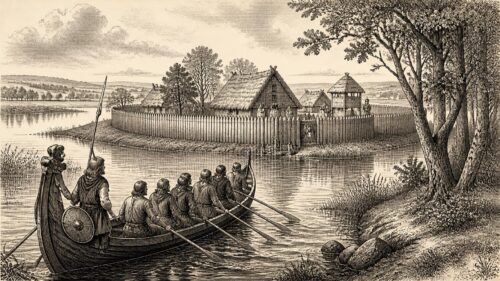
Cenn Corad, often anglicised as Kincora, lay at the heart of Dál gCais power. Its position beside the Shannon connected northern Munster with river routes leading towards Lough Derg and the midlands, while nearby Killaloe was both an ecclesiastical centre and a place closely associated with the dynasty of Brian Bóruma. Toirdelbach’s death there therefore occurred within the political landscape from which his family’s power had first expanded.
Three Heirs, One Kingship
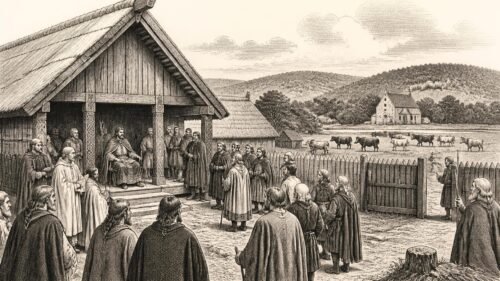
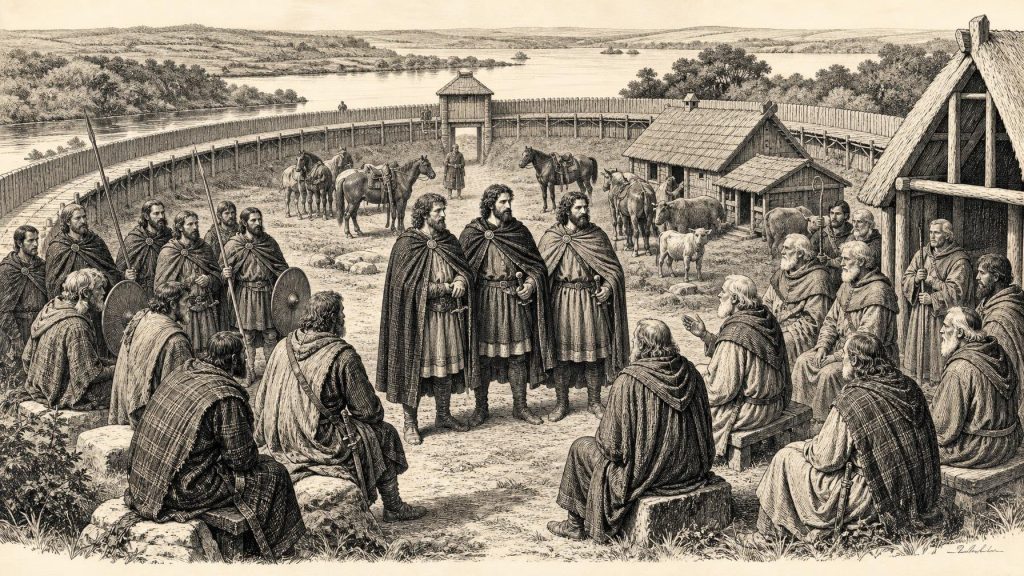
The Annals of Inisfallen preserve the clearest account of the immediate succession. Munster was divided among three of Toirdelbach’s sons: Tadc, Muirchertach and Diarmait. This was not a permanent administrative partition of a modern kind. It was an attempt to accommodate several adult royal claimants, each with followers, family connections and expectations of rule. Irish kingship was not governed by automatic succession from father to eldest son. Eligibility extended across a royal kindred, making agreement among powerful relatives essential and often temporary.
The settlement collapsed within weeks. Tadc died at Cenn Corad, reportedly in his father’s bed, about a month after Toirdelbach. The Annals of Ulster also place his death a month after his father’s. Muirchertach then banished Diarmait from Munster and secured the provincial kingship for himself. The sequence is firmly connected to 1086, even though some fighting associated with the new reign is placed in 1087 by the principal contemporary chronologies.
Muirchertach was already an experienced commander and had been entrusted with authority in Dublin during his father’s lifetime. His military reputation had been strengthened by victory over Donnchad Ua Ruairc at Móin Cruinneóige in 1084. Yet inheritance of Munster did not automatically confer Toirdelbach’s wider supremacy. Hostages and submissions given to the father were not an impersonal national constitution transferable to the son. Muirchertach had to reconstruct power through campaigning, negotiation and control of Munster’s resources, while Diarmait’s expulsion created a lasting source of dynastic opposition.
Wars Beyond Munster
The collapse of Toirdelbach’s personal ascendancy did not cause every conflict recorded in 1086, but his death removed a major restraining and organising force. At Crinach, the Leinstermen and the “foreigners” — the Norse-Gaelic inhabitants and forces associated with Dublin — defeated Máel Sechlainn son of Conchobar. Máel Ciaráin Ua Cathasaigh, a king in the Brega region, was killed, along with Máel Muaid, king of Fir Cell, and others according to several chronicles. The battle demonstrates that Dublin remained a military power embedded in Irish alliances rather than an isolated Scandinavian colony.
Máel Sechlainn survived Crinach but is accused by the Annals of Tigernach and Chronicon Scotorum of another violent act during the year. At Loch Muige Uatha he treacherously killed Cinaed Ua Catharnaigh, called the “White Fox” and identified as king of Tethbae, together with Cinaed’s son and Ua Muiredaig, chief of Muintir Tlamáin. The language of treachery is important. Warfare was accepted as part of aristocratic politics, but killings committed under protection, during negotiation or contrary to sworn expectations attracted particular condemnation.
Further north, the annals record a dense pattern of local struggles. Amalgaid, son of Ruaidrí Ua Ruadacáin, was killed by the men of Fir Manach. The Airthir defeated the Uí Echach, killing Domnall Ua hAiteidh. The Ulaid defeated Airgialla and Ua Ruadacáin at Eochaille; among the dead were Cumuscach Ua Laithéin, king of Síl Duibtire, and Gilla Moninne Ua Eochada, chief of Clann Sínaig. Another source records the king Ua Baigelláin of Airgialla being killed by the Conaille. These entries show that political life continued on several levels at once. Even the most successful claimant to the kingship of Ireland could not replace the numerous provincial and local dynasties defending their own territories.
South-western Ireland was also unsettled. Mac Bethad Ua Conchobair, king of Ciarraige Luachra, died during the year. The Annals of Inisfallen then report that two Ua Muirchertaig kings of the Eóganachta and Cathal Ua Conchobair, king of Ciarraige Luachra, slew one another. The terse wording does not permit a confident reconstruction, but it points to lethal competition among dynasties in a region where older Eóganacht interests remained strong beneath Dál gCais supremacy.
A Scholar of Two Languages
The year’s outstanding cultural loss was Máel Ísu Ua Brolcháin. The Annals of Ulster place his death on 16 January and praise his wisdom, piety and poetry “in both languages”, meaning Irish and Latin. The Annals of Inisfallen identify him with the community of Armagh and say that he died at Lismore, one of Munster’s foremost centres of religion and learning. Other chronicles claim that he composed books and substantial learned works, although only a limited body of poetry can now be connected with his name.
Máel Ísu’s career illustrates the movement of scholars between major churches and the continuing vitality of bilingual intellectual culture. Latin linked Irish clerics with scripture, liturgy and Continental Christianity; Irish served preaching, poetry, law, genealogy and learned composition. His death at Lismore while belonging to the Armagh community also warns against imagining medieval monasteries as culturally isolated local institutions.
Several other senior churchmen died in 1086: Erchad Ua Máel Fhogmair, chief bishop of Connacht; Máel Coemgin, a bishop of the Ulaid; and Fiachna Ua Rónáin, superior of Clondalkin. Their differing titles reflect a church still organised substantially around important communities, hereditary interests and networks of patronage rather than the territorial diocesan system established more fully during the twelfth-century reforms. Toirdelbach had corresponded with Archbishop Lanfranc of Canterbury and had already encountered calls for reform, but it would be misleading to project the later structures of Cashel and Ráith Bressail fully backwards into his lifetime.
Work, Wealth and Settlement
No chronicle describes an ordinary household in this particular year. The broader evidence nevertheless places most people in dispersed rural settlements: ringfort farms, unenclosed homesteads, crannógs and lands attached to churches or aristocratic centres. Families cultivated grain, tended gardens and managed cattle, sheep and pigs. Cattle were especially important as food, portable wealth, tribute and the principal objective of many raids. A notice for 1085 reports severe destruction of people and livestock, a reminder that the campaigns surrounding 1086 could damage food security far beyond the warrior elite.
Craft work included spinning, weaving, leatherworking, carpentry and metalworking. Churches and elite households supported specialist scribes, poets and craftsmen, while hospitality helped rulers display status and bind followers to them. The population remained overwhelmingly rural, but Dublin, Waterford, Wexford, Cork and Limerick were established towns. Their merchants and craftspeople connected Irish producers with Britain, the Irish Sea world and more distant markets.
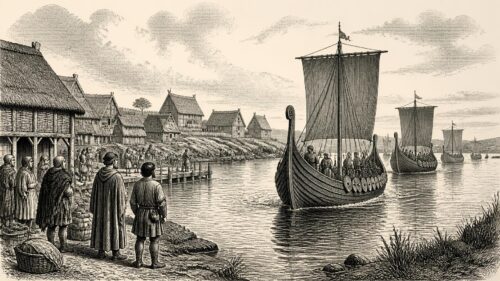
Coinage existed, particularly in Dublin, although wealth and obligations were not measured solely in money. Silver, livestock, food renders, ships, labour and military service all mattered. The appearance of Dublin’s “foreigners” beside Leinster at Crinach shows how urban resources, fleets and fighting men had become integral to Irish politics. Norse-Gaelic identity endured, but town rulers and inhabitants operated within the same shifting web of alliances as neighbouring Irish kingdoms.
A Transforming Year
The central event of 1086 was therefore not the disappearance of a single ruler but the unmaking of the political order built around him. Toirdelbach’s authority had reached far beyond Munster, yet it remained dependent upon his personal power. His death, Tadc’s rapid demise and Diarmait’s banishment left Muirchertach with Munster but not an uncontested kingship of Ireland. Alongside this dynastic turning point, the battles of Crinach and Eochaille, killings across the midlands and north, and the death of Máel Ísu Ua Brolcháin reveal a country that was politically fragmented but closely connected by warfare, scholarship, religion, trade and travel.
Primary Sources
- The Annals of Ulster: Year U1086
- Annals of Inisfallen: Annal AI1086
- The Annals of Tigernach: Annal T1086
- Chronicon Scotorum: Annal CS1086
- Annals of the Four Masters: Annal M1086
- Ua Briain, Tairdelbach
- Ua Briain, Muirchertach
- Patrick (Gilla-Pátraic)
- Malachy (Máel-M'áedóc) Ua Morgair
- The Viking Age in Ireland
- 950–1450: Vikings, Normans and Medieval Mints
- Early Medieval Collections
- Kingship and Sacrifice Exhibition Guide
- Wooden Plank with Viking Ship and Weathervane Graffiti
- Brian Boru’s Fort
- Rock of Cashel Site Guide
- The Practices of Irish Kings and Dynasties in the Central Middle Ages
- Kingship, Lordship, and Resistance: A Study of Power in Eleventh- and Twelfth-Century Ireland
- From Kingdom to Colony: Framing the English Conquest of Ireland
- Martin of Tours: A Patron Saint for Armagh?
- Letter from Lanfranc, Archbishop of Canterbury, to Terdelvacus or Tirloghe, King of Ireland
- Canterbury’s Claim to Primacy over Ireland
- Was There a Jewish Presence in Medieval Ireland?
- Animals and the Economy of Medieval Ireland: A Zooarchaeological Analysis of the Faunal Remains from Caherconnell Cashel, Co. Clare
- The Vikings in Ninth-Century Ireland: Sources and Settlements