Derryvree’s Thaw Pulse30625 BCE
At 30,625 BCE, Ireland lay within the climatically unstable Marine Isotope Stage 3. Derryvree in County Fermanagh preserves freshwater sediments deposited during an ice-free interval, later sealed by glacial deposits. Pollen, plants, mosses and insects indicate a cold, treeless, periglacial wetland with sedges, pools and Arctic-alpine vegetation. Its broad radiocarbon range encompasses the nominated date but cannot identify a specific year or climate event. Ireland’s variable ice margins and North Atlantic climate permitted temporary ecological opportunities before major glaciation. Cave fauna document cold-stage mammals, while a possibly butchered reindeer bone suggests, but does not prove, fleeting human presence or settlement.

Dateline
30,625 BCE is a modern label for a point more than 32,000 years before the conventional radiocarbon present of AD 1950. It must not be treated as an anniversary. No inhabitants of Ireland counted this year, and neither archaeology nor palaeoclimate can isolate a political event, a journey or even a single season within it. The responsible frame is the later part of the Last Glacial period, within Marine Isotope Stage 3: an age of abrupt climatic swings, expanding ice and exceptionally fragmentary Irish evidence.
The date falls broadly within the calibrated range associated with one of Ireland’s most valuable deep-time records, the Derryvree freshwater series near Maguiresbridge in County Fermanagh. That association does not mean the deposit was laid down in 30,625 BCE. Rather, a legacy radiocarbon determination from its organic sediments, 30,500 ± 1,100 radiocarbon years BP, calibrates to a wide span of roughly 36,900–31,700 calendar years BP. The nominated year lies within that range, but the uncertainty is measured in centuries and millennia, not years.
A Wetland Between Ice Advances
Derryvree was revealed when roadworks cut into a drumlin: a streamlined hill built and reshaped by glacier ice. Beneath later glacial deposits lay organic-rich muds and fine sands; below them lay older till. This sequence is direct evidence for a local order of events. Ice had affected the site, then a period without overriding ice allowed freshwater sediment and biological remains to accumulate, and later ice or ice-related deposits sealed the record. It is among the clearest Irish reminders that the last glacial cycle was not one uninterrupted freeze.
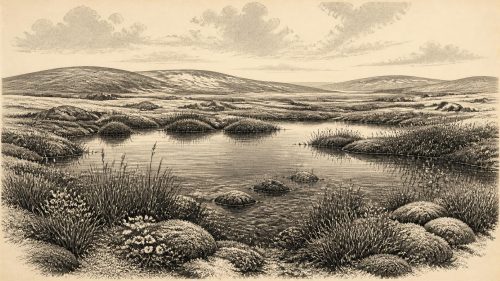
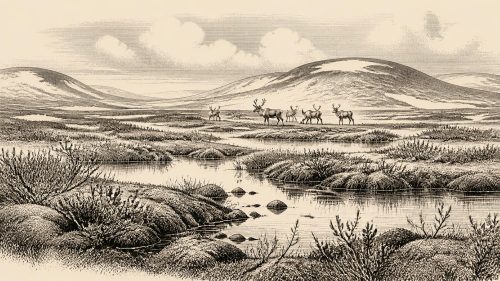
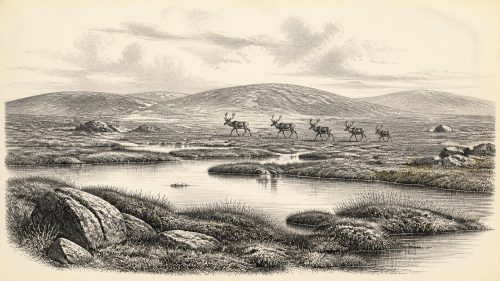
The buried bed preserves pollen, plant macrofossils, mosses and insect remains. Together they support an interpretation of a cold, open, largely treeless environment, often described as tundra or muskeg-like wetland. Sedges and mosses grew around shallow water and saturated ground. Bogbean and water-milfoil indicate freshwater habitats; dwarf willow, mountain-avens and other Arctic-alpine plants point to exposed, severe conditions beyond the pools. Such evidence does not recreate every hillside in Ireland, but it makes a persuasive local picture: frost-prone terrain with low vegetation, pools and marshy margins rather than woodland, farms or settled villages.
The word periglacial is useful here. It does not require that a glacier stood at Derryvree at every moment. It describes landscapes strongly governed by cold climate, seasonal freezing and thawing, frost-shattered ground, sparse plant cover and proximity to ice margins. Water could nevertheless be abundant. A shallow basin, supplied by meltwater, rainfall or local drainage, could sustain aquatic plants and insects while the wider landscape remained exposed and inhospitable by later standards.
Ireland in a Changing North Atlantic
The broader climate was unstable. Greenland ice-core records identify short-lived interstadials and stadials during Marine Isotope Stage 3, when North Atlantic conditions could change sharply over periods far shorter than archaeological chronologies normally resolve. Around the calendar equivalent of 30,625 BCE, the Greenland sequence lies close to the beginning of Greenland Interstadial 5.2. That is a useful continental-scale comparison, not a precise Irish weather report: the Derryvree radiocarbon range is too broad to match its silts securely to one ice-core transition.
Nor was Ireland uniformly ice-free. Research on the British–Irish Ice Sheet has transformed older, simple narratives of a single late advance. Marine, coastal and terrestrial evidence shows substantial and regionally variable glaciation before the conventional Last Glacial Maximum, while Derryvree demonstrates a non-glacial freshwater interval in Fermanagh. These observations are compatible because ice margins, sea levels and local environments varied greatly through time and across the island. Derryvree is a window onto one basin, not a national map.
Within several millennia, the ice sheet would expand into its major late-glacial phase. Reconstructions place the ice sheet’s maximum volume at about 23,000 years BP, while different sectors reached their greatest extent at different times. From the standpoint of 30,625 BCE, Ireland was therefore in an unsettled prelude to fuller glaciation: ecological opportunities existed in some places and intervals, but they were vulnerable to climatic deterioration and advancing ice.
Animals and Open Country
Irish caves, especially Castlepook Cave near Doneraile in north County Cork, provide a second kind of evidence. Their fossil collections include remains of woolly mammoth, giant deer, reindeer, brown bear, wolf, Arctic fox, lemmings and spotted hyaena. Revised radiocarbon work has shown that parts of this fauna belong to Marine Isotope Stage 3, and has also demonstrated why old cave chronologies require caution: improved pretreatment can make bone dates thousands of years older than results obtained in the 1990s.
The fauna establishes that Ireland could be reached by a diverse cold-stage mammal community over the wider period. It should not be converted into a single imagined herd. Cave bones may have accumulated through predation, scavenging, natural death, water movement and excavation practices that pre-date modern recording. Mammoth, hyaena and reindeer remains need not be contemporary with one another, and the Cork caves cannot prove that these animals occupied Fermanagh in the same century as the Derryvree wetland.
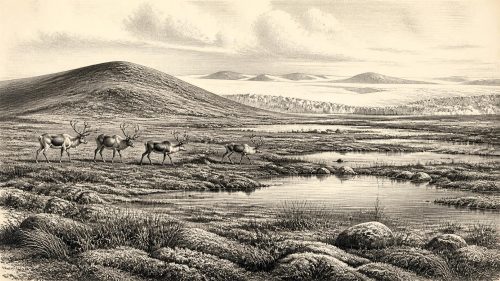
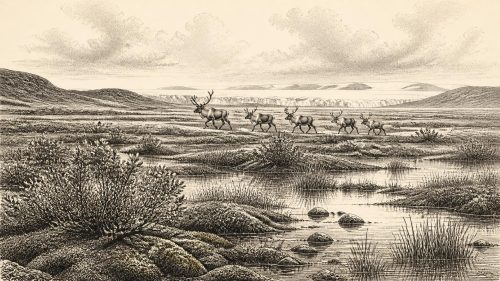
Even with those qualifications, animal evidence gives scale to the landscape. Reindeer and lemmings are consistent with open, cold habitats; mammoth and giant deer suggest wider tracts of grazeable country during suitable phases; hyaenas and wolves indicate predators operating within that food web. Seasonal movement was probably crucial. The sparse vegetation of an Ice-Age wetland was not barren: it could support insects, browsing animals, birds and scavengers, though its productivity would have changed sharply through the year.
The Uncertain Human Question
The most provocative Irish object from this general horizon is a reindeer femur from Castlepook Cave. It has been interpreted as bearing a cut or chop mark made by a sharp stone tool during butchery, and has been publicised as roughly 33,000 years old. If that interpretation is confirmed, it would indicate a brief Upper Palaeolithic human presence in Ireland far earlier than the island’s better-established post-glacial hunter-gatherer record.
Its limits are as important as its promise. The bone derives from an old cave collection, not a securely excavated occupation floor accompanied by stone tools, a hearth, dwelling remains or human skeletal material. The cave may not have been where the animal was killed or processed; a carnivore could have carried a discarded limb into it. One marked bone cannot demonstrate permanent settlement, a continuous population, the size of a hunting party or a specific archaeological culture. It is best understood as possible evidence of a fleeting human action within a much larger, unstable landscape.
For 30,625 BCE itself, no securely dated human artefact or site allows us to say that people were in Ireland. If people did make crossings during this broad phase, they were likely highly mobile hunter-gatherers connected to the Upper Palaeolithic worlds of Britain and continental north-west Europe. Lower sea levels altered coastlines and narrowed sea passages, but did not automatically create a known land bridge or a known route to Ireland. The crossing problem remains real, and the evidence is too slight to turn possibility into a settled narrative.
What Cannot Be Written
There were no demonstrable Irish kingdoms, chiefs, laws, diplomatic alliances, armies, languages or religious institutions that can responsibly be assigned to this date. There is no evidence for agriculture, stock-keeping, pottery, metalworking, long-distance trade networks, monuments, graves, art or formal learning on the island at this time. Absence is not proof that every human visitor lacked belief, social ties or knowledge; it means that Ireland’s record supplies no basis for describing them.
Accordingly, “society” is better approached through ecology than through invented communities. Derryvree reveals the ordinary requirements of life in a cold landscape: persistent water, hardy plants, insects and sheltered ground. Castlepook reveals a wider animal world shaped by hunting and scavenging, predators and carcasses. These archives are not silent because nothing happened. They are silent because later ice, erosion, rising seas and the passage of time removed almost everything that might once have recorded short-lived human activity.
A Landscape, Not a Chronicle
The strongest history for 30,625 BCE is therefore environmental. In a Fermanagh hollow, freshwater mud accumulated among sedges, mosses and cold-adapted plants during an interval later buried by glacial deposits. Elsewhere, Ice-Age mammals moved through landscapes whose precise geography can no longer be recovered. Farther south, a cave would eventually preserve bones that raise, but do not settle, the question of early people in Ireland.
Derryvree’s value lies in that modest, durable testimony. It replaces the false certainty of a year-by-year story with something more revealing: evidence that parts of the island could briefly hold wetlands and animal life amid profound climatic volatility, shortly before ice again remade much of the Irish landscape.
Primary Sources
- A Middle Midlandian Freshwater Series at Derryvree, Maguiresbridge, County Fermanagh, Northern Ireland
- A Reconsideration of the Radiocarbon Dating of the Marine Isotope Stage 3 Fauna from Southern Ireland
- The Irish Quaternary Fauna Project
- New Insights on the Fauna of Ireland’s Younger Dryas and Early Holocene from Alice & Gwendoline Cave
- Castlepook Cave
- Heritage Artefacts of County Cork 2021
- The Archaeological Heritage of County Cork
- Radiocarbon Constraints on the History of the Western Irish Ice Sheet Prior to the Last Glacial Maximum
- Growth and Retreat of the Last British–Irish Ice Sheet, 31,000 to 15,000 Years Ago: The BRITICE-CHRONO Reconstruction
- The Timing and Magnitude of the British–Irish Ice Sheet Between Marine Isotope Stages 5d and 2: Implications for Glacio-isostatic Adjustment, High Relative Sea Levels and ‘Giant Erratic’ Emplacement
- Exploring Controls of the Early and Stepped Deglaciation on the Western Margin of the British Irish Ice Sheet
- The IntCal20 Northern Hemisphere Radiocarbon Age Calibration Curve (0–55 cal kBP)
- The Greenland Ice Core Chronology 2005, 15–42 ka. Part 1: Constructing the Time Scale
- A Stratigraphic Framework for Abrupt Climatic Changes During the Last Glacial Period Based on Three Synchronized Greenland Ice-Core Records: Refining and Extending the INTIMATE Event Stratigraphy
- Dansgaard–Oeschger Events in Climate Models: Review and Baseline Marine Isotope Stage 3 Protocol
- Greenland Ice-Core Chronology 2005 (GICC05) for Various Greenland Ice Cores
- Menyanthes trifoliata
- Salix herbacea
- Dryas octopetala
- Myriophyllum alterniflorum
- BRITICE-CHRONO: Introduction
- Irish Pleistocene Biostratigraphy