Frontiers and Fortunes1199 CE
In 1199, Ireland remained a fragmented landscape of Gaelic lordships, church lands and expanding Anglo-Norman seigneuries rather than a uniform English possession. King John’s accession united the English crown with the lordship of Ireland, though power remained uneven. In Connacht, Cathal Crobhdearg and Cathal Carrach made an uneasy peace as William de Burgh pursued his grant. Northern campaigns exposed colonial limits when Áed Ua Néill defeated foreign forces. Raids damaged communities and churches, including Armagh. Richard de Tiúit built Granard’s motte-and-bailey, strengthening Meath’s frontier. Annals record famine, capture, deaths, cattle-raiding and hostages, revealing conflict’s burden on ordinary populations throughout Ireland.
Dateline
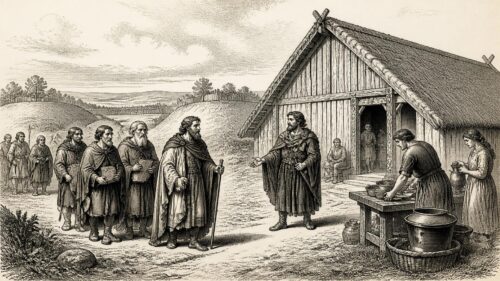
In 1199 Ireland was neither a single kingdom nor a country wholly controlled from England. It was a patchwork of Gaelic lordships, church lands and expanding Anglo-Norman seigneuries, linked by river routes, cattle wealth, kinship, military service and rivalry. The year’s surviving records are especially revealing for the north and midlands: they show war reaching churches and farming communities, a new castle rising at Granard, and the fragile political bargains on which power depended. In Connacht, peace between rival members of the Ua Conchobair dynasty briefly checked a dangerous succession dispute. Elsewhere, raids and counter-raids made clear how incomplete the newcomers’ control remained.
A New King, an Existing Lordship
The most consequential event beyond Ireland was the death of King Richard I on 6 April 1199 and the succession of his younger brother John. John was already lord of Ireland, a title and territorial lordship created under their father Henry II. His coronation at Westminster followed on 27 May. The change therefore did not suddenly place Ireland under an entirely new form of English authority: royal claims, castles, grants and officials had operated there for three decades. But it did unite the English crown and the lordship in one person, ending the possibility that Ireland might remain a separate apanage in John’s hands.
Its immediate effects should not be exaggerated. John was occupied with securing his wider Angevin inheritance, while authority in Ireland was exercised unevenly through powerful settlers and local rulers. Yet his accession mattered because the ambitions of men such as William de Burgh, John de Courcy and the de Lacys ultimately rested on royal favour. Land grants could encourage conquest; royal displeasure could suddenly imperil even great magnates. Ireland in 1199 was thus connected to a wider political world, but it was not governed as a uniform English province.
Connacht: Peace and Pressure
Connacht was the most volatile arena. Cathal Crobhdearg Ua Conchobair and his younger kinsman Cathal Carrach both possessed credible claims within the ruling Síl Muiredaig dynasty. The Annals of Ulster and the Annals of Loch Cé record that peace was made between them in 1199, with Cathal Carrach brought into the country and given land. This was more than a private family settlement. Kingship depended upon the backing of leading kindreds, clients and churchmen, and a negotiated territorial share was a practical means of reducing the risk that the rival would seek allies abroad.
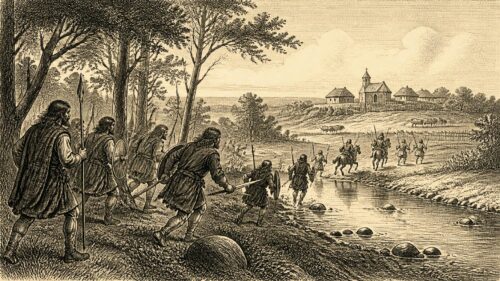
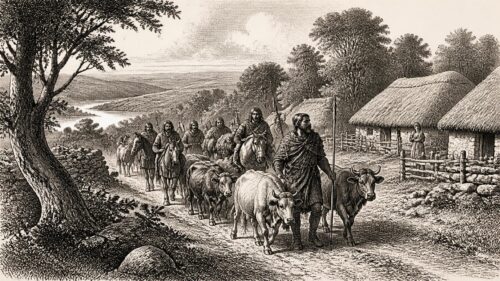
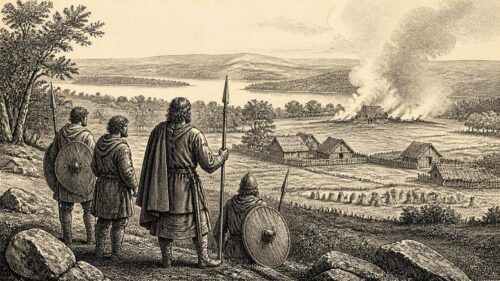
The settlement was plainly uneasy. The Annals of Loch Cé also report a raid by Cathal Crobhdearg against the Gall, or foreigners: a defended settlement called the bódhún of Áth was burned, people were killed and cattle were carried off. The location is not certain enough to permit a confident modern identification, but the form of the report is important. Burning a fortified place and driving away cattle attacked both military standing and the resources needed to sustain a lord’s household and followers. Warfare in this period was often directed at food, livestock, dependants and prestige rather than at a single decisive pitched battle.
William de Burgh’s growing involvement made Connacht’s internal contest still more dangerous. He was an Anglo-Norman lord established around Limerick and the Shannon frontier, and he held a speculative royal grant of Connacht made some years earlier. Modern scholarship identifies 1199 as the point from which he actively began to pursue that claim. Such a grant did not mean possession on the ground: Connacht had its own rulers, military forces and political institutions. It did, however, give de Burgh an incentive to intervene and gave rival Irish candidates reason either to resist him or to seek his support. The apparently conciliatory agreement between the two Cathals therefore sat beside an expanding external threat.
War in the Northern Marches
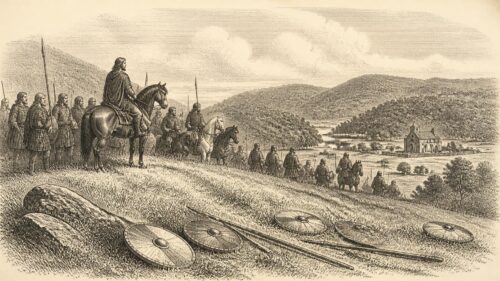
The clearest firmly dated conflict of the year occurred in and around Tír Eógain, the territory dominated by Áed Ua Néill. The Annals of Loch Cé state that the foreigners made three major expeditions there. On the third they established a camp at Domhnach Mór in Magh Imchlair and sent out a large force to devastate the surrounding country. Áed met them and inflicted what the annalist calls a countless slaughter; the survivors escaped by night and crossed the Bann at Toome. The language is formulaic and the numbers cannot be tested, but the sequence itself is credible evidence of repeated campaigning and a serious local reverse for the colonial forces.
This fighting belonged to a wider contest in north-east Ireland. John de Courcy’s lordship in eastern Ulster had brought settlers, castles and new religious patronage into the region, but it had not subdued all neighbouring Gaelic powers. The same annal tradition preserves a linked account of de Courcy’s campaigning among northern churches, his devastation of Ardstraw, Raphoe, Derry and Inishowen, and a counterstroke by Áed Ua Néill’s men at a settlement in Larne. Medieval annals may group events imperfectly by year, so that episode cannot safely be assigned an exact date within 1199; it nevertheless supplies the immediate background to the year’s three incursions. The frontier was active, maritime as well as terrestrial, and resistance could exploit ships, local knowledge and the difficulty of maintaining an army far from its bases.
Conflict also ran between Gaelic polities. The Annals of Ulster describe war between Cenél Conaill and Cenél nEógain. Cenél Conaill supported Ua hEicnigh as king; Áed Ua Néill and the men of Magh Ítha confronted him near the sanctuary of Termon Dabeoc, defeated him and took pledges or hostages. Áed’s forces then raided Cenél Conaill, bringing away cattle, before a later expedition ended in a form of peace when the opposing camp was abandoned. Hostages, tribute animals and the occupation of camps were instruments of politics as much as battlefield trophies. The record shows that the northern balance of power cannot be reduced to a simple Irish-versus-English struggle.
Churches Under Strain
Religious institutions stood at the centre of these struggles, not outside them. Churches and monasteries possessed cattle, food stores, dependent tenants, sanctuary rights and political authority; they could be valuable targets and essential partners. The Annals of Loch Cé record that Ruaidrí Mac Duinn Sléibe, accompanied by some of the foreigners of Meath, plundered the monastery of Saints Peter and Paul at Armagh so thoroughly that only one cow remained. The attack is striking precisely because Armagh was the foremost Patrician church and a major centre of authority. Its perpetrators evidently did not regard sacred status as an absolute protection in a campaign for resources.
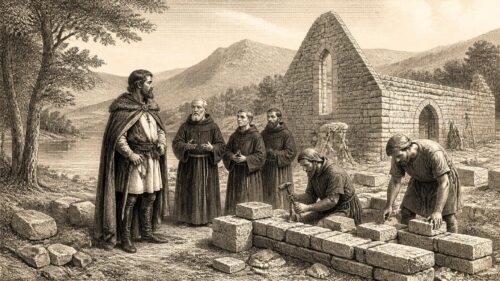
Two ecclesiastical deaths recorded for the year offer a quieter counterpoint. Máel Ísu, son of Gilla Ernáin, was erenagh of Kilmore in Oneilland and designated successor of St Patrick; Sanctus Mauricius Ua Báedáin died at Iona, the island community associated with Columba. The office of erenagh involved the hereditary management of church lands and obligations, demonstrating how religious life was embedded in local society and kin networks. Armagh and Iona also remind us that ecclesiastical influence crossed political frontiers: the communities of Patrick and Columba connected Irish regions to Scotland, northern England and the wider Latin Christian world.
A Castle at Granard
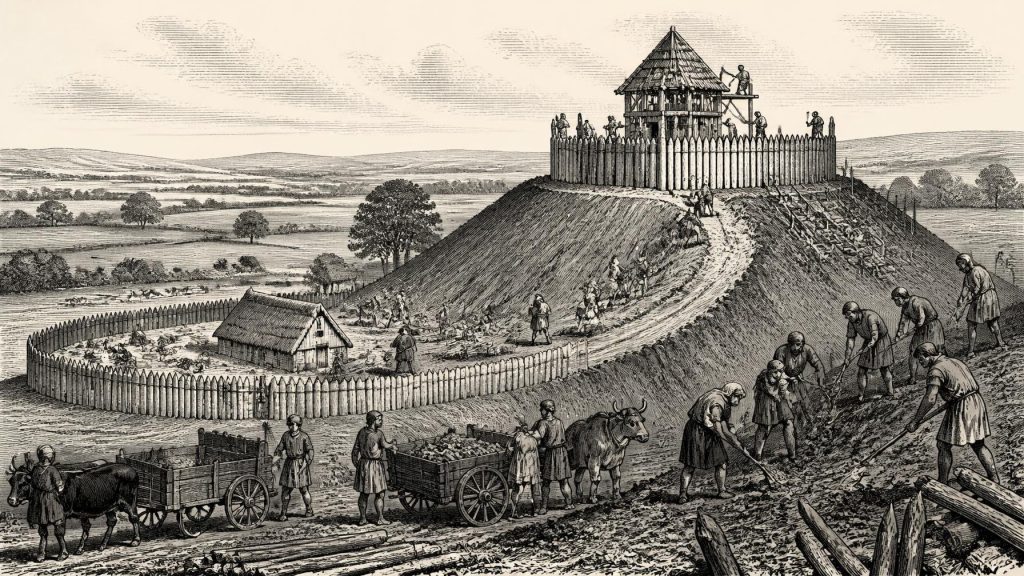
One of the year’s most tangible developments was the building of the castle of Granard, recorded by the Annals of Loch Cé. Archaeological and heritage evidence identifies the surviving monument as a substantial motte-and-bailey, constructed by Richard de Tiúit on a prominent hill in what is now County Longford. The earthwork incorporated an earlier ringfort landscape. This reuse was practical, taking advantage of a commanding site, but it also physically overlaid a new lordship upon an older Irish place of assembly, settlement and defence.
Granard lay on the north-western edge of the Anglo-Norman lordship of Meath, near the contested approaches to Bréifne and the midlands. A motte was not merely a military lookout. Its timber tower, palisaded bailey, stores, livestock, household and armed garrison created a local centre through which land, labour and movement could be controlled. Construction required timber, digging, carts, food, craftsmen and coerced or paid labour. For neighbouring communities, the castle signalled a permanent claim whose consequences could include new rents, obligations and markets, as well as the threat of military force.
Lives Recorded Through Loss
The annals preserve other brief notices that convey the human cost of instability. Gormghal Ua Cuinn was seized by foreigners, and his people were said to have been reduced to hardship through lack of food and clothing after plundering. Members of the Conmaicne were killed by Connacht mercenaries. Domnall Ua Dochartaigh, ruler of Cenél nÉnna and Ard Míre, died peacefully. These short entries do not permit a full reconstruction of ordinary experience, but they show the essentials at stake: security of persons, cattle, crops, garments, stores and the protection owed by a lord.
1199 was consequently not a year of one all-Ireland turning point, but of converging pressures. John’s accession altered the political horizon of the lordship; de Burgh’s ambitions sharpened the Connacht question; castles advanced the frontier in Meath; and the northern campaigns demonstrated the limits of colonial power. Peace-making, raiding and church patronage or plunder were not separate spheres. They were the means through which Irish rulers, Anglo-Norman lords, ecclesiastical communities and farming populations negotiated survival and authority at the close of the twelfth century.
Primary Sources
- The Annals of Ulster: Year U1199
- The Annals of Ulster: Irish Text, Year U1199
- Annals of Loch Cé: English Translation, LC1199
- Annals of Loch Cé: Irish Text, LC1199
- Annals of the Four Masters: English Translation, M1199
- Annals of the Four Masters: Irish Text
- Ua Conchobair, Cathal Mór Crobderg
- Burgh, William de
- Courcy, John de
- Ua Conchobair, Ruaidrí
- John, Lord of Ireland, 1185–1216
- The Kingdom of Connacht, 1166–1224
- Granard Motte and Bailey
- County Longford Urban Archaeological Survey: Granard
- 1999:540 – Rathcronan, Granard, Longford
- Granard Motte and Bailey
- Who Was Who in Medieval Limerick City
- Calendar of Documents Relating to Ireland, 1171–1307
- Parchment Conquest, 1171–1307
- John
- The Coronation of John
- The Song of Dermot and the Earl
- Farming and the Normans
- Irish Historic Towns Atlas: Tuam