
Synod and Supremacy1158 CE
In 1158, Ireland remained politically fragmented, though Muirchertach Mac Lochlainn of Cenél nEógain dominated the high-kingship contest against Connacht’s Ruaidrí Ua Conchobair. Raids, rebellions and struggles in Tethbae, Meath, Tír Conaill and Munster exposed limits of overlordship, while annalistic dating leaves some campaigns uncertain. The Synod of Brí Mic Taidg, led by Armagh’s archbishop and a papal legate, promoted church reform and elevated Derry’s Flaithbertach Ua Brolcháin as arch-abbot of Columban churches. Yet travelling bishops were attacked. Munster saw dynastic violence, whereas Amhlaoibh Ó Donnchadha completed Aghadoe’s church before his death. Cattle-based wealth, rural life, towns, and destructive flooding underpinned.
Dateline
In 1158 Ireland had no uncontested monarch ruling through a central administration. Power rested instead upon overlapping hierarchies of provincial kings, lesser rulers, dynasties, churches and towns. Muirchertach Mac Lochlainn, king of Cenél nEógain, was the strongest claimant to the high-kingship, but Ruaidrí Ua Conchobair, the energetic king of Connacht, was building a rival coalition. Their competition shaped politics across the midlands and north, while Munster remained divided by struggles among the Uí Briain, Mac Carthaigh and regional dynasties.
The surviving annals are unusually informative for this year, although they do not always agree. The Annals of Ulster, Annals of Tigernach, Annals of the Four Masters and Mac Carthaigh’s Book preserve partly different selections and chronological arrangements. Events recorded under 1158 in one compilation can appear under 1159 in another. A responsible account must therefore separate occurrences consistently assigned to 1158 from campaigns whose precise year remains uncertain.
A Contested Supremacy
Mac Lochlainn’s strength rested on Cenél nEógain and alliances with Airgialla, Ulaid and other northern peoples. He expected subordinate rulers to provide hostages, troops and hospitality, and he demonstrated supremacy by conducting large hostings across provincial boundaries. Hostages were not merely prisoners: they were political guarantees, usually drawn from the ruling families of territories expected to obey an overking.
Ruaidrí, who had succeeded his father Toirdelbach Ua Conchobair in 1156, challenged this northern ascendancy. The Four Masters place a Connacht incursion into Tethbae in 1158. Ruaidrí’s force plundered part of Muintir Chéirín and drove away many cattle, but the men of Tethbae defeated a detached portion of his army. Several named nobles were killed, while a son of Ua Flaithbertaig was captured. The episode shows both the reach and limitations of Connacht power: Ruaidrí could penetrate the midlands, yet local resistance might punish an army whose units became dispersed while raiding.
Meath was especially unstable. Donnchad and Diarmait Ua Máelshechlainn competed for kingship, while neighbouring rulers intervened whenever an opportunity arose. According to the Four Masters, Cairbre Ua Ciardha and some of the men of Tethbae restored Donnchad, only for Tigernán Ua Ruairc and Diarmait to defeat them at Áth Maigne. The conflict helped break the existing peace between Connacht, Bréifne and Meath. Control of this central region mattered because its routes connected Connacht, Dublin, Leinster and the northern kingdoms.
War in Tír Conaill
The Annals of Ulster record that Mac Lochlainn campaigned in Tír Conaill and devastated Fanad. The Four Masters provide a fuller but more complicated account: Cenél Conaill rebelled against him, whereupon he entered their territory with forces from Ulaid and Airgialla, plundering churches as well as secular lands. Cenél Conaill then attacked the Ulaid encampment and killed Áed Mac Duinn Sléibe, king of Ulaid, together with other nobles and common soldiers.
This was more than a border raid. Cenél Conaill and Cenél nEógain were rival branches of the northern Uí Néill, and resistance in Tír Conaill threatened Mac Lochlainn close to his own power-base. The reported plundering of churches also illustrates how difficult it was to protect ecclesiastical property during a major hosting. Churches possessed cattle, grain, precious objects and dependent settlements, making them economically valuable even when rulers professed reverence for saints and relics.
Mac Carthaigh’s Book assigns additional campaigns to 1158, including a northern victory over Ruaidrí’s coalition, the destruction of Dún Mór in Connacht and intervention in Meath. Other important annalistic traditions place the decisive confrontation near Ardee and the subsequent invasion of Connacht in 1159. These campaigns belong to the immediate political setting of 1158, but their exact placement within this calendar year cannot be considered secure.
The Synod at Brí Mic Taidg
The most consequential firmly dated development was a great church synod at Brí Mic Taidg in the kingdom of Meath. The Annals of Ulster describe an assembly called by the successor of Patrick, meaning the archbishop of Armagh, and attended by twenty-five bishops and the papal legate. Its declared purpose was to establish discipline and good conduct. The gathering continued the reform movement expressed at Ráith Bressail in 1111 and Kells-Mellifont in 1152, which sought clearer dioceses, stronger episcopal government and closer conformity with wider Latin Christian practice.
The synod elevated Flaithbertach Ua Brolcháin, abbot of Derry and successor of Colum Cille. He was granted a chair comparable to that of a bishop and recognised as arch-abbot of the Columban churches throughout Ireland. This should not be simplified into the straightforward foundation of a modern Diocese of Derry. The decision blended older monastic authority with the increasingly territorial and episcopal organisation of the reformed church. It also strengthened Derry, the principal Irish centre of the Columban federation, and reflected Mac Lochlainn’s patronage of institutions within his northern sphere.
The journey to the synod exposed the collision between ecclesiastical ideals and secular warfare. The Four Masters report that bishops travelling from Connacht were attacked at Cuirr Cluana by soldiers of Diarmait Ua Máelshechlainn. They were robbed and beaten, two members of their company were killed, and the delegation returned home. The Annals of Tigernach identify the bishops of Connacht and Clonmacnoise among those obstructed. Thus an assembly intended to impose order met without some of the senior clergy whose participation had been expected.
The death of Domnall Ua Longargáin, archbishop of Cashel or Munster, was also recorded in 1158. The Four Masters remembered him as a senior churchman distinguished by wisdom and charity. His death removed an experienced prelate at a time when the ecclesiastical province of Cashel was still adapting to the settlement reached at Kells.
Violence and Patronage in Munster
Munster’s divisions were starkly displayed when Toirdelbach Ua Briain blinded Conchobar Ua Briain and Conchobar’s son. The annals say that the deed violated the protection of the clergy and laity of Munster. Blinding was a political weapon because bodily perfection was associated with fitness for kingship. It could remove a rival without killing him, but an assault committed against guarantees damaged the ruler’s honour and endangered future agreements.
Mac Carthaigh’s Book also records violent deaths among the regional elites of the south. Brian son of Donnchad Ua Briain and Donnchad son of Áed Ua Cerbaill killed one another in a clash that cost several other lives. Amhlaoibh Ó Donnchadha raided Uaithne, killing local leaders, but was later defeated and killed beside the River Suir by Muirchertach son of Toirdelbach Ua Briain and a Thomond force. Mathgamain Mac Carthaigh died with him.
The Church at Aghadoe
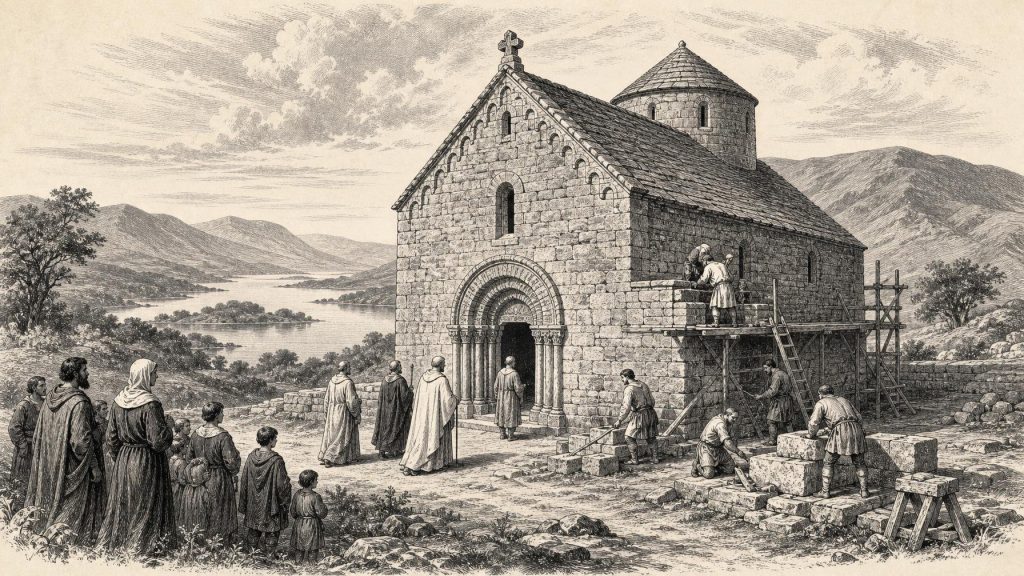
Amhlaoibh’s career was also associated with one of the year’s clearest cultural achievements. Mac Carthaigh’s Book states that he completed the great church at Achadh Dá Eó, now Aghadoe overlooking Loch Léin in County Kerry. After his death, his household carried his body home and buried him honourably beside the church with hymns, psalms and Masses. The building was dedicated to the Trinity and the Virgin Mary.
Aghadoe is a rare Irish Romanesque church linked by a written source to a particular year and patron, although later rebuilding means that not every surviving feature can confidently be assigned to 1158. Its carved sandstone doorway belongs to the architectural world transforming important Irish churches during the twelfth century. The project demonstrates how regional kings used stone construction, liturgy and burial at a favoured church to proclaim legitimacy and lasting attachment to a territory.
Work, Wealth and Weather
The annals concentrate on rulers and clerics, but their accounts repeatedly reveal the foundations of ordinary life. Cattle were mobile wealth, supplying milk, meat, hides and social status. They could be paid as tribute, presented to churches or seized by raiders. Archaeological evidence confirms that cattle dominated the farming economy, alongside sheep, pigs and cereal cultivation. A hosting therefore burdened communities not only through fighting but through billeting, the consumption of food stores and the removal of herds.
Most people lived in dispersed rural settlements, farmsteads and ringforts, while major churches acted as centres of worship, craft, learning and exchange. Dublin, Waterford, Cork and Limerick maintained maritime connections with Britain and continental Europe, but no particular commercial transaction can be securely assigned to 1158. The political importance of Limerick and Dublin nevertheless shows that kings valued access to ships, merchants, specialised crafts and concentrated resources.
The Four Masters close their account of the year with unusually heavy summer rain. Flooding on the Inis na Subh river in Sliabh Fuaid was said to have drowned twenty-three people. Although recorded in a much later compilation, the notice preserves the vulnerability of travellers and farming communities to sudden water, especially where roads crossed rivers without permanent masonry bridges.
Viewed as a whole, 1158 was a year of assertion rather than settlement. Mac Lochlainn remained Ireland’s predominant king, but rebellion in Tír Conaill and Ruaidrí’s activity in the midlands revealed persistent opposition. The synod at Brí Mic Taidg advanced church reform and raised Derry’s Columban leadership, even as armed men attacked bishops travelling to it. At Aghadoe, meanwhile, a newly completed stone church became the burial place of its fallen patron. Political violence, religious renewal and material ambition were not separate worlds: each depended upon the same networks of kinship, land, cattle, labour and sacred authority.
Primary Sources
- The Annals of Ulster: Year U1158
- Annals of the Four Masters: Annal M1158
- Mac Carthaigh’s Book: Annal MCB1158
- Annals of Tigernach: Annal T1158
- The Annals of Ulster
- Annals of the Four Masters
- Mac Carthaigh’s Book
- The Annals of Tigernach
- Mac Lochlainn, Muirchertach
- Ua Conchobair, Ruaidrí
- Mac Fáeláin, Fáelán
- Ua Brolcháin, Flaithbertach (d. 1175), Abbot of Derry and Head of Columban Churches in Ireland
- Aghadoe Monastic Site & Parkavonear Castle
- Aghadoe
- Medieval Ireland 1150–1550
- The Zooarchaeology of Medieval Ireland
- Agriculture, Settlement and Society in Early Medieval Ireland
- The Archaeology of Livestock and Cereal Production in Early Medieval Ireland, AD 400–1100
- Chronological Synchronisation of the Irish Annals
- Have There Been Synods in Ireland in the Past?
- Medieval Irish Institutions
- The Benedictine Shift
- Medieval Irish Ecclesiastical Organisation and the Synod of Brí Maic Taidg
- Medieval Ireland 1150–1550: National Museum Guide