

Kingship and Sacred Guarantees1143 CE
In 1143 Tairdelbach Ua Conchobair, Connacht’s dominant king, deposed Murchad Ua Máelshechlainn of Mide despite sacred guarantees, installed his son Conchobar, and provoked clerical condemnation. His authority was equally strained by the imprisonment of another son, Ruaidrí, despite ecclesiastical sureties, and by Munster’s contested incursion into south Connacht. In the north, Muirchertach Mac Lochlainn was temporarily expelled. Annals also record raids, destructive fires at major settlements, and church land transactions. The year revealed intertwined kingship, ecclesiastical power and local economies, while highlighting unreliable chronologies and conflicting annalistic accounts. Religious reform advanced through Mellifont and St Malachy alongside older sacred customs.
Dateline
Ireland in 1143 was dominated by the ambitions of Tairdelbach Ua Conchobair, king of Connacht and the strongest claimant to the high-kingship. His influence reached far beyond his western homeland, but it remained dependent upon alliances, hostages, military expeditions and the careful management of rival dynasties. The year’s surviving record is unusually revealing about the methods and limits of royal power. It describes the deposition of a provincial king, the imprisonment of Tairdelbach’s own son, clerical protests against broken guarantees, warfare between Connacht and Munster, and political upheaval among Cenél nEógain.
The evidence comes principally from Irish annals compiled or preserved in different centres. Their accounts do not always agree, and some entries were copied or assigned to years long after the events. Where several traditions support an event, it may confidently be connected with 1143; where they diverge, their disagreement is itself important. No exact day should be assigned to the year’s political or military events unless the record supplies one.
The Seizure of Mide
The most consequential political development was Tairdelbach’s intervention in Mide. Murchad Ua Máelshechlainn, king of Mide, was seized despite elaborate guarantees intended to protect him. According to the fullest account, Tairdelbach assembled his forces as though preparing an expedition into Munster. When the Connacht army, the Conmaicne and the Uí Briúin had gathered, Murchad was arrested and taken to Dún Mór together with the general hostages of Mide.
The annalist stresses that Mide itself was not plundered during the operation. This suggests a planned change of government rather than an ordinary cattle raid. Murchad was released after about a month and escorted into Munster, but he lost his kingship. Tairdelbach installed his own son Conchobar over Mide, described expansively as ruling from the Shannon to the sea. The appointment placed a loyal Ua Conchobair prince in control of the central approaches between Connacht, Dublin and the eastern kingdoms.
Mide possessed exceptional symbolic weight because it contained Tara and lay at the geographical centre of competing royal networks. Its native Uí Máelshechlainn rulers nevertheless retained substantial local support. Tairdelbach could impose a king, but he could not erase the political community beneath him. Conchobar’s installation therefore represented both the height of Connacht power and a dangerous overextension. His murder by Mide nobles in 1144 would demonstrate how fragile the settlement had been.
Relics, Sureties and Broken Faith
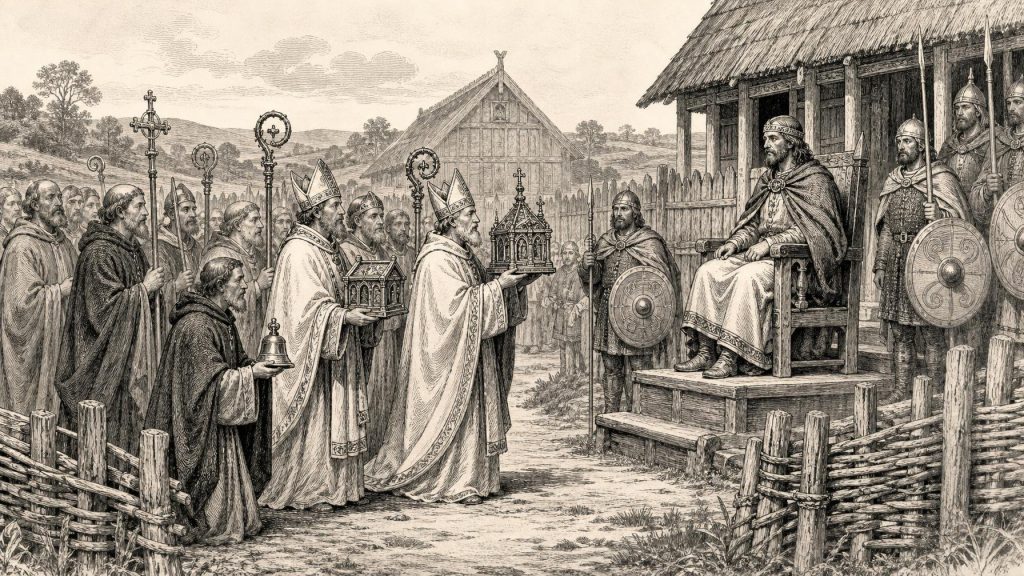
Murchad’s arrest was especially controversial because his safety had been guaranteed by leading clerics, rulers and sacred objects. The Annals of the Four Masters list the altar and shrine of St Ciarán, the abbot and prior of Clonmacnoise, the successor of Patrick and the Staff of Jesus, the successor of Feichín and Feichín’s bell, and a relic associated with Cóemgen. These were not merely devotional objects. Relics, bells, croziers and shrines could witness agreements, embody the authority of their saints and make a political promise spiritually binding.
The agreement reportedly prohibited treachery, imprisonment, blinding or the reduction of Murchad’s territory unless a recognised offence was proved before the sureties. The annalist insists that no such offence was established. The episode consequently appears not simply as a royal coup but as a breach of a public and sacred compact. Tairdelbach secured Mide, yet the clerical pressure that obtained Murchad’s release shows that even a dominant overking was expected to answer for violated protection.
A Son in Captivity
A parallel crisis unfolded within Tairdelbach’s family. His son Ruaidrí Ua Conchobair, the future last generally recognised Gaelic high-king, was imprisoned by his brother Conchobar and Tigernán Ua Ruairc acting for their father. Ruaidrí had already been involved in opposition to Tairdelbach during the 1130s. His renewed detention reveals the intense rivalry among the king’s many sons and the importance of deciding which prince would receive commands, territories and recognition as heir.
Ruaidrí too had been protected by lay and ecclesiastical sureties. Muiredach Ua Dubthaig, the senior bishop of Connacht, led a major clerical intervention demanding his release. The Annals of Tigernach claim that the gathering included twelve bishops and 500 priests, figures best treated as an annalistic expression of exceptional scale rather than a precise attendance list. Tairdelbach promised to surrender Ruaidrí to the clergy by the following Bealtaine, but the prince remained a prisoner into 1144. Clerics also fasted against the king at Ráth Brenainn, using ritual abstinence as a form of public and moral pressure.
War on the Munster Frontier
Tairdelbach Ua Briain, who had succeeded to the kingship of Munster in 1142, challenged Connacht during the year. The Annals of Tigernach describe Munster forces entering south Connacht and fighting at Ruadbethach, identified with Roevehagh in County Galway. The name probably referred to a place characterised by birch woodland rather than a single sacred tree. The account describes two violent encounters, losses on both sides and the deaths of prominent figures, including the king of Corcu Baiscinn and a leading warrior of Tairdelbach Ua Conchobair’s household.
Chronicon Scotorum gives a notably different version. It reports that the Munstermen cut down or destroyed Ruadbethach and dismantled its rampart before returning without plunder or battle. It is therefore safest to conclude that a Munster expedition reached this contested district in 1143, while recognising that the extent and sequence of the fighting cannot be securely reconstructed. The campaign formed part of a wider struggle between the Uí Briain and Ua Conchobair powers for authority over central and southern Ireland.
Change in the North
Among Cenél nEógain, Muirchertach Mac Lochlainn was expelled and Domnall Ua Gairmledaig elevated in his place. The reversal proved temporary, since Mac Lochlainn would recover and emerge as Tairdelbach Ua Conchobair’s principal rival later in the decade. For the moment, however, it exposed divisions within the leading northern dynasty.
The Four Masters also place under 1143 a Cenél nEógain raid into Fernmag, the territory remembered in Farney, County Monaghan. The raiders damaged its cattle and standing or stored corn, and Art Ua Ruairc was killed. Such language identifies the foundations of local wealth with unusual clarity. Warfare targeted herds, grain, dependants and the ability of a ruling lineage to feed its household and reward followers.
An Evolving Church
The clerical confrontations of 1143 belonged to an Irish tradition in which churches and saints’ successors served as diplomats, guarantors and political communities. At the same time, new forms of religious organisation were spreading. Mellifont, founded in 1142 with monks trained at Clairvaux, was passing through its first full year as Ireland’s earliest Cistercian monastery. St Malachy, papal legate and leading reformer, promoted continental monastic observances and a more territorial diocesan structure.
The older and newer systems existed together. Muiredach Ua Dubthaig could act as a reform-era senior bishop while invoking inherited forms of surety and sacred protection. Another annalistic entry records Tairdelbach granting a property near Loch na nÉan to Gilla na Naomh Ua Flainn, successor of St Commán, with gold involved in securing its perpetual possession. Kingship, ecclesiastical lordship and landholding remained closely intertwined.
Fire, Learning and Daily Life
The Four Masters record an exceptional series of fires under this year. Much of Clonard burned, including Les an Memra, a name commonly interpreted as an enclosure associated with manuscripts or learning. Kells, Trim, Dunshaughlin and Kildare were also burned, while Cork reportedly burned twice. The annal does not identify causes, and it should not be assumed that every fire resulted from warfare. Timber walls, wooden churches, workshops, open hearths and thatched roofs made both ecclesiastical settlements and towns highly vulnerable to accidental conflagration.
Loss at Clonard would have affected more than buildings. The settlement was an episcopal centre, a landholder and a place where books, teaching and trained clergy supported a wide religious network. A further reminder of literary culture is the death of Gilla Aengusa Ua Clumhain, ollamh of Connacht in poetry, although his obituary is placed in 1143 by the Four Masters and in 1144 by the Annals of Tigernach. His exact year of death is therefore uncertain, but his office demonstrates the continuing prestige of professional poets.
Most people left no individual trace in the chronicles. They lived principally from mixed farming, with cattle providing food, status and movable wealth, while grain supported households and armies. Towns such as Cork connected agricultural hinterlands with craftsmen, mariners and overseas commerce. Gold appears in the recorded church property transaction, but exchange also relied upon cattle, silver, valuables and obligations. The year’s raids and fires mattered to ordinary families because they threatened harvests, livestock, homes, tools and the protection offered by local rulers or churches.
Thus 1143 was not a year of stable supremacy. Tairdelbach Ua Conchobair could depose a king and place his son over Mide, yet he faced rebellion within his household, clerical condemnation and military pressure from Munster. Sacred guarantees could be broken, but not ignored; conquered territories could be reassigned, but not quietly absorbed. Beneath the annals’ language of kings and bishops lay communities whose labour sustained every army, monastery and royal ambition.
Primary Sources
- The Annals of Tigernach
- Annals of Tigernach — Irish Text
- Chronicon Scotorum: Annal CS1143
- Chronicon Scotorum
- Annals of the Four Masters: Part 25
- Annals of the Four Masters: Part 25 — Irish Text
- Annals of the Four Masters
- Annals of Inisfallen
- The Annals of Ulster
- Cath Ruis na Ríg for Bóinn: History and Literature in Twelfth-Century Ireland
- The Definite Article in Irish Place-Names
- Ua Conchobair, Tairdelbach (O'Conor, Turlough)
- Ua Conchobair, Ruaidrí
- Ua Conchobair, Conchobar
- Ua Briain, Tairdelbach
- Malachy (Máel-M'áedóc) Ua Morgair
- Ua Ruairc, Tigernán
- Ua Cerbaill, Donnchad
- Ua Dubthaig, Cadla (Catholicus)
- Old Mellifont Cistercian Abbey Monastic Site
- Viking
- Early Medieval
- Medieval Ireland 1150–1550
- 950–1450: Vikings, Normans and Medieval Mints
- Clonmacnoise Monastic Site