
Castlepook’s Hyena Archive30260 BCE
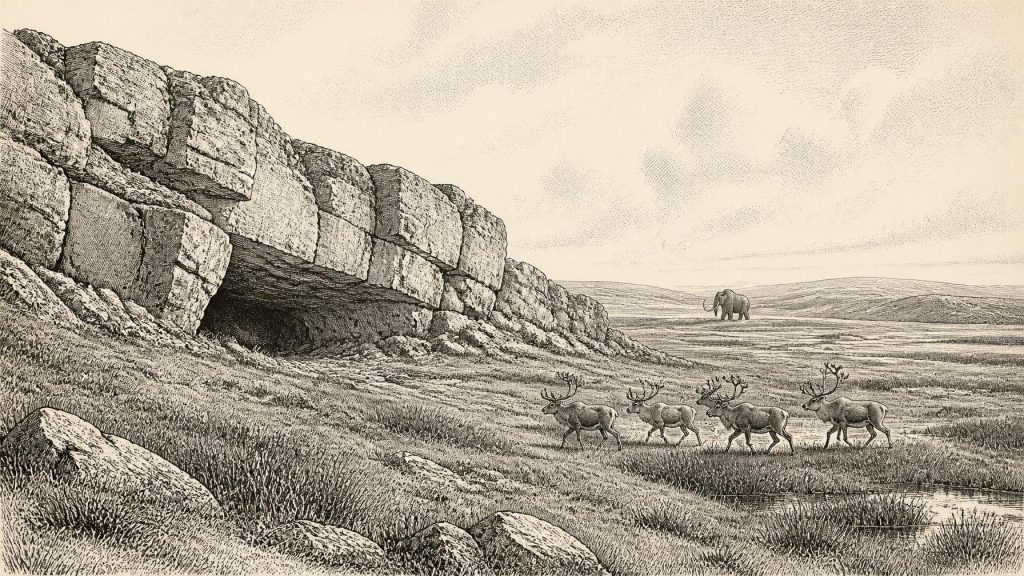
At 30,260 BCE, Ireland lay in a volatile later MIS 3 glacial environment, approaching maximum ice cover but not uniformly frozen. Changing ice margins, sea levels and climates created open tundra, wetlands and hazardous routes for animals and possible people. Castlepook Cave in County Cork preserves a long-accumulated MIS 3 fauna, including mammoth, giant deer, reindeer, hyena and wolf, reflecting carnivore activity rather than a single occupation. Its dates span millennia, preventing reconstruction. An incised reindeer femur may record stone-tool butchery around 31,000 BCE, suggesting fleeting Upper Palaeolithic human presence, but no settlement, tools, hearths or social history is evidenced.
Dateline
The label 30,260 BCE is a modern point on a deep-prehistoric timeline, not a date at which Ireland can be described through annals, rulers or events. No calendar-year precision is available. In the archaeological convention of years before AD 1950, it lies roughly 32,200 years before present; the useful evidence instead consists of calibrated age ranges, cave-bone dates, glacier reconstructions and environmental deposits whose uncertainties are usually measured in centuries or millennia. The responsible setting is later Marine Isotope Stage 3 (MIS 3), within the Midlandian, or last, glacial cycle.
Ireland at this point was not the familiar green island of later history. It was entering a severe and unstable phase before the Last Glacial Maximum. Yet it should not be imagined as uniformly entombed beneath ice in one simple national moment. The British–Irish Ice Sheet grew at different rates in different sectors. Recent reconstructions indicate rapid expansion of Scottish ice around 32,000–31,000 years ago, while the fullest ice cover of Ireland and its shelf belongs broadly to c. 27,000–23,000 calibrated years before present. Around the modern label 30,260 BCE, local conditions, coastlines and ice margins were changing too quickly, and are too imperfectly dated, to draw a precise island-wide map.
A Landscape Approaching Ice
The strongest conclusion is climatic rather than political. Ireland lay on the Atlantic edge of north-west Europe, where relatively small shifts in temperature and sea ice could alter rainfall, snow accumulation, river flow and the survival of vegetation. Speleothems from Crag Cave in County Kerry are particularly valuable: cave calcite can grow only when liquid water enters the cave and temperatures permit it. Uranium-thorium dates show episodes of speleothem growth through much of the last glacial period, with notably frequent deposition in later MIS 3. This is evidence for repeated ameliorations, not for a warm or stable Ireland.
Such intervals alternated with much colder conditions. The contrast between Greenland interstadials and stadials was large enough to influence whether Irish caves received dripping water, whether small wetlands could function, and whether snowfields expanded into glacier systems. The phrase ‘Ice Age’ therefore conceals a restless world of cold oscillations. A particular numbered BCE year cannot be aligned securely with one of those short-lived climatic pulses; the most that can be said is that Ireland was moving within a volatile pre-maximum glacial landscape.
Lower global sea level exposed more land around the Irish coast than exists today, but it does not follow that Ireland was simply joined to Britain by a broad, dependable land bridge. The Irish Sea basin was deep and its geography was complicated by changing sea level, crustal movement and advancing ice. Animals plainly reached Ireland in the Pleistocene, but the routes varied through time and remain uncertain. Any people who may have reached the island faced the same practical problem of crossing an altered but hazardous western seaway or moving through a changing ice-margin world.
Castlepook’s Long Bone Record
The best-known Irish archive for this broad period is Castlepook Cave near Doneraile in north County Cork, a limestone maze cave whose chambers were given evocative early names including Hyenahall and Elephant Hall. Excavations between 1904 and 1918 recovered more than 2,000 bones. The site is exceptionally important, but its limitations are equally important. The bones came from a long-lived cave repository affected by carnivores, water movement and antiquarian excavation methods, rather than from a sealed camp floor left during a single occupation.
Improved radiocarbon work has transformed the chronology. Earlier measurements from Irish caves were often too young because of problems in treating old bone collagen. Re-dating at Castlepook produced ages thousands of radiocarbon years older than previous determinations and indicates that several mammals lived in Ireland during MIS 3, with some species apparently gone locally by about 40,000 calibrated years before present. Geological Survey Ireland summarises a wide span of direct bone dates from the cave, c. 45,700–19,950 years before present. That range is much too broad to say that every species was alive in 30,260 BCE, but it securely establishes Castlepook as a window onto the wider pre-maximum Ice Age world.
The fauna includes woolly mammoth, giant deer, reindeer, brown bear and spotted hyena; other remains include wolf, Arctic fox, mountain hare and lemmings. These are not a complete census of a single landscape. Some animals may have died far apart in time, and cave predators could have carried carcass parts into the passages. Nevertheless, the assemblage shows that Ireland periodically supported a much richer cold-stage mammal community than the later island’s fauna. Mammoth and giant deer signal substantial herbivore biomass; reindeer, hares and lemmings point towards open, cold-adapted habitats; hyena and wolf reveal predators or scavengers within that food web.
What a Hyena Cave Can Tell Us
Spotted hyena is especially revealing. At Castlepook, its remains and the character of the bone accumulation make carnivore activity a central explanation for how the cave archive formed. A hyena den was not a neutral collection point: bones could be dragged in from elsewhere, gnawed, broken and mixed across successive visits. This cautions against picturing the cave as a human dwelling merely because it contains large-animal remains. It also makes Castlepook valuable for reconstructing animal behaviour. Carnivores, prey herds, scavengers and seasonal mortality all helped create the deposit.
Everyday life can therefore be described with confidence for animals, but only very cautiously for humans. The surrounding terrain was likely an open mosaic rather than closed forest: cold grassland, herb-rich tundra, exposed ground, patches of shrub vegetation and wet places where water persisted. This is an interpretation drawn from the ecology of the recorded fauna and from scattered Irish environmental sequences, not a directly observed panorama of north Cork on one day. There is no excavated dwelling, hearth, food store, burial ground, artwork or stone-tool workshop securely dated to this point in Ireland.
The Marked Reindeer Femur
The crucial human question turns on one object: a reindeer femur from Castlepook, held in the National Museum of Ireland’s Natural History collections. County Cork heritage material assigns it broadly to c. 31,000 BCE, close to the date considered here. Zooarchaeologist Ruth Carden has interpreted its deep linear incision as a mark made by a sharp stone tool while a fresh carcass was being processed. If that interpretation is confirmed, the bone may preserve Ireland’s earliest known trace of human action: not a settlement, but an encounter between people and a reindeer carcass during the Upper Palaeolithic.
The distinction between evidence and interpretation is essential. The evidence is a reindeer bone with a distinctive mark, from a complicated old cave collection. The interpretation is that the mark is a cut mark, and that people butchered the animal. Even if correct, it does not show whether people hunted the reindeer or scavenged it; whether they worked at the cave or discarded a limb later taken there by carnivores; whether they arrived alone or in a group; or whether they stayed for hours, days or a season. It cannot identify a language, ancestry, named archaeological culture or continuous population.
No securely associated Palaeolithic lithic assemblage, fireplace, shelter, human bone or occupation surface has yet been recovered from Castlepook. The femur therefore cannot bear the weight of claims that Ireland had an established human community in 30,260 BCE. It is, however, an important challenge to older accounts that placed all human presence after the retreat of the last ice. Further controlled work in and around the cave may clarify its context, but it must not be treated as evidence already obtained.
Wetlands, Plants and Seasonal Opportunity
Environmental records from northern Ireland add a second kind of evidence. At Derryvree near Maguiresbridge, County Fermanagh, organic freshwater sediments were preserved between tills later laid down by ice. Plant macrofossils from such deposits include sedges, mosses, dwarf willow, mountain avens, lesser clubmoss, water-milfoil and bogbean. Their exact chronology is debated and cannot be pinned to the modern year-label, but they demonstrate that during parts of the Midlandian cold stage, ice-free freshwater basins and tundra wetlands existed in Ireland before being overridden or buried by later glacier advances.
These small records matter because they show that a cold landscape was not biologically empty. Pool margins could support aquatic plants; sedge and moss communities occupied wet ground; low shrubs and herbs exploited short growing seasons. In such environments, animal movements would have followed fodder, water, shelter and snow conditions. Reindeer herds may have been highly mobile, while predators and scavengers tracked vulnerable prey and carrion. A possible human visitor would likewise have depended on mobility, detailed environmental knowledge and temporary access to animal resources rather than on agriculture or permanent settlement.
Society Beyond Recovery
There is no evidence for political affairs, formal diplomacy, territorial states, warfare, trade networks, farming, domestic livestock, metalworking, monuments, writing or organised religion in Ireland at this date. This is not a claim that a visiting person lacked beliefs, kinship or culture. It is a statement about what Irish evidence can presently recover. A single possible butchery mark cannot reveal social organisation, ceremonial life or learning. Nor should familiar later categories—tribe, king, nation, Celtic culture or Irish identity—be projected backwards into a time tens of millennia before them.
What can responsibly be said is both more limited and more striking. Around the broad horizon represented by 30,260 BCE, Ireland was a climatically unstable edge of Ice Age Europe. Its landscapes intermittently supported tundra and wetland vegetation and an imposing community of large mammals and carnivores. Castlepook Cave preserves the densest Irish archive of that world, while the marked reindeer femur raises the possibility of a fleeting human presence. The principal history of this date is therefore one of ice advance, animal movement, fragile habitats and an unresolved human clue—not of an invented event in a precise year.
Primary Sources
- Castlepook Cave: County Geological Site Report
- A Reconsideration of the Radiocarbon Dating of the Marine Isotope Stage 3 Fauna from Southern Ireland
- The Irish Quaternary Fauna Project
- The Exploration of Castlepook Cave, County Cork
- Occurrence of Mammalia Relicts at Site Castlepook Cave
- Heritage Artefacts of County Cork
- Growth and Retreat of the Last British–Irish Ice Sheet, 31,000 to 15,000 Years Ago: the BRITICE-CHRONO Reconstruction
- Pattern and Timing of Retreat of the Last British-Irish Ice Sheet
- Pleistocene Glaciations in Ireland
- Ireland: Submerged Prehistoric Sites and Landscapes
- Episodic Speleothem Deposition Tracks the Terrestrial Impact of Millennial-Scale Last Glacial Climate Variability in SW Ireland
- Freshwater Organic Deposits and Stratified Sediments Between Early and Late Midlandian (Devensian) Till Sheets, at Aghnadarragh, County Antrim, Northern Ireland
- Mammoth and Musk Ox ESR-Dated to the Early Midlandian at Aghnadarragh, County Antrim, Northern Ireland, and the Age of the Fermanagh Stadial
- A Middle Midlandian Freshwater Series at Derryvree, Maguiresbridge, County Fermanagh, Northern Ireland
- The Colonization of Ireland: A Human Ecology Perspective
- New Insights on the Fauna of Ireland's Younger Dryas and Early Holocene from Alice & Gwendoline Cave
- The IntCal20 Northern Hemisphere Radiocarbon Age Calibration Curve (0–55 cal kBP)
- IntCal13 and Marine13 Radiocarbon Age Calibration Curves 0–50,000 Years cal BP
- A 60,000 Year Greenland Stratigraphic Ice Core Chronology
- Growth Dynamics and De-Glaciation of the Last British-Irish Ice Sheet: the Deep-Sea Ice-Rafted Detritus Record