BIRM-166’s Radiocarbon Uncertainty30280 BCE
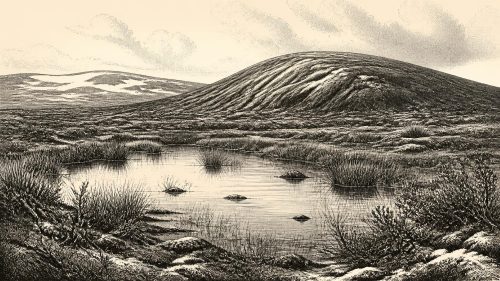
Around 30,280 BCE, Ireland was a dynamic Late Pleistocene landscape, not a documented historical society. Derryvree, County Fermanagh, preserves organic freshwater deposits between tills, radiocarbon-dated broadly to 34,950–29,750 BCE. Its plants and insects indicate treeless, periglacial tundra wetlands, with sedges, mosses, herbs and shallow water, during an ice-free local interval. Castlepook Cave, County Cork, contains animal remains accumulated over millennia, including reindeer, mammoth, giant deer, predators and cold-adapted small mammals. A marked reindeer femur may indicate human carcass processing, but cannot establish settlement, hunting, community, culture or a precise date. Evidence chiefly reveals changing ice, environments and wildlife in Ireland.
Dateline
The label 30,280 BCE is a modern point on a timescale far beyond any Irish calendar, chronicle or oral record that survives. It cannot identify a particular year, season, expedition or individual. Around this notional date Ireland lay in the Late Pleistocene, within Marine Isotope Stage 3, an unstable interval of the last Ice Age. The responsible evidence is geological and biological: layers of glacial sediment, fossil plants and insects, animal bones, and a small number of radiocarbon determinations. It provides calibrated ranges measured in centuries or millennia, not modern year-by-year precision.
The closest exceptionally informative Irish record is the Derryvree freshwater series near Maguiresbridge in County Fermanagh. Road construction exposed a drumlin cut in 1969. Within it, organic silts and fine sands lay between two thick deposits of till, the unsorted material left by glacier ice. Organic matter from the freshwater layer produced radiocarbon determination BIRM-166: 30,500 radiocarbon years before present, with a large published uncertainty. Calibration has placed the deposit broadly at about 36,900–31,700 calibrated years BP, approximately 34,950–29,750 BCE. Thus 30,280 BCE falls within the broad range relevant to the deposit, but cannot be assigned to an individual stratum within it.
A Wetland Between Ice Advances
Derryvree’s sequence is more secure than its exact age. The lower till shows that ice had previously occupied the locality. Above it, freshwater sands, silts and organic material accumulated while ice was absent from that spot. The upper till demonstrates a later return or expansion of glacier ice sufficient to bury and preserve the wetland. This is firm local evidence for change: ice, then a cold but living freshwater landscape, then renewed glacial conditions. It is not proof that all of Ireland was simultaneously ice-free, nor that every region experienced the same climate.
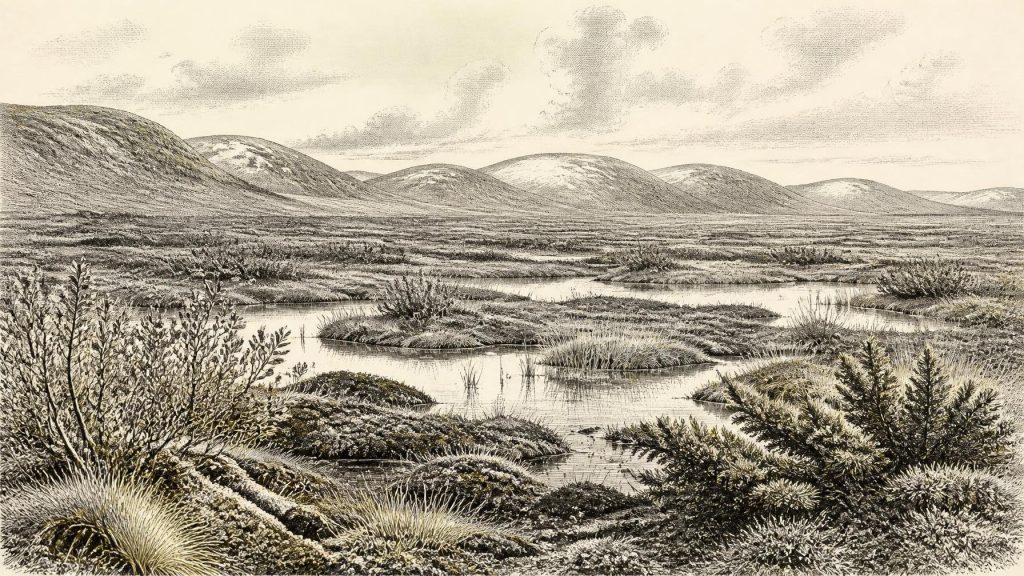
The plants and small animals in the organic bed make the buried landscape unusually vivid. Pollen was poorly preserved, but the surviving macrofossils and insect remains indicate open tundra vegetation and a periglacial regime: ground repeatedly affected by freezing and thawing beside waterlogged places. Mosses, sedges and cold-tolerant herbs occurred with plants associated with damp ground and shallow freshwater, including bogbean and water-milfoil. Dwarf willow, juniper, mountain-avens and lesser clubmoss are among the plants reported from the series. These were not woodland indicators. Trees could not form the dense canopy associated with later Ireland; any dry ground was likely sparse, exposed and seasonally severe.
“Tundra” should not conjure a uniform, lifeless white plain. The Derryvree evidence instead suggests a patchwork of pools, slow water, mossy or peaty ground, sedge margins and drier mineral surfaces. Summer growth could be concentrated into a short season, while winter frost and snow restricted the landscape. A wetland in a cold climate also created local ecological variety: aquatic plants and invertebrates could thrive where liquid water persisted even as the wider environment remained treeless and harsh. The record is therefore one of environmental resilience as well as cold.
An Island in a Changing Ice World
At this depth of time, Ireland’s physical geography was changing quickly by geological standards. Ice sheets did not advance or retreat as a single, neat wall. Their margins, thickness and flow routes varied across Ireland, Britain and the surrounding shelves. Recent British–Irish Ice Sheet reconstructions begin at 31,000 years BP because earlier constraints are sparse, and depict growing ice centres in northern parts of Ireland and Britain. Derryvree, whose calibrated range overlaps this wider transition, is especially valuable because it preserves direct evidence of an ice-free interval before later burial.
The wider landscape cannot be reconstructed from Fermanagh alone. Uplands, western coasts, southern limestone country and Irish Sea basins responded differently to ice, precipitation and sea level. Lower global sea level exposed more of the continental shelf than exists today, but that fact does not demonstrate a particular human route into Ireland or a walkable land connection at this moment. Any claim that people simply crossed a known land bridge would exceed the Irish evidence. The important point is that Ireland formed part of a wider north-west European environmental zone, in which ice, exposed shelf, cold seas and shifting animal habitats continually altered opportunities for movement.
There were no identifiable polities, rulers, frontiers, diplomatic relations or organised wars in Ireland around this date. Nor is there evidence for an Irish population that could be described as a tribe, nation or kingdom. Such language belongs to much later history. Even the naming of a distinct archaeological culture would be unwarranted. The material record is too fragmentary to establish permanent settlement, social hierarchy, territorial control or institutions.
Castlepook’s Animal Archive
County Cork offers another important, if more complicated, window on this broad period. Castlepook Cave, near Doneraile and also called Mammoth Cave, produced one of Ireland’s richest collections of Late Pleistocene animal remains. The Irish Quaternary Fauna Project showed that mammals colonised Ireland during a long span between at least about 45,000 and 20,000 years ago. Castlepook specimens include reindeer, woolly mammoth, giant deer, brown bear, wolf, Arctic fox, mountain hare, lemmings and spotted hyaena.
That list must not be mistaken for one herd, one season or one scene outside the cave at 30,280 BCE. The remains accumulated across a long period, and early excavations did not always preserve the detailed stratigraphic information expected today. Caves are also selective archives. Hyaenas and other carnivores could drag bones inside; animals may have died there; flowing water, collapsing sediments and earlier digging could mix remains. Castlepook establishes that Ireland supported a richer Ice Age mammal community than the modern island, but it cannot provide a census of north Cork at a particular date.
Nevertheless, the fauna supports some careful ecological conclusions. Reindeer point to open, cold-adapted grazing country, while mammoth and giant deer indicate that, during suitable phases, substantial herbivores used the wider Irish landscape. Hyaena, wolf and Arctic fox reveal predators and scavengers within those food webs. Lemmings and mountain hares reinforce the evidence for cold, open habitats. The animals would have moved through landscapes shaped by seasonality, forage availability and ice margins rather than through the familiar agricultural fields, hedgerows and woods of later Ireland.
The Reindeer Femur Question
One Castlepook object gives this broad horizon exceptional historical interest: a reindeer femur bearing a deep linear mark, interpreted by zooarchaeologist Ruth Carden as damage made by a sharp stone tool during carcass processing. County Cork heritage material presents the bone as Palaeolithic and approximately 31,000 BCE; public accounts have associated radiocarbon work with an age of roughly 33,000 years. If the mark was made by people on fresh bone and broadly belongs to the animal’s age, it could be the earliest currently claimed indication of human activity in Ireland.
The distinction between evidence and interpretation is crucial. The bone itself is evidence for reindeer. Its radiocarbon result dates the animal’s remains, not necessarily the making of the incision. The identification of the mark as a stone-tool cut is a specialist taphonomic interpretation. The femur was recovered from an older cave collection, rather than from a modern excavation of a sealed occupation floor with associated tools, hearths and food debris. No securely associated Upper Palaeolithic settlement, dwelling, burial, human skeleton, art assemblage or stone-tool industry of this age has been established in Ireland.
If the human interpretation is upheld, the most that can safely be said is that one or more people may have processed a reindeer carcass during the wider Late Pleistocene interval represented at Castlepook. It does not show whether they killed the animal, scavenged it, camped in the cave, travelled in a larger party, returned regularly, or founded a lasting population. Meat, fat, hide, sinew, bone and antler would all have been useful to hunter-gatherers elsewhere in Ice Age Europe, but their use at Castlepook cannot be inferred from a single marked femur. Recent investigations at the cave are important precisely because they seek undisturbed deposits and securely associated evidence.
Life, Belief and Exchange Beyond Recovery
The environmental archives tell us much more about plants, water, ice and animals than about human society. There is no evidence from Ireland around 30,280 BCE for houses, villages, graves, ritual monuments, images, clothing, language, religious practice, trade goods or exchange networks. Absence of evidence is not proof that no person ever visited the island, particularly when ice, erosion, rising seas and later deposits have destroyed or buried older landscapes. But it does mean that political affairs, diplomacy, warfare, learning, religion and commerce cannot responsibly be narrated for this nominal year.
The strongest history of Ireland at this point is therefore environmental. In Fermanagh, a wetland developed between episodes of glaciation, sustaining cold-adapted plants and invertebrates. In south-western Ireland, cave deposits preserve the traces of large herbivores and formidable carnivores over a much longer interval. A single reindeer bone raises the possibility of a human encounter, but not yet the certainty of an Irish community. Around 30,280 BCE, Ireland was neither a known homeland nor an empty abstraction: it was a difficult, dynamic Ice Age landscape, inhabited demonstrably by wildlife and illuminated for us by sediments, fossils and uncertainty.
Primary Sources
- Middle Midlandian Freshwater Series at Derryvree, Maguiresbridge, County Fermanagh, Northern Ireland
- Middle Midlandian Freshwater Series at Derryvree, Maguiresbridge, County Fermanagh, Northern Ireland
- Palaeoecology
- Figure 6.— The Subdivision of the Quaternary Period in Ireland
- Growth and Retreat of the Last British–Irish Ice Sheet, 31,000 to 15,000 Years Ago: the BRITICE-CHRONO Reconstruction
- BRITICE-CHRONO Maps and GIS Data of the Last British-Irish Ice Sheet 31 to 15 ka
- The IntCal20 Northern Hemisphere Radiocarbon Age Calibration Curve (0–55 cal kBP)
- IntCal Publications
- Pleistocene Glaciations in Ireland
- The Irish Quaternary Fauna Project
- First Evidence of a Late Upper Palaeolithic Human Presence in Ireland
- New Insights on the Fauna of Ireland’s Younger Dryas and Early Holocene from Alice & Gwendoline Cave
- The Colonization of Ireland: A Human Ecology Perspective
- Deglaciation Chronology of the Donegal Ice Centre, North-West Ireland
- Trimlines, Blockfields and the Vertical Extent of the Last Ice Sheet in Southern Ireland
- Archaeology Research Excavation Grant 2022: Castlepook Caves Project Final Report
- 2022:564 – Castlepook Cave, Castlepook South, Cork
- Heritage Artefacts of County Cork
- The Mesolithic in Ireland: When Was It?
- Myriophyllum alterniflorum
- Timing, Pace and Controls on Ice Sheet Retreat: an Introduction to the BRITICE-CHRONO Transect Reconstructions of the British-Irish Ice Sheet
- Growth and Retreat of the Last British–Irish Ice Sheet, 31,000 to 15,000 Years Ago: the BRITICE-CHRONO Reconstruction