Sunningdale’s Fatal Spring1974 CE
In 1974, Northern Ireland’s Sunningdale power-sharing Executive collapsed after anti-agreement unionist electoral success and the Ulster Workers’ Council strike, restoring direct rule from Westminster. During the strike, loyalist car bombs killed thirty-three people in Dublin and Monaghan, exposing the Republic’s vulnerability; no one was prosecuted. Violence continued across Ireland and Britain, while republicanism fragmented with the formation of the IRSP. Economic disruption, inflation and a lengthy Dublin bus strike burdened daily life. Equal-pay legislation advanced women’s rights, but contraception reform failed. Erskine Childers died, Cearbhall Ó Dálaigh succeeded him, and cultural initiatives persisted amid constitutional crisis and widespread social loss.
Dateline
A Year That Began with Power-Sharing
For Ireland, 1974 was dominated by the rapid unravelling of the Sunningdale experiment and by violence that reached with appalling force into the Republic. The year opened with a new Northern Ireland Executive formally taking office on 1 January. It was the practical outcome of the Sunningdale Agreement of December 1973: an administration containing unionists, the nationalist Social Democratic and Labour Party (SDLP), and the cross-community Alliance Party, alongside proposed all-Ireland institutions including a Council of Ireland. Liam Cosgrave’s Fine Gael–Labour government in Dublin regarded that cross-border element as a necessary acknowledgement that Northern Ireland could not be governed securely without the Irish Government’s involvement. For many unionists, however, it appeared to threaten Northern Ireland’s place in the United Kingdom.
The Executive’s authority was weak from the outset. On 4 January the Ulster Unionist Council voted to reject the Council of Ireland. Brian Faulkner, the Executive’s Chief Executive, resigned as leader of the Ulster Unionist Party after that repudiation, although he and his pro-agreement colleagues remained within the Executive. The distinction was politically unsustainable: a power-sharing administration could not flourish while its principal unionist participant had lost the support of its own party machine.
The Westminster election of 28 February offered a stark measure of that opposition. The United Ulster Unionist Council, a coalition of anti-Sunningdale unionists including the Ulster Unionist Party, Vanguard and Ian Paisley’s Democratic Unionist Party, won eleven of Northern Ireland’s twelve Westminster seats. It did not make the election a constitutional referendum in a legal sense, and the SDLP’s vote remained substantial, but it gave anti-agreement unionism an unmistakable parliamentary triumph. Sunningdale now faced resistance not only from paramilitary organisations and street protest, but from elected representatives claiming a powerful democratic mandate.
The Ulster Workers’ Council Strike
The decisive confrontation began in May. On 14 May, after the Northern Ireland Assembly rejected an anti-Sunningdale motion, the Ulster Workers’ Council announced a general strike for the following day. From 15 May, loyalist workers, organisers and paramilitary-backed activists used stoppages, roadblocks, intimidation and control over key workplaces to curtail ordinary life. Electricity supplies were rationed through rotating cuts; factories shut; transport was disrupted; fresh food and milk could not reliably reach markets or processors. The UWC published lists of services it deemed essential, while loyalist paramilitary influence made the distinction between industrial action and coercive political mobilisation impossible to ignore.
The strike revealed the vulnerability of a small, highly interconnected region. Power stations, ports, roads, depots and workplaces became political pressure points. The British Government declared a state of emergency on 19 May, but did not break the stoppage. The security response was constrained by fears that a more direct confrontation with loyalist barricades could create still wider violence. Within the Executive, ministers differed over how forcefully the state should act. By 28 May, Faulkner and the other unionist members had resigned; the strike ended shortly afterwards. The power-sharing Executive, only five months old, was finished.
This was more than a change of ministers. It ended the first serious attempt to combine devolved government, cross-community participation and a structured Irish governmental role in Northern Ireland. In July, the Northern Ireland Act 1974 placed the Assembly in abeyance, restored direct rule from Westminster and provided for an elected Constitutional Convention. The immediate future was therefore not reconciliation through joint administration, but another search for a constitutional formula under British control.
Dublin and Monaghan Attacked
Amid the strike came the year’s most devastating attack in the Republic. On Friday 17 May, without warning, three car bombs exploded in Dublin during the evening rush hour: on Parnell Street, Talbot Street and South Leinster Street. A fourth exploded later outside Greacen’s public house in Monaghan town. Thirty-three civilians were killed and almost 300 people injured. The dead included a pregnant woman; the attack remains the highest single-day death toll of the Troubles.
The bombings abruptly erased any comforting idea that the Republic stood outside the war. Central Dublin was attacked at the moment workers, shoppers and commuters were making their way home; Monaghan, a border county town, was hit in the same coordinated operation. Later investigations concluded that the bombings were carried out by loyalist paramilitaries. The Ulster Volunteer Force eventually claimed responsibility in 1993. No person has been prosecuted for the murders. The later Barron inquiry criticised serious shortcomings in the original Garda investigation and examined evidence relating to possible knowledge or involvement by members of British security forces; it did not establish a proven higher-level official conspiracy.
In 1974, the immediate experience was one of shock, bereavement and uncertainty. The attacks also deepened the political crisis surrounding Sunningdale. They occurred on the strike’s third day, when the proposed role of Dublin in Northern Ireland’s affairs was under especially vehement attack. It would be wrong to reduce the victims to symbols in a constitutional struggle: they were civilians killed in streets and a public house by a deliberately indiscriminate operation.
Conflict, Politics and Daily Strain
Violence continued across and beyond Ireland throughout the year. The Provisional IRA campaign remained active in Northern Ireland and Britain, while loyalist killings and bombings intensified fear in nationalist communities. November’s Birmingham pub bombings, which killed twenty-one people in England, underscored the conflict’s British dimension and contributed to a harsher security climate. In Dublin on 8 December, Seamus Costello and fellow dissidents from the Official republican movement founded the Irish Republican Socialist Party. Its formation, with the associated emergence of the Irish National Liberation Army, demonstrated that republican politics itself was fragmenting rather than settling.
Yet 1974 was not lived only through headlines from the North. The Republic’s coalition government, in office since March 1973, struggled with the wider international economic dislocation following the oil crisis. Imported energy and commodity costs drove inflation and made household budgets uncertain. Parliamentary debate repeatedly returned to price rises, petrol supply, redundancies and unemployment. Ireland’s recent membership of the European Economic Community created new opportunities and obligations, but did not insulate an import-dependent economy from international shocks. Economic growth achieved in the previous year offered little reassurance to families watching the cost of food, fuel and transport.
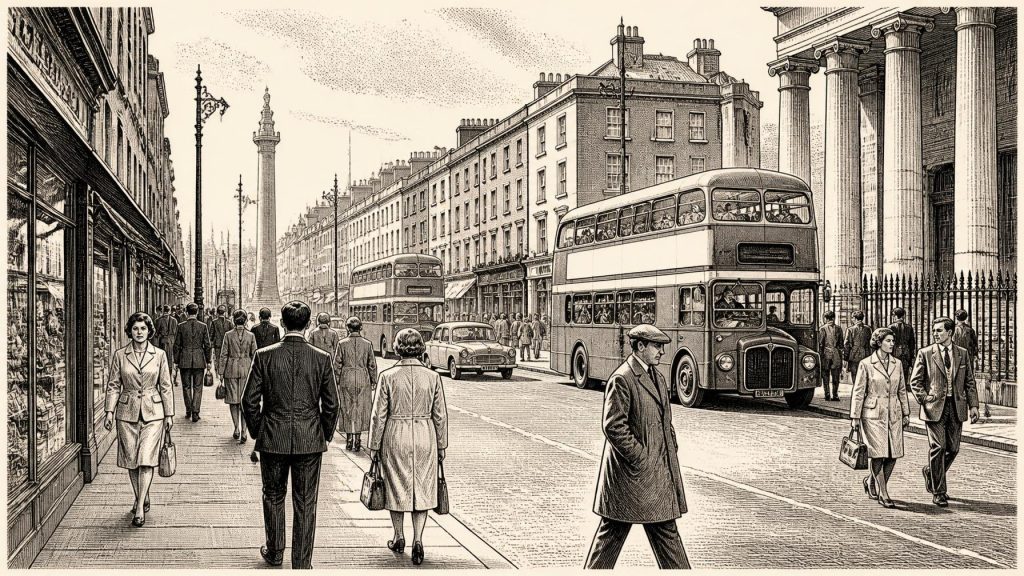
In Dublin, public transport gave those pressures an everyday form. A bus strike lasting sixty-five days ended on 9 July, after nine weeks without normal city bus services. People improvised journeys to work, school and shops, while city-centre retailers lost trade. The settlement was followed by a 20 per cent rise in Córas Iompair Éireann bus and suburban rail fares. For many households, this was a tangible reminder that industrial disputes and public finance were not abstractions: they determined whether one could reach work, visit family or afford a routine journey.
Law, Family and Equality
Social change proceeded unevenly. The Anti-Discrimination (Pay) Act became law on 1 July. It established the principle that women and men doing like work for the same employer should receive equal pay, with equal-pay officers and the Labour Court given roles in enforcement. The Act was not due to come into operation until the end of 1975, so it did not instantly transform wages in 1974. Nevertheless, its passage marked an important legislative acknowledgement that sex-based pay inequality was a public question rather than merely a matter for private employers or collective bargaining.
On family planning, change was much less assured. The Government’s Control of Importation, Sale and Manufacture of Contraceptives Bill was defeated in the Dáil in July on a free vote. The proposed measure was restrictive by later standards: it would have regulated importation and sale through licensing and would not have offered equal access to unmarried people. Even so, the defeat exposed deep divisions within the coalition and in Irish public life. Taoiseach Liam Cosgrave voted against his Government’s own bill. The episode showed that the Republic’s legal and moral debates over sexuality, marriage, privacy and religious influence were moving into open parliamentary conflict, but had not reached legislative resolution.
Institutions, Culture and Continuity
The presidency also changed hands in sombre circumstances. Erskine Childers died in office on 17 November, only a year and a half after becoming President. His death prompted a national transition at a time when public confidence was already strained by violence and economic anxiety. Cearbhall Ó Dálaigh, a former Chief Justice and judge of the European Court of Justice, was nominated without opposition and inaugurated as President on 19 December in Dublin Castle. The peaceful succession mattered: it demonstrated the resilience of the Republic’s constitutional institutions amid extraordinary pressure beyond the Border.
There were quieter signs of cultural and civic energy. Kilkenny Arts Week, later Kilkenny Arts Festival, was founded in August, using the city’s churches and historic spaces for classical music, literature, craft and visual arts; Seamus Heaney appeared at its first literary event on 25 August. In November, Michael O’Brien’s new publishing house issued its first title, Éamonn Mac Thomáis’s Me Jewel and Darlin’ Dublin. Such developments did not cancel the grief or political danger of 1974. They did, however, show a society continuing to create local institutions, make art and argue about its future.
By year’s end, the hopes invested in Sunningdale had been broken, direct rule had resumed in Northern Ireland, and the Dublin and Monaghan dead had exposed the Republic’s vulnerability to the conflict. The year also left a more complicated inheritance: a precedent for power-sharing and formal North–South machinery had been tested and defeated, but not forgotten. The structures later associated with the peace process would be built in a landscape still marked by the collapse and violence of 1974.
Primary Sources
- CAIN: A Chronology of the Conflict – 1974
- CAIN: Events: Ulster Workers’ Council Strike – Chronology
- CAIN: Politics: Elections: Westminster General Election (NI), Thursday 28 February 1974
- Sunningdale Agreement
- Northern Ireland, House of Lords debate, 3 June 1974
- Northern Ireland Act 1974
- Northern Ireland: Direct Rule
- Report No. 01 – Interim Report into the Dublin and Monaghan Bombings
- Report No. 02 – Final Report into the Dublin and Monaghan Bombings
- Dublin Bombings of 1974
- Statement by the Taoiseach on 45th Anniversary of Dublin/Monaghan Bombings
- Dublin Bus Strike Cost 1974
- Economic Situation: Motion, Dáil Éireann, 6 February 1974
- OECD Economic Surveys: Ireland 1974
- Anti-Discrimination (Pay) Act, 1974
- Anti-Discrimination (Pay) Bill, 1974: Second Stage
- Control of Importation, Sale and Manufacture of Contraceptives Bill, 1974
- Health (Family Planning) (Amendment) Bill, 1985: Second Stage (Resumed)
- Erskine Childers
- Cearbhall Ó Dálaigh
- Inauguration Address by President Cearbhall Ó Dálaigh, 19 December 1974
- Kilkenny Arts Festival: About Us
- Heaney celebrated as Kilkenny Arts Festival turns 50
- About O’Brien Press
- Founding Statement of the IRSP, 13 December 1974
- International Telephone Exchange 1974