

Enniskillen’s Lake Coup1508 CE
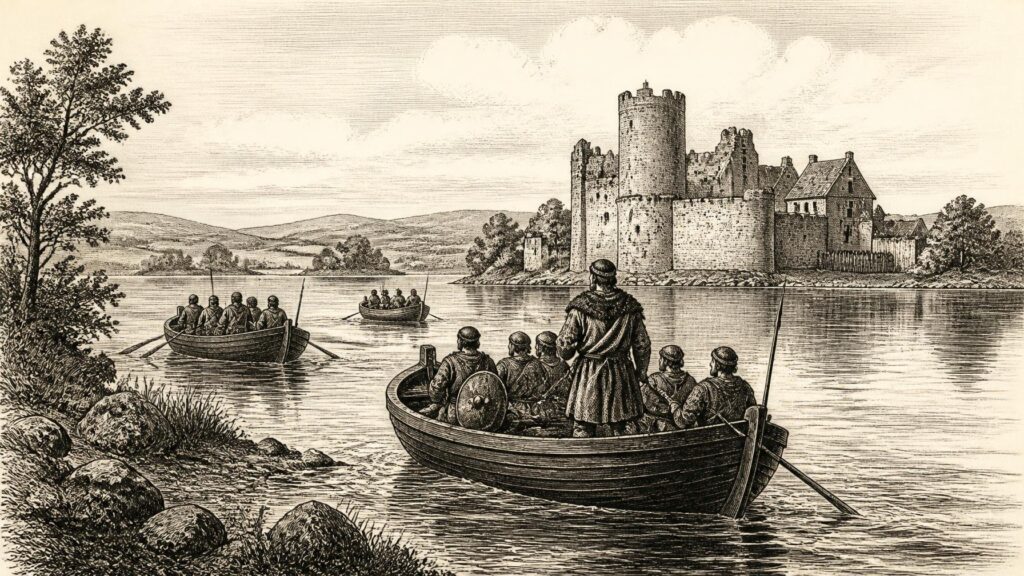
In 1508 Aodh Óg Ó Domhnaill transformed power in Fermanagh by travelling across Lough Erne, capturing Enniskillen castle from Ruaidhrí Mag Uidhir, installing a rival Maguire and taking hostages. His expeditions also reached Lower Connacht, illustrating negotiated, military lordship. Elsewhere, feuds produced killings, raids, castle destruction, exile and attacks around churches, including a St Patrick’s Day defence at Domhnach Mhaighe Dá Chlaoine. Eoghan Ó Ruairc and Margaret O’Brien began the Franciscan friary at Creevelea, demonstrating aristocratic patronage. Annals also record clerical deaths, hospitality and learning. In the Pale, parliament authorised taxation, revealing overlapping Gaelic and English political systems within Ireland.
Dateline
In 1508, the most consequential recorded Irish action was fought not on a great open battlefield but across the waters of Lough Erne. Aodh Óg Ó Domhnaill, lord of Tír Chonaill, travelled with boats against the castle at Inis Ceithleann, now Enniskillen, seized it from Ruaidhrí Mag Uidhir and redistributed power within Fermanagh. The episode shows how readily lordship in late medieval Ireland could be won through control of a crossing, a castle, hostages and the allegiance of competing kin-groups. Yet the same year also records a dramatic defence of a church on St Patrick’s feast, the creation of a Franciscan house in Breifne, ecclesiastical vacancies, feuds and a parliamentary tax within the lordship’s reduced English sphere.
What the Year’s Records Can Tell Us
The evidence for 1508 is unusually rich in Irish annalistic terms, but it needs careful handling. The Annals of Ulster, Annála Connacht and the later Annals of the Four Masters each place a series of incidents in this year. Their entries are concise, shaped by the concerns of learned clerics and hereditary historians, and often describe events through the fortunes of ruling families. They are strongest for identifying that an event was remembered under 1508; they rarely supply the logistical detail that would permit a modern reconstruction of every campaign. Where two annals agree, the outline is firmer. Where an annalist adds speeches, religious interpretation or precise motives, those details should be read as part of the source’s telling rather than treated as a verbatim record.
Boats on Lough Erne
The capture of Enniskillen was the year’s clearest shift in regional power. Aodh Óg Ó Domhnaill went by boat on Lough Erne and took the castle from Ruaidhrí Mag Uidhir. He then handed it to Pilip, son of Toirdhealbhach Mag Uidhir, while securing hostages from the country. The waterways of Fermanagh were not a peripheral setting: Upper and Lower Lough Erne, joined near Enniskillen, formed routes for movement, communication and armed intervention. A force able to arrive by water could strike at a strongpoint in a landscape where roads were often difficult and local power was dispersed among islands, lake shores and fortified residences.
The transaction was more than a raid. By installing one Maguire claimant after displacing another, Ó Domhnaill acted as an overlord and broker of succession. Hostages were a normal political instrument: high-status people were held as pledges for obedience, agreements or good conduct. Domhnall Ó Néill, lord of Tír Eógain, and Conchobhar Mag Uidhir came to Enniskillen, met Ó Domhnaill and made peace on his terms. One rival, Pilip son of Brian Mag Uidhir, destroyed his own castle out of fear; the sons of Brian then left the country, Ruaidhrí going to Ó Ruairc and Pilip to Art Óg, son of Conn Ó Néill. Exile, demolition and the transfer of hostages made the settlement tangible, even if its permanence was doubtful.
Ó Domhnaill’s reach did not end at Lough Erne. The Annals of the Four Masters also place an expedition by him in Lower Connacht in 1508, from which he returned with hostages. Taken together, the notices depict a Tír Chonaill ruler using military mobility, alliances and hostage-taking to project influence south-eastward into Fermanagh and south-westward towards Connacht. This was not an Irish national government in embryo. It was personal, negotiated lordship, dependent upon military reputation and the willingness—or compulsion—of other dynasties to acknowledge a superior.
St Patrick’s Day at Domhnach Mhaighe Dá Chlaoine
The annals give one rare firm festival date. On the feast of St Patrick, 17 March, Redmond Óg Mac Mathghamhna was killed at Domhnach Mhaighe Dá Chlaoine while Pilip, son of Edmond Mag Uidhir, was attending Mass there. According to the account, Redmond arrived with a large force, surrounded the church and lit fires at its four corners. Pilip and his kinsmen emerged, fought, killed Redmond after he was thrown from his horse, and took prisoners. The story is framed as a vindication of the saint and the threatened church: the annalist’s concluding praise of God and Patrick is devotional interpretation, not neutral reportage.
Its core nevertheless reveals much about conflict in 1508. Sacred space did not guarantee safety during a feud, though an attack on a church could carry exceptional moral and political danger. The attackers and defenders were connected to the interlocking Maguire and Mac Mahon worlds of Fermanagh, Monaghan and the Cavan borderlands. A Mass congregation could be accompanied by armed retainers; a church could shelter people and movable wealth; and a local confrontation could turn swiftly into a mounted fight. The killing did not end instability. Later entries for the year note an attack on Conchobhar Mag Uidhir by rival Maguire branches and Mac Mahons, which he repelled, killing Féidhlimidh son of Donnchadh Mag Uidhir and capturing opponents.
Feud, Succession and the Cost of Rule
Elsewhere the annals record the violent intimacy of dynastic politics. Tigernán Óg, son of Eoghan Ó Ruairc, was killed by John, son of Tigernán Finn Ó Ruairc. Hugh Óg Ó Maolmhuaidh was killed by his own kinsmen in his castle. Muircheartach Mac Eochagáin was likewise slain by relatives. These were not random crimes in a lawless vacuum. Gaelic lordships had legal specialists, customary procedures, negotiated settlements and recognised ranks, but succession within a broad ruling kindred offered recurrent scope for lethal rivalry. Authority had to be defended within the family as well as against neighbouring powers.
Raiding remained a central means of war and extraction. Art, son of Conn Ó Néill, made major raids on Cenél Fearadhaigh; his pursuers killed Aonghus, son of Somhairle Mac Domhnaill, but Art escaped with the cattle and other spoils. The annals’ attention to “preys” matters. Livestock sustained households, paid military followers and represented visible wealth. Their seizure was at once economic damage, humiliation and a declaration that a lord could not protect his people. The death in 1508 of Somhairle Bacach Mac Domhnaill, captain of the gallóglaigh serving Ó Néill, also points to the importance of professional heavily armed soldiers in these contests.
Creevelea and Religious Patronage
Amid these conflicts, 1508 brought a notable act of religious patronage. Eoghan Ó Ruairc and his wife Margaret, daughter of Conchobhar Ó Briain of Thomond, began a monastery at Carraig Phádraig, identified with Creevelea near Dromahair in present-day County Leitrim. They invited Observant Franciscans, and the foundation was associated with the Franciscan community at Donegal. The friary was not completed in a day: it was consecrated only in 1511. But the commencement recorded for 1508 was significant, committing aristocratic resources, land, skilled labour and long-term protection to a new religious community.
The foundation demonstrates that warfare and piety were not opposing worlds. Lords sought prestige, intercession, burial, learning and hospitality through patronage; friaries gained protectors and a material base. Margaret’s O’Brien connection also linked West Breifne to the political and devotional networks of Thomond. In the same year, the annals praise Philip O’Reilly and Philip Óg Mag Uidhir as heads of households who kept guest-houses, while recording the death of Cormac Ó Cianáin, a learned historian and poet. Such notices make clear that hospitality and learning were not decorative virtues. They were public obligations and sources of status among elite families.
Churches and the Pale
Several senior churchmen died in 1508: Maighí Mac Craith, bishop of Clonfert; Thomas Ó Conghaláin, identified in the Four Masters as bishop of Elphin; Walter Blake, bishop of Clonmacnoise; and William Óg Mac Cathmhaoil, dean of Clogher. David Burke, nominated to succeed at Clonfert, died while travelling from Rome, a reminder that appointment to an Irish see remained connected to papal administration beyond the island. On 12 December Christopher Fisher was appointed bishop of Elphin, though the overlapping claims and uncertain tenures visible in episcopal lists caution against imagining an orderly succession everywhere.
Within the English lordship, Henry VII remained Lord of Ireland and Gerald FitzGerald, eighth earl of Kildare, dominated government. A parliamentary session conventionally dated 1508–09 enacted protections for the liberties of the church and of the land, and authorised a tax on ploughlands. The legislation was real, but its reach was not island-wide. Its practical constituency lay chiefly in the shires and towns of the Pale and other areas where the Dublin administration could collect revenue. The contrast with Enniskillen is instructive: one island, but overlapping political systems—parliamentary statute and fiscal assessment in the Crown’s sphere, lordly negotiation and armed intervention across much of Gaelic Ireland.
Thus 1508 was not a quiet interval before the Tudor religious and political revolutions. It was a year in which Irish political life worked through lakes, churches, castles, kinship and patronage. Ó Domhnaill’s boats at Enniskillen made the year’s most striking statement of power, while the new Franciscan foundation at Creevelea showed another durable means by which rulers sought authority: building an institution that could outlast the immediate quarrels of their age.
Primary Sources
- The Annals of Ulster
- Annals of the Four Masters
- Annals of the Four Masters: Annal M1508
- Annala Rioghachta Eireann: Annals of the Kingdom of Ireland
- Annála Connacht: Annal 1508
- Creevelea Franciscan Friary
- Creevelea/Dromahair (Co. Leitrim)
- The Franciscans in Medieval Ireland: Sources / Creevalea Franciscan Friary, County Leitrim
- O'Rourke, Conn
- Preston, Sir William
- Butler, James
- De Brana, George
- Ireland under the Tudors, Volume I
- Pre-Union Irish Statutes
- Statute Law Revision Act 2007, Schedule 2
- Attacks
- Enniskillen/Inis Ceithleann
- Gazetteer of Ireland: Gaeilge–Béarla
- The See of Clonmacnoise in the Sixteenth Century
- Annals of the Kingdom of Ireland, Volume V
- The Antiquities of Ireland, Volume I