Walter Burke’s September Succession1440 CE
Annals for 1440 depict regional political and social change rather than an island-wide event. Walter Burke, Mac William Íochtar of Lower Connacht, died of plague in early September and was promptly succeeded by his brother Edmund, illustrating Gaelicised kin-based succession. Neachtan O’Donnell and Owen O’Neill made peace, temporarily easing northern conflict. In Fermanagh, deaths and killings among Maguire kin revealed interconnected lordly households, while Matthew Mac Craith’s replacement as coarb of St Dabeoc showed hereditary ecclesiastical authority. The deaths of historian Duibhgenn Ua Duibhgennáin and lawyer Domnall Ua Breislen underscored learned orders’ political importance. Sources remain fragmentary and cautiously dated.
Dateline
Ireland in 1440 is visible less through a single island-wide turning point than through a concentrated set of annalistic notices: a lord died of plague in Connacht, rival northern rulers made peace, and Fermanagh lost men and women whose positions linked lordship, law, learning and the church. The year’s surviving record is therefore unusually revealing. It shows political authority resting not simply on a ruler’s military following, but on hereditary offices, learned expertise, ecclesiastical foundations and the capacity to manage succession without immediate collapse.
The evidence must be read with care. The Irish annals assign these occurrences to 1440, but were compiled or copied later and vary in their detail. The Annals of the Four Masters provide the fullest Connacht and Ulster notices, while the Annals of Ulster and Annals of Loch Cé preserve shorter, independent obituaries. They give firm dates in only a few cases. Where the record says merely ‘this year’, that is the strongest responsible dating available.
A Plague Death in Lower Connacht
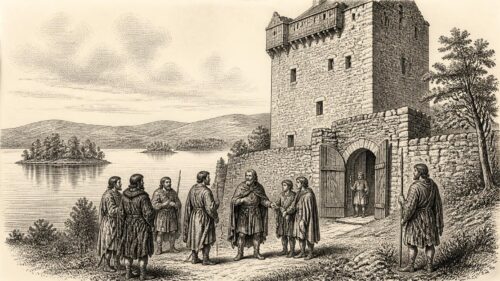
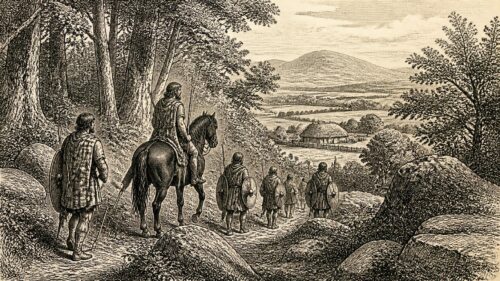
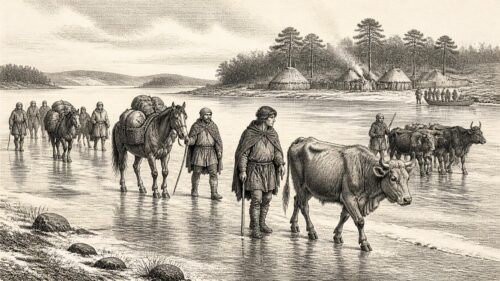
The year’s clearest political change occurred in Lower Connacht, broadly the Burke lordship centred on much of modern County Mayo. Walter Burke, Mac William Íochtar, died of plague a week before the autumn feast of the Holy Cross. The feast fell on 14 September, so the annalist’s wording places his death in early September, without giving a modern calendar date. His brother Edmund Burke, later known as Edmund na Féasóige (‘of the beard’), was immediately styled Mac William in his place.
This was more than a family bereavement. The title Mac William carried the authority of a great lordship created out of the fragmentation of the de Burgh inheritance in Connacht. The annalist calls Walter ‘lord of the English of Connacht and of many of the Irish’: a revealing formula rather than a simple ethnic description. The Burkes were descendants of Anglo-Norman settlers, but their Mayo branch operated within a predominantly Gaelic political world, used Irish modes of lordship and intermarried with neighbouring dynasties. Their power depended on alliances, tribute, military households, clients and control of land, cattle and local strongholds.
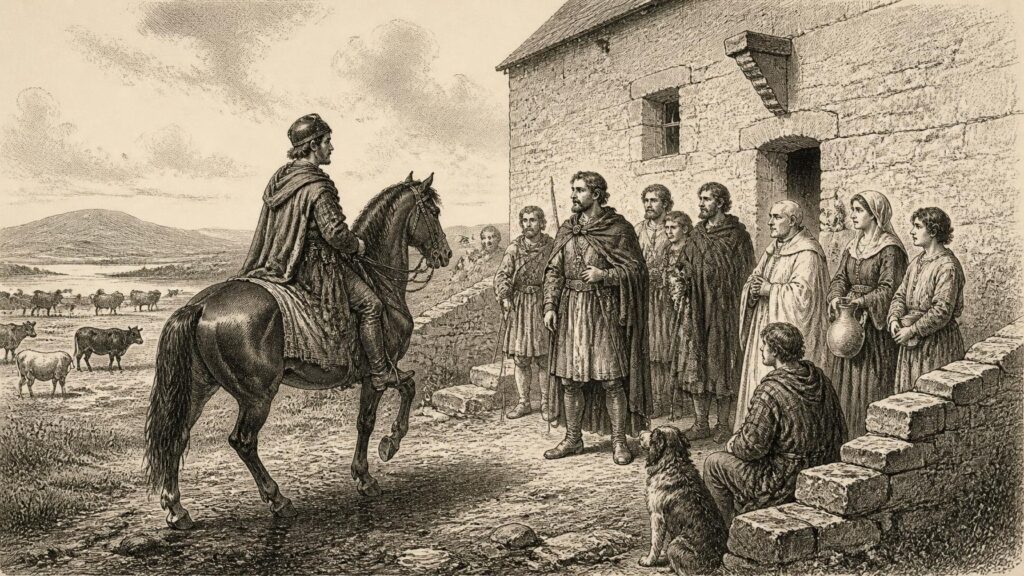
Walter’s succession also demonstrates that inheritance was not mechanically primogenitary. His son Theobald existed, yet the lordship passed to Walter’s brother Edmund. Modern scholarship identifies this as part of the increasing adoption by the Mayo Burkes of a Gaelicised, elective and kin-based political practice: a capable adult kinsman could take precedence over a lord’s son. That did not eliminate future rivalries, but in 1440 the transition recorded by the annals appears swift.
The sources do not permit the conclusion that plague ravaged all of Connacht in 1440. They securely establish only that Walter died of it. Yet the manner of his death is still important. Disease could remove a lord as decisively as raiding or battle, making the capacity for an orderly succession a practical test of a polity’s resilience. The Annals of Ulster also record the death of a Mac William de Burgh in the year, though its compressed wording gives a different personal name; the fuller identification of Walter and Edmund comes from the Four Masters and later prosopographical study.
Peace Between O’Neill and O’Donnell
In Ulster, the Annals of the Four Masters record that Neachtan O’Donnell and Eóghan (Owen) O’Neill made peace. The entry is brief, but its significance lies in the conflict it interrupted. O’Donnell, lord of Tír Chonaill in north-western Ulster, had only succeeded his brother Niall Garbh O’Donnell after Niall’s death in captivity on the Isle of Man in 1439. O’Neill was lord of Tír Eoghain, a neighbouring and powerful lordship whose internal dynastic divisions had shaped northern politics for decades.
The peace of 1440 should not be treated as a permanent settlement or as a union of Ulster. Earlier years had seen raids, shifting alliances and warfare involving the O’Neills, O’Donnells, Maguires, MacQuillins and forces from the Scottish Isles. In 1434, Niall Garbh had been captured by English forces after campaigning near Meath; his imprisonment and death changed the balance in Tír Chonaill. Against that immediate background, a reconciliation between Neachtan and Owen in 1440 offered both rulers room to consolidate. It also reduced, at least temporarily, the danger that a dispute between two major lordships would draw in their many dependants and neighbours.
Nothing in the entry proves that ordinary communities experienced peace as security. A lordly agreement might lessen large-scale campaigning while leaving local exactions, cattle-raids and dynastic tensions intact. Still, in a region where political relations could be expressed through hostage-taking, marriage, military service and retaliatory raids, the fact that the annalist recorded the peace suggests that it mattered beyond a private meeting of two rulers.
Fermanagh’s Offices and Households
The most striking cluster of 1440 notices concerns Fermanagh and the world around Lough Erne. Maghnus ‘the Eoganian’ Maguire, son of Philip ‘of the battle-axe’, died during the year. Catherine, daughter of Donn Maguire and wife of Mac Maghnus Maguire, also died. Art, son of Brian Mac Maghnus, died on 5 April, one of the few precisely dated deaths in the record. The annals further note the killing of Ross, son of John Maguire, and Feidhlimidh Ruadh Maguire. These notices do not amount to a continuous narrative of a Maguire succession crisis, and it would be unsafe to invent one. Together, however, they show a dense network of kinship in which death, violence and marriage all had political implications.
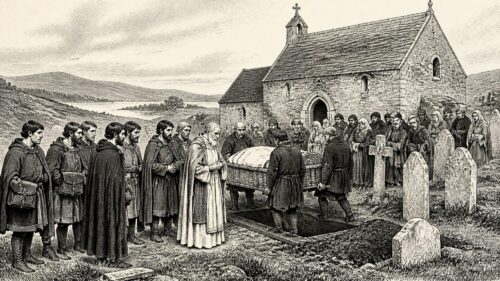
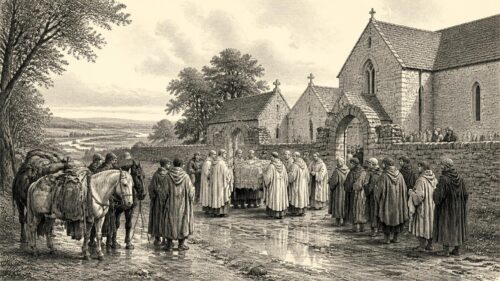
Another succession occurred at the Termon of St Dabeoc, a church landholding associated with the Lough Derg district. Matthew Mac Craith, its coarb, or hereditary ecclesiastical successor and office-holder, died; John Buidhe Mac Craith was made coarb in the same year. The entry captures an important feature of late medieval Irish religious life. Churches, pilgrimage places and termon lands were spiritual institutions, but they also possessed property, local influence and hereditary custodians. Their leadership mattered to surrounding communities and lordships.
Religion in 1440 was therefore not separate from the structures of society. The use of the feast of the Holy Cross to date Walter Burke’s death shows the liturgical calendar ordering historical memory. The Fermanagh coarbship shows hereditary service within the church. These were not signs of a static society: office-holders changed, families negotiated status, and ecclesiastical institutions remained embedded in regional politics.
The Loss of Learning
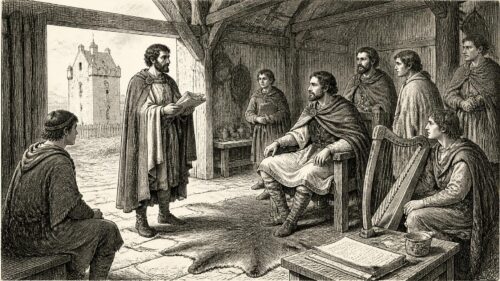
The Annals of Ulster also mourn Duibhgenn Ua Duibhgennáin, described as an eminent historian, and Domnall Ua Breislen, an eminent brehon who was expected to become ollam, or chief master, of the Fir Manach. Their deaths make 1440 a small but significant year for Ireland’s learned orders. Historians, poets, genealogists and lawyers preserved knowledge that was useful as well as prestigious: pedigrees could underpin claims to lordship; historical precedent could frame political arguments; and legal learning served arbitration, compensation and landholding.
A brehon was not simply an informal village judge. In late medieval Gaelic society, legal specialists belonged to learned families, acquired technical training and could serve lords and communities over generations. The description of Ua Breislen as a prospective ollam indicates high standing within that professional world. His death did not end Irish legal learning, but it removed a recognised successor before he achieved its highest rank in Fermanagh.
The death of Brian, son of Domnall son of Muirchertach O’Connor, lord of Sligo, was likewise recorded in both the Ulster and Loch Cé traditions. The latter remarks that few deaths among the Irish had caused greater sorrow. Such phrasing is conventional and cannot be converted into a measurable public reaction, but it conveys his prominence within north Connacht and the wider north-western political sphere. Meanwhile, Maghnus, son of Domnall son of Toirdelbach O’Donnell ‘of the Wine’, was killed: another reminder that the peace between the leading O’Neill and O’Donnell did not erase danger within the broader kindred networks of Ulster.
A Limited but Revealing Year
There is no securely dated parliamentary act, crown campaign, major battle, harvest report or urban commercial development for Ireland in the surviving notices for 1440. It would be misleading to manufacture one. The English lordship based around Dublin remained an important force, especially in the east, but the year’s Irish annals place their emphasis elsewhere: Connacht, Tír Eoghain, Tír Chonaill and Fermanagh. Their focus reflects the realities of a politically plural island, where regional lords and institutions exercised substantial initiative.
What 1440 offers is a close view of how late medieval Ireland worked at regional level. Plague could remove a Mac William, but kin-based succession supplied an immediate replacement. Peace between great northern lords could pause a cycle of conflict, though not resolve every rivalry. The deaths of a historian, lawyer, church coarb and noble households show that learning, religion and political power were interdependent. Far from being peripheral details, such entries are the year’s history: they record the people and offices through which lordship was maintained, remembered and contested.
Primary Sources
- Annals of the Four Masters: Annals M1433–M1442
- Annals of the Four Masters: Project Bibliography and Editions
- The Annals of Ulster: Year U1440
- Annals of Ulster Otherwise Annala Senait, Annals of Senat
- Annals of Loch Cé A.D. 1014–1590: Annal LC1440
- Annals of Loch Cé A.D. 1014–1590
- Annála Connacht
- Burke (de Burgh), Walter
- Burke, Uilleag (‘Uilleag an Fhiona’) (Ulick de Burgh)
- The Rise and Fall of the Clann Éinrí Aimhréidh Uí Néill: Dynastic Feuding and Geopolitics in the Late Medieval Irish Sea World
- Gaelic Law and the Tudor Conquest of Ireland: The Social Background of the Sixteenth-Century Recensions of the Pseudo-Historical Prologue to the Senchas Már
- Mendicant Orders and Vernacular Irish Learning in the Late Medieval Period
- Moymlough
- The Medieval Irish Annals
- Versions: Annals of Ulster
- Calendar of Ormond Deeds, Volume III, 1413–1509
- Genealogical Tracts I
- Versions: Annals of the Four Masters
- Historians, Aristocrats and Plantagenet Ireland, 1200–1360
- Annals of Cluain Mhic Nóis (to AD 1408)