Sligo’s Rebel Coalition1445 CE
In 1445, Ireland’s fragmented political order was exposed by the burning of Sligo, attacked by O’Donnell, Maguire and discontented Ó Conchobhair kinsmen opposing Toirdhealbhach Carrach. Dynastic disputes also destabilised Annaly and West Breifne, where contested lordships prompted warfare, division or rival proclamations. Other annals record killings during raiding and travel, revealing pervasive local feud. English authority remained limited: John Talbot’s appointment as lieutenant did not bring immediate control, while Gaelic lords used written diplomacy and ecclesiastical seals. Irish nobles travelled to Santiago, clerics were commemorated, and Athenry’s Dominican friary housed thirty members, demonstrating religious networks amid conflict and political negotiation.
Dateline
The surviving record for 1445 is uneven, but it is unusually revealing about how power worked in later medieval Ireland. No single government directed the island. Rather, lordships, kindreds, church houses, towns and the English administration around Dublin made and unmade local arrangements. The most dramatic event placed in this calendar year was the burning of Sligo by a coalition of northern and Connacht forces. Yet the same annals also record disputed successions in Annaly and West Breifne, a Leinster killing during a cattle raid, a diplomatic agreement in the English lordship, and Irish pilgrims travelling to the shrine of St James in Spain. Together, they show a politically connected country whose connections did not guarantee peace.
The Burning of Sligo
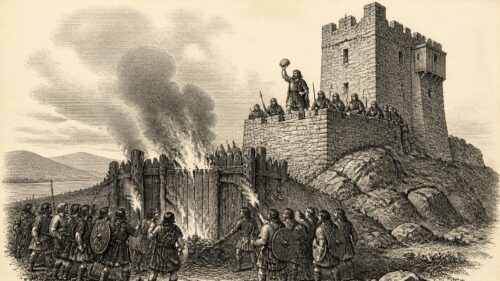
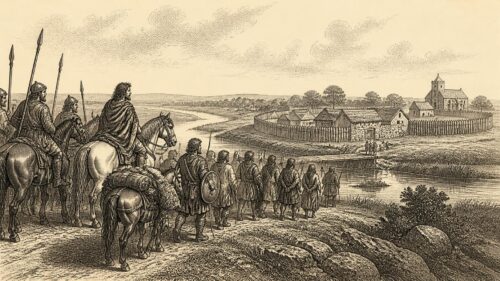
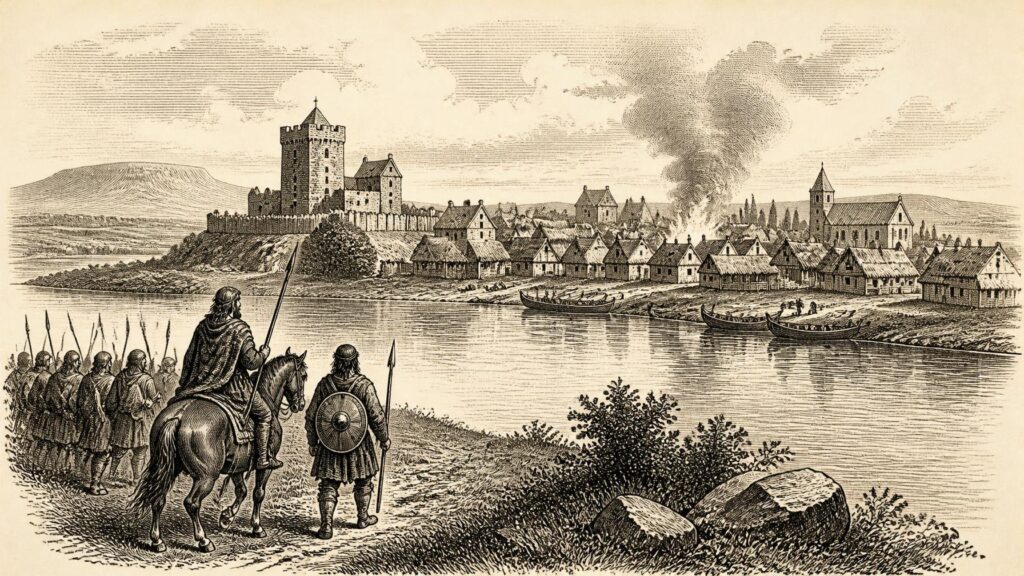
The Annals of the Four Masters place a major incursion into Sligo in 1445. A “great army”, as the annal calls it, was led by O’Donnell with Philip Maguire, the sons of Hugh Maguire and the sons of Eoghan O’Connor. The force burned Sligo, which was then held by Toirdhealbhach Carrach Ó Conchobhair, and killed Tomaltach Mac Donnchadha, lord of Tírerrill, along with many others. The entry provides neither a day nor a season, and no figures for the army or the casualties. Those limits matter: this was a serious attack, but the annal does not permit a modern reconstruction of its exact scale, route or material cost.
Its political setting is clearer. Sligo was not merely an isolated target on the north-west coast. It was a strategic settlement within the contested world of the Ó Conchobhair Sligigh, where the interests of the rulers of Tír Chonaill, Fermanagh and Connacht met. Toirdhealbhach Carrach had succeeded after the killing of his brother Eoghan in 1444, but Eoghan’s sons opposed him. Their participation alongside O’Donnell and Maguire in 1445 was therefore an act of family rebellion as well as an external assault. The episode demonstrates the practical importance of collateral kin: nephews and cousins could call in powerful neighbours, turning a succession dispute into a regional crisis.
The burning also reminds us that towns and lordships were interdependent. Medieval Sligo had grown around a castle and beside a navigable river and harbour system; it linked a surrounding agricultural district with wider Irish Sea traffic. The annal says that Sligo was burned, but does not identify which buildings, stores or inhabitants suffered. It would be unsafe to imagine the whole town reduced to ashes. Even so, setting fire to a settlement was a direct statement that its holder could not protect the resources, dependants and trading place under his control. Violence against a town was political communication as well as warfare.
Successions Without Certainty
In central Ireland, the death of William Ó Fearghail, lord of Annaly, produced another struggle over authority. The Annals of the Four Masters say that Rossa, descended from Murchadh Ó Fearghail, was proclaimed “the O’Farrell” by one body of the kindred, while Donnell Buidhe, William’s kinsman, was backed by the Clann Aodha, the Clann Sheáin and other allies. The territory, the annal says, was devastated during their contest; peace eventually followed, with Annaly divided equally between the rivals.
The Annals of Connacht preserve the same succession crisis but formulate its ending differently. They state that Donnell set himself up as chief, that Rossa was raised against him, and that much damage was done before the chieftainship was left with Donnell. The discrepancy should not be concealed. It may reflect different local traditions, or different moments in a changing settlement; neither account assigns a precise date. What both sources firmly convey is that lordship did not pass automatically from father to eldest son. Recognition by influential branches of a ruling kindred was decisive, and armed competition could devastate the very district whose leadership was at stake.
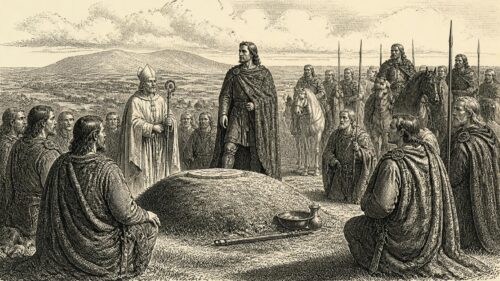
West Breifne experienced a comparable transfer of power. Donnchadh Bacach Ó Ruairc died in 1445. The people of West Breifne then proclaimed Donnchadh, son of Tighearnán Óg, as Ó Ruairc, in opposition to Lochlainn, son of Tadhg. This was no brief technical disagreement over a title. Donnchadh’s subsequent career shows that Lochlainn remained a formidable rival. In 1445, however, the important point is that the death of one lord opened a contested election within the dynasty, rather than producing an uncontested inheritance. Such arrangements could select capable leaders, but they also gave excluded branches powerful incentives to seek allies and fight.
Elsewhere the annals record smaller but telling acts of violence. Diarmait Ó Tuathail, lord of Clann Tuathail, was killed by grandsons of Tomaltach Ó Diomasaigh while pursuing a prey; he was said to be in his eightieth year. In Munster, Conchobhar Ó Conchobhair of Kerry was killed by his kinsman Mahon while both travelled by boat to Inis Cathaigh, Scattery Island. These entries do not explain every motive, and they should not be expanded into imagined campaigns. They do show, however, that raiding, travel by water and feud penetrated daily lordly life across widely separated regions.
English Authority and Irish Diplomacy
Developments in the English lordship form an essential part of the year’s story, but they should not be mistaken for control of the whole island. On 12 March 1445, John Talbot, earl of Shrewsbury, was reappointed king’s lieutenant in Ireland for seven years. He did not arrive in Ireland until October 1446. The appointment therefore represented royal intention and patronage in 1445, not Talbot’s immediate personal direction of events in Sligo, Annaly or Breifne.
Nonetheless, diplomacy continued. An agreement of 1445 between Cahir Ó Diomasaigh and Talbot illustrates the adaptable legal culture at the frontier of English and Gaelic power. Cahir lacked a personal seal, so the document was sealed with that of the prior of Conall Abbey, one of its witnesses. This small detail is important. It shows a Gaelic lord using a written agreement and an ecclesiastical institution to transact with the English administration, without ceasing to be the head of his own kindred. Political Ireland was not divided into sealed-off “English” and “Irish” worlds; negotiation, legal forms and local alliances crossed that supposed boundary.
Pilgrims, Clerics and Religious Houses
Amid raids and succession disputes, the year also preserved evidence of religious movement and aspiration. The Annals of Connacht call 1445 a year of indulgence and report that many Irish nobles went to the shrine of St James in Spain. The annalist names Mairgreg, daughter of Ó Cearbhaill, and Mag Eochagáin among those who returned safely. The notice offers no itinerary, port of departure or explanation of the indulgence, so none should be supplied as fact. But it securely establishes that members of Irish elite society undertook a demanding overseas pilgrimage and came home, carrying prestige and devotional experience across the sea.
The routine life of local churches appears more quietly. Thomas Ó Leannáin, canon and sacristan of Lisgoole, died in 1445. A sacristan’s office involved responsibility for the church’s furnishings and liturgical arrangements; his commemoration in the annals reflects the standing of ecclesiastical personnel within their communities. The same Connacht annal records a remission of sins by Conchobhar Ó Cuinnlis, a bishop, although it gives no further circumstances. These brief notices cannot yield a full picture of parish religion, but they show that the religious landscape was made up not only of famous saints and great monasteries, but also of named clerics, pastoral acts and local institutions.
There is also securely dated evidence of the scale of mendicant religion. A papal rescript issued in favour of the Dominican friary at Athenry in 1445 described a community of thirty. That does not connect Athenry directly to the attack on Sligo, nor does it prove that every friary was similarly large. It does, however, place a substantial preaching community within the same year as the annalists’ reports of war and pilgrimage. Religious houses were centres of worship, hospitality, education, record-keeping and patronage, embedded in the same lordly society that could be both violent and outward-looking.
A Connected, Contested Island
What can responsibly be said of 1445 is therefore not that Ireland was simply chaotic, nor that it was falling under any single power. Sligo’s burning arose from a coalition built around a dynastic rupture; Annaly and West Breifne reveal rival claims negotiated through kinship and force; a Leinster agreement shows diplomacy operating through seals and church witnesses; and the journey to St James places Irish nobles on an international devotional road. The sources give us no continuous national narrative and few exact dates. Their value lies instead in their sharply observed fragments: a town burned, a territory divided, a claimant proclaimed, a pilgrim returned, and a sacristan remembered.
Primary Sources
- Annals of the Four Masters, Annals M1443–M1452
- Annals of the Kingdom of Ireland by the Four Masters: CELT Project Record
- Annála Connacht
- Annála Connacht: Editorial and Manuscript Information
- The Annals of Ulster, Year U1444
- Exploring the Irish Annals
- Talbot, John
- Irish Lords and English Rulers: The Materials of Diplomacy Between England and Gaelic Ireland in the Later Middle Ages
- O'Connor (Ó Conchobhair), Domhnall
- O'Rourke (Ó Ruairc), Donnchadh
- O'Donnell (Ó Domhnaill), Neachtan
- MacMurrough (Mac Murchadha), Domhnall Riabhach
- ‘Geographical Loyalty’? Counties, Palatinates, Boroughs and Ridings
- Gaelic Lordship and Tudor Conquest: Tír Eoghain, 1541–1603
- An Tulach Tinóil: Gathering-Sites and Meeting-Culture in Gaelic Lordships
- Worlds Apart?
- James IV, the O’Donnells of Tyrconnell and the Road to Flodden
- Edmund MacRichard Butler: Books and Warfare in Fifteenth-Century Ireland
- Wood-Martin: History of Sligo
- Medieval Irish Dominican Studies
- Eugene IV
- The Pilgrimage in the Great Jubilee
- English Lordship of Ireland and the Irish Sea World: Re-assessing the Origins of the Kildare Ascendancy, c.1390–c.1513
- Returning to Core Principles