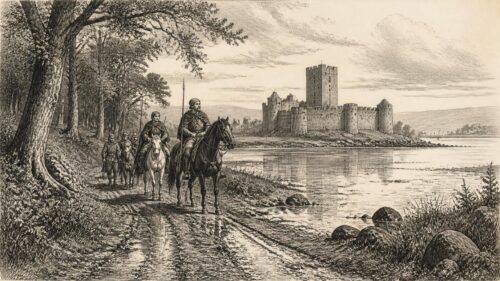
Braganstown’s Broken Earldom1329 CE
In 1329, John de Bermingham, earl of Louth, was killed at Braganstown near Ardee by Louth’s English gentry, exposing divisions within the lordship rather than an ethnic revolt. His disputed authority, kern’s alleged depredations, and weak local roots fuelled resentment. Parliament in Dublin sought to curb magnate feuds, while rivalries persisted. The killers received pardons, Bermingham’s earldom lapsed, and Mortimer acquired Louth’s liberty. Political conflict also embroiled Bishop Ledrede. Campaigns and killings in Wicklow, the midlands, Breifne and Connacht revealed continuing warfare and shifting alliances. Wet weather delayed harvests, intensifying insecurity across Ireland for tenants, townspeople, and landed communities alike.

Dateline
In 1329, the killing of John de Bermingham, earl of Louth, at Braganstown near Ardee exposed the brittleness of lordship in fourteenth-century Ireland. Bermingham had been among the foremost men of the English lordship: a veteran of the war against Edward Bruce, former justiciar, and the holder of an earldom created in reward for service at Faughart. Yet on 10 June he and many members of his following were killed by men drawn from the English gentry of Louth. The event was not a rising of ‘Irish’ against ‘English’. It was a violent reckoning within a frontier society where political allegiance, landholding, military service and local resentment crossed ethnic and linguistic lines.
A Parliament Seeking Peace
The year began with the government attempting to restrain precisely the sort of magnate violence that Braganstown would soon display. Edward III was still a young king, while Roger Mortimer exercised immense influence in England and Ireland. The Dublin administration had to govern through powerful local families whose private armies and inherited feuds could overwhelm formal justice.
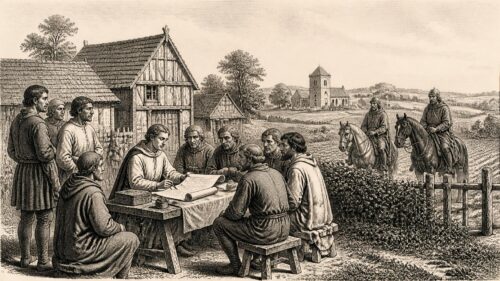
A parliament met at Dublin on 2 April. John de Bermingham attended, as did William de Burgh, the young earl of Ulster, Maurice fitz Thomas FitzGerald, and other leading lords. Later chronicle material describes an agreement that each magnate should discipline his own kin and retainers. This was a practical admission of the limits of government: the crown could issue writs and summon assemblies, but peace depended upon lords controlling their households, tenants and fighting men.
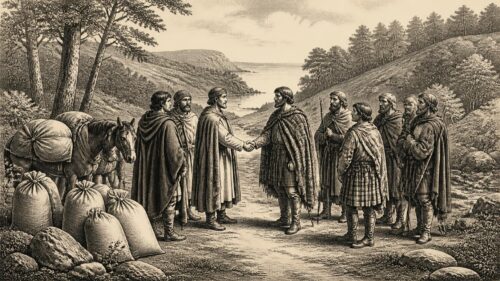
The gathering also helped to reconcile William de Burgh and Maurice fitz Thomas, whose rivalry over lands connected with the Clare inheritance had threatened wider conflict in Munster and Connacht. Ceremonial hospitality mattered in such settlements. De Burgh and FitzGerald gave public feasts, acts intended to demonstrate that hostility had been suspended. The reconciliation was real enough for the moment, but it did not remove the competing interests, armed followings and disputed rights beneath it.
Braganstown, 10 June
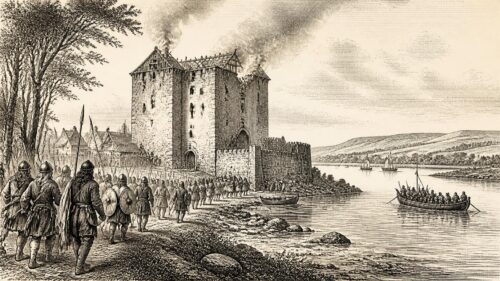
The most firmly dated Irish event of 1329 occurred on the eve of St Barnabas, 10 June. At Braganstown, near Ardee in County Louth, John de Bermingham was killed with two of his brothers and a large company of followers. The Annals of Connacht call him the most active, vigorous, generous and bountiful baron in Ireland, but say that he was treacherously slain by his own people, the English of Oriel. The wording is important. In the annalists’ usage, the killers were settlers of the lordship, not an outside force.
Bermingham’s position had long been awkward. Edward II had made him earl of Louth in 1319 after the defeat of Edward Bruce, but he had not grown up as a great Louth landholder and lacked deep roots among the county’s established families. His elevation therefore placed an ambitious outsider above local gentry who possessed their own manors, connections and expectations. The immediate quarrel appears to have involved Bermingham’s Irish kern, whom the Louth gentry accused of burning local estates indiscriminately. Behind that grievance lay the larger problem of an earldom imposed upon a politically crowded county.
The casualties demonstrate the mixed character of Bermingham’s household. English and Irish men died together. Among them was Máel Ruanaid Mac Cerbaill, remembered as Gilla Caech, a celebrated performer on the tiompan, a plucked string instrument. The Annals of Connacht praises him extravagantly as the supreme master of music-making and wonders whether his equal had ever existed or would exist. His death gives an unusually vivid glimpse of aristocratic culture: a military lord’s entourage included not only armed retainers but a renowned professional musician and his brother. Patronage linked Gaelic learned and artistic specialists to an Anglo-Irish household.
Later accounts have supplied differing totals for the dead, sometimes exceeding 160. Such figures should be treated cautiously, since surviving sources do not provide a complete contemporary roll of casualties. What is beyond doubt is the scale of the political shock. A crowned earl, former chief governor and defender of the lordship had been cut down by fellow settlers in a county supposedly within the English administration’s secure heartland.
Justice, Pardon and Confiscation
The response revealed the political realities behind the language of royal justice. Indictments were brought against participants in the killing, but the men of Louth successfully presented their case to the regime governing for Edward III. On 2 September they received a pardon. Bermingham’s widow, Avelina de Burgh, pursued redress, but without success. The earldom itself lapsed because John left no son, while the liberty of Louth was appropriated by Mortimer. In effect, the crown’s leading minister benefited from the disappearance of a problematic local earldom.
The episode should not be mistaken for a simple failure of law. Rather, it shows how law, patronage and force worked together. A pardon could close a dangerous quarrel, reward useful allies and transfer valuable rights. For people who lived on the affected estates, the consequences were immediate: uncertainty over lordship, rents, protection, military obligations and the handling of local disputes.
Churchmen in Political Conflict
Conflict also reached the church. On 18 June, only days after Braganstown, Edward III wrote to Pope John XXII concerning Richard Ledrede, bishop of Ossory. The king alleged that Ledrede had stirred dissension among Ireland’s nobles and had fled first to England and then towards the papal curia rather than answer royal inquiries. The accusations came from a hostile political environment and cannot simply be accepted as an impartial verdict. They nevertheless show that a bishop’s authority could become entangled with the struggles of magnates and royal officers.
Ledrede’s quarrel with Roger Outlaw, prior of the Hospital of St John at Kilmainham and a leading royal administrator, had roots in the contentious prosecution of Arnold le Poer for heresy. By 1329, disagreements over doctrine, jurisdiction and personal safety had become part of a larger contest over who could command trust and exercise power in the lordship. Religion was not separate from politics; bishops, religious houses and royal ministers were all major landholders and political actors.
War Beyond the Settled Counties
Violence did not stop at Louth. In August, John Darcy, who was active in the Irish administration, led a successful expedition against the O’Byrnes in Wicklow. The campaign indicates the continuing pressure along the mountainous Leinster frontier, where royal authority depended on fortified points, local allies and short, punitive expeditions rather than uninterrupted control.
A battle traditionally placed on 10 August at Ardnurcher, near modern Horseleap in Westmeath, offers a second warning about the year’s unsettled warfare. James Grace’s later annals state that Thomas Butler attacked the fort there and was defeated and killed by William Mac Geoghegan. The Annals of the Four Masters place what appears to be the same Mac Geoghegan victory under 1328 and give an implausibly vast casualty figure. The precise dating and numbers are therefore disputed; what can responsibly be said is that the surviving traditions preserve a major Mac Geoghegan success over a settler force in this period. It reflects the resilience of Gaelic lordship in the midlands.
In Breifne, Cathal O’Rourke, described by the annals as well fitted to be king, was treacherously killed with companions at the house of Richard Tuite in the monastery of Fore. His killers were the sons of John O’Farrell and the English of Meath. The setting is revealing: a monastery could be a place of hospitality and negotiation, but it could not guarantee safety when regional rivalries hardened into murder.
Connacht’s Shifting Balance
Connacht remained divided among the de Burgh affinity and competing Gaelic dynasties. The annals record the death of Muirchertach O’Conor, lord of Carbury and a potential claimant to the Connacht kingship. Walter Burke ordered the expulsion of Cathal O’Conor from Fásach and Tír Maine, using the O’Kellys and other men of Uí Maine. Turlough O’Conor, king of Connacht, also fought the Clann Mhaolruanaidh MacDermot, while Tomaltach MacDermot raided the territory of the O’Flanagans.
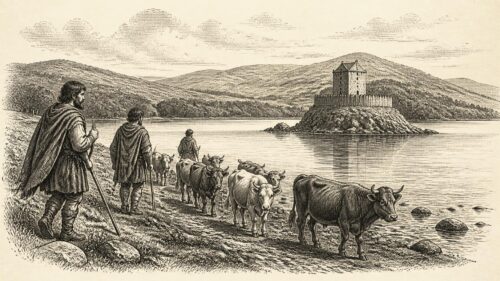
These were not marginal disturbances. Raiding removed cattle, crops and movable wealth, while expulsions altered who could collect tribute and command service. Political change was experienced locally in burned stores, seized livestock, disrupted cultivation and the movement of households seeking protection. Yet alliances remained flexible: the same families could fight one season and negotiate the next, and both Gaelic and settler leaders drew support across cultural boundaries.
A Difficult Agricultural Year
The Annals of the Four Masters also records that wet weather left corn unharvested throughout Ireland until after Michaelmas. As a later compilation, the chronicle must be used with care, but the entry is a valuable reminder that weather shaped the year as surely as politics did. Delayed harvesting threatened grain supplies, fodder and rents, and made an already violent landscape more precarious for tenants and townspeople alike. No nationwide famine is securely recorded for 1329, but prolonged wet conditions would have added practical strain to a society accustomed to living close to the margins of subsistence.
Thus 1329 was not defined by one isolated massacre. Braganstown was its sharpest event, but it belonged to a wider pattern: uneasy reconciliation at Dublin, contested lordship in Louth, churchmen drawn into secular faction, war in Wicklow and the midlands, dynastic conflict in Breifne and Connacht, and a troublesome harvest. The death of an earl did not stabilise the lordship. It showed how little stability its political order possessed.
Primary Sources
- Annála Connacht
- Annals of the Four Masters, Part 16
- The Annals of Ulster
- Annales Hiberniae
- Bermingham, John | Dictionary of Irish Biography
- Bermingham, William de | Dictionary of Irish Biography
- Burgh, William de | Dictionary of Irish Biography
- FitzGerald, Maurice fitz Thomas | Dictionary of Irish Biography
- Outlaw (Outlagh, Outlawe, Utlagh, Utlawe), Roger | Dictionary of Irish Biography
- Ledrede (Leatherhead), Richard | Dictionary of Irish Biography
- Darcy, Sir John | Dictionary of Irish Biography
- Burgh, Sir Edmund de | Dictionary of Irish Biography
- Mandeville, Henry de | Dictionary of Irish Biography
- O'Rourke (Ó Ruairc), Ualgharg | Dictionary of Irish Biography
- MacDermott (Mac Diarmata), Maolruanaidh (Máelruanaid) | Dictionary of Irish Biography
- O'Connor (Ó Conchobhair), Cathal | Dictionary of Irish Biography
- Colonial Society in Co. Louth, 1150–1450
- The Impact of the Bruce Invasion, 1315–27
- The Anglo-Irish Colony Under Strain, 1327–99
- Ardnurcher | logainm.ie
- Braganstown Massacre | County Louth Archaeological and Historical Society Subject Index
- Bermingham, John | Irish Biography Portal Record