Archived: 2 November 2026
Abstract
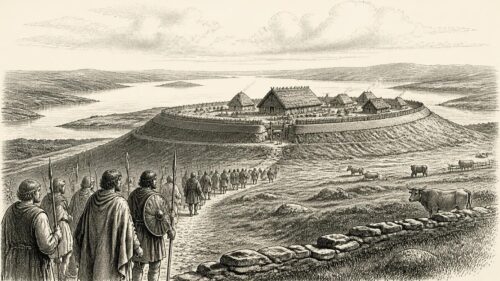
In 676 CE, the most consequential Irish event assigned by the annals to the year was the destruction of Ailech Frigrenn by Fínsnechtae Fledach, king of Tara. The record is brief, but its implications were not. Ailech stood at the heart of the Cenél nÉogain’s northern power, while Fínsnechtae belonged to the southern Uí Néill dynasty of Síl nÁedo Sláine. His attack was therefore not a local raid but a forceful declaration that his newly won supremacy extended beyond Brega and the midlands. Medieval Irish annal chronology is not mechanically exact: the same cluster is placed under 676 in the
Read Article
Archived: 2 November 2026
Abstract
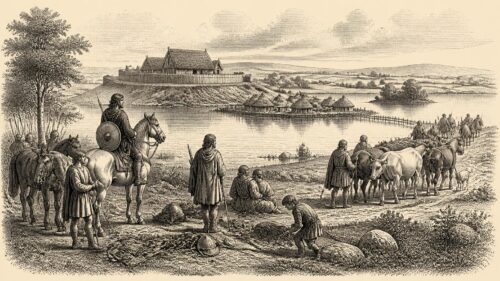
In 677 CE, the most consequential Irish event securely associated with the conventional year was a battle near Loch Gabair, modern Lagore in County Meath, where Fínshnechtae Fledach, king of Tara, defeated the Laigin. It was a victory on the frontier of his own Brega heartland, not a conquest of Leinster, and that distinction matters. The surviving annals are terse, while their chronological headings are not wholly straightforward: the Annals of Ulster place the relevant dossier under an annal numbered 677 but give an equivalent of AD 676, whereas the Fragmentary Annals and modern biographical reference works conventionally date the
Read Article
Archived: 2 November 2026
Abstract
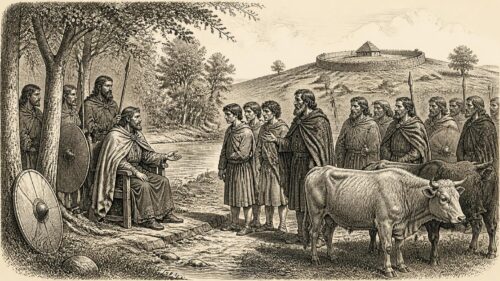
In 678 CE, the most consequential Irish event securely associated with the year was a victory by Uí Cheinnselaig over Osraige in which Tuaim Snáma, king of Osraige, died. The annals are terse, but a fuller annalistic tradition identifies the victor as Fáelán Senchustul of Uí Cheinnselaig and preserves a verse claiming that Osraige gave hostages ‘from Áth Buana to Comar’. This was not a clash between modern counties or nations. It was a contest between neighbouring dynasties in south-eastern Ireland, conducted through armed followings, negotiated submission and the transfer of persons whose custody guaranteed an agreement. The same annalistic
Read Article
Archived: 2 November 2026
Abstract
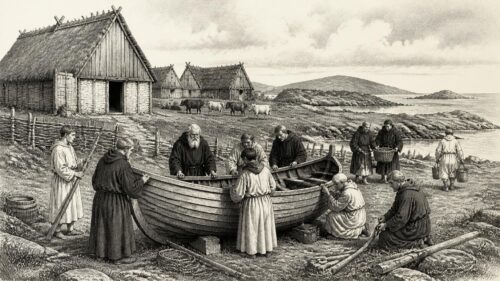
In 679 CE, Ireland’s annalists record a year defined less by a single island-wide crisis than by the passing and testing of influential people and institutions. The securely dated core consists of the death of Fáilbe, abbot of Í or Iona; the death of Cenn Fáelad, styled “the learned”; and a clash in which Fínnechta Fledach, the dominant Uí Néill king of Tara, defeated Bécc Bairrche. These concise notices are unusually revealing. Together they show a country of many competing dynasties, in which armed expeditions, ecclesiastical leadership and learned reputation all carried political weight. A Year in Difficult Calendars The
Read Article
Archived: 2 November 2026
Abstract
In 680 CE, Ireland’s surviving annalistic record brings together a striking mixture of dynastic violence, ecclesiastical change and a grave outbreak of illness. The entries are brief, and the manuscripts that preserve them were written much later, so their calendar headings require care. This account follows modern chronological synchronisation rather than simply repeating the sometimes displaced year-numbers in individual annals. On that basis, several developments can responsibly be assigned to 680: the death of Colmán, abbot of Bennchor (Bangor); the killing of Fíanamail mac Máel Tuile, king of Leinster; deaths and fighting in several regions; and, most memorably, the report
Read Article
Archived: 2 November 2026
Abstract
In 681 CE, Ireland’s surviving annalistic record preserves three securely associated notices: the killing of Cenn Fáelad, described as king of Connacht; a battle at Ráith Mór in Mag Line against Britons, in which Cathasach, king of the Cruithin, was killed; and the death of Suibne, superior of Corcach. These are short entries, but they reveal a political world in which royal authority remained precarious, conflict crossed the narrow seas, and ecclesiastical communities were led by figures important enough to be entered beside kings and battles. The evidence must be handled carefully. The Annals of Ulster place these items under
Read Article
Archived: 2 November 2026
Abstract
In 682 CE, the clearest Irish event is the killing of Cenn Fáelad son of Colgú, styled king of Connacht in the annals. The Annals of Ulster preserve the event in a terse entry; the related Annals of Tigernach and Chronicon Scotorum name his killer as Ulcha Derg, grandson of Caillide, of the Conmaicne Cúile. Tigernach adds the vivid but limited detail that Cenn Fáelad was slain after the Conmaicne had stormed his house. It is the year’s central fact: a provincial king died violently in his own residence, not in a named pitched battle. The sources provide neither a
Read Article
Archived: 2 November 2026
Abstract
In 683 CE, Ireland’s surviving annalistic record places political violence, contested provincial authority and the first reported onset of a grave mortality within the same year. The entries are terse, but their conjunction is striking: Dúnchad Muirisce, king of Connacht, was killed; Colgu, son of the former Tara ruler Blathmac, fell in the battle of Corann alongside Fergus, king of Cenél Cairpri; two strongholds were besieged; and, in October, a disease described as the “mortality of children” began. For a society whose history was usually recorded through the fates of rulers, clerics and religious houses, this last notice points beyond
Read Article
Archived: 2 November 2026
Abstract
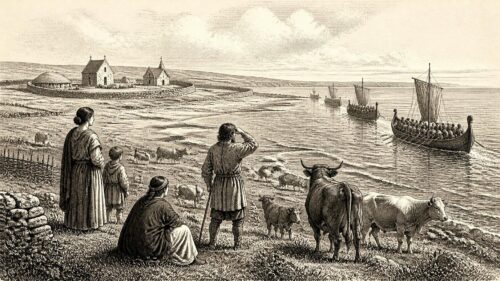
In 684 CE, a Northumbrian force crossed the Irish Sea and devastated Mag Breg, the rich plain of Brega in the eastern midlands. The expedition, sent by Ecgfrith, king of Northumbria, and led by his ealdorman Berht, is the year’s firmly dated Irish event. It was brief in the surviving record, but its targets make it unusually revealing: the raiders struck a politically central region and, according to both Irish and Northumbrian testimony, did not spare churches. For the communities of Brega, June brought not an abstract clash between distant kingdoms but the loss of movable wealth, damaged settlements, disrupted
Read Article
Archived: 2 November 2026
Abstract
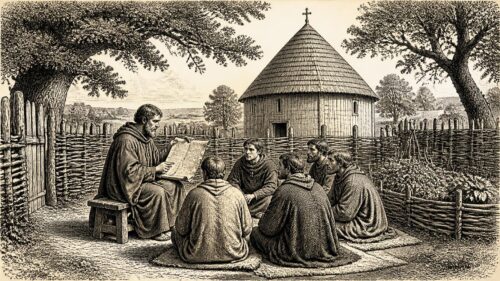
In 685 CE, Ireland’s surviving record is unusually sparse, but it is not empty. The year is best approached through a small, difficult cluster of annalistic notices: the death of Banbán ‘Os Cach’, described as a learned man and, in the fuller notice of the Annals of Tigernach, lector of Kildare; the repose of Forcrann, abbot of Clonmacnoise; and events in northern Britain recorded by Irish writers, above all the defeat and death of the Northumbrian king Ecgfrith at Dún Nechtain on 20 May. These sources do not preserve a single narrative of Ireland in 685. Their differing chronological systems
Read Article
