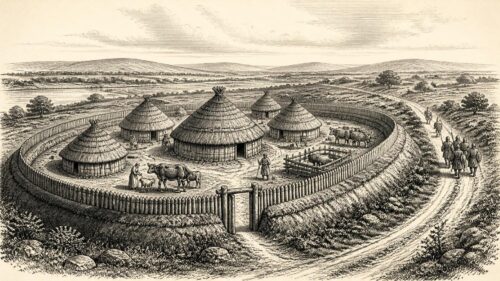
Archived: 2 November 2026
Abstract
In 666 CE, Ireland remained in the grip of the great epidemic remembered in the Irish annals as the buide Chonaill, while a battle at Áine brought together the Arada and the Uí Fhidgeinti and cost the life of Eógan son of Crunnmáel. These are the securely relevant notices in the Annals of Ulster under its heading for AD 666. The same entry also records the death of Cernach Sotal, son of Diarmait. They are brief records, not narratives: they do not tell us the cause of the disease, the size of either force, the precise location of the battlefield,
Read Article
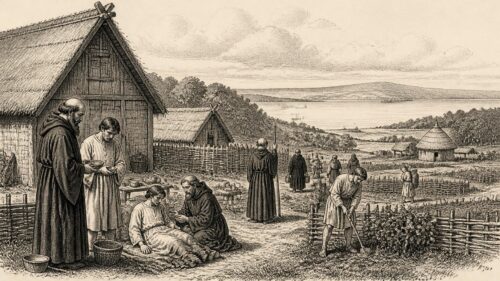
Archived: 2 November 2026
Abstract
In 667 CE, Ireland was still living through the human consequences of a great mortality that had begun several years earlier. The clearest annalistic entry assigned to this year records a plague in which four abbots of Bangor—Berach, Cuimíne, Colum and Aedán—died. It also records fighting at Áine between the Araid and the Uí Fhidgeinti, in which Eógan son of Crunnmael was killed, and the slaying of Bran Finn, king of the Déisi of Munster. These brief notices are unusually revealing: disease could strike centres of authority as well as households; local warfare continued amid loss; and Ireland remained a
Read Article
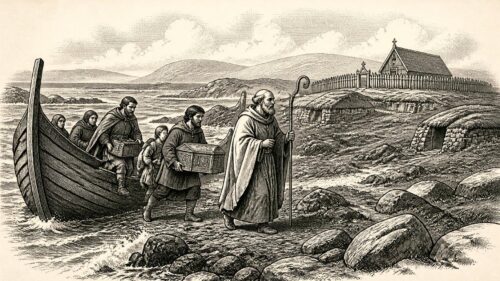
Archived: 2 November 2026
Abstract
In 668 CE, the surviving Irish record brings together a northern battle, a western monastic foundation and evidence of continuing movement across the Irish Sea. These are not events with securely known days or seasons. They are annalistic notices, preserved in texts copied long after the seventh century and subject to differing chronological systems. The year is nevertheless conventionally associated with the battle of Fertas between the Ulaid and the Cruithin, and with Bishop Colmán’s journey to Inis Bó Finne, where he founded a church. The Annals of Ulster place both under their entry U668, although that manuscript’s calendrical heading
Read Article
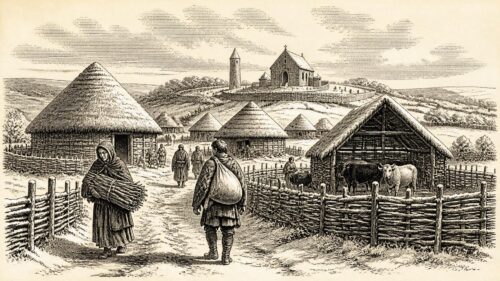
Archived: 2 November 2026
Abstract
In 669 CE, Ireland’s surviving annalistic tradition preserves a brief but unusually revealing cluster of notices: a great snowfall and famine; the deaths of leading churchmen; the passing of Máel Fothartaig, king of Uí Thuirtri; and the killing of Máel Dúin son of Máenach. These are sparse records, not a continuous narrative, and they must be handled carefully. The early Irish annals have notorious chronological offsets between manuscripts and modern calendar years. Yet the severe snow and famine are placed under a heading explicitly equated with AD 669 in the Annals of Ulster, while Cumméne Find’s death is conventionally dated
Read Article
Archived: 2 November 2026
Abstract
In 670 CE, Ireland’s surviving annalistic record preserves a stark notice: “Great snow fell. A great famine occurred.” The entry, in the Annals of Tigernach, is brief enough to conceal almost everything a modern reader wants to know: how long the snow lay, which districts suffered most, whether harvest stores failed, and how many people died. None of that can responsibly be supplied. Yet the pairing of exceptional snowfall and famine is itself important. In an overwhelmingly agrarian society, winter weather could turn stored food, fodder, livestock and labour into matters of survival. The year is therefore best approached through
Read Article
Archived: 2 November 2026
Abstract
In 671 CE, the most consequential recorded Irish event was the killing of Sechnassach mac Blathmaic, king of Tara, at the beginning of winter. The terse notice in the Irish annals is unusually revealing despite its brevity: it names his killer, Dub Dúin of Cenél Cairpri, and preserves a four-line verse remembering the king’s household as rich in bridles, horse-switches and surplus. The same annalistic year also records a battle at Druim Cepais, the death of Fergus son of Crunnmael, the death of Bran Finn of the Déisi in one source, and Máel Ruba’s sea-voyage from Ireland to Britain. Together
Read Article
Archived: 2 November 2026
Abstract
In 672 CE, Ireland’s annalistic record places a local northern battle, a royal succession, a destructive fire at Armagh and an unusually plentiful woodland harvest within the same year. None of these notices offers a full narrative, and none is dated to a particular month or day. They are brief entries preserved in chronicles copied much later, whose year-numbering is not perfectly uniform: the Annals of Ulster’s entry conventionally assigned to 672 even carries an internal AD 671 heading. The safest conclusion is therefore that these events belong to the annalistic year 672, rather than that their exact modern calendar
Read Article
Archived: 2 November 2026
Abstract
In 673 CE, the Irish annals conventionally group together a small but revealing set of notices: the killing of Domangart, king of Dál Riata; the burning of Mag Luinge; the capture of two named men; the death of Cormac son of Máel Fothartaig; and the voyage to Ireland of Fáilbe, abbot of Iona. None is supplied with a month, day or full narrative. Even the year requires care: the Annals of Ulster preserve these entries under their annal 673 while displaying an Anno Domini equivalent of 672, whereas the Annals of Tigernach place the closely corresponding material under 673. Modern
Read Article
Archived: 2 November 2026
Abstract
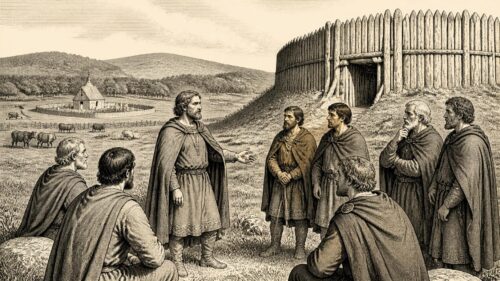
In 674 CE, the annals place Ireland’s most consequential recorded development in a struggle within the Síl nÁedo Sláine, an important branch of the Southern Uí Néill. Cenn Fáelad, son of Blathmac and styled king of Tara in later historical reckoning, was killed in battle; his kinsman Fínnechta Fledach emerged as victor and began to rule. The terse report offers neither battlefield narrative nor a reliable location. Yet it marks a real change in the leadership of the midlands, where claims to the kingship of Tara depended less on a unitary national state than on kinship, military following, tribute, alliances
Read Article
Archived: 2 November 2026
Abstract
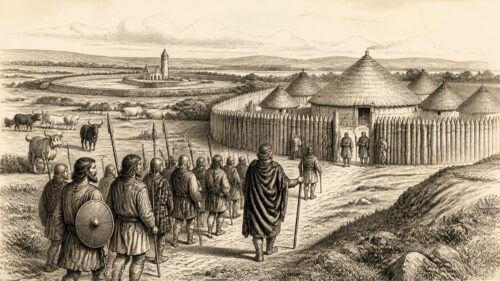
In 675 CE, a battle brought down Cenn Fáelad mac Blathmaic and raised his cousin Fínnechta Fledach mac Dúnchada to the kingship of Tara. The event was a decisive change within the dominant southern branch of the Uí Néill, rather than the founding of a new Irish state or the conquest of a unified island. The contemporary annalistic tradition is terse but emphatic: Cenn Fáelad was killed, Fínnechta was victorious, and Fínnechta then began to reign. For a year with few securely dated Irish happenings, this violent transfer of power is its central historical fact.A Battle With Uneasy GeographyThe principal
Read Article
