Law Amid Disorder1050 CE
In 1050 Ireland remained politically fragmented, with Donnchad mac Briain of Munster pursuing overlordship through hostages, alliances and force, while rival rulers strengthened elsewhere. He proclaimed a law at Killaloe, intended to curb violence, protect agreements and demonstrate royal guardianship of Christian order amid scarcity. Clonmacnoise was repeatedly plundered by neighbouring Irish groups, while Kildare, Emly and Lann Léire suffered fires or attacks, revealing ecclesiastical centres’ wealth and vulnerability. Kings died violently, rivals were imprisoned, and churchmen continued teaching and collecting renders. Rural livelihoods depended on livestock and crops alongside trading towns. Muirchertach Ua Briain, a future king, was born.
Dateline
Ireland’s surviving chronicles give an unusually vivid, though not perfectly consistent, picture of this year. They record murdered kings, the repeated plundering of Clonmacnoise, destructive fires at major churches and an attempt by the ruler of Munster to restrain violence through a widely proclaimed law. These notices do not amount to a continuous narrative, and some details survive only in chronicles compiled centuries later. Nevertheless, when compared carefully, they reveal a society in which political authority, ecclesiastical influence and control of agricultural wealth were closely entangled.
A Divided Political Landscape
No ruler exercised undisputed authority throughout Ireland. Donnchad mac Briain, a son of Brian Bóruma, ruled Munster and advanced a claim to wider supremacy, but his reach depended upon hostages, tribute, alliances and repeated military demonstrations. The previous year he had obtained the hostages of Leinster and Osraige, an important assertion of status rather than proof of permanent government. Leinster itself was increasingly dominated by the ambitious Diarmait mac Máel na mBó, while Aed Ua Conchobair was strengthening his position in Connacht. The northern kingdoms, Mide and numerous smaller territories retained their own rulers and interests.
Kingship therefore operated in layers. A provincial ruler sought submission from lesser kings, while those kings competed with cousins and neighbouring dynasties. Hostages guaranteed agreements; cattle and other renders expressed submission; and a ruler’s household could be as dangerous as an external enemy. The annals’ concentration on betrayal, imprisonment and sudden killing reflects a political order built upon personal relationships that could be renegotiated by force.
The Law of Donnchad
The Annals of Inisfallen state simply that a “great law” was enacted by Brian’s son, almost certainly Donnchad mac Briain. The later Annals of the Four Masters preserve a fuller account. According to that tradition, severe weather had deprived people of corn, milk, fruit and fish. Disorder followed, and protection was no longer respected at church, fortress, foster-relationship or sworn agreement. Clergy, laypeople and chieftains of Munster then assembled with Donnchad at Killaloe and established a restraint upon injustice “from small to great”.
The Four Masters add that peace and favourable weather followed the law, language that presents political order as divinely rewarded. That moral conclusion should not be read as a meteorological report. The detailed description was written down in its surviving form long after the event, but the independent Inisfallen notice supports the central claim that Donnchad sponsored an important legal proclamation during the year.
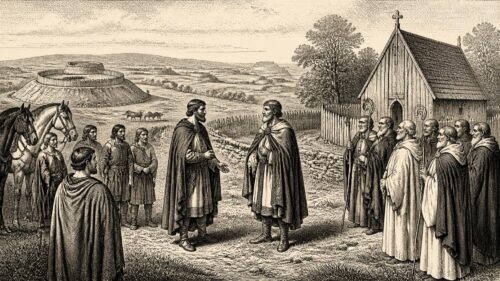
Such laws were not parliamentary statutes in the modern sense. They were public agreements backed by kings, leading churches, sureties and sanctions. Their effectiveness depended upon powerful people accepting and enforcing them. Donnchad’s initiative was consequently both practical and political: it attempted to protect communities while advertising his ability to act as guardian of peace and Christian order. Killaloe, a Dál Cais centre beside the Shannon, provided an appropriate setting for that display of authority.
Clonmacnoise Under Attack
The most consistently reported violence concerned Clonmacnoise. The Annals of Tigernach and Chronicon Scotorum say that the great settlement was plundered three times within one quarter of the year: once by Síl Anmchada and twice by the Calraige in association with the Sinnaig. The Annals of Inisfallen compress responsibility into a statement that the Sinnaig plundered it three times. These variations probably reflect different local records or later efforts to identify the raiders.
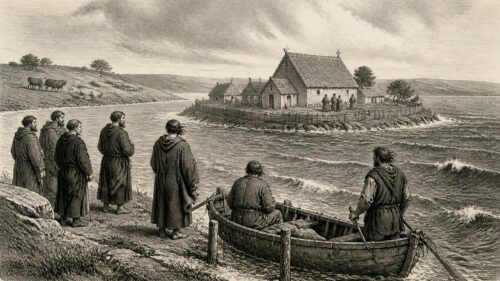
Chronicon Scotorum also records a raid by the Conmaicne upon Clonmacnoise and Inis Clothrann, an ecclesiastical island in Lough Ree. It is uncertain whether this was an additional expedition or another version of one of the attacks already counted. The evidence responsibly establishes repeated predation, but not an exact sequence of four securely distinguishable raids.
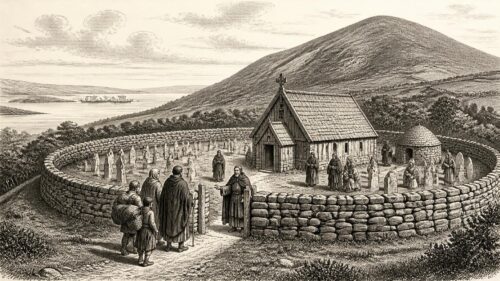
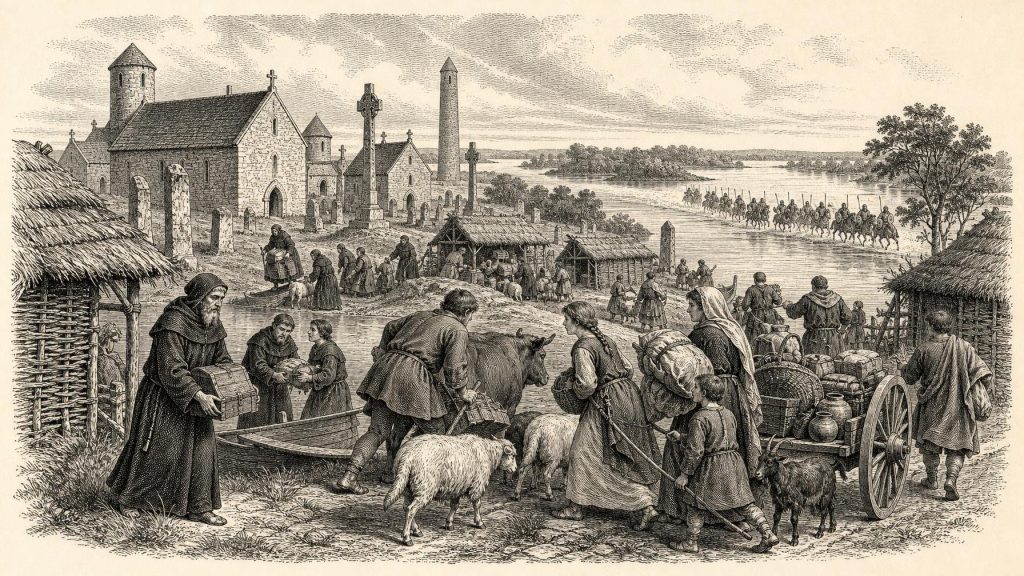
Clonmacnoise was more than an isolated monastery. Its position where the Shannon met major east–west routes made it a centre of worship, burial, learning, craftsmanship and exchange. Clerics lived alongside artisans, tenants, pilgrims and other lay inhabitants. Its churches, relics, livestock, food stores and dependent lands made it wealthy, while its river location made it accessible. Plundering need not have meant the complete destruction of the settlement. Raiders could seize cattle, provisions, captives and portable valuables, or force the community to surrender tribute. Even so, three attacks in a short period must have disrupted worship, teaching, farming and travel.
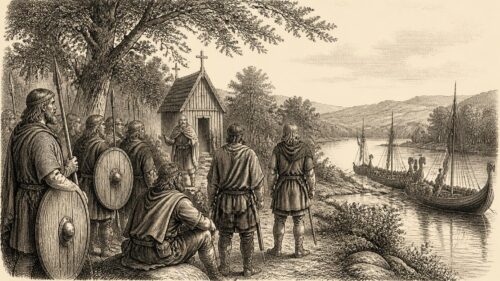
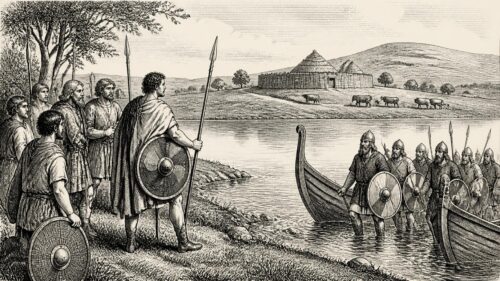
The identity of the attackers is significant. They were neighbouring Irish groups, not overseas Vikings. By the mid-eleventh century, ecclesiastical settlements remained vulnerable to local dynastic warfare and cattle raiding. A monastery might enjoy sacred status while also possessing resources desired by surrounding rulers. The same political families could patronise a church on one occasion and prey upon it on another.
Fire at Sacred Centres
Kildare suffered a major fire. The Annals of Ulster report that the settlement was burned with its stone church, while the Annals of Inisfallen specify both the stone church and an oratory. Inisfallen adds that Emly was burned at the same time. The sources do not identify an attacker, and the fires should not automatically be classified as deliberate military destruction. Dense collections of timber houses, workshops and stores were highly vulnerable to accidental fire, which could spread to roofed stone buildings.
The references to stone churches are important. They testify to substantial ecclesiastical investment before the better-known Romanesque rebuilding of the twelfth century. Stone conveyed permanence and prestige, but a stone-walled church still contained combustible roofs, screens, furnishings, books and reliquaries. A fire could therefore devastate a sacred building without destroying its masonry completely.
Lann Léire, probably modern Dunleer in County Louth, was both plundered and burned. The Annals of Tigernach attribute this attack to Conchobar Ua Maelsechlainn, linking damage to the monastery with the struggles of the Mide dynasties. Inis Clothrann was likewise plundered. Taken together, these notices show that churches stood inside, rather than outside, the contest for regional power.
Deaths, Captivity and Succession
Mael Ruanaid, king of Éile, was killed by his own people or household. The chronicles differ over his patronymic, but agree that the fatal threat came from within his political community. Éile lay across parts of what are now counties Tipperary and Offaly, between larger powers whose campaigns repeatedly crossed the region.
Donnchad son of Gilla Faeláin, king of Uí Failge, also died violently according to the Annals of Ulster, Chronicon Scotorum and the Four Masters, although Tigernach merely records his death. Chronicon Scotorum says that he was killed by a rival Ua Conchobair who claimed the Uí Failge kingship. This was characteristic of succession disputes in smaller kingdoms, where several adult men of a ruling lineage might possess credible claims.
In Connacht, Aed Ua Conchobair imprisoned a son of Cathal son of Ruaidrí. The captive was probably Amalgaid, a western Connacht dynast whom the annals report as blinded in the following year. Only the imprisonment belongs firmly here, but its later outcome illustrates how captivity could be used to neutralise a competitor before imposing a permanent physical disqualification from kingship.
Churchmen and Learning
Several learned churchmen died during the year. The Annals of Inisfallen name Maílín, lector of Kells, and Conall, lector of Cell Mo-Chellóc. The Four Masters preserve a longer list that includes bishops, priests, erenaghs and lectors associated with Leighlin, Ferns, Kildare, Glendalough, Scattery Island and other foundations, although not every obituary can be independently assigned to this exact calendar year.
A lector was a senior teacher and scholar, responsible for reading, interpretation and instruction. Such notices remind us that monasteries continued to preserve Latin and Irish learning despite warfare. Annal-writing, genealogical study, biblical teaching, legal expertise and the copying of manuscripts were maintained by institutions that could simultaneously serve as schools, estates, pilgrimage centres and political actors.
The Four Masters also describe Dub dá Leithe, successor of Patrick at Armagh, making a visitation of Cenél Eógain and receiving three hundred cows. The entry appears twice and may duplicate a single event. Even with that warning, it illustrates how leading ecclesiastics travelled through territories to assert rights and collect renders. Cattle linked religion, economy and lordship: they fed households, measured wealth and embodied obligations.
Work, Trade and Everyday Life
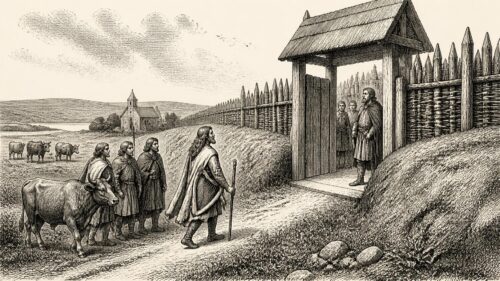
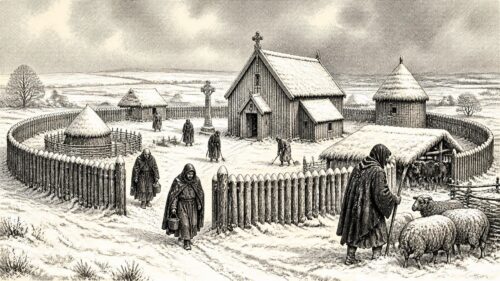
Most people lived in a rural landscape of farmsteads, ringforts, open settlements and ecclesiastical estates. Families tended cattle, sheep and pigs, cultivated cereals, processed milk, spun wool and flax, and worked wood, leather and iron. The year’s reported shortage of corn and dairy produce, whether exactly remembered or rhetorically enlarged, identifies the foods upon which daily security depended. Bad harvests or livestock losses could quickly weaken hospitality, tribute networks and the ability of households to survive raiding.
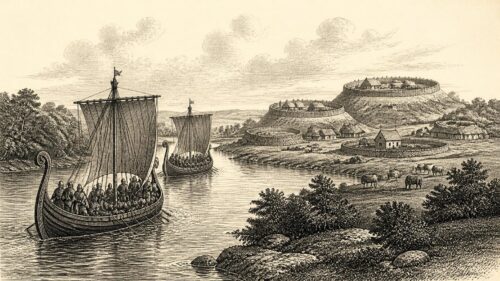
Ireland was not wholly rural. Dublin, Waterford, Wexford, Cork and Limerick supported Hiberno-Norse populations engaged in seafaring, craft production and long-distance trade. Dublin had issued silver pennies since the late tenth century, while imported pottery, soapstone, metals and luxury goods connected Irish ports with Britain and continental Europe. Yet coined money did not replace the cattle, food renders and personal obligations that dominated much of the countryside.
A Future King Is Born
The Annals of Tigernach and Chronicon Scotorum place the birth of Muirchertach Ua Briain in this year; modern scholarship generally gives his birth as about 1050. A grandson of Donnchad’s half-brother Tadc, he would eventually become king of Munster and one of the most internationally active Irish rulers of the pre-Norman age. Nothing of that future could yet be seen. For contemporaries, the year was defined not by the birth of an infant prince but by damaged churches, contested kingships and the difficult effort to turn royal power into public peace.
Primary Sources
- The Annals of Ulster
- The Annals of Tigernach, Part 18: English Translation
- The Annals of Tigernach
- Chronicon Scotorum
- Annals of Inisfallen
- Annals of the Four Masters, Volume II
- Annales Breves Hiberniae
- Chronological Synchronisation of the Irish Annals
- Exploring the Irish Annals
- Clonmacnoise Monastic Site
- Clonmacnoise Visitor Guide
- Viking
- 950–1450: Vikings, Normans and Medieval Mints
- Early Medieval
- Guide to the National Museum of Ireland – Archaeology
- Irish School of Illumination, c. 650–1100
- Ringforts / Ráthanna
- The Earthen Rath or Lios
- The Archaeology of Early Medieval Ireland: Settlement and Economy
- Early Medieval Ireland: Archaeological Excavations, 1930–2009
- Places for the Living, Places for the Dead
- Ua Briain, Muirchertach
- Diarmait (Diarmait mac Maíl na Mbó)
- Donnchad Máel na Mbó
- The Archaeology of Early Medieval Ireland, c. 400–1169: Settlement and Economy