Relics and Rival Kings1073 CE
In 1073, Ireland’s contested kingship was marked by Conchobar Ua Máelshechlainn’s sacrilegious murder beside the Bachall Ísu, followed by conflict in Mide. His severed head was taken from Clonmacnoise to Toirdelbach Ua Briain’s Kincora, then returned with gold. Toirdelbach, expanding after Diarmait mac Máel na mBó’s death, raided Gailenga, killed Brega’s king and demonstrated authority without securing permanent control. Sitriuc son of Amlaíb and Brian Bóruma’s grandsons died on Man. Religious deaths, pilgrimage, and fires at Clonard and Kells highlighted ecclesiastical importance. Annals portray power as dependent on warfare, cattle, alliances, hostages, towns and sacred legitimacy across a divided island.
Dateline
The surviving record of this year is brief but unusually vivid. Irish annalists noted a dynastic assassination committed in the presence of a revered relic, the removal of a dead king’s head from Clonmacnoise, a major campaign through the north Midlands, deaths on the Isle of Man, church fires and the passing of several prominent religious figures. These notices illuminate an Ireland in which royal power rested upon armed followings, hostages, cattle wealth, ecclesiastical alliances and control of strategically important towns. They also require caution: the annals differ in detail, and some accounts were compiled or expanded long after the events.
A New Overking
The political setting had been transformed in February 1072, when Diarmait mac Máel na mBó, king of Leinster and Dublin and the dominant ruler in southern Ireland, was killed at Odba by Conchobar Ua Máelshechlainn of Mide. Diarmait’s former ally, Toirdelbach Ua Briain, king of Munster and grandson of Brian Bóruma, rapidly occupied the resulting space. He entered Leinster and Osraige, received submissions and extended his influence over Dublin. The Annals of Inisfallen say that leading rulers, including Conchobar’s son and Gofraid, king of Dublin, acknowledged his high-kingship in 1072.
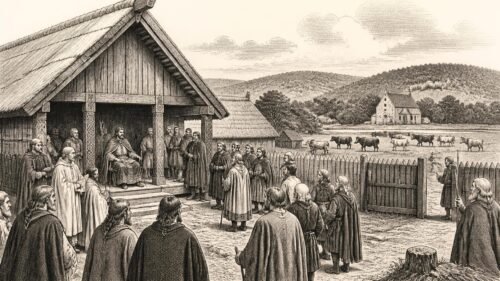
By 1073, therefore, Toirdelbach was the most formidable claimant to authority beyond his own province. This was not government of Ireland in a modern territorial sense. An overking’s supremacy had to be repeatedly demonstrated through hostages, tribute, military expeditions and the submission of lesser kings. Powerful northern dynasties remained outside Toirdelbach’s effective control, while Mide, Brega and the smaller Midland kingdoms formed a contested zone between Munster, Connacht, Dublin and the northern Uí Néill.
Murder in Mide
The central event placed in 1073 by several independent annalistic traditions was the killing of Conchobar Ua Máelshechlainn, king of Mide and styled king of Tara. A member of Clann Cholmáin, he had ruled Mide for more than four decades and had briefly enhanced his standing by defeating Diarmait mac Máel na mBó. His killer was his nephew, Murchad son of Flann Ua Máelshechlainn. The annals describe the act as treacherous rather than as an open battle or formally accepted succession.
The killing was made more shocking by its religious setting. Conchobar was slain despite the protection, and in the presence, of the Bachall Ísu, the Staff of Jesus. This celebrated relic was associated with Patrick and Armagh and was employed in solemn guarantees and oath-taking. The Annals of Inisfallen add a dramatic detail: Murchad had the staff in his hand, cast it aside and rushed upon the king. Whether every element is literal cannot now be established, but all the principal accounts emphasise sacrilege. The story expressed a contemporary judgement that Murchad had violated both kinship and a sacred pledge.
The Four Masters state that Mide was subsequently devastated in conflict between Murchad and Máel Sechnaill, a son of the murdered king. This detail comes from a later compilation and should not be treated as a complete campaign narrative, yet a disputed succession is entirely consistent with later events. Murchad’s kingship remained insecure, and he was killed by the Gailenga in 1076. Conchobar’s death thus weakened a kingdom whose location made it central to every serious contest for the wider kingship of Ireland.
The Head of a King
Conchobar was buried at Clonmacnoise, one of Ireland’s foremost ecclesiastical settlements. Around Easter, however, his head was forcibly removed from the grave and carried south to Toirdelbach’s royal centre at Kincora, near Killaloe. The sources disagree over the precise day: some say Good Friday, while the edited chronology of the Chronicon Scotorum places the removal on the Friday after Easter. It is therefore safest to locate the episode only within the Easter season.
The head was soon returned to Clonmacnoise, accompanied by two gold rings. Annalists attributed its recovery to God and St Ciarán, the monastery’s founder. The Four Masters add a later and more elaborate miracle story in which a mouse emerging from the head entered Toirdelbach’s clothing and caused an illness marked by the loss of his hair and beard. This should be read as moral and ecclesiastical storytelling, not medical reportage.
Toirdelbach’s reason for taking the head is not stated. It may have served as a trophy over the man who had killed his former protector, Diarmait, or as a forceful intervention in Mide’s succession struggle. Whatever the motive, removing a consecrated burial from Clonmacnoise challenged the monastery’s rights and St Ciarán’s protection. Its ceremonious return, with gold, allowed the community to portray sacred authority as having overcome even Ireland’s strongest living king.
War in the Midlands
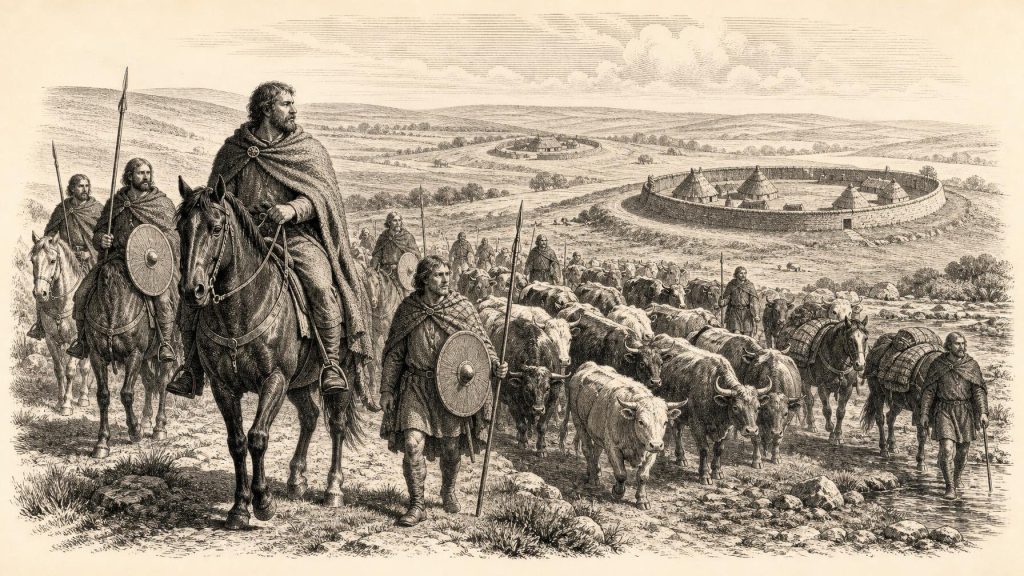
Toirdelbach also led an army into Leth Cuinn, the traditional name for the northern half of Ireland. His forces took what the annals call innumerable or countless prey from the Gailenga and killed Máel Mórda Ua Cathasaigh, king of Brega. Such language usually points above all to livestock. Cattle were food, mobile wealth, units of tribute and a practical means of rewarding warriors. A large cattle raid could impoverish opponents while financing the victor’s political following.
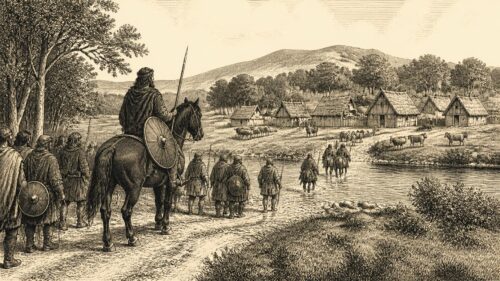
The campaign was more than simple plunder. The Gailenga occupied territories of strategic value in and around northern Mide, while Brega lay between the Midlands and Dublin. By striking these groups after Conchobar’s death, Toirdelbach exploited instability and warned neighbouring rulers against resisting him. Yet the campaign should not be mistaken for permanent annexation. Armies could cross kingdoms rapidly, but lasting authority depended on local cooperation, hostages and repeated displays of force.
Dublin and the Irish Sea
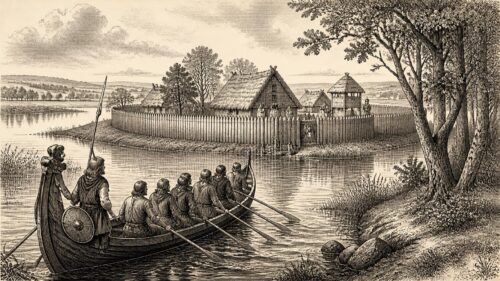
The year also brought violence beyond Ireland. The Annals of Ulster record that Sitriuc son of Amlaíb and two unnamed grandsons of Brian Bóruma were killed on the Isle of Man; the Annals of Loch Cé preserve a shorter version. Their identities and exact objective are uncertain. It is reasonable, though not provable, to connect the expedition with the recent extension of Uí Briain power over Dublin. Irish rulers who controlled Dublin gained access to its ships, experienced seafarers and long-standing connections with Man and the Hebrides.
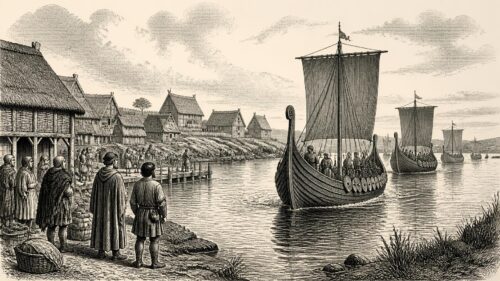
The deaths show that Irish politics did not stop at the coastline. Dublin, Man, western Scotland, Wales and ports around the Irish Sea formed an interconnected maritime world. Dynastic marriages joined Gaelic and Norse-Gaelic families, while merchants and war bands followed many of the same sea routes. The failed enterprise of 1073 demonstrates both the ambition of Brian’s descendants and the limits of their reach. Toirdelbach could dominate much of southern Ireland, but influence across the sea remained hazardous and contested.
Churches and Communities
Religious travel and learning also appear in the record. Bé Binn, a daughter of Brian Bóruma, died while on pilgrimage at Armagh. Her journey illustrates the continuing prestige of Patrick’s principal church and the mobility of aristocratic women within the ecclesiastical landscape. The Four Masters place under this year the deaths of Máel Mórda, abbot of Emly; Cormac Ua Máelduin, described as a chief lector and exceptionally learned elder; and Gilla Caissi of Fidh Dúin. The Annals of Ulster also note the penitential death of Cormac Ua Clothagáin, steward of Munster. Such notices reveal monasteries as centres of worship, education, record-keeping, lordship and administration.
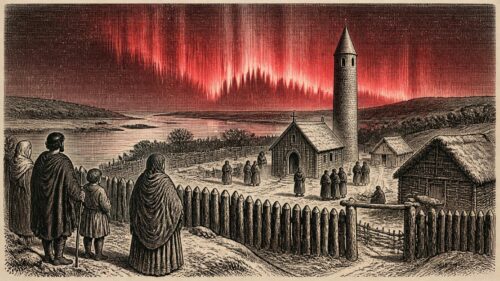
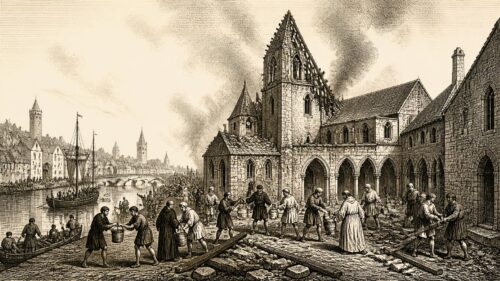
The Four Masters further report that Clonard and Kells, including their churches, burned within one month. No cause is supplied, so the fires cannot responsibly be assigned to warfare, accident or arson. Both were major ecclesiastical settlements in the troubled kingdom of Mide. Their loss would have affected clergy, dependants, stored food, manuscripts, workshops and people who sought protection near sacred precincts. The report also reminds us that many important buildings were timber-built and vulnerable to fire.
Beyond these recorded crises, most people continued to live in a predominantly rural landscape. Farming households occupied ringforts, cashels and unenclosed settlements, tending cattle, sheep and pigs while cultivating grain and producing dairy foods, wool, leather and tools. Lords drew food renders, hospitality and military service from dependent communities. Dublin offered a markedly different environment of closely packed houses, workshops, lanes and waterfront activity. Archaeology reveals woodworking, metalworking, textile production, fishing and commerce involving silver, pottery, soapstone, amber and other imported materials.
A Year of Contested Authority
No single event in 1073 created a united Irish monarchy. Instead, the year shows how supremacy was pursued and resisted. Conchobar’s assassination shattered the balance in Mide; Toirdelbach answered with intervention, symbolic domination and a profitable northern campaign; and men connected with the Uí Briain died attempting to project influence into Man. Churches acted as sanctuaries, political institutions and guardians of memory, while annalists interpreted broken oaths and disturbed graves through the power of saints and relics. Beneath these elite struggles, rural production and Dublin’s maritime economy supplied the wealth upon which kingship depended.
Primary Sources
- The Annals of Ulster: Year U1073
- Annals of the Four Masters: Annal M1073
- Annals of Inisfallen: Annal AI1073
- The Annals of Tigernach: Annal T1073
- Annals of Tigernach: Irish Text and Document Description
- Chronicon Scotorum: Annal CS1073
- Annals of Loch Cé: Annal LC1073
- Annals of the Four Masters: Document Description and Bibliography
- Annals of Inisfallen: Document Description
- Ua Máelshechlainn, Conchobar
- Ua Briain, Tairdelbach
- Patrick (Patricius, Pátraic, Pádraig)
- Pre-Norman Dublin: Capital of Ireland
- Viking
- Nine Unmissable Objects from Clontarf 1014
- An Interesting Point: Antler as a Craft Material
- Bachal Isu: The Symbolism of St Patrick’s Crosier in Early Medieval Irish Hagiography
- The Relic Cult of St Patrick between the Seventh and the Late Twelfth Centuries
- Emerging from the Mist: Ireland and Man in the Eleventh Century
- Seán Duffy – Department of History
- The Dublin Region in the Middle Ages: Settlement, Land-use and Economy
- The Archaeology of Medieval Rural Settlement in Ireland
- Animals and the Economy of Medieval Ireland
- Ardagh Ringfort
- Early Medieval Ireland, AD 400–1100: The Evidence from Archaeological Excavations
- Western Stone Forts Project