A Year of Rival Kings1091 CE
1091 Ireland remained divided among provincial dynasties, ecclesiastical centres and Hiberno-Norse towns, while Muirchertach Ua Briain of Munster and Domnall Ua Lochlainn of Ailech contested supremacy. Muirchertach raided Meath and the midlands, but Connacht attacked Munster and Dublin passed to Gofraid son of Mac Arailt, strengthening Irish Sea power. In Leinster, Énna killed rival Murchad. Domnall defeated and killed Donn Sléibe Ua hEochada of Ulaid, consolidating northern dominance. Armagh suffered a major fire, then Máel Ísu died and Domnall grandson of Amalgaid succeeded him. Treacherous killings reflected political insecurity, although favourable weather produced abundance, sustaining rural and urban communities alike.
Dateline
The Ireland visible in the records for 1091 was not a single kingdom governed from one capital. It was a web of provincial kingships, lesser realms, dynastic territories, ecclesiastical centres and Hiberno-Norse towns. Powerful rulers could demand hostages, tribute and military service far beyond their ancestral lands, yet their authority depended upon repeated campaigning and negotiation. The year’s annals record killings, invasions, a decisive northern battle, a change of leadership at Armagh and unusually favourable weather. They do not provide a continuous narrative, and some events appear only in later compilations. A responsible account must therefore distinguish entries firmly assigned to 1091 from the wider political and social setting that gives them meaning.
Competing Claims to Supremacy
Two kings overshadowed Irish politics. Muirchertach Ua Briain, king of Munster and great-grandson of Brian Bóruma, sought to restore the wide authority exercised by his father, Tairdelbach Ua Briain. In the north, Domnall Ua Lochlainn, king of Ailech and leader of Cenél nÉogain, was building a rival supremacy. Neither possessed an uncontested national monarchy. The high-kingship was effectively a claim to pre-eminence, demonstrated through hostages, tribute, alliances, royal meetings and military success.
Domnall had recently held the advantage. In 1088 he and Ruaidrí Ua Conchobair of Connacht had invaded Munster, burned Limerick, devastated extensive districts and demolished the Ua Briain stronghold at Kincora. A royal meeting in 1090 ended with Muirchertach, Ruaidrí and Domnall Ua Máel Sechnaill of Meath giving hostages to the northern king. Yet submission was neither permanent nor equivalent to peaceful government. By 1091 Muirchertach was again campaigning aggressively across the centre and east of Ireland.
War in Meath and Munster
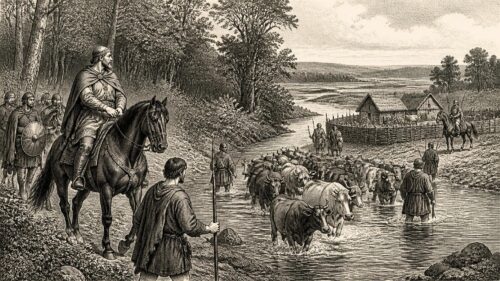
The Annals of Tigernach and the Four Masters place a hosting by Muirchertach in Meath during 1091. His army plundered western Meath, striking into the territory of Domnall Ua Máel Sechnaill. Such an expedition was intended to seize cattle and valuables, punish resistance and demonstrate that the Munster king could operate despite his recent submission to Ua Lochlainn. It followed bitter warfare in 1090, when Muirchertach had been defeated in Meath and his opponents had retaliated by raiding Munster.
Connacht also remained deeply involved. The annals report that a Connacht army entered Munster and burned a large part of it. The sources do not preserve a battlefield narrative or a reliable route, but the destruction illustrates the instability of Muirchertach’s northern frontier. Ruaidrí Ua Conchobair had family connections with the Uí Briain, yet marriage and fosterage did not prevent warfare when political interests changed. Raids could destroy houses, stored grain and churches while driving away cattle and captives. Their burden fell heavily upon farming communities even when no famous king was killed.
The Four Masters alone add a Christmas-season attack by Muirchertach upon Uí Fhailge and the descendants of Bran Brecc in the midlands. The same compilation records a peace between him and the sons of his deceased brother Tadc. These nephews had challenged their uncle’s hold over the Uí Briain inheritance and maintained important connections with Man and the Irish Sea. The settlement was evidently fragile: the entry immediately accuses Tadc’s sons of treachery against returning Thomond forces, after which Connachtmen plundered them. Because this detail is absent from the more contemporary northern annals, it is best treated as plausible but less securely witnessed than the main Meath and Connacht campaigns.
Leinster and Dublin
Leinster’s dynastic divisions offered Muirchertach both opportunities and persistent danger. The annals securely assign to 1091 the treacherous killing of Murchad, a grandson or son of Domnall Remar, by Énna son of Diarmait. Both belonged to branches of the Uí Chennselaig dynasty that had competed for Leinster and Dublin. The killing removed one claimant but did not pacify the province. Muirchertach had invaded Leinster repeatedly since the death of his father, and scholarly reconstruction places another intervention in or around this year.
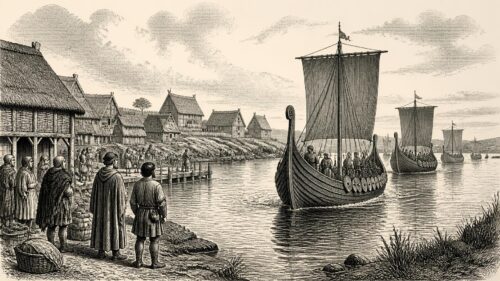
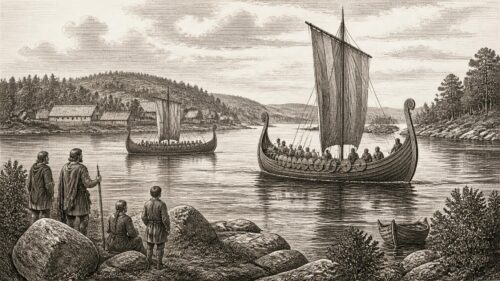
Dublin then slipped from his control. The Annals of Tigernach call Gofraid son of Mac Arailt king of Dublin under 1091, while the Chronicle of Mann says that Godred Crovan, king of Man and the Isles, subdued Dublin and claimed authority in part of Leinster. The latter claim is probably exaggerated, but his acquisition of Dublin is well supported. It gave an experienced Norse-Gaelic sea-king access to the city’s fleet, wealth and Irish Sea connections. Muirchertach’s earlier recovery of Dublin was therefore short-lived; Gofraid remained there until the Munster king expelled him in 1094.
This change mattered beyond the city walls. Dublin was a fortified Christian town of merchants, craftspeople, sailors and warriors. Its ruler could supply ships and troops to Irish allies, while its harbour linked the Liffey valley with Man, Britain, the Scottish Isles and continental markets. Possession of Dublin was consequently part of the wider contest for Leinster and the Irish Sea, not merely a local urban succession.
A Northern Victory
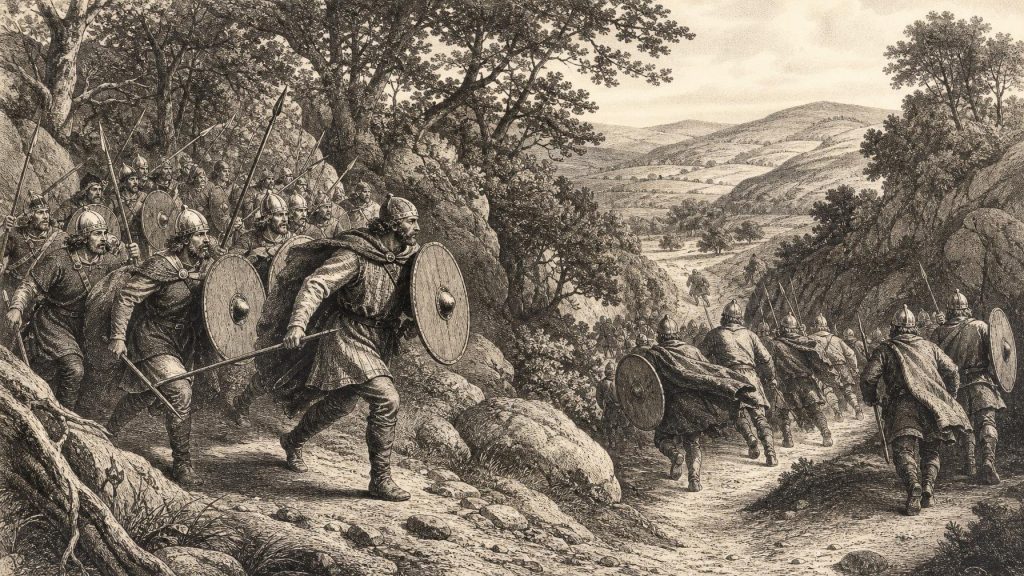
The clearest military turning point of 1091 occurred in Ulster. Donn Sléibe Ua hEochada, overking of Ulaid, was killed in battle by Domnall Ua Lochlainn at Belach Goirt in Ibair, a place associated by modern scholarship with County Armagh, though its exact identification is disputed. The Annals of Ulster, Loch Cé, Inisfallen and Chronicon Scotorum agree on the essential event. One later reconstruction suggests that the Ulaid had invaded Cenél nÉogain territory and were defeated during the resulting campaign.
Donn Sléibe belonged to Dál Fiatach and had ruled, with interruptions, since the 1070s. His death strengthened Ua Lochlainn’s position as the dominant ruler of the north. The Annals of Inisfallen state that Donn Sléibe’s son Donnchad was then made king of Ulaid. This was not a straightforward hereditary succession in the modern sense: Irish kingship was contested among eligible male relatives, and Donnchad would face challenges from brothers, rival branches and Ua Lochlainn himself. Nevertheless, the succession avoided an immediate collapse of Dál Fiatach rule.
Fire and Succession at Armagh
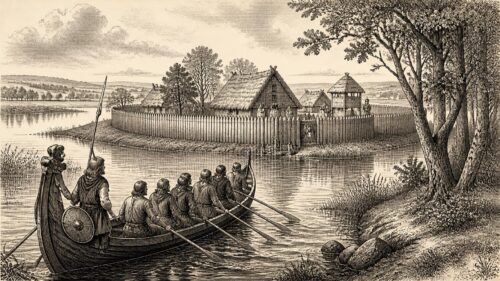
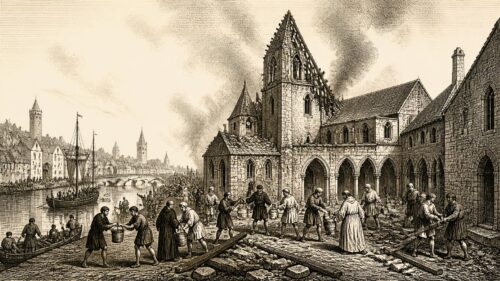
Armagh suffered a serious fire during the year. The Annals of Ulster say that the western half of its ráth, or enclosed settlement, burned; other traditions describe the greater, southern or western portion. Medieval Armagh was much more than a single church. Its ecclesiastical enclosure contained churches, houses, workshops, stores and communities of clergy, scholars, dependants and craftspeople. Fire was a recurrent danger where timber, wattle and thatch predominated, although the annalists do not say whether this blaze resulted from accident or violence.
Late in the year Máel Ísu, successor of Patrick and head of Armagh, died after penitential preparation. The precise date varies between annalistic traditions, ranging across the second half of December, so no single day should be asserted without qualification. Domnall grandson of Amalgaid was immediately installed as abbot. The speed of the succession reflected Armagh’s political importance. The coarb of Patrick headed a powerful federation of churches, guarded major relics and could mediate between kings. Domnall would later intervene repeatedly in the struggle between Ua Briain and Ua Lochlainn.
Kinship, Oaths and Violence
Several lesser notices expose the insecurity surrounding aristocratic households. At Cashel, Cinaed Ua Mórda, lord of Laois, and a son of Máel Ruanaid son of Cú Coirne killed one another in Ua Briain’s house. Another man, a son of Dub dá Bairenn Ua Domnaill, was slain by a kinsman despite oaths sworn upon Irish relics; the killer was immediately put to death. Sitric son of Gilla Brigte Ua Ruairc was also treacherously killed by his own followers.
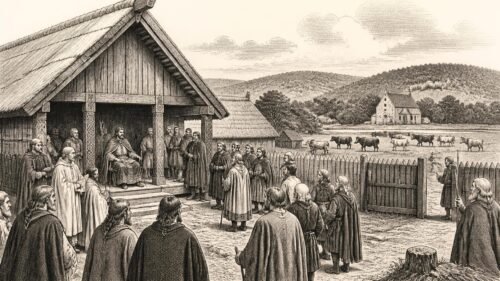
These were not random curiosities. Royal households were places where clients received food, gifts and judgement, but also where armed rivals met. Oaths on relics carried immense religious and legal weight, making their violation especially shocking. Annalists repeatedly labelled killings as treacherous when victims had been protected by kinship, hospitality, truce or sworn guarantees. Such language reveals expectations of lawful conduct even in a society accustomed to feuding and cattle raiding.
A Fruitful Year
Against the record of warfare, the Annals of Ulster and Loch Cé close with a rare positive judgement: 1091 was a fruitful, plentiful year of good weather. This firmly dated environmental notice deserves emphasis. Ireland remained overwhelmingly rural, and most households depended upon mixed farming. Cattle supplied milk, meat, hides, status and transferable wealth, while oats and barley, pigs, sheep, woodland produce and fishing supported regional diets. Good growing conditions meant fuller stores and healthier livestock, although armies could still consume, burn or carry away the surplus.
The towns presented a different concentration of activity. Archaeology from Dublin shows post-and-wattle houses, timber streets and specialised production in iron, bronze, bone, antler, leather, wood and textiles. Silver pennies had been struck in Dublin since the late tenth century, although bullion and exchange in goods remained important. Finds of amber, glass, jet and precious metals reveal long-distance contacts. Gofraid’s seizure of Dublin was therefore control of a functioning commercial community, not the occupation of an isolated fortress.
The Meaning of the Year
No ruler achieved lasting supremacy in 1091. Muirchertach Ua Briain demonstrated renewed strength in Meath and the midlands, but Munster was attacked and Dublin passed to Gofraid. Domnall Ua Lochlainn’s victory over Ulaid consolidated his northern power without bringing the south under his control. Armagh endured fire yet maintained institutional continuity through an immediate succession. Beneath these contests, a favourable season sustained the farms, workshops and trading communities upon which every king depended. The year stands as a revealing moment in Ireland’s transition towards the political, ecclesiastical and urban transformations of the twelfth century.
Primary Sources
- The Annals of Ulster: Year U1091
- The Annals of Tigernach: Annal T1091
- Annals of the Kingdom of Ireland by the Four Masters: Annal M1091
- Annals of Loch Cé: Annal LC1091
- Annals of Inisfallen: Annal AI1091
- Chronicon Scotorum: Annal CS1091
- Ua Briain, Muirchertach
- Ua Lochlainn (Mac Lochlainn), Domnall
- Gofraid Méránach
- Ua Briain, Domnall
- Ua hEochada, Donnchad
- Ua hÉnna, Domnall
- Ua Briain, Tairdelbach
- The Viking Age in Ireland
- Early Medieval
- 950–1450: Vikings, Normans and Medieval Mints
- Wooden Plank with Viking Ship and Weathervane Graffiti
- The Viking Excavation
- St Patrick
- Ecclesiastical Settlement in Ireland in the Early Medieval Period
- Cotton MS Julius A VII, ff. 3–54
- Chronicles of the Kings of Man and the Isles
- The Chronicle of Man and the Sudreys
- Vikings in Ireland