Munster Divided1118 CE
In 1118, Diarmait Ua Briain’s death intensified Munster’s succession crisis and enabled Toirdelbach Ua Conchobair of Connacht to reshape southern politics. After fighting near Glanmire, where Brian Ua Briain was killed, Toirdelbach allied with Tadc and Cormac Mac Carthaig. He allocated Desmond to Mac Carthaig and Thomond to Diarmait’s sons, securing obedience through hostages and weakening Uí Briain supremacy. He also attacked Kincora and extended influence over Dublin, Leinster and Osraige. Regional warfare continued elsewhere. Royal deaths, church affairs, learning and burdens of military hostings reflected a society unsettled by conflict. The unstable partition nevertheless established Munster’s enduring political division.
Dateline
In 1118 the balance of power in Ireland shifted sharply towards Connacht. The decisive developments occurred in Munster, where the death of Diarmait Ua Briain opened the way for military intervention by Toirdelbach Ua Conchobair. Campaigns around Cork, Glanmire, the Shannon and Dublin weakened the long ascendancy of the Uí Briain and advanced both the Connacht king and the resurgent Mac Carthaig dynasty. The surviving annals agree on the broad movement of events, although they differ over details and sometimes place connected episodes under neighbouring years. No precise day can responsibly be assigned to the year’s principal Irish events.
The Collapse of Uí Briain Power
Munster entered the year divided by a bitter Uí Briain succession struggle. Muirchertach Ua Briain had once exercised authority across much of Ireland, maintained relations with rulers overseas and supported reform of the Irish Church. Serious illness in 1114, however, allowed his brother Diarmait to challenge him. Their conflict involved broken guarantees sworn upon relics, imprisonment, sieges and repeated changes of power. By 1118 Muirchertach remained a figure of considerable prestige, but the political and military structure that had sustained his wider supremacy was disintegrating.
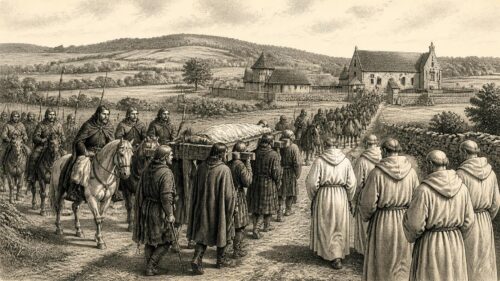
Diarmait Ua Briain died at Cork during 1118. The Annals of Ulster call him king of Munster and of Leth Moga, the traditional southern half of Ireland, while the Annals of Tigernach more briefly describe him as king of Leth Moga. Several sources emphasise that he died after anointing, repentance or a “victory of penance”. Such language was not ornamental. A ruler’s reconciliation with the Church mattered greatly in an age when warfare, sanctuary, oaths and ecclesiastical guarantees were closely connected.
Diarmait’s death removed a forceful but divisive claimant and left his sons, including Conchobar and Toirdelbach Ua Briain, facing rival branches of their dynasty. It also presented Toirdelbach Ua Conchobair, king of Connacht, with an opportunity to decide Munster’s settlement from outside. Although Domnall Ua Lochlainn of Ailech remained the strongest northern claimant to the high-kingship, it was Toirdelbach whose actions most visibly shaped affairs in the south and east during the year.
Battle at Glanmire
The southern annals preserve the fullest account of fighting near Glenn Magair, modern Glanmire east of Cork. Brian, son of Murchad Ua Briain, had emerged as an important contender within Munster. He was opposed by Tadc Mac Carthaig, the people of Desmond and Uí Briain enemies from another branch of the dynasty. Brian was killed in battle. Mac Carthaigh’s Book attributes the fatal stroke to Toirdelbach, a son of the recently deceased Diarmait Ua Briain who was then associated with Tadc Mac Carthaig; other annals record the killing less specifically.
Brian’s death was important because it united dynastic vengeance with the revival of the Éoganachta under the name Mac Carthaig. The Mac Carthaig family descended from the older royal tradition of Cashel, which Uí Briain dominance had displaced. Tadc and his kinsman Cormac were not creating a southern kingdom from nothing in 1118. They were transforming older genealogical standing and regional support into a more durable territorial power.
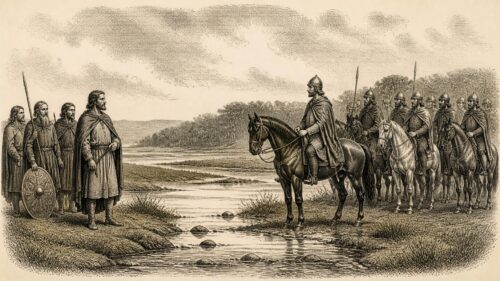
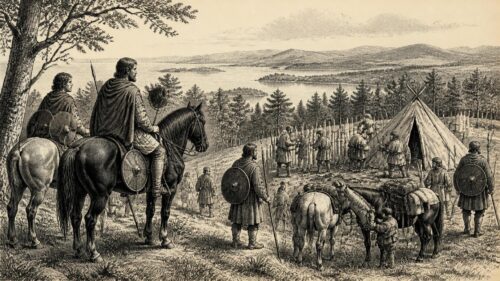
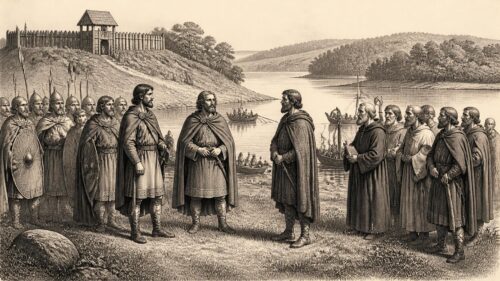
A large army then entered Munster. It was led by Toirdelbach Ua Conchobair and included Murchad Ua Máelshechlainn, king of Mide, and Aed Ua Ruairc of Bréifne. Some accounts also place the diminished Muirchertach Ua Briain with the expedition, intending to avenge Brian and recover authority. At Glanmire, however, Toirdelbach and his allies reached an agreement with Tadc Mac Carthaig and Cormac. Mac Carthaigh’s Book presents this as an enduring treaty directed against Muirchertach and the wider Uí Briain interest.
A Province Partitioned
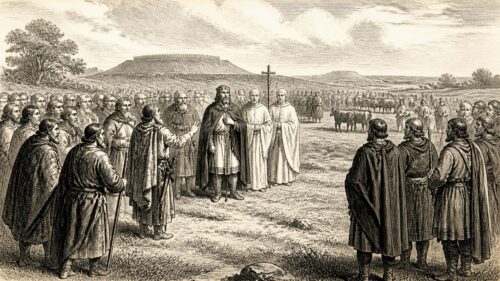
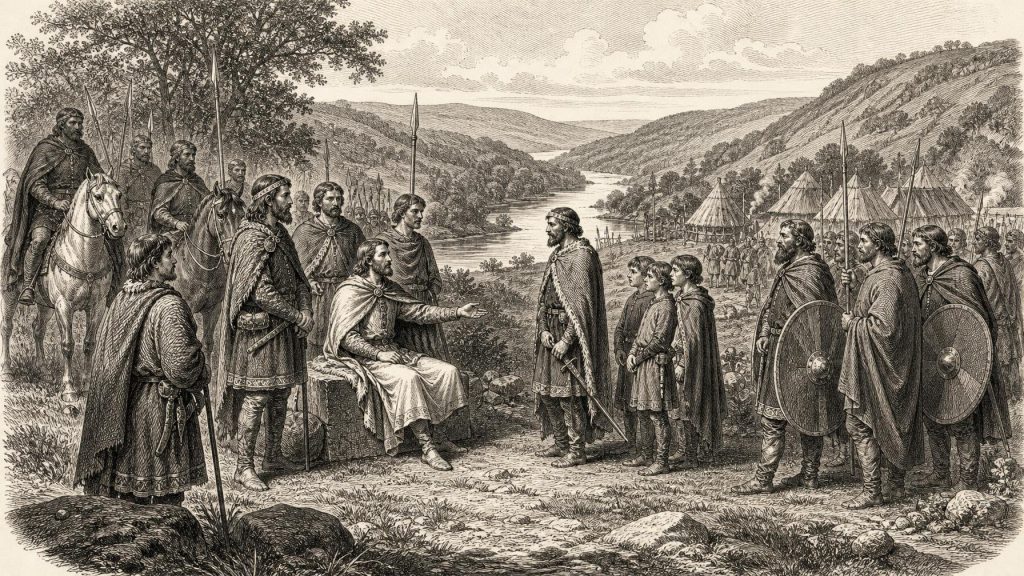
The Annals of Ulster state that Toirdelbach gave Desmumu, southern Munster or Desmond, to Mac Carthaig and Tuadmumu, northern Munster or Thomond, to Diarmait Ua Briain’s sons. He took hostages from both sides. This is often described as the division of Munster into Thomond and Desmond, but it should not be imagined as the drawing of a permanent administrative border. Toirdelbach was recognising and manipulating rival zones of lordship, using hostages to enforce submission and prevent either dynasty from immediately recovering the whole province.
Nevertheless, the settlement was of lasting importance. It gave the Mac Carthaig kings a recognised position in southern Munster and confined the principal Uí Briain succession to the north. The arrangement required later enforcement, and the Annals of Tigernach record another formal division in 1121. The need to repeat it shows that the decision of 1118 was neither uncontested nor fully secure. Its significance lies in establishing the political pattern around which much of twelfth-century Munster would be contested.
Toirdelbach also struck at the material symbols of Uí Briain kingship. Annalistic traditions place a Connacht expedition to Cenn Corad, or Kincora, the royal centre beside Killaloe. Its timber and stone were thrown into the Shannon. The destruction was both practical and theatrical: a fortress was removed, but so too was a monument to the descendants of Brian Bóruma. Control of the Shannon corridor connected warfare, river transport, tribute and access between Connacht and Munster.
Dublin and the Eastern Kingdoms
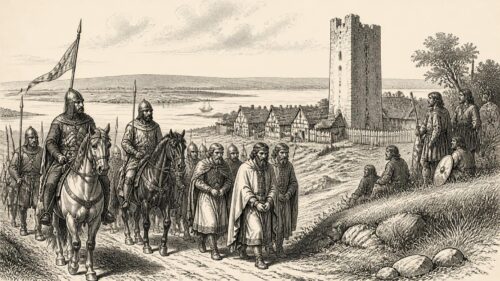
Toirdelbach followed his Munster intervention with a march to Dublin. He recovered Domnall, the son of his ally Murchad Ua Máelshechlainn, who was being held by the town’s inhabitants, and carried away hostages belonging to Dublin, Leinster and Osraige. The Annals of Tigernach add that he assumed the kingship of the foreigners after expelling Domnall Gerrlámhach Ua Briain. Énna Mac Murchada subsequently ruled Dublin as Toirdelbach’s subordinate, although the evidence does not establish a securely dated installation ceremony in 1118.
Dublin mattered far beyond its walls. Its Scandinavian-descended and increasingly Gaelic-connected population occupied the leading port and commercial centre of the Irish Sea coast. Whoever controlled it gained ships, revenue, craftsmen, imported goods and a base from which to influence Leinster. By removing an Uí Briain ruler and taking eastern hostages, Toirdelbach demonstrated that his ambitions extended beyond opportunistic intervention in Munster.
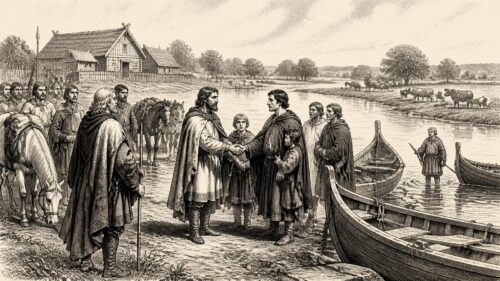
Hostages were central to these events. They were generally members of ruling families or important kindreds whose detention guaranteed an agreement. Taking them was a public measurement of political superiority, not merely an incidental result of battle. Toirdelbach’s simultaneous possession of hostages from Munster, Dublin, Leinster and Osraige made 1118 a striking display of overlordship, though not an unchallenged kingship of the entire island.
War Beyond the South
Violence continued elsewhere without being absorbed into Toirdelbach’s campaigns. Laidcnén Ua Duib Dara, king of Fir Manach, was killed by the Uí Fhiachrach of Ard Sratha and the men of Craeb. In Ulster, Murchad Ua Ruadacán defeated the Uí Echach at Cenn Daire and inflicted substantial losses. An expedition by a son of Mac Lochlainn also carried away cattle from Tana-inis in Tír Conaill. These notices reveal an Ireland of overlapping regional conflicts rather than a country moving in obedience to a single monarch.
Church, Penance and Learning
The year’s obituaries illustrate the close relationship between religious retirement and royal memory. Ruaidrí Ua Conchobair, a former king of Connacht who had lived for decades after being blinded, died at Clonmacnoise as a pilgrim or cleric. His son Domnall also died during the year. Their deaths left Toirdelbach more secure within the wider Uí Conchobair dynasty. Clonmacnoise, meanwhile, remained a place where defeated or elderly rulers could seek penitence, honourable burial and association with Saint Ciarán.
Cellach, successor of Patrick at Armagh and an important reforming bishop, appears in a more unusual entry. Valuable Mass vestments belonging to him, assessed at one hundred ounces, were lost in the River Dall, while Cellach himself suffered a shock or narrow escape. The notice indicates the wealth, mobility and ceremonial importance of leading churchmen. News of Pope Paschal II’s death also reached Irish annalists, demonstrating awareness of the wider Latin Church.
The great Synod of Ráith Bressail is sometimes assigned to 1118 in older writing, but the prevailing scholarly chronology places it in 1111. It should therefore not be presented as an event of this year. Its consequences, however, formed part of the setting: reformers were promoting territorial dioceses, stronger episcopal authority and closer integration with western European church practice. Older monasteries, hereditary ecclesiastical families, local saints and pilgrimage centres continued to shape religious life alongside those reforms.
Life Under the Hostings
For most people, the year was experienced through the demands of armies rather than royal settlements. A hosting required food, cattle, horses, boats, guides and accommodation. Campaigning could consume stored grain, drive livestock from pasture and expose settlements to burning or robbery. Munster had already suffered warfare, famine and disease in the immediately preceding years, making further troop movements especially burdensome. Rural society depended upon mixed farming, with cattle prominent in wealth, diet and tribute, while sheep, pigs, cereals, dairying, fishing and household crafts supported local communities.
Cork, Limerick, Waterford and Dublin offered a different concentration of activity. Their inhabitants included merchants, craftspeople, sailors and families of both Scandinavian and Gaelic background. The annals’ fishermen at Waterford and at a weir in Osraige belonged to this working landscape of rivers and estuaries. The same entry reports that they caught “mermaids”. Such marvels are not reliable zoological evidence, but their recording shows how unusual catches, oral reports and religious ideas about wonders entered learned chronicles.
Learning itself was not sheltered from political violence. One annalistic tradition places in 1118 the killing of Ua Baígelláin, chief poet of Ireland, when his house was stormed; other sources enter the episode under 1119 and describe the deaths of his wife, sons, guests and followers. The chronological uncertainty should be retained. The account nevertheless reveals the status of an ollam, whose household could include a substantial professional and dependent company sustained by aristocratic patronage and hospitality.
A Lasting Realignment
The settlements of 1118 did not bring peace, and Toirdelbach Ua Conchobair would repeatedly return to Munster. Yet the year marked a recognisable turning point. Diarmait Ua Briain was dead, Muirchertach’s authority was nearly exhausted, Kincora had been attacked, Dublin had been brought under Connacht influence and Mac Carthaig power had received decisive recognition in Desmond. Munster’s division remained unstable, but the older Uí Briain claim to command the whole province—and through it much of southern Ireland—had been broken.
Primary Sources
- The Annals of Ulster: Year U1118
- The Annals of Tigernach: Annal T1118
- Annals of Inisfallen: Annal AI1118
- Annals of the Four Masters: Annal M1118
- Annals of Loch Cé: Annal LC1118
- Chronicon Scotorum: Annal CS1118
- Mac Carthaigh’s Book: Annal MCB1118
- Ua Conchobair, Tairdelbach (O'Conor, Turlough)
- Ua Briain, Muirchertach
- Ua Briain, Diarmait
- Ua Briain, Conchobar
- Ua Briain, Tairdelbach
- Mac Carthaig, Cormac
- Ua Máelshechlainn, Murchad
- Cellach (Celsus)
- Regulating the Dioceses of the Bishops of Ireland
- Crisis and Recovery: Church and Society in Twelfth-Century Ireland
- Councils and Synods of the Gaelic Early and Central Middle Ages
- The History of Ireland: The Synod of Ráith Breasail
- Medieval Ireland: Territorial, Political and Economic Divisions
- Animals and the Economy of Medieval Ireland
- Ireland’s Viking Age Hoards: Sources and Contacts
- The Irish and the Vikings: Notes for Teachers
- Vikings in Ireland
- Lebor na Cert: The Book of Rights, Part 4
- Irish Kingship in the Eleventh and Twelfth Centuries: Approaches to the Study of Power