Frontiers and Fractures1209 CE
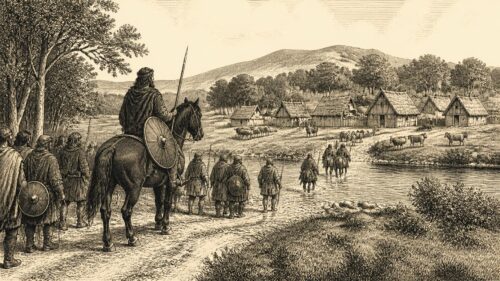
In 1209, Ireland remained politically divided between King John’s lordship, centred on Dublin and Anglo-Norman estates, and competing Gaelic dynasties. John de Grey, acting justiciar, strengthened royal administration, while Dublin’s developing castle symbolised expanding governance. The later tradition of Black Monday recalled settlers’ vulnerability beyond the city walls, though its details are uncertain. Warfare in Inishowen between Ó Néill and Ó Domnaill forces demonstrated contested northern borderlands. In Desmond, Finghin Mac Carthaigh’s killing during a booty dispute triggered succession change; Breifne likewise saw rival Ó Ruairc claimants. Ecclesiastical deaths and everyday economic obligations underscore communities affected by unstable, negotiated power.
Dateline
In 1209, Ireland was not a single political unit moving to one national rhythm. The lordship claimed by King John of England was strongest in and around the port towns and the estates held by Anglo-Norman lords, while powerful Gaelic dynasties continued to govern, compete and make war across much of the island. The year’s surviving record is therefore a mosaic: a royal official newly active in Dublin, hard fighting in the north, a violent succession crisis in Desmond, and the remembered vulnerability of settlers beyond Dublin’s walls. What joins these stories is the uncertainty of frontier power. Neither the English crown nor any Irish ruler possessed unchallenged authority over the whole country.
A Royal Government in Dublin
John de Grey, bishop of Norwich, was acting as justiciar of Ireland by the end of January 1209. His appointment in the previous year put a trusted servant of King John at the head of the royal administration. The justiciar was not merely a military commander: he represented the king in issuing orders, managing lands and revenues, overseeing royal justice, and dealing with magnates whose loyalties were useful but never automatic. De Grey’s arrival signalled the crown’s wish to tighten its hold over the lordship after years in which great baronial families, especially the Lacys, had accumulated formidable regional influence.
It is important not to place King John himself in Ireland in 1209. Some later annalistic material misdates his arrival, but royal and contemporary evidence places his expedition in the following year, 1210. In 1209 he was occupied with wider Angevin problems: conflict with the papacy, strained relations with Scotland and Wales, and fear of enemies among his own leading subjects. Ireland mattered within that larger political setting. It offered revenue, ports and military resources, but it was also a place where disaffected barons might find allies, refuge or an independent base.
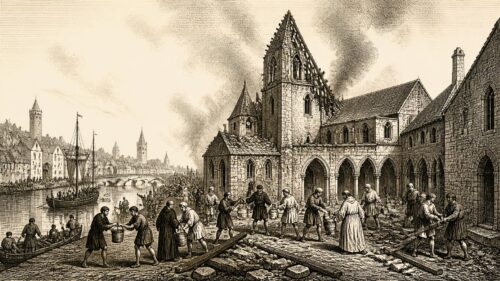
Dublin was the principal centre from which this authority was projected. King John had ordered a strong castle there in 1204, intended for the defence of the city, the custody of treasure and the administration of justice. The exact pace of building is uncertain, and the familiar stone castle should not simply be imagined as complete in 1209. Yet the continuing development of a royal stronghold expressed a real transformation: Dublin was becoming the administrative focus of a lordship increasingly governed through records, officials, revenues and fortified places as well as through personal lordship.
Black Monday and a Dangerous Hinterland
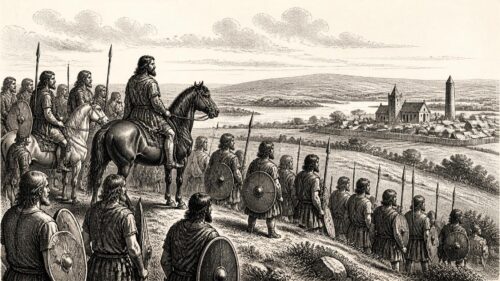
A grim Dublin tradition assigns an attack at Cullenswood, near modern Ranelagh, to Easter Monday 1209. Later accounts say that colonists, often described as recent arrivals from Bristol, had gone out from the city for holiday sport when warriors from the Wicklow uplands attacked them. The episode was remembered as “Black Monday”; later Dubliners reportedly marked the anniversary by mustering at the site and displaying a black banner towards the mountains.
The story deserves both attention and caution. It became deeply embedded in Dublin’s civic memory, but the detailed surviving narratives are much later than 1209, and they disagree over such matters as the number killed, the identities of the attackers and the precise circumstances. Claims of several hundred victims should therefore not be treated as securely established statistics. Nor should the participants be reduced to a simple contest between “English” and “Irish”. Dublin contained people of varied origins, while the communities beyond its southern edge had their own political interests and long experience of resisting encroachment.
Nevertheless, the tradition is historically revealing. Cullenswood lay outside the safety of the town, in a landscape of woodland and routes leading towards the Wicklow mountains. The story captures the practical limits of urban security. Dublin’s walls, harbour connections and royal institutions gave the town exceptional importance, but its inhabitants remained exposed whenever they travelled, grazed animals, cultivated outlying ground or gathered beyond the defences. It also points to the continuing Irish Sea relationship with Bristol: migration, commerce and family connections bound the two ports closely, even if the precise scale of any settlement immediately before the alleged attack cannot be recovered.
War in the Northern Kingdoms
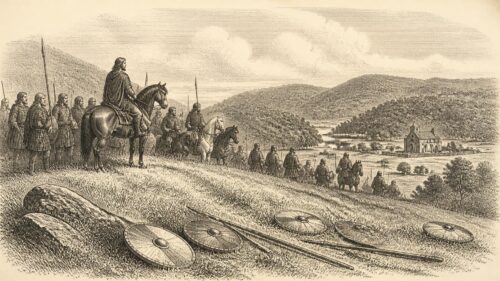
The Annals of Ulster give the year a much firmer military event. Áed Ó Néill, king of Tír Eógain, led a hosting into Inis Eógain, the Inishowen peninsula. He was overtaken by Ó Domnaill’s force from Tír Conaill, and a battle followed in which, the annalist says, countless people died on both sides. Among the named dead were Domnall Mac Murchadha of Cenél nÉogain and several nobles of Cenél Conaill, including Cathbarr Ó Domnaill. Mac Carthaigh’s Book likewise records a battle near Fahan, naming Cathbarr as king of Cenél Conaill.
The clash was more than a local raid. Inishowen stood between the expanding interests of Tír Eógain and Tír Conaill, and control of such borderlands affected access to tribute, cattle, clients and strategic routes. The death of prominent men demonstrates the high stakes of what annals sometimes call merely a “hosting”. These were not standing national armies but retinues and levies assembled through lordship, kinship and obligation. Their campaigns could devastate a district’s stores and livestock, interrupt cultivation and expose civilians to seizure or displacement.
Modern scholarship suggests that the contest did not produce a straightforward Ó Néill victory. Although the fighting was fierce, the rival rulers subsequently reached an accommodation and alliance. That outcome is a useful reminder that medieval Irish warfare was often inseparable from negotiation. A battle could settle neither territory nor status permanently; rulers had to preserve followers, manage rival branches of their own dynasties and respond to the changing pressure of neighbouring powers.
Desmond: Booty, Killing and Succession
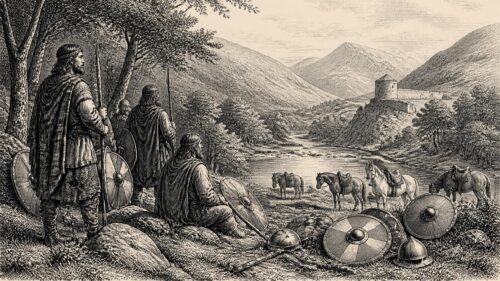
In the south-west, 1209 brought an abrupt change in the kingship of Desmond. Several annalistic traditions record the killing of Finghin Mac Carthaigh, king of Desmond, by his own people. Mac Carthaigh’s Book gives unusually vivid detail: after a hosting and a maritime encounter in Uí Rathach, in the Kerry region, Finghin was killed by the Uí Shúilleabháin during a dispute over the division of booty. It even identifies the weapon as an axe. Diarmaid Dúna Droighneáin Mac Carthaigh then took the kingship.
The episode should not be read as random violence. Raiding, cattle-taking and the distribution of captured goods were central to the political economy of lordship. A king demonstrated capacity by protecting allies and rewarding followers; an unfair or disputed division could turn a successful expedition into a crisis. Finghin’s death also belonged to a wider Mac Carthaigh struggle after the death of Domnall Mór in 1206. Desmond was contested not only among Gaelic branches and neighbouring kindreds, but also in a landscape where Cork, coastal routes and Anglo-Norman lordships shaped the available alliances.
The murder consequently altered more than one household. A new ruler had to secure recognition from leading families, retain fighting men and make terms where necessary with powerful neighbours. The succession was a reminder that kingship in Gaelic Ireland was not automatic inheritance by eldest son. Eligibility rested within a ruling kin-group, but actual accession depended upon political support, force and the ability to command resources.
Breifne and the Limits of Lordship
Another disputed kingship lay in Breifne, spanning parts of the modern Cavan, Leitrim and neighbouring districts. The Annals of Ulster and Annals of Loch Cé place the deposition of Ualgharc Ó Ruairc in 1209 and the installation of Art, son of Domnall, son of Fearghal Ó Ruairc, in his place. Later evidence indicates that Art had sought English assistance, while Ualgharc found support from Cormac Ó Máel Sechlainn of Mide. The rival claimant was killed soon afterwards and Ualgharc recovered his position.
Thus even an apparently decisive annal entry records only a moment in an unfinished contest. The crisis illustrates how Gaelic dynastic rivalries and the lordship’s expansion could become entangled. English aid was a political resource, not a sign that a claimant had surrendered all independent ambition; equally, Irish rulers could compel accommodation from colonial lords. Authority on this frontier was negotiated in cattle rents, hostages, raids, marriages, military support and control of routes rather than guaranteed by a single border on a map.
Churches, Communities and the Year’s Meaning
The annals also preserve quieter notices. The Annals of the Four Masters record the deaths of Célé Ua Dubthaig, bishop of Mayo of the Saxons; Gilla Críst Ua Cearnach, coarb or hereditary ecclesiastical successor at Connor; and Flaithbertach Ua Flainn, coarb of a church at Eas Mic nEirc. Such entries show that religious life rested not only on bishops and cathedral centres but on local churches whose offices remained closely connected with learned and hereditary families. The title coarb, literally successor, carried institutional authority rooted in the memory of a saintly founder.
For most inhabitants, 1209 was experienced less through named battles or changes of justiciars than through the demands they created: labour on estates, food for travelling households, obligations to local rulers, the safeguarding of cattle, and attendance at churches and markets. Towns such as Dublin, Waterford, Limerick and Cork linked Ireland to seaborne trade, while rural and pastoral production underpinned every political power. Yet the year’s conflicts show how fragile those routines could be. A campaign could strip cattle and food; a contested succession could reorder obligations; an unsafe road could separate a town from its hinterland.
Seen together, the events of 1209 reveal an Ireland of institutions in formation and sovereignties in competition. De Grey’s government in Dublin prepared the ground for a more forceful royal intervention in 1210, but it did not erase the capacity of Ó Néill, Ó Domnaill, Mac Carthaigh, Ó Ruairc and many lesser powers to make their own history. The island’s future would be shaped not by one conquest completed, but by the continuing encounter of royal administration, settler lordship, Gaelic kingship and local communities.
Primary Sources
- The Annals of Ulster, Year U1209
- Mac Carthaigh's Book, Annal MCB1209
- Annals of Loch Cé
- Annals of the Four Masters, Annal M1209
- Annales Dominicani de Roscoman
- Grey, John de, Dictionary of Irish Biography
- O'Neill (Ó Néill), Áed, Dictionary of Irish Biography
- O'Rourke (Ó Ruairc), Ualgarc, Dictionary of Irish Biography
- Mac Carthaig (MacCarthy), Domnall Mór, Dictionary of Irish Biography
- John, Lord of Ireland, 1185–1216, A New History of Ireland, Volume II
- History, Dublin Castle
- Dublin: A Short History, National Archives of Ireland
- Dublin City Urban Archaeology Survey: Public Buildings and Industrial Areas
- His Majesty's Castle of Dublin
- Ireland in the Angevin Empire, History Ireland
- Calendar of Documents Relating to Ireland, 1171–1307
- Parchment Conquest, 1171–1307, Virtual Record Treasury of Ireland
- King John's Castle, Dungarvan Castle, Waterford County Museum
- Early Medieval Ireland: Archaeological Excavations 1930–2009
- The Economy of Early Medieval Ireland
- Medieval Dublin XIII, Friends of Medieval Dublin
- Ranelagh, County Dublin: History and Description, A Vision of Britain through Time