Royal Power Tested1210 CE
In 1210 King John launched a 63-day expedition to Ireland, asserting authority over Anglo-Norman magnates and seeking alliances with Gaelic rulers. Landing at Waterford, he received Donnchadh Ua Briain and Cathal Crobhdearg Ua Conchobair, then advanced through Dublin, Meath and Ulster. Walter and Hugh de Lacy were dispossessed; Carrickfergus fell to royal forces, while Man suffered punitive attack. John expanded administration, installed John de Grey, promoted castles and a bridge at Athlone, and supported royal coinage. Yet hostage-taking damaged relations with Connacht, Gaelic submissions remained conditional, and regional conflicts continued. The campaign strengthened royal control but left divided politics unresolved.
Dateline
In 1210 Ireland was the scene of King John’s most forceful personal intervention in the affairs of the lordship. His summer expedition was not a conquest of an otherwise united island, nor did it settle every dispute. It was, rather, a concentrated assertion of royal authority against magnates of the Anglo-Norman colony and an attempt to draw powerful Gaelic rulers into a more dependable relationship with the English crown. The campaign moved through Waterford, Dublin, Meath, Louth and Ulster, while its consequences reached Connacht, Thomond, Man and the western frontier at Athlone.
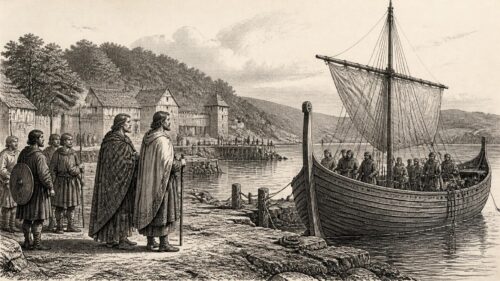
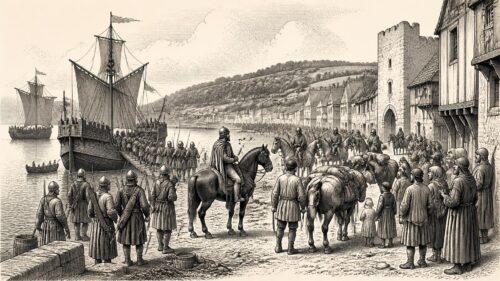
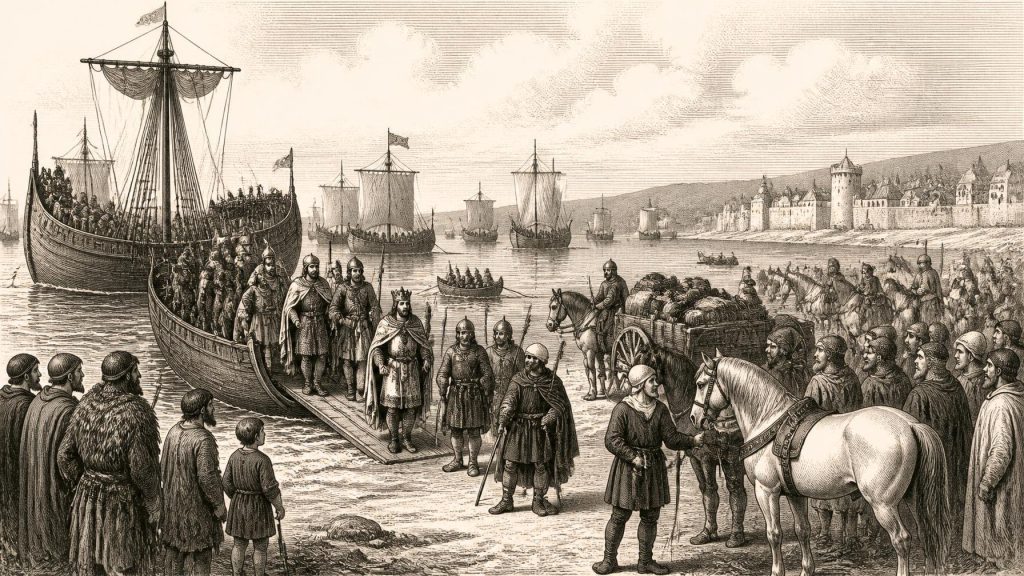
The scale of John’s arrival made an immediate impression. The Annals of Ulster record that the king came with a fleet “hard to count”, giving the memorable figure of 700 ships. Such a number should not be treated as an audited total: annalists often used large figures to convey awe. Yet there is no doubt that this was an exceptionally substantial royal operation. Modern work based on surviving financial records identifies a campaign lasting 63 days, supplied by sea and involving English feudal service, paid soldiers, crossbowmen and maritime support. John landed at Crook, near Waterford, on 20 June; by 26 August he was back at Fishguard in Wales. The dates are unusually secure, even though the detailed purpose of every stop on his Irish itinerary is not.
A King Returns
John had first visited Ireland as a young prince in 1185. In 1210 he returned as king of England and lord of Ireland, armed with much greater resources and determined not to let the great colonial lordships become virtually independent. His immediate targets were the de Lacy brothers: Walter de Lacy, lord of Meath, and Hugh de Lacy, earl of Ulster. Their position had been strengthened by inheritance, conquest and local alliances; from the king’s perspective, their combined influence across Meath, Oriel and Ulster was an unacceptable threat to royal control. The wider crisis also involved the fugitive William de Braose and his family, whose conflict with John had spread across the Irish Sea world.
John’s purpose was therefore political as well as military. A royal army could overawe opponents, but the expedition also allowed the king to receive submissions, redistribute lands, supervise officials and demonstrate that castles and towns ultimately answered to him. Records and chronicles associate the campaign with a strengthening of the governmental machinery of the lordship: the exchequer, courts, writs and royal administration modelled on those in England. The survival of the evidence is uneven, however. Much of the original Irish administrative archive was later destroyed, and historians must combine fragmentary financial material with English chronicles and Irish annals, whose interests and perspectives differ sharply.
Waterford and Gaelic Alliances
Waterford was the natural landing point: a major walled port on the Suir, closely linked by shipping to south Wales and western Britain. Its quays and hinterland had to absorb the sudden demands of a royal host—food, fodder, vessels, labour, accommodation and security. Ordinary inhabitants appear only faintly in the sources, but the logistics behind the expedition suggest an intense, disruptive summer for the townspeople, merchants, tenants and rural suppliers along its route. The royal presence also brought opportunities for those prepared to negotiate.
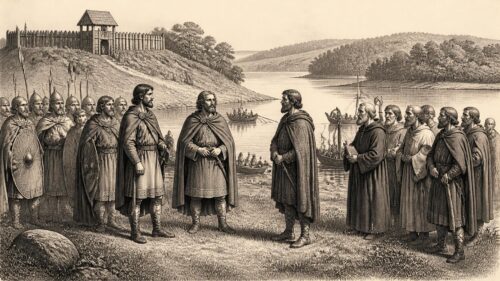
One such ruler was Donnchadh Cairbreach Ua Briain, claimant to the kingship of Thomond. Mac Carthaigh’s Book reports that he came to John at Waterford, was knighted, and received Carraig Ó gCoinneall—Carrigogunnell—with its lordship, on a yearly rent of sixty marks. The same account links the settlement with the release of Muirchertach, son of Domnall Mór Ua Briain. This was no merely ceremonial meeting. By intervening in an Ua Briain dynastic struggle, John could reward a useful ally, attach a monetary obligation to the grant and deepen royal influence in the Shannon region. For Donnchadh, royal recognition offered a powerful advantage against rivals, though it also bound his position more closely to the lordship.
Cathal Crobhdearg Ua Conchobair, king of Connacht, likewise came with a substantial following to honour John and joined the northern hosting, according to the Irish annals. His participation illustrates a central reality of the year: Gaelic kings were neither simply conquered subjects nor detached observers. They made calculations of their own, balancing local rivalries, territorial pressures and the possibility that cooperation with the king might secure recognition. The Annals of Inisfallen add that Ua Néill, ruler of Tír Eógain, also submitted. These gestures enhanced John’s authority, but they did not make Connacht or Tír Eógain straightforward parts of the royal administration.
Against the De Lacys
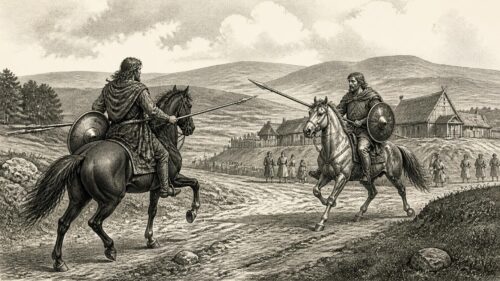
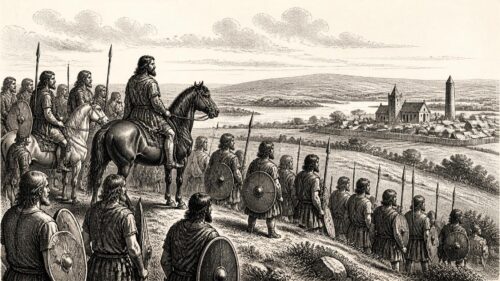
From Waterford John travelled north through the lordship, reaching Dublin and then Meath. Walter de Lacy was driven from Ireland and his lands were taken into royal hands. The advance into Meath mattered because it struck at the heart of de Lacy power: a lordship built around castles, manors, boroughs and control of routes between Dublin and the midlands. Trim, the great de Lacy stronghold on the Boyne, was among the places associated with John’s progress. Royal occupation of such centres did not erase local lordship overnight, but it made clear that even the largest estates could be confiscated when their holder defied the king.
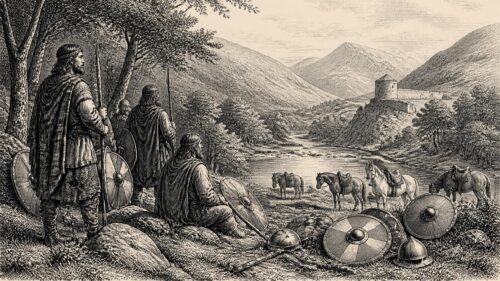
The confrontation with Hugh de Lacy unfolded further north. Mac Carthaigh’s Book states that, as John approached, Hugh burned his castles at Machaire Conaille and Cooley, while Dundalk was also burned. He withdrew towards Carrickfergus and then crossed the sea, leaving followers to hold the castle. The account describes John moving from Drogheda to Carlingford, where his ships formed a bridge across the harbour, before land force and fleet converged on Carrickfergus. The exact mechanics of this dramatic operation cannot all be independently reconstructed, but the result is clear in several sources: Carrickfergus was surrendered or taken, Hugh fled, and John installed his own men in the fortress.
Carrickfergus was strategically important because it faced Scotland and dominated a harbour within the Irish Sea zone. Its capture gave John a royal foothold in the earldom of Ulster and checked a magnate whose authority had grown rapidly. Carlingford Castle, probably built by Hugh de Lacy around 1190 and still popularly called King John’s Castle, belonged to the same political landscape of harbours, sea routes and fortified lordship. The campaign showed how control of the sea was inseparable from control of territory: ships carried the king’s army, supported operations on shore and enabled rapid movement around the coast.
The expedition did not stop at the Ulster shoreline. The Annals of Loch Cé report that John sent a fleet to Man, where it plundered and killed inhabitants. English chroniclers connect the punishment of Man with assistance given to John’s enemies. The episode was brutal, and it is a reminder that royal success did not mean bloodless government. It also underlines the cross-channel character of the crisis. The Irish Sea was not a boundary separating Ireland from neighbouring polities; it was the route through which allies, fugitives, soldiers, goods and retaliation travelled.
Submission, Hostages and Limits
John’s dealings with Cathal Crobhdearg soon exposed the limits of apparent harmony. After the northern campaign, the king summoned Cathal to meet him again and expected Cathal’s son Áed to be brought along. The Annals of Loch Cé preserve a particularly revealing tradition: Áed was to receive a charter for a third of Connacht, but Cathal and his advisers decided against delivering him. When Cathal appeared without his son, John seized members of his entourage, including Diarmaid Mac Diarmada of Magh Luirg, Conchobhar Ua hEgra of Luighne, Find Ua Carmacáin and Toirberd, a Gall-Ghaeil steward. They were carried overseas as hostages.
Hostage-taking was a recognised political practice, intended to guarantee agreements and future conduct, but its human cost was immediate. It turned trusted representatives and regional rulers into securities held far from home. The incident also suggests that Cathal’s submission was conditional rather than submissive in the modern sense. He had joined John’s host when it suited Connacht’s interests, yet he would not automatically surrender his heir or accept every proposed settlement. The more sceptical Annals of Inisfallen judged that John achieved little in Ireland apart from taking Ua Conchobair’s hostages and arranging Donnchadh’s position in Thomond. Its terse assessment is a valuable corrective to later accounts of an effortless royal triumph.
Government, Castles and Coin
On departing, John left the government of Ireland in the hands of John de Grey, bishop of Norwich and justiciar. The annals call him the “Foreign Bishop”, an apt phrase for an English royal servant exercising authority in a politically divided country. John ordered him to build three castles in Connacht. Whether every intended fortification was completed exactly as envisaged is uncertain, but the policy was unmistakable: push the frontier of royal power westwards through permanent structures, garrisons and communications.
Athlone, at a crucial Shannon crossing, became central to that programme. Later in 1210 de Grey led forces of Meath and Leinster to Athlone, where a bridge was constructed and a castle established in place of Ua Conchobair’s fortification, according to the Annals of Loch Cé. This was regional change in a very literal sense. A bridge and castle could redirect traffic, facilitate military movement, anchor officials and tax or protect passage. It also advertised a competing claim to authority at the threshold of Connacht. Yet the need for negotiation and later campaigning shows that stone, timber and royal orders alone could not settle the frontier.
Money formed another, less visible, instrument of rule. John’s Irish coinage was being struck during these years, including silver issues from Dublin; surviving coins name moneyers and show the material reach of royal administration. Scholarship associates the 1210 expedition with a new, more explicitly royal Irish coinage bearing the king’s title. The evidence does not justify imagining a uniform cash economy across the entire island. Coin use was strongest in towns, ports, lordship estates and military or administrative payments, while many Gaelic districts retained other forms of exchange and obligation. Nevertheless, the mint connected Dublin and the colonial towns to the king’s fiscal ambitions and to the commercial networks of the Irish Sea.
A Divided Island
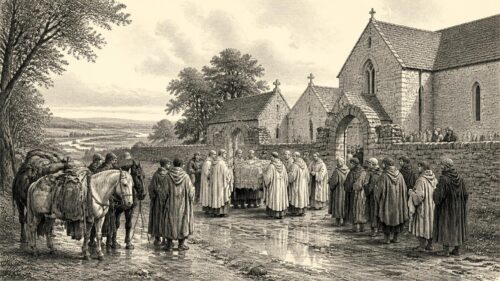
Events beyond John’s route demonstrate why his expedition cannot stand for the whole of Ireland. In Breifne, Art Ua Ruairc was killed by treachery, an episode recorded in the annals as a change within local kingship rather than as a consequence of the king’s arrival. In the church, the deaths of Gilla Críst Ua Cernaigh, bishop of Connor, Céle Ua Dubhthaigh of Magh Eó, and Flaithbertach Ua Flainn, successor of St Dachonna of Eas Mic Eirc, were also noted. Such entries reveal the continued importance of diocesan and hereditary ecclesiastical offices in communities far beyond the immediate reach of John’s army. There is no evidence for a single religious transformation in 1210; instead, the annals place royal expedition, provincial warfare and church leadership side by side.
By late August John had achieved a formidable display of power. The de Lacys were in exile, Carrickfergus was held for the crown, Walter de Lacy’s lands had been seized, and important Irish rulers had met or submitted to him. He had also laid foundations for tighter administration and frontier defence. But he left behind strained relations with Cathal Crobhdearg and Áed Ua Néill, unresolved ambitions in Connacht and Ulster, and a lordship whose authority still depended on alliances, garrisons and continuing coercion. The year was therefore a turning point, but not a final settlement: royal power had been dramatically asserted, not securely completed.
Primary Sources
- The Annals of Ulster, Year U1210
- Annals of Loch Cé, Year LC1210
- Annals of Inisfallen, Year AI1210
- Mac Carthaigh’s Book, Year MCB1210
- Annals of the Four Masters, Year M1210
- Annales Hiberniae
- King John’s expedition to Ireland, 1210: the evidence reconsidered
- King John’s Expedition to Ireland, 1210: The Evidence Reconsidered
- The 1210 Campaign in Ireland: Evidence for a Military Revolution?
- King John, the Braoses, and the Celtic Fringe, 1207–1216
- John
- Grey, John de
- Ua Conchobair, Cathal Mór Crobderg
- From Kingdom to Colony: Framing the English Conquest of Ireland
- King John’s Irish Rex Coinage Revisited
- Coin: King John, Dublin mint
- 950–1450: Vikings, Normans and Medieval Mints
- Carlingford Castle
- Athlone Castle
- Trim Castle
- Anglo-Norman Trail
- The 1210 Irish Expedition and Its Background