Castlepook Reindeer Femur31994 BCE
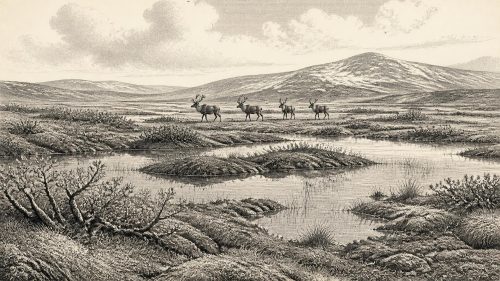
About 31,994 BCE, Ireland lay in the climatically unstable Late Pleistocene, before the Last Glacial Maximum. Expanding ice had not covered all regions: north-central and southern areas retained exposed ground, while low sea levels reshaped coasts. Castlepook Cave in County Cork preserves fauna including reindeer, mammoth, giant deer, predators and cold-adapted species, indicating open steppe-tundra habitats. A reindeer femur, dated near 31,000 BCE, bears a possible stone-tool butchery mark, but disturbed deposits and absent associated artefacts prevent confirmation of human occupation. Secure Irish human evidence is later. Glacial expansion subsequently shaped terrain, leaving this era ecologically significant yet archaeologically uncertain.
Dateline
31,994 BCE is not a year that can be recovered with modern calendar precision. It is a retrospective label for a point roughly 34,000 years before 1950, in the Late Pleistocene and broadly within Marine Isotope Stage 3 (MIS 3). The relevant archaeological and environmental dates are calibrated ranges, often with margins of centuries or millennia. Ireland has no securely dated settlement, named community, written record or political history for this precise moment. What can be responsibly described is an ice-age island or near-island landscape in profound climatic transition, and the sparse animal and geological evidence that survives from it.
A Pre-Glacial Peak in Ireland
This was before the Last Glacial Maximum, the phase when the last Irish Ice Sheet reached its greatest overall extent. It was not, however, a benign interval. The climate of MIS 3 was unstable, marked by sharp cold episodes and warmer interstadials. Ice sheets, glaciers, sea level, vegetation and animal ranges changed repeatedly over timescales far longer than a single human lifetime but short in geological terms.
For Ireland, the important point is regional variation. Research on the chronology of the last Irish Ice Sheet suggests that north-central Ireland remained ice-free until at least about 34,000 years ago. Organic deposits beneath later glacial tills in County Fermanagh provide a rare indication that land surfaces there had not yet been overridden by the expanding ice sheet. Marine-shell evidence from Donegal Bay likewise indicates periods of open water and nearby ice-free conditions during much of the preceding interval. These findings do not produce a neat nationwide map for 31,994 BCE. They do show that the ice sheet was building and expanding, rather than that every part of Ireland was already buried beneath its eventual maximum cover.
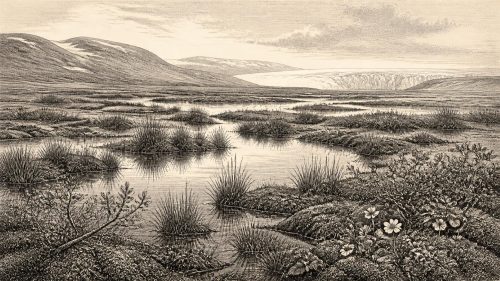
Southern Ireland was also not yet at the later glacial limit. Evidence from the south coast indicates that inland ice did not cross it until after about 24,000 years ago. By the global Last Glacial Maximum, conventionally dated around 26,500–19,000 years ago, ice had transformed much of the island. Around the date considered here, by contrast, the landscape was more likely a changing mosaic: exposed ground in some districts, mountains and uplands bearing ice, active rivers carrying sediment, and coastal environments altered by much lower sea levels. The familiar outlines of modern shorelines, lakes and river valleys should not be projected unchanged into this world.
Animals and Open Country
The strongest evidence for Ireland at this depth of time is palaeontological rather than archaeological. Cave deposits and museum collections show that a richer Pleistocene fauna reached Ireland during the period between at least about 45,000 and 20,000 years ago. The record is incomplete, much disturbed and repeatedly reassessed, but it establishes that large mammals could live in, or pass through, parts of Ireland before the great ice advance.
Castlepook Cave, near Doneraile in north County Cork, is especially important. Excavated principally in the early twentieth century, it produced a remarkable concentration of bones, including those attributed to reindeer, mammoth, giant deer, brown bear, wolf, Arctic fox, lemming and spotted hyaena. Such a list should not be treated as a photograph of one simultaneous ecosystem: cave carnivores accumulated prey, water moved bones, and early excavation removed most deposits before modern stratigraphic methods were available. Some specimens may represent different episodes separated by thousands of years. Nonetheless, improved radiocarbon pretreatment and redating have demonstrated that at least some southern Irish cave fauna belongs to MIS 3, well before the Last Glacial Maximum.
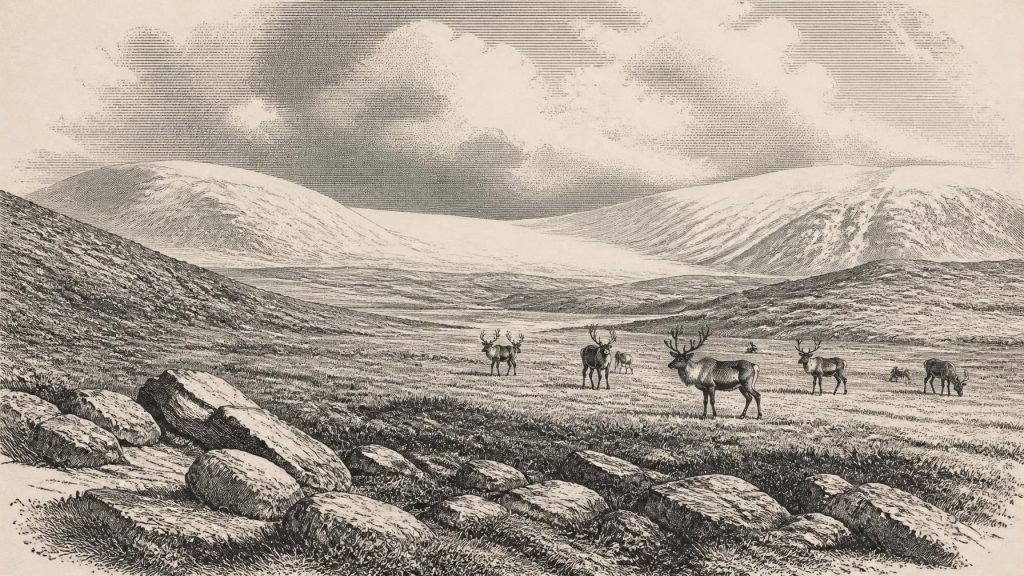
Reindeer are particularly relevant to a scene around 31,994 BCE. Their presence signals open, cold-adapted habitats rather than the dense Atlantic woodland that developed much later in the Holocene. The wider animal record suggests grassland, herb-rich steppe-tundra or patchy open vegetation, with local shelter determined by relief, soils, season and proximity to ice. Mammoth and giant deer remains add to the impression of a landscape capable, at intervals, of supporting large herbivores. Predators and scavengers, including wolves and spotted hyaenas, were part of the same broad ecological world. Yet fossil occurrence records cannot determine the size, continuity or exact distribution of their populations.
The Castlepook Question
The date has special interest because a reindeer femur from Castlepook has been presented as dating to about 31,000 BCE and bearing a mark interpreted by zoologist Ruth Carden as having been made by a sharp stone tool during butchery. If that interpretation is sustained, it would place human activity in Ireland far earlier than the island’s formerly accepted Late Upper Palaeolithic evidence and close to the time represented by this article.
It must nevertheless be described as possible rather than conclusive year-specific proof of human occupation. The bone comes from an old cave collection, not from a newly excavated, undisturbed camp floor. No securely associated stone tools, hearth, dwelling, human remains or animal-processing area of comparable date has been recovered from Castlepook. The cave’s deposits were heavily disturbed by carnivores, water and antiquarian excavation; later investigations have found only limited surviving Pleistocene material and stratigraphy. A radiocarbon date establishes the age of the animal bone, while the interpretation of a surface mark as a tool cut requires separate taphonomic judgement.
The responsible conclusion is therefore restrained. Around 31,994 BCE, north Cork contained, or was visited by, reindeer within an ice-age ecosystem. One reindeer bone offers a potentially important indication that people may have processed such an animal. It does not yet demonstrate a permanent population, a settlement at Castlepook, or a continuous human presence in Ireland. Archaeology advances precisely by testing such promising but fragile traces against new excavations, microscopic analysis and securely dated contexts.
People Beyond the Evidence
If small groups did reach Ireland at this time, they would have belonged to the wider Upper Palaeolithic world of north-western Europe. Across that world, people made sophisticated stone, bone and antler equipment; hunted and scavenged animals; processed hides; used fire; maintained social ties across substantial distances; and in some regions created portable and cave art. None of those practices can simply be assigned to Ireland in 31,994 BCE. There is no Irish assemblage of tools from this date with which to identify a particular technological tradition, such as the Gravettian, and no basis for naming a people or language.
Equally, there is no evidence for political institutions, rulers, warfare, diplomacy, farming, trade networks or formal religious monuments in Ireland at this date. These absences are not trivial gaps in a conventional historical narrative; they are the central fact of the record. A passing hunting party and a settled community would leave very different archaeological signatures, but neither has yet been securely identified for Ireland in this period. If people came, their movements may have been seasonal, intermittent and dependent upon changing animal routes and weather.
Travel itself remains an open question. Lower global sea levels changed the geography of the Irish Sea basin, but did not automatically create a simple and permanent land route from continental Europe to Ireland. Ice margins and sea passages changed through time. Any human arrival could have involved coastal movement, crossings over water or ice, or routes that are now submerged and difficult to investigate. The absence of clear evidence for boats is not evidence that no crossing was made; nor is it grounds for assuming one.
No Settlement Yet Known
The contrast with later periods is instructive. The earliest published direct evidence of human presence in Ireland that is generally treated as secure is a butchered brown-bear kneecap from Alice and Gwendoline Cave in County Clare, radiocarbon dated to calibrated ranges around 12,800–12,600 years before present, or roughly 10,800–10,500 BCE. Even then, the evidence suggests small-scale activity rather than a fully documented landscape of settlement. Substantial and widespread archaeological evidence for Mesolithic communities appears only from about 8000 BCE.
Thus, 31,994 BCE belongs to a much deeper and more tentative chapter. It is not the beginning of an identifiable Irish society, nor a date to which later Irish identities, religions or political traditions can be traced. It is a window onto the environmental preconditions of human history: a cold, open and changing Ireland; animal populations moving through habitable refuges; and perhaps one fleeting trace of people at the north-western edge of Upper Palaeolithic Europe.
What the Landscape Remembered
Although the human record is nearly silent, this period helped shape the physical Ireland inherited by later inhabitants. The ice that expanded after this interval eroded bedrock, deposited till, redirected drainage and contributed to the formation of drumlin fields, eskers, lake basins and sediment-rich lowlands. These processes did not occur in one event, and many landforms record later advances and retreats rather than conditions in 31,994 BCE itself. Still, the onset of the last major glacial build-up belongs to the long making of Ireland’s terrain.
The historical lesson is one of scale and caution. Around this approximate date, there were no recorded leaders or battles to recover. There are instead calibrated dates, cave bones, glacial sediments and unresolved marks on a reindeer limb. Together, they reveal an Ireland that was ecologically active, climatically volatile and only possibly touched by human visitors—an important beginning not because it supplies certainty, but because it shows how much of the island’s earliest past remains to be discovered.
Primary Sources
- Growth and retreat of the last British–Irish Ice Sheet, 31,000 to 15,000 years ago: the BRITICE-CHRONO reconstruction
- Trimlines, blockfields and the vertical extent of the last ice sheet in southern Ireland
- A reconsideration of the radiocarbon dating of the Marine Isotope Stage 3 fauna from southern Ireland
- The Irish Quaternary Fauna Project
- Ancient DNA, radiocarbon dating and osteological analyses of red deer from Ireland: implications for population history and human colonisation
- Late Pleistocene chronostratigraphy and ice sheet limits, southern Ireland
- Reconstructing the last Irish Ice Sheet 2: a geomorphologically-driven model of ice sheet growth, retreat and dynamics
- The evolution of the terrestrial-terminating Irish Sea glacier during the last glaciation
- The timing and magnitude of the British–Irish Ice Sheet between Marine Isotope Stages 5d and 2
- Maximum extent and dynamic behaviour of the last British–Irish Ice Sheet west of Ireland
- Landform modification by palaeo-ice streams in east-central Ireland
- The Irish Quaternary: A Guide to the Evidence
- Castlepook Cave, County Cork: County Geological Site Report
- Heritage Artefacts of County Cork
- The Exploration of Castlepook Cave, Co. Cork
- Castlepook Cave, Co. Cork, 2022
- First evidence of a Late Upper Palaeolithic human presence in Ireland
- New insights on the fauna of Ireland’s Younger Dryas and Early Holocene from Alice & Gwendoline Cave
- The Mesolithic in Ireland: when was it?
- Occurrence of mammalia relicts at site Castlepook Cave